Psychology

Insomnia
Insomnia is a sleep disorder characterized by difficulty falling asleep, staying asleep, or experiencing non-restorative sleep. It can lead to daytime fatigue, irritability, and impaired cognitive function. Insomnia can be caused by various factors, including stress, anxiety, depression, and certain medical conditions. Treatment may involve cognitive-behavioral therapy, medication, and lifestyle changes to improve sleep hygiene.
Written by Perlego with AI-assistance
Related key terms
1 of 5
12 Key excerpts on "Insomnia"
 eBook - PDF
Sleep Disorders
Diagnosis and Therapeutics
- S. R. Pandi-Perumal, Joris Verster, Jaime Monti, Salomon Langer, S. R. Pandi-Perumal, Joris Verster, Jaime Monti, Salomon Langer(Authors)
- 2008(Publication Date)
- CRC Press(Publisher)
INTRODUCTION Insomnia is commonly defined as the subjective report of difficulty in initially falling asleep, difficulty in maintaining sleep (long or multiple awakenings during the sleep period), or awakening too early with the inability to go back to sleep. In recent years, 1 a diagno-sis of Insomnia has also included a report of decreased daytime function associated with the poor sleep at night to differentiate a patient with Insomnia from an individual who simply requires less sleep. Insomnia may be either an acute or a chronic problem. Acute Insomnia, usually defined as poor sleep associated with a specific life event, such as an important examination, resolves when the event passes or within a period of 3 weeks. Chronic Insomnia may begin after an acute episode, if conditioning factors are involved, but typi-cally presents as a long-standing complaint despite var-ied attempts at treatment. Insomnia is the most common sleep problem. 2 About 30% of respondents from large surveys report at least occasional difficulty with sleep. 3 With the added criterion of associated daytime deficit, about 10% of respondents can still be diagnosed with insom-nia. 4 Using the criteria from the Diagnostic and Statistical Manual of Mental Disorders , 4th edn (DSM-IV), which requires persistence of at least 1 month and exclusion of other sleep, mental, or medical disorders as a direct cause, the prevalence of Insomnia is about 6%. 5 Reports of chronic Insomnia vary with both sex and age. Adult women report Insomnia about 50% more often than men. 3 In elderly populations, only about 12% of respondents reported normal sleep. About 57% of older individuals reported some prob-lems with their sleep, and 28% reported chronic Insomnia. 6 Insomnia is strongly related to psychiatric disorders and substance abuse. Patients with chronic Insomnia were about 40 times more likely to suffer from depression but were also more likely to have anx-iety or alcohol abuse compared with normal sleepers. eBook - PDF
- Silberman, Stephanie(Authors)
- 1010(Publication Date)
- New Harbinger Publications(Publisher)
Although there are different definitions of Insomnia from various authors, let’s start by going directly to the diagnostic classification put out by the American Academy of Sleep Medicine in the International Classification of Sleep Disorders. There, Insomnia is defined as “repeated difficulty with sleep initiation, duration, consolidation, or quality that occurs despite adequate time and opportunity for sleep and results in some form of daytime impairment” (AASM 2005, 1). Most people with Insomnia have difficulty either falling asleep, known as sleep onset Insomnia, or staying asleep, known as sleep maintenance Insomnia. If you have Insomnia, you may also have trouble The Insomnia Workbook 20 functioning during the day. For example, you might feel irritable or short-tempered or have an overall bad mood. Other impairments may include feeling sluggish, being fatigued or tired, and having decreased attention and concentration. And what’s worse, even though you may feel tired during the day, you prob- ably can’t sleep well at night or take a nap when you feel like you really need it. Transient, or Acute, Insomnia Transient, or acute, Insomnia is a short-term sleep problem. It’s actually quite common and usually occurs during stressful times, such as losing a loved one, moving to a new city, changing jobs, or ending of a significant relationship. Even seemingly joyous occasions, such as planning a wedding, graduating from college, or sending your child off to their first day of school, can cause stress and lead to Insomnia. Transient Insomnia can also result from short-term illnesses; disruptions in the normal sleep sched- ule due to jet lag or working rotating shifts; environmental factors, such as light, noise, or temperature changes; certain medications, particularly those used for colds, allergies, asthma, and high blood pres- sure; and temporary physical or emotional discomfort or pain. eBook - PDF
- Nathaniel F. Watson, Bradley V. Vaughn, Nathaniel F. Watson, Bradley V. Vaughn(Authors)
- 2006(Publication Date)
- CRC Press(Publisher)
3 Insomnia: Difficulty Falling and Staying Asleep Oneil S. Bains Section of Sleep Medicine, Virginia Mason Medical Center, Seattle, Washington, U.S.A. Symptoms of Insomnia Diagnoses Difficulty initiating sleep Adjustment Insomnia Difficulty maintaining sleep Psychophysiological Insomnia Daytime fatigue Paradoxical Insomnia Inadequate sleep hygiene Idiopathic Insomnia Insomnia due to: Mental disorder Insomnia due to: Drug or substance Insomnia due to: Medical condition 83 INTRODUCTION Many people complain of occasional nights fraught with difficulty falling or staying asleep. These complaints often go beyond mere annoyance or incon-venience, representing an issue with significant medical, social, and economic impacts (Tables 1 and 2) (1–5). The complaint of Insomnia is universal across cultures and genders. Despite the frequency of this complaint, our poor under-standing of Insomnia and its root causes still plagues our ability to successfully manage this condition. Indeed, for many people the word ‘‘Insomnia’’ has different meanings and nuances. Despite this, physicians caring for patients with this sleep complaint must use a single definition. Insomnia is the complaint of difficulty initiating or maintaining sleep combined with daytime impairment. The type of impairment can be varied and may include a change in alertness, energy, cognitive function, behavior, or emotional state. Individual sleep need varies significantly. Some people have no impairment of performance with five hours of sleep per night, whereas others need greater than nine hours to preserve daytime functioning. Thus, the requirement of daytime sequelae differentiates individual sleep need from the complaint of Insomnia. In this chapter, we will explore the epidemiology, etiologies, and clinical approach to Insomnia and offer clinical situations to highlight important clues in managing this common problem. EPIDEMIOLOGY Insomnia is the most common sleep complaint in the industrialized world. eBook - PDF
- Antonio Culebras(Author)
- 2007(Publication Date)
- CRC Press(Publisher)
Part III: Insomnia and Circadian Dysrhythmias B 4 Insomnia in Neurology Federica Provini Department of Neurological Sciences, University of Bologna, Bologna, Italy Carolina Lombardi Department of Clinical Medicine, University of Milano-Bicocca, and Physiology and Hypertension Center, S. Luca Hospital, IRCCS, Istituto Auxologico Italiano, Milan, Italy Elio Lugaresi Department of Neurological Sciences, University of Bologna, Bologna, Italy INTRODUCTION Insomnia is defined as difficulty with the initiation, maintenance, duration, or quality of sleep resulting in the impairment of daytime functioning despite adequate opportunity and circumstances for sleep (1,2). Although research studies sometimes require a specific quantitative definition, a patient’s subjective judgment that sleep is insufficient, inadequate, or nonrestorative is the most important factor in clinical practice. Insomnia is the most common sleep complaint. Transient Insomnia lasts less than one week, and short-term Insomnia one to four weeks. Chronic Insomnia, Insomnia lasting more than one month, affects between 10% and 35% of the population in the western world (3,4). The number of chronic Insomniacs rises with age, and women of all ages complain of Insomnia more often than men (3,5). Insomnia is frequently associated with other medical com-plaints and psychological symptoms, particularly anxiety, worry, and depression. Stressful life events (difficulties in interpersonal relationships, family discord, pro-blems at work, and financial troubles) may also generate a nonrestorative sleep com-plaint. Insomnia is not a specific illness or disease, but rather a symptom or consequence of other primary disorders. “Poor quality of sleep” is a common com-plaint in the family members of chronic Insomniacs. eBook - PDF
- Alexander Golbin, Howard Kravitz, Louis G. Keith, Alexander Golbin, Howard Kravitz, Louis G. Keith(Authors)
- 2004(Publication Date)
- Taylor & Francis(Publisher)
Section 2: The effect of sleep disorders on health and mental function 5 Insomnia: perspectives from sleep medicine and psychiatry Jamie K. Lilie and Henry W. Lahmeyer INTRODUCTION Insomnia can have a serious impact upon one’s ability to perform at work and maintain healthy social relationships, and it can be the source of, or contribute to, a variety of psychological disturbances, including major mood and anxiety disorders. Several studies have also indicated that the length and quality of sleep are related to general health and longevity. Given the potential impact Insomnia can have on physical and mental health and well-being, it is not surprising that there has been a proliferation of research in the areas of assessment and treatment for this sleep disorder 1–5 . EPIDEMIOLOGY Despite advances in pharmacological and behavioral treatments, Insomnia remains a common problem for both children and adults. Some surveys estimate that in the USA about 75 million people feel their sleep is inadequate 3 . Several large-scale surveys of sleep problems, both in the USA and in Britain, have found that about 30–35% of adults report at least occasional difficulties with falling asleep or staying asleep 3–5 . Furthermore, large-scale studies have consistently found that females report more complaints than males and that the incidence of sleep complaints increases with age 6–8 . DEFINITION OF Insomnia Insomnia is defined as an inability to obtain adequate sleep. This statement is sufficiently broad to permit classification of essential commonalities, which are persistence of the complaint (i.e. more than a transient poor night of sleep), and the subjective element as noted by the word adequate. The latter also highlights the fact that individuals vary in their need for sleep. eBook - PDF
Sleep Medicine
A Guide to Sleep and its Disorders
- John M. Shneerson(Author)
- 2009(Publication Date)
- Wiley-Blackwell(Publisher)
Difficulty in initiating sleep is twice as common in women as in men, but there is less gender difference in difficulty in maintaining sleep, and early morning awakening is equally common in men and women. The high prevalence figures need to be interpreted cautiously because of the subjective nature of the com-plaint and differences in the definitions of Insomnia. Its commonness may reflect the pressure in developed societies to function effectively during the day, particu-larly at work, while restricting sleeping time because of social activities and leisure opportunities, and com-bined with an increasing preoccupation with medical problems. The complaint of Insomnia is commoner in those who are anxious or depressed, those with chronic physical illnesses, and those who drink excessive quantities of alcohol or take drugs which affect the quality of sleep. In about half of these it is felt to be severe enough to require medical care, although this 7 Insomnia 161 162 CHAPTER 7 is surprisingly often not obtained. The reasons for this are uncertain, but the lack of attention directed to Insomnia by the medical profession, the failure to develop coherent management plans and the per-ception that there is a lack of effective treatments probably all contribute. Patterns of Insomnia Insomnia can be separated into the following three patterns (Table 7.1). Difficulty in initiating sleep (DIS, sleep onset Insomnia) This is defined as a sleep latency of greater than 30 min and is often due to a high level of arousal associ-ated with anxiety, and other factors. Difficulty in maintaining sleep (DMS, sleep maintenance Insomnia) Waking may occur irregularly during the night, or at specific times as in cluster headaches occurring dur-ing REM sleep and the 90-min cycles of REM sleep behaviour disorder episodes. Early morning waking without further sleep (EMW) This is common in the elderly and in most of the con-ditions listed in Table 7.2. eBook - PDF
- Alon Y. Avidan, Cathy Alessi, Alon Y. Avidan, Cathy Alessi(Authors)
- 2008(Publication Date)
- CRC Press(Publisher)
The second group encompasses newer studies which further restrict the def-inition of Insomnia to require the presence of Insomnia symptoms (such as DIS, DMS, or EMA) as well as daytime functional impairment, such as daytime sleepi-ness, irritability, and trouble concentrating. These studies report prevalence rates ranging from 9% to 15% and averaging around 10% in the general population (1). As will be discussed in more detail later, the presence of clinically significant day-time impairment is a key criterion in establishing a diagnosis of Insomnia in all modern sleep disorder classification systems. The third group of studies has focused on an alternative definition of insom-nia, requiring only the report of a subjective sense of dissatisfaction with sleep qual-ity, with the consequence of feeling unrested upon awakening. These studies report prevalence rates similar to the second group, 8% to 18%. Note that this is a rel-atively recent definition, and there is still some controversy among sleep experts over whether individuals with this complaint share similar pathophysiologic mech-anisms with Insomniacs as defined in the first two groups (2). For example, patients with obstructive sleep apnea (OSA) may have severely disrupted sleep due to mul-tiple apneic episodes throughout the night, but are often unaware of this, and thus tend to answer “no” when asked whether they have difficulty falling or staying asleep at night. These subjects would thus be categorized as nonInsomniacs in the first two groups. However, they would tend to be included in the third group, as most patients suffering from this condition report waking up feeling unrested (4). Despite this controversy, however, there is a general consensus that a subjective sense of sleep dissatisfaction is a useful marker of Insomnia, and it is included in the diagnostic criteria for Insomnia under the DSM-IV classification system as the criterion of “nonrestorative sleep.” eBook - PDF
- Lois E. Krahn, Michael H. Silber, Timothy I. Morgenthaler, Lois E. Krahn, Michael H. Silber, Timothy I. Morgenthaler(Authors)
- 2010(Publication Date)
- CRC Press(Publisher)
Patients who overestimate their sleep needs can aggravate their sleep problem by allocating excessive time for sleep (Figure 2). This mismatch may result in undesired wakefulness relative to the person’s sleep expectations. In these cases, inadequate sleep hygiene is commonly a major contributor to Insomnia. Patient education that helps individual patients develop an awareness of their functioning, including drowsiness and alertness, allows them to gauge their preferred bedtime and awakening times. Underestimating the amount of sleep achieved and excessively restricting the patient’s time in bed may lead to daytime fatigue (but not to nighttime wakefulness). MECHANISMS OF Insomnia Insomnia has numerous causes (Figure 3). In clinical practice, chronic Insomnia is not due to a single etiologic factor but instead has multiple intertwined mechanisms, both physiolog-ical and psychological. A valuable model of chronic Insomnia proposed by Spielman (2) conceptualizes three components: vulnerability, triggers, and a perpetuating process. For exam-ple, physiologically a patient may be a lifelong “light sleeper” with an increased risk of Insomnia because of heightened baseline levels of central nervous system arousal. After a psy-chologically stressful event triggers Insomnia, the sleeplessness is then sustained by environmental factors, behavioral issues, or concurrent illnesses. An alternate approach is to classify Insomnia into primary and secondary types by whether a cause of the sleep disruption can be identified. However, this more simplistic scheme does not reflect the complexity of Insomnia nor does it identify to the same degree the perpetuating conditions that could eventually be addressed in a treatment plan. The nosology for Insomnia that was adopted in 2005 by ICSD-2 will be discussed in more detail later in this chapter. Physiological Vulnerability Persons may be vulnerable physiologically to Insomnia for various reasons. eBook - PDF
The Health Psychology Handbook
Practical Issues for the Behavioral Medicine Specialist
- Lee M. Cohen, Dennis E. McChargue, Frank L. Collins, Lee M. Cohen, Dennis E. McChargue, Frank L. Collins(Authors)
- 2003(Publication Date)
- SAGE Publications, Inc(Publisher)
For example, many physicians do not ask about Insomnia during office visits (Dement & Vaughan, 1999). Moreover, when Insomnia is recognized, physi-cians defer to medication treatment rather than very efficacious behavioral treatments. In fact, practice guidelines from the American Medical Association, the Canadian Medical Association, and many health maintenance organizations indicate that behavioral interventions should be the treatment of choice for Insomnia. BACKGROUND AND ETIOLOGY The Basics of Sleep, Sleep Architecture, and Sleep Cycles Sleep is an exceedingly important activity. Although scientists are not certain how sleep 426 BEHAVIORAL ASPECTS OF MEDICAL PROBLEMS helps daytime functioning, it is fairly easy to assess the difficulties associated with sleep deprivation. Without enough sleep, individu-als find themselves edgy and irritable. In addi-tion, their concentration and ability to learn new information begin to decline. One of the first symptoms of sleep deprivation is depres-sion. After a few days of no sleep, some people will perform as if they are intoxicated. When people have been denied sleep for about a week, they can experience visual and auditory hallucinations. Sleep deprivation impairs func-tion in nearly everyone. However, the amount of sleep deprivation a single person can toler-ate without ill effects varies. Fatigue also contributes to a host of psy-chiatric and medical diagnoses. Both anxiety and depression have a strong sleep compo-nent. Among patients with depression, 8 5 % report Insomnia and 1 0 % to 1 5 % complain of hypersomnia (Ford 8c Kamerow, 1989). Patients with bipolar disorder frequently function energetically for days or weeks on a few hours of sleep and then have periods of hypersomnia associated with major depres-sive episodes. No longer available
Clinical Handbook of Psychological Disorders
A Step-by-Step Treatment Manual
- David H. Barlow(Author)
- 2021(Publication Date)
- The Guilford Press(Publisher)
G. (2001). Insomnia: symptom or diagnosis? Clin- ical Psychology Review, 21(7), 1037–1059. Harvey, A. G. (2002a). A cognitive model of Insomnia. Be- haviour Research and Therapy, 40, 869–894. Harvey, A. G. (2002b). Trouble in bed: The role of pre-sleep worry and intrusions in the maintenance of Insomnia [Spe- cial issue]. Journal of Cognitive Psychotherapy, 16, 161–177. Harvey, A. G. (2003a). The attempted suppression of presleep cognitive activity in Insomnia. Cognitive Therapy and Re- search, 27, 593–602. Harvey, A. G. (2003b). Beliefs about the utility of presleep worry: An investigation of individuals with Insomnia and good sleepers. Cognitive Therapy and Research, 27, 403– 414. Harvey, A. G. (2005). A cognitive theory of and therapy for chronic Insomnia. Journal of Cognitive Psychotherapy, 19, 41–60. Harvey, A. G. (2008). Sleep and circadian rhythms in bipo- lar disorder: Seeking synchrony, harmony, and regulation. American Journal of Psychiatry, 165, 820–829. Harvey, A. G. (2009). The adverse consequences of sleep dis- turbance in pediatric bipolar disorder: Implications for in- 666 CLINICAL HANDBOOK OF PSYCHOLOGICAL DISORDERS tervention. Child and Adolescent Psychiatry Clinics of North America, 18(2), 321–338, viii. Harvey, A. G., Belanger, L., Talbot, L., Eidelman, P., Beau- lieu-Bonneau, S., Fortier-Brochu, E., et al. (2014). Com- parative efficacy of behavior therapy, cognitive therapy, and cognitive behavior therapy for chronic Insomnia: A randomized controlled trial. Journal of Consulting and Clinical Psychology, 82(4), 670–683. Harvey, A. G., & Buysse, D. J. (2017). Treating sleep problems: A transdiagnostic approach. New York: Guilford Press. Harvey, A. G., & Eidelman, P. (2012). Intervention to reduce unhelpful beliefs about sleep. In M. Perlis, M. Aloia, & B. Kuhn (Eds.), Behavioral sleep medicine treatment protocols (pp. 79–90). New York: Academic Press. Harvey, A. G., Dong, L., Hein, K., Yu, S. H., Martinez, A., Gumport, M. B., et al. (in press).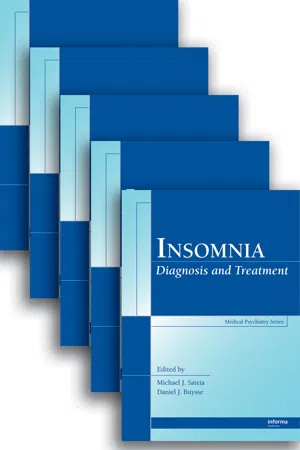 eBook - PDF
Insomnia
Diagnosis and Treatment
- Michael J. Sateia, Daniel Buysse, Michael J. Sateia, Daniel Buysse(Authors)
- 2016(Publication Date)
- CRC Press(Publisher)
UNDERSTUDIED PSYCHOLOGICAL PROCESSES: AFFECT AND PERSONALITY Within the psychological level of explanation for causal and maintaining factors in Insomnia, the majority of the models reviewed have addressed behavioral and cognitive factors. How-ever, it seems likely that other psychological processes, such as affect and personality, are also important. The role of affect is increasingly recognized to be important across a number of psychiatric disorders (24). Following Gross (25), we use the term “affect” to include emotion (short-lived responses that involve changes in the behavioral, experiential, autonomic, and neuroendocrine systems), emotion episodes (emotions more extended in time and space), and mood (longer duration responses than emotions, more diffuse than emotions). PSYCHOLOGICAL MODELS OF Insomnia 47 It is well established that Insomnia is associated with psychiatric disorders characterized by affect regulation difficulties, such as depression, bipolar disorder, and anxiety disorders (26,27). However, there is minimal research on the role of presleep affect in Insomnia. An interesting untested hypothesis is that individual differences in ability to downregulate affect could be a predisposing or perpetuating factor. One study that supports this hypothesis found that individuals with Insomnia rated the impact of daily minor stressors and the intensity of major negative life events as higher than good sleepers (28). Furthermore, such individuals used more emotion-oriented coping strategies and had greater presleep arousal than good sleepers, while a path model indicated that emotion-focused coping indirectly negatively impacted sleep by increasing both the impact of stress and presleep cognitive arousal. While in the previously paragraph we suggest that affect can negatively impact sleep, a further hypothesis is that the lack of sleep experienced by individuals with Insomnia will adversely impact next-day affect. eBook - PDF
Common Pitfalls in Sleep Medicine
Case-Based Learning
- Ronald D. Chervin(Author)
- 2014(Publication Date)
- Cambridge University Press(Publisher)
She began to experience symptoms of depression a month after her difficulty sleeping had reappeared. Aside from Insomnia, the patient denied symptoms of other sleep disorders such as obstructive sleep apnea, restless legs syndrome, and circadian rhythm sleep disorders. Her medical history was unremarkable and her psychiatric history, other than the depression diagnosis, was negative. The initial diagnostic consideration was psychophy- siologic Insomnia, as suggested for example by the sleep-focused ruminations and an apparent associ- ation between bedroom stimuli and arousal. In add- ition, her poor sleep hygiene practices, including excessive time in bed and an inconsistent sleep sched- ule, likely contributed to the maintenance of her Insomnia complaints. Given her history of Insomnia in childhood, a diagnosis of idiopathic Insomnia was also considered. A 6-week course of cognitive behav- ioral therapy for Insomnia (CBT-I) was initiated, with sleep restriction and stimulus control therapy, supple- mented by sleep hygiene psychoeducation. Cognitive therapy addressed her tendency to ruminate. The patient had a favorable response after 6 weeks of treatment and maintained this initial treatment response at 1-month follow-up (Table 28.1). Discussion Poor sleep is reported in up to 90% of people diag- nosed with depression. 5 Therefore depression and Insomnia occurring together is a common presenta- tion for psychiatric referrals. However, it is a common mistake for clinicians assessing depression to assume that a complaint of Insomnia would be subsumed by a diagnosis of depression rather than representing a primary comorbid diagnosis. This may have been the assumption that the initial clinician made, which may explain why the patient’s Insomnia was not an initial focus of treatment. A simple timeline (Figure 28.1a) can be utilized during the initial evaluation to chart the onset and intensity of depression and Insomnia symp- toms.
Index pages curate the most relevant extracts from our library of academic textbooks. They’ve been created using an in-house natural language model (NLM), each adding context and meaning to key research topics.

