Psychology

Prison
A prison is a secure facility designed to confine individuals who have been convicted of a crime. It serves as a form of punishment and rehabilitation, aiming to protect society from potential harm caused by the incarcerated individuals. Prisons also provide structured routines and programs to address the psychological and behavioral needs of inmates.
Written by Perlego with AI-assistance
Related key terms
1 of 5

9 Key excerpts on "Prison"
 eBook - ePub
Criminal Psychology
A Beginner's Guide
- Ray Bull, Claire Cooke, Ruth Hatcher(Authors)
- 2009(Publication Date)
- Oneworld Publications(Publisher)
9Experiencing imPrisonment
As we saw in chapter 1 , many criminal psychologists work within Prisons where they will assess, manage and treat offenders in their care with the aim of reducing their likelihood of reoffending on release from Prison. In addition to these responsibilities, Prison psychologists also conduct research related to imPrisonment. Such research can aim to increase our understanding of what imPrisonment is like with a view to enhancing rehabilitative efforts or it may focus on the evaluation of the effectiveness of psychological interventions in place. Academic criminal psychologists working in universities have also been conducting such research.While chapter 10 outlines the research on the rehabilitation of offenders, this chapter will introduce you to the research conducted on how being imPrisoned can affect Prisoners and how they cope with this experience.So, when considering the numbers of people affected by imPrisonment, how many are we actually talking about? According to the International Centre for Prison Studies there are over 8.5 million people imPrisoned worldwide. Although this is a very high number, should we really be concerned about how imPrisonment affects these people? Some newspaper reports would suggest not. I am sure you have seen newspaper reports stating that Prison is ‘too easy’ and is more like a ‘holiday camp’ than a Prison. In contrast, there have been numerous documentaries and television series which have shown a more unpleasant and distressing side to imPrisonment. Unless we have visited a Prison or have been imPrisoned ourselves, most of what we know of imPrisonment comes from the television or other media. But with these conflicting reports of what Prison is like it is difficult to know whether we should be concerned about the 8.5 million people currently imPrisoned.Psychologists and other social scientists have been researching the effects of imPrisonment for some time. Much of this research has been conducted in the West: its findings might not apply so readily to Prisons in other parts of the world and it is important to bear this in mind. The research that has been conducted has found that imPrisonment can have very negative effects for some Prisoners. This can result from the actual experience of being imPrisoned or it can be related to a person’s encounters with others whilst imPrisoned. eBook - ePub
Psychology and Law
Bridging the Gap
- David Canter, Rita Žukauskiene(Authors)
- 2017(Publication Date)
- Routledge(Publisher)
Chapter 9 The Consequences of Prison Life: Notes on the New Psychology of Prison Effects Craig HaneyElsewhere I have argued that psychology and related disciplines now explicitly acknowledge the importance of social contextual influences on behavior (Haney, 2002). As a result, the psychological impact of especially powerful social settings and situations – including Prisons – should be recognized more fully and assessed more carefully in future policy-related decisions. ‘Prison effects’ – the psychological impact of Prison conditions themselves – once again have become the topic of serious study and debate (e.g. Haney, 2006; Irwin, 2005; Liebling and Maruna, 2005; Petersilia, 2003). Perhaps, in response, the mindless clamoring for ‘more Prisons’ and ‘harsher punishment’ will finally diminish. Indeed, policymakers, politicians, and members of the public may begin to reflect on the way in which living conditions inside the huge network of Prisons that we have created over the last several decades adversely shape and affect Prisoner behavior – inside Prison and beyond. As I will show in this chapter, adapting to the harsh realities of Prison life may negatively change a Prisoner’s habits of thinking and acting, in ways that can persist long after his or her incarceration has ended.This new perspective represents a turnaround of sorts, a move away from the apparent consensus that emerged in the closing decades of the 20th century, when the era of mass incarceration was in full swing. Specifically, the notion that imPrisonment per se inflicted relatively little measurable psychological harm appeared to be widely accepted – tacitly agreed upon in some circles, openly touted in others. This assertion – and the related suggestion that most corrections experts shared the view – served as implicit reassurance that the punitive policies of the day really had no downside. That is, if Prison did no real damage to the sturdy souls whom we sent there, then locking up the most people we could for the longest possible periods of time would inflict little or no lasting harm. eBook - PDF
- Graham J. Towl, David A. Crighton, Graham J. Towl, David A. Crighton(Authors)
- 2009(Publication Date)
- Wiley-Blackwell(Publisher)
This has included the provision of multidisciplinary ‘in-reach’ teams to work in Prison settings and shifts in philosophy and policy. There remains considerable potential for further development of applied psychology to contribute to meeting the pressing mental health needs that face Prisoners. • The costs of keeping Prisoners in custody are substantial. The human, social and economic costs of criminal reoffending are enormous. There are compelling reasons to improve the outlook for Prisoners on their release. Broad-based interventions that address mental and physical health, attitudes and self-control, institutionalisation, life skills, housing, financial support and debt and finally family networks and employment are likely to be most beneficial as part of an integrated programme of care and support. • Prisoners as a group are drawn from significantly socially disadvan-taged groups and applied psychologists need to be acutely mindful of the impacts of this. The social and cultural environment that Prisoners are released and hopefully settled into will be the context in which they need to apply any new knowledge, skills and attitudes that they may have benefited from in Prison. A good understanding of the importance of the community context is therefore essential to effective practice. Context 70 Notes 1 Based on 2004 figures. 2 One example here is the fact that a large proportion of Prisoners have been the victims of sexual abuse, yet in recent years this has received little attention (Crighton, 2005c; Lane-Morton, 2005). 3 This equates to approximately $20 billion. 4 An example here is the Canterbury Project, a multidisciplinary approach adopted at a local Prison (HMP Canterbury). eBook - PDF
- Angela Uchoa Branco, Jaan Valsiner(Authors)
- 2012(Publication Date)
- Information Age Publishing(Publisher)
As long as psychologists or other health professionals participate in this hybrid task, which includes both punishment and treatment, no simple answers will exist. To handle the dilemma, anyway, the professional has to be very clear about his or her own position and influence when it comes to the specific routes in life pos- sible for the Prisoner. Concerning the concept of self-stigmatization (Mathiassen, 2009), one could argue that this is a kind of demand from the community in which Prisoners and former Prisoners must internalize their own faults and con- demnations. What I observed was that when the Prisoners serve their sen- tences in Prison, the experience seems to influence and have an impact on their self-perceptions. Prison institutions in effect realize the demands of society according to the rule of law. The Prison sentence involves more than incarceration. Judgement and sentencing embodies the vengeance of society against the offender (Christie, 2007). One could argue that this mo- tive has grown during the years and that to a considerable extent, it has replaced the idea that punishment in Prison should reform the Prisoner. This has been described as “the punitive turn,” “penal excess,” and “penal populism” (Brown, 2002; Pratt, 2000). Despite all of the above, rehabilitation still remains the declared goal of the Danish correctional services. On the one hand, the correctional service declares that Prisoners and ex-Prisoners must be rehabilitated. On the other, many people approve of Prisoners feeling guilty and unworthy because of their inhumane deeds. This feeling is a part of the self-stigma- tization process and must be understood as intimately connected with the described contradictory aims of Prison. The Prison Society As described before, the context of the first part of the research was very restricted, mixing concrete physical restrictions related to the logic of pun- ishment with psychological treatment. eBook - ePub
- David A. Crighton, Graham J. Towl, David A. Crighton, Graham J. Towl(Authors)
- 2021(Publication Date)
- Wiley-Blackwell(Publisher)
Though most of the time psychologists have worked in correctional settings, they have been involved in teaching and training a range of Prison staff. Historically, this work was both diverse and often reflected local interests or at times the need for generalist graduate skills that were in short supply. This has changed for many Prison systems in recent years, where the pressures of marketisation and the narrowing of policy to focus on a small number of numerical targets have marginalised this work. Where teaching and training by psychologists in Prisons have continued, they have tended to focus on a number of key areas, linked to various forms of contracting. For example, Prison residential staff have been trained in a range of social skills, problem‐solving and anger management work. The majority of work in this area has come to be focused on the dissemination of standard manual‐based intervention approaches claimed to reduce risk to the public.Work relating to Prisoners’ risk to themselves in the form of suicide and self‐injury has perhaps been less visible across a number of Prison systems, despite the staggeringly high rates seen in correctional settings. Work in this area has often been pioneered by psychologists working in Prisons (Towl and Crighton, 2017 ). This has involved training and support of a range of Prison staff in identifying those at risk and giving psychological ‘first aid’. Within many Prison systems, this type of critical incident work has also extended to training and supporting staff in the resolution of other serious incidents, such as group protests, disturbances, riots and hostage taking.Research and development
Historically, this was a central role for psychologists in correctional settings. Through much of the development of psychology in Prisons, there was a disproportionate number of psychologists working in headquarters administration. This was often associated with a range of research and development work, addressing the manner in which correctional settings operated to control and modify Prisoners’ behaviour (often called Prison ‘regimes’). For example, reforms to the Borstal regime in England and Wales and implementation of ‘Youth Custody’ were informed by research and development by both psychologists working in Prisons and academic psychologists with interests in developmental psychology. The development of specialist regimes such as Democratic Therapeutic Communities and specialist units to manage disruptive and dangerous Prisoners such as the Barlinnie Special Unit in Scotland was similarly the result of psychological research and development work (Bartlett, 2000 ; Brookes, 2012 ). These were evidence‐informed experiments and were evaluated on this basis. Perhaps the most ambitious efforts were made in England to develop an IT‐based monitoring system called Profiling Behaviour. Although abandoned by Prison service management, this, in many respects, prefigured recent developments in computer‐based data gathering, analysis and behavioural monitoring (Longley, 1992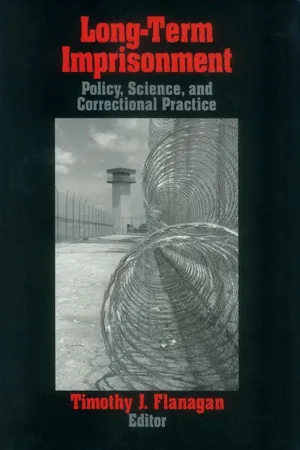 eBook - PDF
Long-Term Imprisonment
Policy, Science, and Corrrectional Practice
- Timothy J. Flanagan(Author)
- 1995(Publication Date)
- SAGE Publications, Inc(Publisher)
Unfortunately, this narrow focus on socializa-tion has often excluded measures of general psychological functioning or adaptation. There AUTHOR'S NOTE: This research was supported by a grant from the Social Science and Humanities Research Council of Canada. The work was much facilitated by the assistance of Jennifer Cumberland. The author is grateful to William Palmer for helpful editorial criticism and also to several institutional psychologists and the Research Division in the Correctional Service of Canada for their active cooperation. Correspondence may be addressed to Edward Zambie, Department of Psychology, Queen's University, Kingston, Ontario, Canada K7L 3N6. NOTE: Reprinted from Criminal Justice and Behavior, Vol. 19, No. 4, December 1992, pp. 409-425. Copyright 1992 by Sage Publications, Inc, and by American Association for Correctional Psychology. Descriptive Longitudinal Results 139 Heskin, and Banister (1976) and Sapsford (1978, 1983). Contrary to the expectations of Prison-ization theory, the evidence from these indi-cates that marked psychological deterioration is not a necessary consequence of imPrison-ment. However, there are several limitations in previous studies. Many have included biased samples of long-term Prisoners, selected after attrition by selective release. This selection procedure is especially problematic given the limitations of the cross-sectional designs em-ployed (Farrington, Ohlin, & Wilson, 1986). The research can also be criticized for using insensitive measures (Flanagan, 1982) and for covering only a limited range of psychological functioning. In a recent study, our research group at-tempted to avoid most of these criticisms through an extended longitudinal investiga-tion of how offenders cope with the problems they encounter, both in Prison and on the outside (Zambie & Porporino, 1988, 1990; Zambie, Porporino, & Kalotay, 1984). eBook - PDF
The Persistent Prison?
Rethinking Decarceration and Penal Reform
- Maeve McMahon(Author)
- 2019(Publication Date)
- University of Toronto Press(Publisher)
The Prison, Criminology, and Rehabilitation The Prison, Criminology, and the Ascendancy of Rehabilitation As Foucault's (1977) work suggests, and as Garland (1985b) has elab-orated, the exercise of penal power through the Prison, and the genesis of criminological ideas, have historically been interwoven. The emer-gence of a distinctively critical criminology in the late 1960s represent-ed a concerted attempt to break with this correctionalist stance. Critical criminologists sought to move away from technicist concerns with crim-inals, the causes of crime, and the effectiveness of penal programs; what they considered to be at issue were deeper, more political questions about the significance of deviance, its definition, and its control, in the reproduction of an oppressive social order. This sociopolitical focus of critical criminologists brought them far beyond the walls of the Prison and into the wider penal realm. Yet, in some respects, critical criminologists' analytical movement away from the Prison reflected a tendency that was also becoming evi-dent in mainstream criminology itself. One way of recapitulating the history of criminological ideas, therefore, is to examine criminology's initial preoccupation with, and gradual movement away from, the insti-tution of imPrisonment. The rapid spread of imPrisonment as a major social institution dur-ing the nineteenth century provided a basis for criminology as a field of inquiry. Originally, what was considered to be at issue in the formation of knowledge was not the nature of imPrisonment itself, but rather that of those who were incarcerated. By virtue of their confinement within the Prison, Prisoners were spatially, socially, legally, and administra-tively segregated from society at large. They became amenable to social-2 The Prison, Criminology, and Rehabilitation 11 scientific inquiry. eBook - PDF
Handbook of Professional Ethics for Psychologists
Issues, Questions, and Controversies
- Kyle E. Ferguson, William O'Donohue, William O′Donohue, William T. O'Donohue, Kyle E. Ferguson(Authors)
- 2003(Publication Date)
- SAGE Publications, Inc(Publisher)
21 Ethical Principles of Correctional Psychology L INDA E. W EINBERGER University of Southern California, Keck School of Medicine USC, Institute of Psychiatry, Law, and Behavioral Science S HOBA S REENIVASAN University of Southern California, Keck School of Medicine Greater Los Angeles Veterans Administration Medical Center 359 I n recent years, there has been a burgeon-ing demand for psychologists to work for correctional agencies. This is a result of the dramatic increase in the number of persons with mental illness who have been arrested and/or convicted. Consequently, there is a great need to pro-vide these individuals with treatment while they are in jail, Prison, or living in the com-munity as probationers or parolees. Psycho-logists working with individuals who are under the jurisdiction of correctional agen-cies face a significantly different set of rules than they are accustomed to when working for mental health facilities. These rules may present a host of both familiar and unfamiliar ethical and professional dilemmas for psychologists employed by correctional facilities. This chapter reviews the history of cor-rections and its expectations of the role of mental health professionals. The struggle psychologists may have in maintaining ethical conduct while meeting the needs of correc-tional agencies and offenders is discussed and explored through the use of vignettes. Finally, recommendations will be offered to assist correctional psychologists in resolving some of the stresses and problems they encounter while working in this unique setting. C H A P T E R HISTORICAL PERSPECTIVE Most societies have adopted a philosophy that individuals who commit criminal acts should be punished. Modern Western judi-cial systems have justified their use of pun-ishment on the basis of four principles: retribution, deterrence, incapacitation, and rehabilitation (Grilliot, 1983).
- Shlomo Giora Shoham, Ori Beck, Martin Kett(Authors)
- 2007(Publication Date)
- Routledge(Publisher)
Prisons and Jails 45 two hundred or so years, a great deal of effort has been expended to try to find effective techniques that could be deployed in furtherance of each of these endeavors. But quite apart from these formal and intended ways in which Prisons may differ, there are many other incidental variables, which enter the equation with unintentional consequences. Most importantly, as we have seen, the nature and composition of the Prison population changes, and it would be surprising if the sociology of the Prison were not profoundly affected by whether the Prison population comprised primarily debtors, as in the time of John Howard, or persons confined because of the dependence of themselves or others on drugs, as is the case today in some jurisdictions. To a possibly lesser, but certainly significant, extent (I know of no calculus to determine this precisely), what goes on in Prison will also be affected by the numbers, nature, and training of staff, and the extent to which the walls of the Prison may be permeated by visits by families, nongovernmental or intergovernmental organizations, the press, and the public. When reading the Prison literatures, therefore, it is important to locate what are often case studies clearly in time and place before deciding whether or not what is reported is generalizable. The early Prison literature, primarily American, was perhaps overly con-cerned with what came to be called the “inmate world,” in which the strange and seemingly alien deviant behaviors of Prisoners were displayed for a middle class, if primarily academic, audience for the first time (e.g., Schrag 1944). Much of this related to what has generally been referred to as the “Big House”: large state or federal penitentiaries, often a legacy of the nineteenth century, whose primary role was custodial and in which there was little by way of classification or programming beyond provision of a few workshops.
Index pages curate the most relevant extracts from our library of academic textbooks. They’ve been created using an in-house natural language model (NLM), each adding context and meaning to key research topics.

