History

Pentonville Prison
Pentonville Prison is a Victorian-era prison located in London, England. It was designed as a model prison with a radial layout to allow for efficient surveillance of inmates. Opened in 1842, Pentonville was known for its strict regime and use of solitary confinement. It served as a prototype for many other prisons around the world.
Written by Perlego with AI-assistance
Related key terms
1 of 5
12 Key excerpts on "Pentonville Prison"
 eBook - ePub
The English Prisons
Their Past and Their Future
- D. L. Howard(Author)
- 2023(Publication Date)
- Routledge(Publisher)
A lthough the separate system instituted at Pentonville in 1842 met with the full approval of the Inspectors of Prisons, who encouraged its introduction throughout the country, and all prisons built after that time were of a cellular kind, the argument for and against separation continued in the Press, among prominent reformers and in the House of Commons. It was not until the Prison Act of 1865 was passed that cellular confinement became absolutely and firmly entrenched into the English prison system, to remain unquestioned for the remainder of the century. Pentonville Prison and the treatment it practised under the Penal Servitude Act of 1857 became the models to which the majority of prisons in Britain, still under county and city control, gradually, with the advice and encouragement of the inspectors and the encroachment of Home Office regulations, approximated. The condition of the various prisons in London in 1855 has indicated how widely different the lives of prisoners could be at that time even in one city. Just as in modern times some counties have an unusually good reputation for the educational services they provide, while others lag a little behind the average standard, in mid-Victorian times the efficiency of prison administration, with the state institution of Pentonville as a yardstick, depended upon the interest and enthusiasm of local authorities, and upon the money they were able or willing to expend upon it.Five years after the opening of Pentonville, the relative values of the separate and silent systems were still under discussion at the Brougham Committee of the House of Lords, whose task was to consider criminal justice with special reference to juvenile offenders. The chaplain of Preston Prison proclaimed cellular isolation to be ‘the only possible basis for a system of reformation’. Captain Maconochie, now in England again, strongly opposed it. He declared that the inmates of Pentonville were in a state of complete mental and physical exhaustion, and incapable of reformation under the regime. Nevertheless, in 1857 the Inspectors of Prisons announced in their report thatso universal . . . is the testimony in favour of the Separate System in English prisons [in the south and west] that there remain only two county prisons [there] in which it has not been adopted, either wholly or in part; and in those exceptional instances new buildings are now in progress, which promise soon to assimilate them to the more perfect establishments of the kind. eBook - PDF
Empire of Hell
Religion and the Campaign to End Convict Transportation in the British Empire, 1788–1875
- Hilary M. Carey(Author)
- 2019(Publication Date)
- Cambridge University Press(Publisher)
4 Designed by military engineer Major Joshua Jebb and set behind massive walls on its own six-acre site, Pentonville was among the most significant investments in social capital of the Victorian age. Lauded by reformers, ridiculed by satirists such as Thomas Carlisle (1795–1881) and Dickens, endlessly visited and com- mented on by contemporaries, in the 1970s radical historians, including Michael Ignatieff, represented it as the emblem of the repressive, per- verted religiosity of the penitentiary movement. 5 Even its labour was designed to be cruelly pointless. Whatever the justice of this representa- tion, and it has been subject to considerable revision by historians dis- agreeing with Ignatieff and Michel Foucault, 6 Pentonville, together with Parkhurst, was the most highly regulated prison ever built in England. By 4 Clive Emsley, Crime and Society in England, 1750–1900 5th edn (Harlow: Longman, 2018), pp. 284–285; Radzinowicz, English Criminal Law, vol. 4, pp. 316–326. 5 For the most extreme condemnation of Pentonville, see Ignatieff, Just Measure, pp. 3–11; Alternatively, McConville, English Prison Administration, pp. 204–217. 6 Bill Forsythe, ‘Foucault’s Carceral and Ignatieff’s Pentonville – English Prisons and the Revisionist Analysis of Control and Penality’, Policing and Society, 1.2 (1990), 141–158. For alternative studies of the penitentiary, see Randall McGowen, ‘The Well-Ordered Prison: England, 1780–1985’, in Norval Morris and David J. Rothman (eds.), The Oxford History of the Prison: The Practice of Punishment in Western Society (Oxford: Oxford University Press, 1995), pp. 71–99; Norval Morris and David J. Rothman, ‘Perfecting the Prison’, Ibid. 184 Probation in Van Diemen’s Land, 1839–1857 1850, Jebb reported there were at least fifty-five British and Irish prisons ‘erected or improved on the Pentonville Plan’ and it was becoming the template for all prisons in the empire. eBook - ePub
- J A Banks(Author)
- 2023(Publication Date)
- Routledge(Publisher)
Pentonville TERENCE AND PAULINE MORRISAll societies make some provision for dealing with what they regard as serious delinquents. In England at the end of the eighteenth and the beginning of the nineteenth centuries, capital punishment for a large number of crimes was largely replaced by transportation overseas to some part of the rapidly growing empire. Eventually this method of disposing of the criminal gave way to the institution of long-term imprisonment. At the present time there are three central maximum-security prisons in England for men—Dartmoor, Parkhurst, and Pentonville. There are also a number of local prisons and four regional prisons, like the one at Maidstone, which attempt to rehabilitate the prisoner into society at the end of his sentence by providing training in occupational skills while he is serving his time. Delinquent boys, between the ages of sixteen and twenty-one, are put to Borstal or one of the other “open” training prisons modeled after it.A prisoner is not normally sent to Pentonville unless he has previously served a prison sentence. Thus, the community described in the following selection consists of individuals who, when they are not in prison, make a living largely through crime and near-criminal activities; and they are kept in order by men who have spent most of their wording lives serving in Pentonville or prisons like it.Mr. and Mrs. Morris spent fifteen months in Pentonville where they were allocated an office as the base from which to conduct their work. Their aim was to describe and analyze the nature of social relationships in a restricted community. Staff members and prisoners alike were invited to visit them in the research office whenever the opportunity presented itself and they felt so inclined, and the researchers were permitted to wander freely about the prison, observing what went on and talking to prisoners and prison staff members. Much of the data, indeed, was obtained from informal conversations carried out in this way; however, formal interviews were carried out with about one third of the staff. Each prisoner completed a “census” form on his age, marital status, birthplace, age of leaving school, etc., and prison records were also analyzed. The researchers attended the morning conferences of the warden (or governor) with the guards, as well as other prison meetings as and when they occurred. Some prisoners wrote essays, selections from which were reproduced as an appendix to the book. As the authors themselves put it, much of their knowledge of prison life came not so much from this find of data but from simply “being on the premises,” and they recorded a daily diary which ran by the end of the study to 700,000 words, which were indexed, classified, and analyzed by Mrs. Barbara Barer eBook - ePub
Punishment and Civilization
Penal Tolerance and Intolerance in Modern Society
- John Pratt(Author)
- 2002(Publication Date)
- SAGE Publications Ltd(Publisher)
(Report of the Inspector of Prisons of the Northern District , 1848: 427). Pentonville itself had been built ‘in the country’.The combined effect of these trends in architectural design and location was to transform the prison, both from its place as an unremarkable feature of everyday life, often indistinguishable from any other public building, and from its place as a kind of extravagant theatre of punishment, as was represented in some of the designs of the other early modern prisons, to a place where it would be set back from but elevated above modern society: looming over it, but at the same time closed off from it, with its windowless high walls and secure gate. Its size made it unmistakable, and the austerity of its design provided a chilling sombre threat, as we see in another description of Pentonville: ‘at night [the] prison is nothing but a dark, shapeless structure, the hugeness of which is made more apparent by the bright yellow specks which shine from the easements. The Thames then rolls by like a flood of ink’ (Mayhew and Binny, 1862: 119).There had been no one plan, no one individual behind this transformation of prison buildings in the first half of the nineteenth century but instead a series of contingent alliances between influential organizations and individuals, often based on contrasting sensitivities: revulsion at squalor, disorder and chaos, and an equal revulsion of extravagance and flamboyance; humanitarian concerns for the health of prisoners, juxtaposed against a recognition that they had become one of modern society’s most unwanted groups. Their confluence had produced an institution which at this juncture hid the administration of punishment from view, but one which in its turn would eventually become hidden from view itself; and yet, despite its own physical disappearance, its early representations were of sufficient force to remain in the public’s imagination, with the power to haunt the Weltanschauung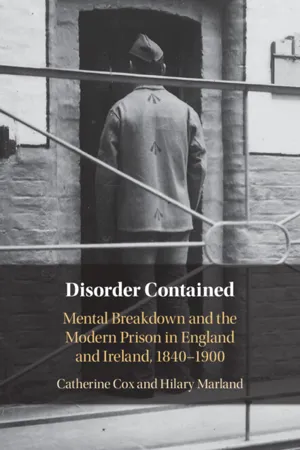 eBook - PDF
Disorder Contained
Mental Breakdown and the Modern Prison in England and Ireland, 1840 – 1900
- Catherine Cox, Hilary Marland(Authors)
- 2022(Publication Date)
- Cambridge University Press(Publisher)
88 Incarceration at Pentonville and the period of probation, was to be first in a system of staged punishments decreasing in rigour with each con- secutive step, with future conditions following transportation to Australia contingent on convicts’ behaviour at Pentonville; an exemplary record could culminate in a complete pardon. 89 Solitude and separation was rigorously imposed at Pentonville; convicts worked, ate and slept while confined to their cells for twenty-three hours per day. All communication was forbidden. They were moved through the prison hooded in masks, exercised in separation in specially designed yards, and were placed in separate stalls, referred to as coffins by the prisoners, at chapel (Figure 2.1). Prisoners were trained in a trade and taught by 85 Forsythe, The Reform of Prisoners, pp. 45, 63. Jebb’s significance has been covered extensively in the secondary literature. See ibid.; Evans, The Fabrication of Virtue; Clive Emsley, ‘Jebb, Sir Joshua (1793–1863)’, DNB, doi.org/10.1093/ref:odnb/14683 [accessed 4 Oct. 2018]. 86 Report of Inspectors of Prisons of Great Britain, Part 1 (1837–38), p. 28. See also Cox and Marland, ‘He Must Die or Go Mad in This Place’. 87 Report of the Commissioners for the Government of the Pentonville Prison (RCGPP) (1843) [449], p. 5. 88 Cited in John A. Stack, ‘Deterrence and Reformation in Early Victorian Social Policy: The Case of Parkhurst Prison, 1838–1864’, Historical Reflections/Réflections Historiques, 6:2 (1979), 387–404, at p. 394. 89 RCGPP (1843), pp. 7–8; Forsythe, The Reform of Prisoners, p. 71. Model Prisons and the Mind 41 schoolmasters, preparing them for their new lives in the colonies. The moral and spiritual reformation of the convicts fell mainly to the chap- lains who also directed the work of the schoolmasters and selected books for the library. eBook - PDF
- P. Raynor, G. Robinson(Authors)
- 2005(Publication Date)
- Palgrave Macmillan(Publisher)
The culmination of these developments, argues Ignatieff, was the construction of Pentonville in north London, which received its first prisoners in 1842. 8 But whilst the strict regime of solitude and silence, monotonous labour and religious instruction initially appealed to proponents of both reforma- tion and severity, Faith in the reformative promise of Pentonville barely survived the 1840s. In the next decade it became fashionable once again to insist that the ‘dangerous classes’ were incapable of reformation. (Ignatieff, 1978, pp. 200, 204) Other historians concur that after 1850, the reformatory objective in penal policy went into decline (e.g. McConville, 1981; Forsythe, 1991). Forsythe draws particular attention to the spread in the latter half of the nineteenth century of ideas about heredity, 9 which undermined optimism about the reform of offenders. In 1863 the Carnarvon Committee, set up to consider the relative merits of deterrence and reform, came down firmly in favour of the former, and indeed argued that regimes intended to bring about reform were inimical to deterrence. By the 1870s, McConville argues, the severity of imprisonment had reached 40 Rehabilitation, Crime and Justice such a level that it could not be increased without endangering the health of prisoners. Indeed, he contends that the severity of prison regimes were such that the new sentence of penal servitude for habitual offenders, which had replaced transportation in the 1850s, was consid- ered by many to be a more lenient sentence than that of imprisonment, despite the fact that it was generally of longer duration. 10 Meanwhile religion, previously at the centre of debates about prison discipline, was in the second half of the century conspicuously absent from discussions of penal policy and practice. The decline of reform as a primary penal objective was underlined in 1877 by the appointment of Edmund Du Cane as chairman of the Prison Commission – a post which he occupied until 1895. eBook - PDF
Law, Crime and Deviance since 1700
Micro-Studies in the History of Crime
- David Nash, Anne-Marie Kilday, David Nash, Anne-Marie Kilday(Authors)
- 2016(Publication Date)
- Bloomsbury Academic(Publisher)
All of those connected with the prison were having to adjust to its – and their – newly diminished status. No longer could they see themselves as penal pioneers, venturing into uncharted territory in order to hammer out the principles of prison management and design for the benefit of the country’s ‘ordinary prisons’. 65 For, by this date, the model prison had become an ordinary prison – a small(ish) cog in Colonel Jebb’s new three-tier convict regime. The prison population at Pentonville had also changed: its inmates were no longer hand-picked probationers, but merely run-of-the-mill convicts undergoing a standardized twelve-month sentence of separate confinement before being readied for dispatch to the public works prisons, the hulks, or the new penal colony established in Western Australia. For those who had placed their faith in the separate system, it was a doubly bitter pill to swallow. The prison’s management committee – now reduced to a three-man rump of professional prison administrators 66 – was, like Kingsmill, keen to lower expectations with regard to separate confinement. Indeed, they quoted the chaplain’s ‘no panacea’ remarks at the end of their report for 1849. 67 The commissioners also stated in their report that the conduct of the prison’s inmates during the previous year had been ‘on the whole quite as good as could have been anticipated considering the descriptions of convicts which have been received’. 68 This was hardly a ringing endorsement for the new regime at the prison. Prospects for reform at Pentonville were evidently having to be revised downwards, as Kingsmill admitted, albeit guardedly, in his report for 1850: It is very obvious that so great a difference in the circumstances and character of our prisoners must very much increase the amount of anxiety and discouragement of those who are called to labour for their moral and religious improvement, and indeed of those whose duty it is to carry out the discipline.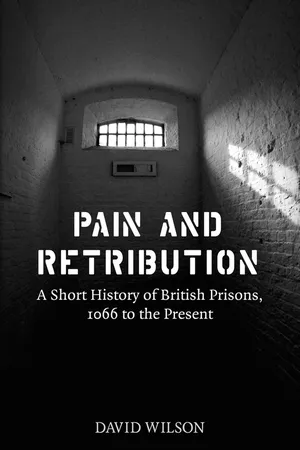 eBook - ePub
Pain and Retribution
A Short History of British Prisons, 1066 to the Present
- David Wilson(Author)
- 2014(Publication Date)
- Reaktion Books(Publisher)
11 In the meantime, influenced by the extraordinary popularity of John Howard, and indeed encouraged by him, Sir William Blackstone and Sir William Eden introduced the Penitentiary Act in 1779, which made it possible to substitute imprisonment for transportation in one of the two proposed state-run penitentiaries. This act basically synthesized everything that was believed at that time about what should be done with prisoners, in that they would be subjected to solitary confinement, have regular religious instruction, be required to work (but not for profit), would have to wear a uniform, and be subjected to a coarse diet. The minimum sentence would be six months for women and twelve months for men, with a maximum sentence of seven years. A commission of three people, including Howard himself, was set up to investigate the best sites for the erection of the penitentiary buildings, but by 1780 this had collapsed through internal disagreement. In 1781 a second commission chose sites at Wandsworth and Battersea, and an architectural competition was advertised to turn the philosophy of the act into reality. This was won by William Blackburn. Nonetheless a change of government in 1782 saw these plans shelved, and a new transportation act passed which would pave the way for Botany Bay.Pentonville Prison, interior view, c. 1840s, from the Illustrated London News.Despite this failure at a national level to make the penitentiaries a reality, there was a flurry of prison-building at the local level, which helped to keep the issue of incarceration in public and parliamentary discourse. Various individuals came to dominate that discourse in one way or another, and one of the most fervent was Jeremy Bentham, who never ceased to advocate on behalf of his unique design for the penitentiary – the Panopticon, or ‘all seeing eye’, the plans for which he published in 1791. Robin Evans provides the best description of the form that the Panopticon would take:The Governor was billeted with his family in a well-fenestrated cylindrical kiosk inside a much larger rotunda. The kiosk looked out across an intermediate space onto a circle of 192 cells four storeys high. All light for the kiosk filtered into the middle of the rotunda through large windows in these encircling bank of cells. Hence the prisoners, themselves brightly illuminated, would be unable to see into the darkness of the kiosk, much as the people out in the street cannot see into a house window. The privilege of those within this protected core – the governor, his family, assistants and visitors – was to observe the prisoners without themselves being seen to spy on them.12 eBook - ePub
Resisting the Rule of Law in Nineteenth-Century Ceylon
Colonialism and the Negotiation of Bureaucratic Boundaries
- James S. Duncan(Author)
- 2020(Publication Date)
- Routledge(Publisher)
Colonising Egypt . Berkeley: University of California Press, p. 35. I am grateful to David Nally for pointing this out to me.4 His vision in this regard had to wait for the creation of privately run prisons in twenty-first century America where prisons are profitable thanks to a combination of cheap prison labour and state funding. See Morin, K.M. 2018. Carceral Spaces, Prisoners and Animals . London: Routledge.A major change in the English prison system, however, came in 1835 when the “silent system,” developed in Auburn Prison in New York, was introduced. Under this system, prisoners worked together in silence during the day. This was followed in the next decade by the “separate system,” which went much further than Howard’s original idea. This entailed solitary confinement and had been famously instituted in Pennsylvania at Eastern State Penitentiary in 1829. The system became dominant in Britain in more and less strictly controlled forms during the second half of the nineteenth century. The isolation of prisoners was seen to have the advantage of separating them from the sinful influence of others and providing a therapeutic environment where total control could be exerted by the authorities. In 1842, Pentonville Prison was the second major prison in Britain constructed around the ideas of Bentham’s panopticon as well as separation and became a model for modern prisons in Britain and the colonies.The nineteenth-century prison was a veritable monument to instrumental rationality in that everything including the length of sentences, the architectural design and the organis ation of daily life was quantified.5 Arguably, the nineteenth century British prison was the preeminent site of the calculability of space and time in society at the time. The prevailing theory of disease was miasmatic, the now obsolete idea that many diseases are caused by bad air emanating from decaying material. So it was decided that prison cells should be exactly thirteen feet long, seven feet wide and nine feet high, as this would provide the optimum of air quality. Inmates were to work in their cells doing repetitive tasks which would instil a work ethic and cause them to reflect upon their misspent lives. As Ignatieff put it, the penitentiary was conceived as “a machine for the social production of guilt,” and the jailers were to be its technicians.6 Through the application of enlightenment rationality, the penitentiary “represented the apotheosis of the idea that a totally controlled environment could produce a reformed and autonomous individual.”7 eBook - PDF
Prisoners of Isolation
Solitary Confinement in Canada
- Michael Jackson(Author)
- 2019(Publication Date)
- University of Toronto Press(Publisher)
In framing the plan of these penitentiary houses, the principal objects were sobriety, cleanliness and medical assistance, by a regular series of labour, by solitary confinement during the intervals of work, by some religious instruction to preserve and amend the health of the unhappy offenders, to inure them to habits of industry, to guard them from pernicious company, to accustom them to 14 Prisoners of Isolation serious reflection, to teach them both the principles and practice of every Christian and moral duty. 33 Although the Penitentiary Act authorized the building of two new national prisons, actual construction never took place. However, the Peni-tentiary Act was to have a profound influence as a model for discipline in the wave of institutional renewal in the years following. Howard's ideas as embodied in the Penitentiary Act came at a critical time in English penal history. The outbreak of the American War of Independence in 1775 resulted in a sudden halt in transportation to the thirteen colonies. Almost overnight imprisonment was transformed from an occasional punishment for a felony to a sentence of first resort for all minor property crimes. Although the government sought to provide the necessary institutional facilities by refitting retired warships and moor-ing these 'hulks' on the Thames, it was not able to cope with the crime wave that swept England in the 1780s, caused by demobilization and accompanied by a trade depression following the loss of the colonial market. Prison reformers interpreted the situation in apocalyptic terms as evidence of a breakdown in the moral discipline among the poor. To men who conceived crime as a part of a wider pattern of insubordination among the poor, there was a compelling fascination in the idea of an institution that would give them total control over the bodies, labour, and minds of the poor. The penitentiary, in other words, was more than a functional response to a civic institutional crisis. eBook - PDF
- Clive Emsley(Author)
- 2018(Publication Date)
- Routledge(Publisher)
Jebb, subsequently appointed Surveyor-General of Prisons, was favourable towards the separate system himself, but his evidence to a parliamentary committee in 1850 suggests that the leading advocates of the system were not averse to a bit of blackmail: I was requested by . . . Mr Crawford and Mr Russell . . . to allow them to be associated with me in the consideration of the plans, and they urged this reason: they said, ‘We do not wish to control your professional opinion; but if you erect a prison which we do not consider to be adapted for the enforcement of the system which we advocate, we will not certify the cells, and the prison will be useless. 40 Pentonville, the end-product of Jebb’s designs and Crawford’s and Whit-worth Russell’s urgings, was opened in 1842. The inmates of Pentonville were kept in solitary cells. Each wore a mask, the ‘beak’, when moved around the building so that anonymity was preserved. At the required church parades each convict was confined to a separate box so that communication with his fellows was all but impossible. The plan was for the solitary confinement and anonymity of Pentonville to last for eighteen months before a man was transported. It was believed that, thrown in upon themselves, in the quiet, contemplative state of the solitary cell, convicts, assisted by their bibles and the exhorta-tions of the chaplain, would come to a realisation and repentance of their 2 8 5 P U N I S H M E N T A N D R E F O R M A T I O N wrong-doing. The Reverend John Clay, another enthusiast for the separate system recorded how: a few months in the solitary cell renders a prisoner strangely impressible. The chaplain can then make the brawny navvy cry like a child; he can work on his feelings in almost any way he pleases; he can, so to speak, photograph his thoughts, wishes and opinions on his patient’s mind, and fill his mouth with his own phrases and language. eBook - ePub
Architecture and Justice
Judicial Meanings in the Public Realm
- Jonathan Simon, Nicholas Temple(Authors)
- 2016(Publication Date)
- Routledge(Publisher)
Victorian Prison Lives: English Prison Biography 1830–1914 (London, 1999), p. 37.27 Robert Ferguson, ‘Pentonville Prisoners’, Quarterly Review , 82 (1847): 184–5.28 Johnston, ‘Buried Alive’.29 Austin Bidwell, From Wall Street to Newgate (London, 1895), p. 397, cited in Sarah Anderson and John Pratt, ‘Prisoner memoirs and their role in prison history’, in Helen Johnston (ed.), Punishment and Control in Historical Perspective (Basingstoke, 2008), p. 181.30 Anderson and Pratt, ‘Prisoner Memoirs’.31 Sean McConville, ‘The Victorian Prison, 1865–1965’, in Norval Morris and David J. Rothman (eds), The Oxford History of the Prison – The Practice of Punishment in Western Society (New York, 1998), pp. 117–50.32 One-who-has-tried-them, Her Majesty’s Prisons and their Effects and Defects by … (London, 1881), p. 264, cited in Priestley, Victorian Prison Lives , p. 41.33 F. Brocklehurst, I was in Prison (London, 1898), p. 29, cited in Anderson and Pratt, ‘Prisoner Memoirs’, pp. 181–2.34 Jewkes and Johnston, ‘The evolution of prison architecture’.35 Roy D. King, ‘The rise and rise of the supermax: An American solution in search of a problem?’, Punishment & Society , 1/2 (1999): 163–86; Sharon Shalev, Supermax: Controlling risk through solitary confinement (Cullompton, 2009); Mona Lynch, ‘Supermax meets death row: legal struggles around the new punitiveness in the US’, in John Pratt, David Brown, Mark Brown, Simon Hallsworth and Wayne Morrison (eds), The New Punitiveness: Trends, theories, perspectives (Cullompton, 2005), pp. 66–84. Passage contains an image
3A Simple Idea in Architecture: On the Principles of Projecting Prisons
Gabriela Ś witek‘The world itself is but a large prison, out of which some are daily led to execution’, said Sir Walter Raleigh, favourite of Elizabeth I and member of her court, for whom the political meanderings of justice were far from indifferent.1
Index pages curate the most relevant extracts from our library of academic textbooks. They’ve been created using an in-house natural language model (NLM), each adding context and meaning to key research topics.

