History

Crime and Punishment in Industrial Britain
Crime and Punishment in Industrial Britain refers to the legal and social systems of dealing with criminal behavior during the period of industrialization in Britain. This era saw significant changes in crime rates, policing, and the development of prisons. The shift from corporal punishment to incarceration and the rise of industrialization influenced the nature of crime and punishment in this period.
Written by Perlego with AI-assistance
Related key terms
1 of 5
9 Key excerpts on "Crime and Punishment in Industrial Britain"
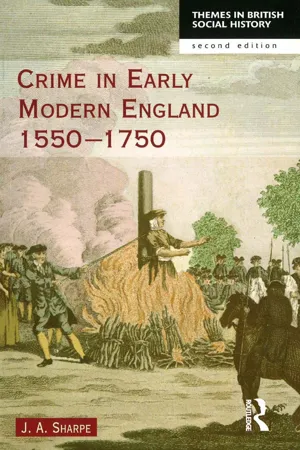 eBook - ePub
- James A Sharpe(Author)
- 2014(Publication Date)
- Routledge(Publisher)
CHAPTER EIGHTContinuity and Change in Crime and Punishment 1550–1750
In the previous chapters we have ranged freely over a number of areas, and have demonstrated, if nothing else, the variety of approaches that can be employed in studying the history of crime, and the multiplicity of issues involved in the subject. The point has now come for pulling these various threads together, and attempting to understand the general developments and problems relevant to the study of crime in our period. These developments and problems are fairly numerous, and the avenues towards understanding them correspondingly diverse. There is, nevertheless, one essential central theme: that of the possible connections between patterns of crime, patterns of punishment, the attitudes of ruling groups to such matters, and broader socio-economic change. After all, a general consensus suggests that such connections exist: thus a student of crime in Victorian and Edwardian Britain, for example, could claim that‘it has become one of the more widely accepted axioms of our age that an increasing crime rate is the invariable price of material progress’.1 Commentators on earlier periods have, in general, been equally convinced of the presence of such links. Hence the author of a general work on crime in early modern Europe informs us that ‘although crime is usually seen as an index of social distress, it can also be appreciated as an index of social development’, claims that the pattern of European theft, if drawn up, would correlate in time and geography with economic development, and suggests that within the timespan he covers Europe witnessed ‘the emergence of new forms of criminality that reflected the ongoing transition to industrial life’.2 eBook - PDF
Murder and Mayhem
Crime in Twentieth-Century Britain
- David Nash, Anne-Marie Kilday(Authors)
- 2018(Publication Date)
- Bloomsbury Academic(Publisher)
New concerns and requirements meant that the police and criminal justice system had to remain alert, dynamic and adaptable. Technological devel-opments created new types of fraud and cybercrime – the advent of a wholly new arena of crime where new crimes arose alongside new ways in which older crimes could be reinvented and could flourish once more. 15 It was also recognised that social change and the realisation of past inertia or blindness allowed heinous crimes to go unnoticed or escape discovery. For example, the twentieth century saw knowledge and action around the crime of child abuse grow to be recognised as a crime that requires its own pathology, criminological investigation and range of prevention and detection strategies. The recent focus upon individuals in positions of power who have been suspected or found to be guilty of child abuse, grooming, indecency and sexual assault, provides a constant reminder that the law needs to evolve regularly in order to protect the powerless from the powerful. 16 Introduction: Crime and Punishment in Twentieth-Century Britain 9 3. The Punishment Debate As many books covering the nineteenth century testify, the issue of punishment was one that preoccupied theorists, legislators, prison admin-istrators, practitioners and reformers throughout the Victorian era. 17 In many respects, the nature of these debates remained unaltered into the twentieth century, although some elements of context and emphasis did change. The perennial argument about the purpose and function of pun-ishment endured into the later twentieth century and even beyond as debates over the use of the death penalty testify. 18 It was during the nine-teenth century, however, that British society gradually became aware that certain forms of punishment that had been inherited from previous eras no longer seemed fit for purpose and had been victims of changing sen-sibilities.
- Hostettler, John(Authors)
- 2009(Publication Date)
- Waterside Press(Publisher)
The punishment for rape has been severe or lenient in different ages. Some activities which were not crimes in the past but have been made so today include drug abuse, white-col-lar crimes, drink driving and some types of pollution of the environment. Punishments for gambling, debt and for sexual immorality such as adultery were severe in the Puritan Commonwealth but are relaxed today, if they exist at all. Protestants and witches are no longer burnt at the stake or, indeed, punished at all. The mere idea would seem ludicrous to the modern mind. Nevertheless, not only ancient lawgivers, but also such influential writers on penal law as Bentham and Stephen, have proceeded in the belief that punishments should be brought to bear on moral as well as legal guilt and this view has persisted until recent times and, indeed, still exists. Another viewpoint is that since it is one of the foundations on which ordered society rests, any system of criminal law and punishment must depend upon subtle methods of coercion, and in extremis upon force for its survival. This raises the question of whether punishment is merely a fluid ad hoc means of social control of the dangerous and politically dissident elements in society. Hugo Grotius defined punishment as, ‘the infliction of an ill for an ill done’ 3 which tells us nothing about who is responsible for the punishing and why. It does, however, presuppose a victim who is in a subordinate position to the punisher. Clearly, in the Middle Ages, local social control was to the fore and punishments crudely reflected that fact. Subsequently, the philosophers of the Enlightenment concentrated on humanism and society’s duty to protect the rights of man, property and personal welfare against the brutality of the still dominant feudal penal laws and institutions. In modern times should this not be extended to seeing the primary aim of punishment as resolving social frictions? Legal punishment often flows from the power of the state. eBook - ePub
Criminal Justice
An Introduction to Philosophies, Theories and Practice
- Ian Marsh, John Cochrane, Gaynor Melville(Authors)
- 2004(Publication Date)
- Routledge(Publisher)
Chapter 3 ) demonstrates that there have been attempts to reform criminals but they have not detracted from the general motif of punishment as needing to be severe and exemplary. Reform and rehabilitation as ‘aims of punishment’ gained perhaps their widest support in the late 1950s and 1960s, providing a different sense of purpose for punishment and leading to a general optimism about the possibilities of punishment. This was reflected in various new methods of punishment introduced in Britain and elsewhere in this period, including parole, suspended sentences, community service orders and day training centres. The optimism of the 1960s soon gave way to a more sceptical perspective: rising crime rates and high rates of reoffending led to criticisms of the new methods of punishment as being too soft. The emphasis moved away from reform, with senior politicians advocating a hardline approach to punishment that was reflected in ‘short, sharp shock’ sentences being introduced in the early 1980s, and more recently the introduction into Britain of policies based on American ‘boot camps’ and ‘three strikes and out’ policies.However, these newer, harsher initiatives have similarly had little effect on the size of the prison population or on rates of recidivism. Without going into great detail, some overall figures will help illustrate the pressures on the prison system in Britain and provide a context for considering the different philosophies of punishment. The prison population in Britain has continued to rise pretty steadily over the past few decades, with over 71,000 people in Prison Service establishments in 2002 (Home Office data, Social Trends 33, 2003). The number of people given immediate custodial sentences in 1999 was over 105,000 compared to just under 80,000 four years previously (Home Office data, Annual Abstract of Statistics, 2002). (The reason that the number of people sent to prison each year is greater than the prison population is that most prisoners are sentenced to short sentences of less than one year and so not all would be in prison when the annual figure is calculated.) As regards repeat offenders, it would seem that a relatively small number of offenders are responsible for a large proportion of offences. Of the 97,800 males who entered prison in 1999, almost 68 per cent had had previous convictions for ‘standard list offences’ (which include all indictable offences plus some of the more serious summary offences), with 46 per cent having had three or more previous convictions (Home Office data, Annual Abstract of Statistics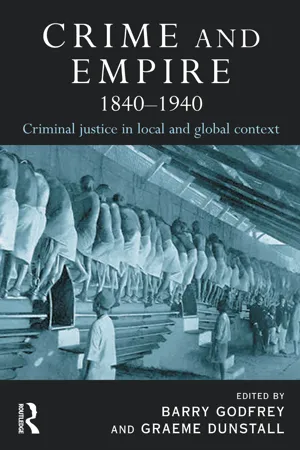 eBook - ePub
- Barry Godfrey, Graeme Dunstall(Authors)
- 2013(Publication Date)
- Willan(Publisher)
Chapter 3
Explaining the history of punishment
John PrattAfter inviting me to give a seminar on my work to a local criminology society meeting, a colleague later introduced me to the audience as ‘an armchair academic’. In their mind, because I had been engaged in historical research, it was as if what I was doing was some sort of esoteric but largely irrelevant luxury. Happily, I am certain that this depressing view of the parameters and possibilities of criminological research is idiosyncratic to that person rather than normative of the discipline as a whole. Indeed, as I show in this chapter, the history of punishment has demonstrated an exhilarating expansion and fortitude over the last three decades or so. Not that it was always like this, though. There had been a dearth of historical scholarship before then. Why this might have been so, how and in what ways the history of punishment has become such a dynamic subject since that point, and how our understanding of the purposes and nature of historical inquiry have changed will be the main themes of this chapter.The contribution of Radzinowicz
Sir Leon Radzinowicz (1948: ix) began the preface to what ultimately became his monumental five volumed History of English Criminal Law with the statement that:Lord Macauley’s generalisation that the history of England is the history of progress is as true of the criminal law of this country as of the other social institutions of which it is a part. Child of the Common Law, nourished and moulded by statute, the criminal law of England has always been sensitive to the needs and aspirations of the English people, and it has continually changed under the impact of the predominant opinion of the day. eBook - ePub
Crime And Punishment In England
An Introductory History
- John Briggs, Christopher Harrison, Angus McInnes, David Vincent, Mr John Briggs(Authors)
- 2005(Publication Date)
- Routledge(Publisher)
Part II Crime, police and punishment in England after the Industrial Revolution, 1800–75
 Passage contains an image
Chapter 8 The ordering of society
Informal disciplines
A.J.P.Taylor argues that one of the impacts of the demands of the First World War on civilian society was that “The history of the state and of the English people merged for the first time.” The proposal is that until then the state and Britain’s citizens inhabited separate spheres. This means that any exploration of the way in which society was ordered at the beginning of the nineteenth century cannot confine itself to a study of legal codes and the actions of officers of the law. It has to go beyond that and undertake the more subtle task of understanding how the much less easily defined forces of opinion, habit and aspiration affected people’s behaviour in a society that existed long before the emergence of the omni-competent state. W.L.Burn expresses it in these terms:As its far-ranging missionaries of social discipline and progress [individualistic England] took the individual man and woman, impelled by their desire to better their condition in this world and to secure a crown of glory in the next. Behind them were the powerful voluntary agencies, the religious and philanthropic associations, the schools and universities, the hospitals, the innumerable societies for inducing people to do something or refrain from doing something else. In the third line was the State. That was the usual order but it was capable of alteration and on occasions the State moved into first place.Society, then, was in normal times essentially ordered by individual motivation, the desire to stand well with your peers and with your God, and by the informal disciplines of family, factory, congregation and the great estate. This was a society in large measure confined within parochial boundaries. Within such confines, informal disciplines— defined as the disciplines of publicity, respectability, dependency, religion and of work and play—were for the most part tolerably efficient, especially when it is remembered that the shadow of the workhouse, the only formal provision for the poor, was cast across all working-class homes in the kingdom. An absence of formal constraints does not, therefore, mean that society was threateningly anarchic, for although legal constraints may have been few, social disciplines were well entrenched and respected. Landlordism, employer-employee relationships, tied cottages, different forms of patronage, all were part of the woof and warp of everyday life.
- Louis Knafla(Author)
- 2006(Publication Date)
- Wilfrid Laurier University Press(Publisher)
We have seen that per-sons of a greater age having committed more than one crime had a great-er chance of receiving imprisonment. Women are also over-represented among the prison inmates, although the length of their stay was shorter compared to male inmates. The fact that the share women took in pro-perty crimes was greater than that of men may explain such over-repre-sentation. If the prison was a heavy punishment, the use of it con-cerning theft is surprisingly high. Nonetheless, within the whole framework of punishment, the more modern penalty of the prison was in many cases combined with other traditional elements of whipping and banishment. Here the differences between the regions became apparent. The influence of the advice of legal professionals or jurists as well as the availability of a prison might have been important reasons for the extent of its utilization. Studying crime and its repression demands an awareness of the con-ceptual difficulties and of the problem of fact-finding. The deficien-cies of the archival material—in this contribution only slightly touched—must always be kept in mind. I have tried to give some 294 Crime and Justice information of a descriptive character with some attempts to trace patterns and seek explanations. Dealing with official punishment, and not with criminality, we can bypass the difficulties connected with the problem of the dark numbers of crimes. Societies and smaller com-munities have a variety of means to deal with their deviants; juridi-cal punishment is just one of the varieties. However, because official punishment on the one hand shows the dominant way of thinking about ruling a society, and on the other hand this way of thinking slowly penetrated large sections of society since the eighteenth century, an examination of this aspect of social control is rewarding. B-iedeHfes/Punishment in the Dutch Republic 295 FOOTNOTES 1 This contribution is partly a result of research made possible by a grant from Z . eBook - ePub
Ethics and Public Policy
A Philosophical Inquiry
- Jonathan Wolff(Author)
- 2019(Publication Date)
- Routledge(Publisher)
6CRIME AND PUNISHMENT
§Introduction
Among the concerns of the British public, crime – or perhaps law and order – always features near the top of the list. Yet it is worth pausing to ask the question: ‘what is so bad about crime?’ This, clearly, is rather provocative. If asked in the spirit of an economist one would expect the answer that, when we look into it, crime isn’t such a bad thing after all. Karl Marx ironically remarked on what would now be called the ‘technology-forcing’ aspects of crime. The need for secure locks led to developments in precision engineering which no doubt had many beneficial applications elsewhere. As Marx says, ‘Doesn’t practical chemistry owe just as much to the adulteration of commodities and the efforts to show it up as to the honest zeal for production?’ and ‘Torture alone has given rise to the most ingenious mechanical inventions, and employed many honourable craftsmen in the production of its instruments’ (Marx 1969 [1863], 387). Crime prevention – not to mention the academic study of crime – is a major enterprise and in this way contributes to economic growth and national wealth, albeit the growth of something that detracts from, rather than adds to, human happiness.Crime prevention, in fact, is an excellent illustration of the point that economic activity is not necessarily a good thing in itself. Crime, we know, is something we would rather be without even if it can have some consequences that are useful for some people. Crime is so bad that we punish people, often with imprisonment, if we find them guilty. In this respect crime is almost unique. Apart from severe cases of mental illness or infectious disease, in a liberal society there is no other reason that we take as sufficient to deprive people of their liberty, however irritating they may be. Many philosophers and legal theorists have looked at the question of the moral justification of punishment, and we will follow this up later on in this chapter. Yet to understand the point of punishment, and its possible justifications, we need first, presumably, ask why we find crime so troubling. And that is what we shall explore in the first part of this chapter. eBook - PDF
Penal Practice and Culture, 1500–1900
Punishing the English
- Paul Griffiths, Simon Devereaux(Authors)
- 2003(Publication Date)
- Palgrave Macmillan(Publisher)
All of this bustle, all of these various changes in the character of debate, can cause us to miss an obvious point; the reformers did not discover the inhumanity of the gallows, nor did they invent the prison; rather, something more com- plicated went on as they transformed the notion of humanity and proposed a different relationship between society and punishment. Notes 1 Solon Secundus, or Some Defects in the English Law with their Proper Remedies (1695), dedication. 2 Lawrence Braddon, The Miseries of the Poor are a National Sin, Shame, and Charge (1717), xxxiv. 3 London Magazine (1735), 598–9. 4 Charles Jones, Some Methods Proposed Towards Putting a Stop to the Flagrant Crimes of Murder, Robbery, and Perjury (1752), 11. Randall McGowen 227 5 J. M. Beattie, Crime and the Courts in England 1660–1800 (Princeton, 1986), 13, 470–83, 500–13; Roger Ekirch, Bound for America: The Transportation of British Convicts to the Colonies 1718–1775 (Oxford, 1987). 6 J. M. Beattie, ‘London crime and the making of the “Bloody Code”, 1689–1718’, in Lee Davison et al., eds, Stilling the Grumbling Hive: The Response to Social and Economic Problems in England, 1689–1750 (New York, 1992), 70, and more gener- ally, 49–76. J. M. Beattie, Policing and Punishment in London, 1660–1740 (Oxford, 2001). Of course other scholars have challenged the significance usually accorded to the ‘Bloody Code’. See, for instance, John Langbein, ‘Albion’s fatal flaws’, P&P, 98 (1983), 96–120; Joanna Innes and John Styles, ‘The Crime wave: recent writing on crime and criminal justice in eighteenth-century England’, in Adrian Wilson ed., Rethinking Social History (Manchester, 1993), 200–65; Randall McGowen, ‘Making the “Bloody Code”?: forgery legislation in eighteenth-century England’, in Norma Landau ed., Law, Crime and English Society 1660–1840 (Cambridge, 2002), 117–38. 7 Peter King, Crime, Justice, and Discretion in England 1740–1820 (Oxford, 2000), 1, and esp.
Index pages curate the most relevant extracts from our library of academic textbooks. They’ve been created using an in-house natural language model (NLM), each adding context and meaning to key research topics.

