History

Crime and Punishment in Medieval England
In medieval England, crime and punishment were heavily influenced by the feudal system and the Church. Punishments for crimes varied widely, from fines and public shaming to physical mutilation and execution. The legal system was also characterized by trial by ordeal and the use of local courts, with the king's authority gradually asserting more control over law enforcement.
Written by Perlego with AI-assistance
Related key terms
1 of 5
11 Key excerpts on "Crime and Punishment in Medieval England"
 eBook - PDF
Crime and Punishment in the Middle Ages and Early Modern Age
Mental-Historical Investigations of Basic Human Problems and Social Responses
- Albrecht Classen, Connie Scarborough, Albrecht Classen, Connie Scarborough(Authors)
- 2012(Publication Date)
- De Gruyter(Publisher)
Introduction Crime, Transgression, and Deviancy: Behaviors that Defines Us All Albrecht Classen and Connie Scarborough When one naively thinks of the concepts of crime and punishment in the Middle Ages and early modern period the first aspects that probably come to mind are arbitrary systems of judges, and harsh and often barbarous corporal punishments. Executions or dismemberment were, as we hear in popular media, the norm during the premodern world, and so cruel judgments, ruthless treatment of even the slightest transgression, and, worst, the absolute power exerted first by the king, and then, often even superseding him, the Church. Romantic, often highly dramatized and emotional perceptions of the past continue to influence the public minds until today, and hence the broad approach to a world in which crime and punishments were, as it seems, simply rampant, crude and cruel, almost beastly. Suffice, of course, to remember this popular opinion, and then to dismiss it quickly since it does not live up to what we really know about crime and punishment in the Middle Ages. After all, crime itself constitutes a highly complex phenomenon representing the norms and their transgression by an individual, a group, or a whole society. Similarly, punishment can be meted out in a vast array of possible degrees and procedures, so both aspects addressed in the present volume alert us to the constant need to revisit the basic assumptions about the premodern or any other world, especially because the concept of what a crime actually means appears to be in constant flux. Every society lives by its own norms and standards, and cultures have differed from each other profoundly from period to period, from country to country, and from religion to religion.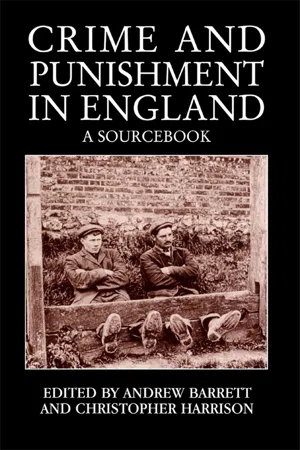 eBook - ePub
Crime and Punishment in England
A Sourcebook
- Andrew Barrett, Chris Harrison(Authors)
- 2005(Publication Date)
- Routledge(Publisher)
Chapter 1 Crime and Punishment in Medieval England
This chapter illustrates some of the basic concepts and practices of English medieval law, in particular the “criminal” law in the counties.1 The origins of the English criminal legal system
“The origin of the criminal law [was] the assumption by the state of the responsibility for avenging personal injuries.”1 What, in the case of England, did this mean in practice? The Anglo-Saxon system of criminal justice was mainly concerned to prevent feuds provoked by violent or serious crime. The system was designed to force the victim or, if he was dead or incapacitated, his family to accept compensation rather than turn to violence. The levels of compensation were established by the kings in consultation with their secular and ecclesiastical counsellors. This initiated some of England’s earliest criminal legislation, as illustrated by these early seventh-century laws of Aethelbert.1.1 Anglo-Saxon Laws
The Laws of Aethelbert2
10. If a man lies with a maiden belonging to the king, he shall pay 50 shillings compensation. 14. If a man lies with a nobleman’s serving maid, he shall pay 12 shillings compensation. 16. If a man lies with a commoner’s serving maid, he shall pay 6 shillings compensation.21. If one man slays another, the ordinary wergeld to be paid as compensation shall be 100 shillings.322. If one man slays another, he shall pay 20 shillings before the grave is closed, and the whole of the wergeld within 40 days. 23. If a homicide departs from the country, his relatives shall pay half the wergeld. 40. If an ear is struck off, 12 shillings compensation shall be paid. 41. If an ear is pierced, 3 shillings compensation shall be paid. 42. If an ear is lacerated, 6 shillings compensation shall be paid. 43. If an eye is knocked out, 50 shillings shall be paid as compensation.
- Drew D. Gray(Author)
- 2016(Publication Date)
- Bloomsbury Academic(Publisher)
33 Third, the nature of prosecution was victim led, and the players involved in the merry-go-round of criminal justice were, for the most part, ordinary citizens and not paid professionals. In English towns and villages, the onus was on individuals to catch and prosecute criminals and this meant that reactions to crime could be sporadic at best, especially in less populated areas. 34 This participatory system of prosecution developed from the medieval period; it allowed individuals (at least for those men of some means) to confront those that had ‘wronged’, and the law gave them an arena in which to settle their differences. 35 Individuals and communities also took an active involvement in punishing those that transgressed accepted norms or broke the law. The overriding nature of punishment in medieval and early modern England was that it was public, painful and shaming. The early modern world appears to have had a broader concept of ‘honour’ and ‘honesty’, and so, thieves, sexual deviants and fraudsters were all lumped together as offenders against the commonweal. Such punishments as the pillory, stocks and ducking stool were all clearly intended to shame offenders and warn others not to follow their example. Offenders were also ritually maimed, whipped and executed, close by the scenes of their crime so that the consequences of offending was visible to all. 36 But we should not fall into the trap of characterizing early modern punishments as merely physical; this was the society that introduced the house of correction and hard labour as a method to reform bad behaviour. 37 So, in prosecution, policing and punishment, we can see clear continuities between the early modern state and that of the long eighteenth century. By the end of the 1800s, however, most of the seemingly brutal physical punishments had been swept away, as had the supposedly shambolic forms of private policing.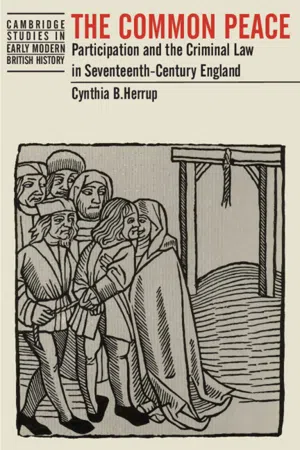 eBook - PDF
The Common Peace
Participation and the Criminal Law in Seventeenth-Century England
- Cynthia B. Herrup(Author)
- 1989(Publication Date)
- Cambridge University Press(Publisher)
*8* I <& The criminal law in early modern England As recently as fifteen years ago, scholars considered the criminal law of Tudor and Stuart England barbaric, the backwater of an increasingly sophisticated legal culture. They saw crime in early modern England as a simple, largely stable tableau of saucy thieves outwitting bumbling constables. Neither generalization stands today. As scholars have looked beyond the proscrip- tions of the law into its practices, notions of both the law and crime have been transformed. Rather than a subject with but a "miserable history," the crimi- nal law appears now as a responsive mechanism of considerable flexibility (albeit one without the subtlety of its private counterparts). Rather than the province of Shallow and Dogberry, crime and -its control appears now as a ground on which villagers struggled over basic definitions of morality and power. Criminal law and crime have rightfully earned a new respectability in the study of early modern England. 1 However, if recent research helps to explain what individuals in early modern England called crime or criminality, it has been less useful in uncovering how people arrived at their definitions. Whether interpreting verdicts as measures of criminal behavior or as measures of social discipline, scholars have generally treated the procedures of the law as background. Although no one who has worked with the legal records of this period would deny the complexity of the legal structure, the structure itself is often seen as secondary to its products. Too frequently legal process appears collapsed from a series of decisions into one judgment and from a multivoiced pro- duction into the solo of a single genteel tenor.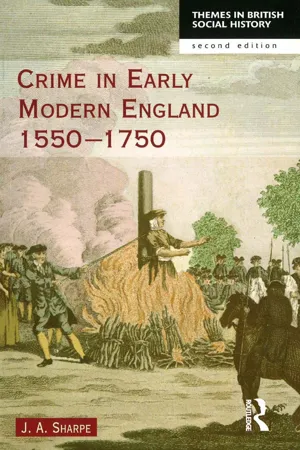 eBook - ePub
- James A Sharpe(Author)
- 2014(Publication Date)
- Routledge(Publisher)
CHAPTER EIGHTContinuity and Change in Crime and Punishment 1550–1750
In the previous chapters we have ranged freely over a number of areas, and have demonstrated, if nothing else, the variety of approaches that can be employed in studying the history of crime, and the multiplicity of issues involved in the subject. The point has now come for pulling these various threads together, and attempting to understand the general developments and problems relevant to the study of crime in our period. These developments and problems are fairly numerous, and the avenues towards understanding them correspondingly diverse. There is, nevertheless, one essential central theme: that of the possible connections between patterns of crime, patterns of punishment, the attitudes of ruling groups to such matters, and broader socio-economic change. After all, a general consensus suggests that such connections exist: thus a student of crime in Victorian and Edwardian Britain, for example, could claim that‘it has become one of the more widely accepted axioms of our age that an increasing crime rate is the invariable price of material progress’.1 Commentators on earlier periods have, in general, been equally convinced of the presence of such links. Hence the author of a general work on crime in early modern Europe informs us that ‘although crime is usually seen as an index of social distress, it can also be appreciated as an index of social development’, claims that the pattern of European theft, if drawn up, would correlate in time and geography with economic development, and suggests that within the timespan he covers Europe witnessed ‘the emergence of new forms of criminality that reflected the ongoing transition to industrial life’.2 eBook - PDF
Religion, Crime and Punishment
An Evolutionary Perspective
- Russil Durrant, Zoe Poppelwell(Authors)
- 2017(Publication Date)
- Palgrave Macmillan(Publisher)
127 © The Author(s) 2017 R. Durrant, Z. Poppelwell, Religion, Crime and Punishment, DOI 10.1007/978-3-319-64428-8_5 5 Religion, Punishment, and the Law Introduction In the city of Cologne in 1163, six men and two women were found guilty of heresy. Obstinately refusing to recant the beliefs of their hereti- cal Cathar ‘sect’ and embrace the Catholic Church they were subse- quently burned to death (Moore, 2012). This episode, Moore suggests, presaged an extended ‘war on heresy’, where ‘Denunciation, arbitrary arrest and imprisonment without charge, judicial torture and burning alive, became ordinary features of European life until the eighteenth cen- tury and beyond’ (p. 6). The systematic persecution of individuals who fail to hold—or often more specifically, publicly support—specific reli- gious belief systems is not a phenomenon restricted to Europe in the late middle ages and early modern period. There is a long history of reli- giously motivated punishment for individuals who fail to hold the appro- priate beliefs and values or who otherwise challenge religious hegemony by engaging in practices that are viewed as antithetical to the dominant order. The punishment of individuals for blasphemy, heresy, and apostasy is thus a prominent feature of social history, occasionally reaching dra- matic heights—brutally illustrated in the killing of tens of thousands of ‘witches’ during the early modern period in Europe (Levack, 2006). 128 As we shall see, neither the punishment for crimes against religion such as blasphemy nor the persecution of witchcraft is an entirely historical phenomenon and both are present in the modern world. Religion has played an important historical role in influencing the development of legal systems, shaping our notions of justice and influenc- ing the practice of punishment, but these influences have been largely neglected or downplayed by criminologists (Garland, 1990; Richardson, 2009; Sadique, 2016).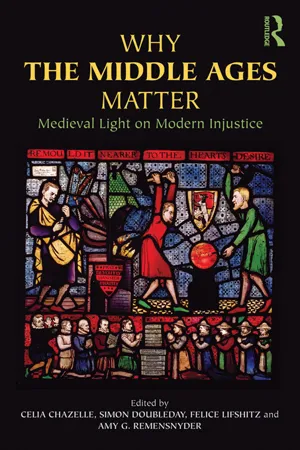 eBook - ePub
Why the Middle Ages Matter
Medieval Light on Modern Injustice
- Celia Chazelle, Simon Doubleday, Felice Lifshitz, Amy G. Remensnyder, Celia Chazelle, Simon Doubleday, Felice Lifshitz, Amy G. Remensnyder(Authors)
- 2012(Publication Date)
- Routledge(Publisher)
5Early medieval practices underscore the value of community and reparative justice for responding to nonviolent offenders in cities like Camden and, further, point toward initiatives that could provide similar benefits when dealing with violent offenders. Among the advantages of looking at modern penal policies through the lens of early medieval justice, one is that it reveals the particular importance of family and social networks to community wellbeing.Early Medieval JusticeThe best known medieval European judicial punishments are no doubt the spectacularly dramatic, painful torments seen in Hollywood films and Far Side cartoons: bodies broken on wheels and hanging from public gallows, beheadings, burnings, tortures like the thumbscrew and the rack. Foucault famously begins Discipline and Punish with a lurid account of the torture and drawing and quartering of Damiens, the would-be regicide (king-killer), in Paris in 1757. For Foucault, this scene harked back to a medieval emphasis on punishing the body, an approach to crime for which, he asserts, modernity has substituted the equally coercive punishment of prison. We now realize physical torture is still with us; but most Americans would agree that prisons illustrate our modernity, and most – unlike Foucault – believe these institutions are far more humane than any penalties of the middle ages.Medieval records, however, reveal a more nuanced situation. The majority of the sources for studying medieval penalties date from the twelfth and later centuries. The evidence is sparser for the early middle ages, yet people then, too, were familiar with a host of painful practices. Early medieval lawcodes enjoin execution for offenses ranging from homicide to adultery to relapsing into paganism. Narrative sources tell of kings and aristocrats who condemned enemies to exile or death, and of lords who commanded that dependents be branded, blinded, or lose noses or ears. Courts ordered torture and ordeals – such as trial by fire, where the suspect walked on burning coals, or trial by water where he or she picked an object out of boiling water. Skeletons unearthed from burial grounds show the effects of decapitation, amputation, and limbs bound possibly for hanging.6 Furthermore, while imprisonment was unusual, it was not absent, and again the experience must have been decidedly unpleasant. Nobles who rebelled against kings, priests who disobeyed bishops, and slaves or serfs (people of servile or unfree status) who tried to escape were sometimes confined in monasteries; some religious houses had a special room called a carcer eBook - PDF
Murder and Mayhem
Crime in Twentieth-Century Britain
- David Nash, Anne-Marie Kilday(Authors)
- 2018(Publication Date)
- Bloomsbury Academic(Publisher)
New concerns and requirements meant that the police and criminal justice system had to remain alert, dynamic and adaptable. Technological devel-opments created new types of fraud and cybercrime – the advent of a wholly new arena of crime where new crimes arose alongside new ways in which older crimes could be reinvented and could flourish once more. 15 It was also recognised that social change and the realisation of past inertia or blindness allowed heinous crimes to go unnoticed or escape discovery. For example, the twentieth century saw knowledge and action around the crime of child abuse grow to be recognised as a crime that requires its own pathology, criminological investigation and range of prevention and detection strategies. The recent focus upon individuals in positions of power who have been suspected or found to be guilty of child abuse, grooming, indecency and sexual assault, provides a constant reminder that the law needs to evolve regularly in order to protect the powerless from the powerful. 16 Introduction: Crime and Punishment in Twentieth-Century Britain 9 3. The Punishment Debate As many books covering the nineteenth century testify, the issue of punishment was one that preoccupied theorists, legislators, prison admin-istrators, practitioners and reformers throughout the Victorian era. 17 In many respects, the nature of these debates remained unaltered into the twentieth century, although some elements of context and emphasis did change. The perennial argument about the purpose and function of pun-ishment endured into the later twentieth century and even beyond as debates over the use of the death penalty testify. 18 It was during the nine-teenth century, however, that British society gradually became aware that certain forms of punishment that had been inherited from previous eras no longer seemed fit for purpose and had been victims of changing sen-sibilities.
- Hostettler, John(Authors)
- 2009(Publication Date)
- Waterside Press(Publisher)
CHAPTER 4 Criminal Law in Medieval and Early Modern England Substantive law was now being more clearly defined and will be dealt with here and on later occasions when it underwent substantial changes. TREASON In general, the crime of treason involves the violation of the allegiance due from the subject to the sovereign as supreme head of state. It might appear that to define this in legal terms would present little difficulty. Indeed, because treason was regarded as the most heinous offence in the calendar of crimes it was one of the first to be defined by statute in the Middle Ages. However, later statutes, and interpretations by the judges, led to ‘constructive treasons’ and a great many problems. The kings of England in medieval times saw treason as the most foul offence since it threatened their thrones. The times were dangerous and the Crown was still not powerful enough to prevent continuing blood-feuds, executions and arbitrary punishments among powerful barons at the head of large bodies of armed retain-ers. They posed a constant threat to the king’s peace and sometimes attempted to exercise royal power. It is often claimed that the Statute of Treasons of 1352 1 , passed in the first Parlia-ment to sit after the Black Death, was enacted to preserve the land of the barons from Edward III. Certainly the king’s justices were securing widespread forfeitures by mul-tiplying new treasons that held any thing to be treason which directly or indirectly diminished the king’s dignity or his prerogative. The forfeitures took the property of traitors that would otherwise have escheated to the mesne lords for felony. However, John Bellamy indicates a clear division between historians on whether the design was legal, to settle the rules about forfeiture in the king’s favour, or political, to prevent reckless royal charges and arbitrary punishments which were ruining so many noble families. eBook - PDF
Penal Practice and Culture, 1500–1900
Punishing the English
- Paul Griffiths, Simon Devereaux(Authors)
- 2003(Publication Date)
- Palgrave Macmillan(Publisher)
Speck, Literature and Society in Eighteenth-Century England, 1680–1820 (1998). 54 Cesare de Beccaria, On Crimes and Punishments, 1764, ed. Henry Paolucci (New York, 1963), 57. 55 There will be a chapter on these themes in Paul Griffith’s forthcoming book, Lost Londons: Crime, Control, and Change in the Capital City, 1545–1660. 56 See J.A. Sharpe, ‘ “Such disagreement betwyx neighbours”: litigation and human relations in early modern England’, in John Bossy ed., Disputes and Settlements: Law and Human Relations in the West (Cambridge, 1983), 167–87; id., ‘Enforcing the law in the seventeenth-century English Village’, in Gatrell et al., eds, Crime and the Law 97–119; Keith Wrightson, ‘Two concepts of order: justices, constables and jurymen in seventeenth-century England’, in John Brewer and John Styles, eds, An Ungovernable People: The English and Their Law in the Seventeenth and Eighteenth Centuries (1980), 21–46; Joan Kent, The English Village Constable 1580–1642: A Social and Administrative Study (Oxford, 1986), esp. chaps 7–8. 57 Shoemaker, Prosecution and Punishment, esp. chaps 4–5. 58 See Bob Shoemaker’s chapter in this volume. 59 Innes, ‘Prisons for the poor’. 60 Ian W. Archer, The Pursuit of Stability: Social Relations in Elizabethan London (Cambridge, 1991), chaps 5–6; A.L. Beier, Masterless Men: The Problem of Vagrancy in England 1560–1640 (1985), chap. 9; Anthony Fletcher. Reform in the Provinces: The Government of Stuart England (New Haven and London, 1986), chap. eBook - PDF
Flogging Others
Corporal Punishment and Cultural Identity from Antiquity to the Present
- G. Geltner(Author)
- 2014(Publication Date)
- Amsterdam University Press(Publisher)
It may suggest a prescriptive swing away from corporal punishment, but it may also indicate a class bias in the application of such commutations: Those who could af ford to pay, remained intact, while those who could not, did not. In other words, in certain contexts certain bodily marks would brand a person as belonging to a lower socioeconomic status rather than as merely a criminal. The Middle Ages, a period out of which Western civilization was allegedly reborn, having rejected many of its shared assump-tions and values, is hard to typify in terms of princely rulers’ or urban regimes’ recourse to corporal punishment. On the one hand, diverse evidence from this long era strongly suggests that, as in preceding periods, court-issued corporal punishment as well as the measure’s use in private settings is dif ficult to shoehorn into a particular mold. On the other, and as the next and final section will demonstrate, modern societies in and beyond Europe continued to practice corporal punishment, and in certain cases even expanded its use. In this sense, the period known as early modernity did indeed operate as a watershed moment in the history of corporal punishment, but in ways that depart from its traditional image. As we shall see, from a global perspective, European corporal punishment achieved a renais-sance of sorts with the expansion of European powers into the Americas, Africa, and Asia. Modernity to the Present The evidence surveyed in the previous section undermines a prevalent view, especially outside specialist circles, that associ-ates the demise of corporal punishment with the West’s transi-tion into modernity. Moreover, it implies that Enlightenment 69 figures such as Cesare Beccaria (1738-1794) and Jeremy Bentham (1748-1832), the founding fathers of modern penology, developed their reformist blueprints in response to the specif ic penal prac-tices of the early modern period rather than to any perennial premodern state of af fairs.
Index pages curate the most relevant extracts from our library of academic textbooks. They’ve been created using an in-house natural language model (NLM), each adding context and meaning to key research topics.

