History

Crime and Punishment in Early Modern England
Crime and Punishment in Early Modern England refers to the legal and social systems of justice during the 16th to 18th centuries. It involved a range of punishments for various crimes, including fines, public shaming, and corporal punishment. The period saw the emergence of more formalized legal processes and the development of prisons as a means of punishment and rehabilitation.
Written by Perlego with AI-assistance
Related key terms
1 of 5
12 Key excerpts on "Crime and Punishment in Early Modern England"
 eBook - PDF
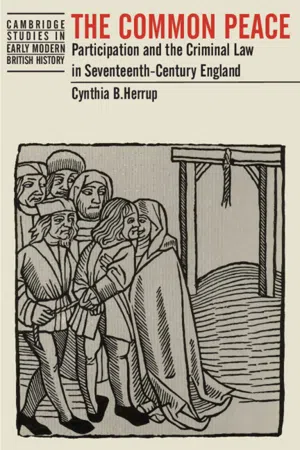
The Common Peace
Participation and the Criminal Law in Seventeenth-Century England
- Cynthia B. Herrup(Author)
- 1989(Publication Date)
- Cambridge University Press(Publisher)
*8* I <& The criminal law in early modern England As recently as fifteen years ago, scholars considered the criminal law of Tudor and Stuart England barbaric, the backwater of an increasingly sophisticated legal culture. They saw crime in early modern England as a simple, largely stable tableau of saucy thieves outwitting bumbling constables. Neither generalization stands today. As scholars have looked beyond the proscrip- tions of the law into its practices, notions of both the law and crime have been transformed. Rather than a subject with but a "miserable history," the crimi- nal law appears now as a responsive mechanism of considerable flexibility (albeit one without the subtlety of its private counterparts). Rather than the province of Shallow and Dogberry, crime and -its control appears now as a ground on which villagers struggled over basic definitions of morality and power. Criminal law and crime have rightfully earned a new respectability in the study of early modern England. 1 However, if recent research helps to explain what individuals in early modern England called crime or criminality, it has been less useful in uncovering how people arrived at their definitions. Whether interpreting verdicts as measures of criminal behavior or as measures of social discipline, scholars have generally treated the procedures of the law as background. Although no one who has worked with the legal records of this period would deny the complexity of the legal structure, the structure itself is often seen as secondary to its products. Too frequently legal process appears collapsed from a series of decisions into one judgment and from a multivoiced pro- duction into the solo of a single genteel tenor.
- Louis A. Knafla(Author)
- 2002(Publication Date)
- Greenwood(Publisher)
A. Sharpe, “The History of Crime in Late Medieval and Early Modern Europe: A Review of the Field,” Social History 7 (1982): 187–203; Innes and Styles, “The Crime Wave,” 380–435; J. B. Post, “Crime in Later Medieval England: Some Historiographical Limitations,” Continuity & Change 2 (1987): 211–24; John L. McMullan, “Crime, Law and Order in Early Modern England,” British Journal of Criminology 27 (1987): 252–74; J. A. Sharpe, “The History of Crime in England, c. 1300–1914,” British Journal Criminology 28 (1988): 124–37; Malcolm Gaskill and Tim Meldrum, “ ‘Crime, the Law, and the State’ University of Essex/Istituto Italiano per gli Studi Filosofici, Naples, Comparative History Summer School, 6–10 July 1992,” Social History 18 (1993): 87–92; and the second edition of Jim Sharpe’s Crime in Early Modern England (London, 1998). 7. Joyce U. Harn, ed., Historical Research for Higher Degrees in the United Kingdom. List No. 58. Part II Theses in Progress, 1997 (London, 1997). “The History of Crime and Punishment in England,” a course taught at Keele University, Staffordshire, has spawned its own textbook: John Briggs, Christopher Harrison, Angus McInnes, and David Vincent, eds., Crime and Punishment in England: An Introductory History (London, 1996). The early modern period is covered bychaps. 2–7. 8. To my knowledge, two of the last conventional countybased doctoral theses were completed in the late 1980s: R.A.H. Bennett, “Enforcing the Law in Revolutionary England: Yorkshire, 1640–1660” Ph.D. thesis, University of London, 1988); Sarah BarbourMercer, “Prosecution and Process: Crime and the Criminal Law in Later SeventeenthCentury Yorkshire” (D. Phil. thesis, York University, 1989). 9. Robert B. Shoemaker, Prosecution and Punishment: Petty Crime and the Law in London and Rural Middlesex, c. 1660–1725 (Cambridge, 1991); Gwenda Morgan and Peter Rushton, Rogues, Thieves and the Rule of Law: The Problem of Law Enforcement in NorthEast England, 1718–1820 (London, 1998).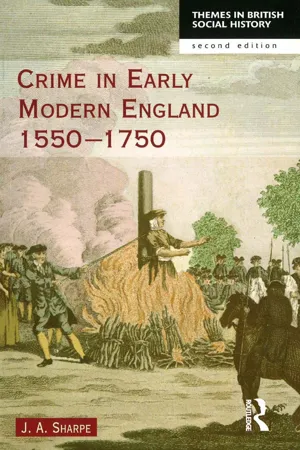 eBook - ePub
- James A Sharpe(Author)
- 2014(Publication Date)
- Routledge(Publisher)
CHAPTER EIGHTContinuity and Change in Crime and Punishment 1550–1750
In the previous chapters we have ranged freely over a number of areas, and have demonstrated, if nothing else, the variety of approaches that can be employed in studying the history of crime, and the multiplicity of issues involved in the subject. The point has now come for pulling these various threads together, and attempting to understand the general developments and problems relevant to the study of crime in our period. These developments and problems are fairly numerous, and the avenues towards understanding them correspondingly diverse. There is, nevertheless, one essential central theme: that of the possible connections between patterns of crime, patterns of punishment, the attitudes of ruling groups to such matters, and broader socio-economic change. After all, a general consensus suggests that such connections exist: thus a student of crime in Victorian and Edwardian Britain, for example, could claim that‘it has become one of the more widely accepted axioms of our age that an increasing crime rate is the invariable price of material progress’.1 Commentators on earlier periods have, in general, been equally convinced of the presence of such links. Hence the author of a general work on crime in early modern Europe informs us that ‘although crime is usually seen as an index of social distress, it can also be appreciated as an index of social development’, claims that the pattern of European theft, if drawn up, would correlate in time and geography with economic development, and suggests that within the timespan he covers Europe witnessed ‘the emergence of new forms of criminality that reflected the ongoing transition to industrial life’.2 eBook - PDF
Penal Practice and Culture, 1500–1900
Punishing the English
- Paul Griffiths, Simon Devereaux(Authors)
- 2003(Publication Date)
- Palgrave Macmillan(Publisher)
7 Peter King, Crime, Justice, and Discretion in England 1740–1820 (Oxford, 2000), 1, and esp. chap. 2. 8 ‘The changes that one can see taking place in several aspects of the law and crim- inal administration of the period’, Beattie reports, ‘were accompanied by very little public discussion’ (Policing and Punishment, 5). 9 A column in the July, 1737 issue of the Gentleman’s Magazine, produced responses in January, April, and June of 1738. John Beattie has mined London grand jury presentments for their discussions of the nature of the criminal threat. Particularly interesting are the repeated calls for an attack on the ‘roots’ of crime, suggesting the presence of a widely accepted version of what the causes of crime were, and what needed to be done about them (Policing and Punishment, 51–6). A charge to the grand jury at the Guilford Quarter Sessions in 1740 summarized the conven- tional wisdom. ‘As no man is completely wicked at once but become so insensi- bly by a gradation of wickedness, wch would continually gain Strength by Impunity, till the Offender loosing all Sense of fear & remorse, grows harden’d to the Commission of Crimes of the deepest Dye.’ Reprinted in Charges to the Grand Jury, 1689–1803, ed. Georges Lamoine, (1992), 293. 10 Robert Zaller, ‘The debate on capital punishment during the English Revolution’, The American Journal of Legal History, xxxi (1987), 133, and more generally 126–44. The earlier shift in the frequency of capital punishment has been explored by Philip Jenkins, ‘From gallows to prison? The execution rate in early modern England’, Criminal Justice History, vii (1986), 51–71. See also Beattie, Policing and Punishment, 278–82; Nancy Matthews, William Sheppard, Cromwell’s Law Reformer (Cambridge, 1984), esp. 168–72. 11 Beattie, ‘London crime’, 49–76; and esp. Beattie, Policing and Punishment.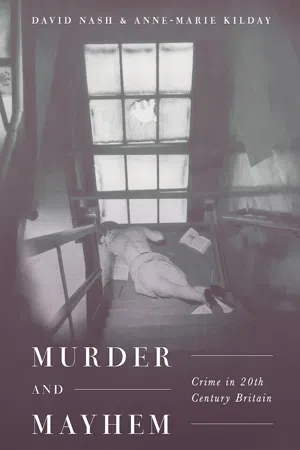 eBook - PDF
Murder and Mayhem
Crime in Twentieth-Century Britain
- David Nash, Anne-Marie Kilday(Authors)
- 2018(Publication Date)
- Bloomsbury Academic(Publisher)
New concerns and requirements meant that the police and criminal justice system had to remain alert, dynamic and adaptable. Technological devel-opments created new types of fraud and cybercrime – the advent of a wholly new arena of crime where new crimes arose alongside new ways in which older crimes could be reinvented and could flourish once more. 15 It was also recognised that social change and the realisation of past inertia or blindness allowed heinous crimes to go unnoticed or escape discovery. For example, the twentieth century saw knowledge and action around the crime of child abuse grow to be recognised as a crime that requires its own pathology, criminological investigation and range of prevention and detection strategies. The recent focus upon individuals in positions of power who have been suspected or found to be guilty of child abuse, grooming, indecency and sexual assault, provides a constant reminder that the law needs to evolve regularly in order to protect the powerless from the powerful. 16 Introduction: Crime and Punishment in Twentieth-Century Britain 9 3. The Punishment Debate As many books covering the nineteenth century testify, the issue of punishment was one that preoccupied theorists, legislators, prison admin-istrators, practitioners and reformers throughout the Victorian era. 17 In many respects, the nature of these debates remained unaltered into the twentieth century, although some elements of context and emphasis did change. The perennial argument about the purpose and function of pun-ishment endured into the later twentieth century and even beyond as debates over the use of the death penalty testify. 18 It was during the nine-teenth century, however, that British society gradually became aware that certain forms of punishment that had been inherited from previous eras no longer seemed fit for purpose and had been victims of changing sen-sibilities.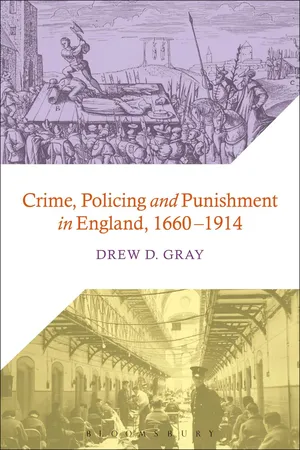
- Drew D. Gray(Author)
- 2016(Publication Date)
- Bloomsbury Academic(Publisher)
The path itself was winding and uneven with many twists and turns along the route, but more importantly the destination and goal seems far from certain. It is not at all clear whether the reforms of the late eighteenth and early nineteenth centuries actually improved the situation for the many thousands of inmates of British prisons. While we can be clear, of course, that the retreat from the public hanging of selective petty property criminals represents an advance for a ‘civilized’ country, it is much less clear that civilization was the driving force behind that change. Crime, Policing and Punishment in England, 1660–1914 322 In the early modern period brutal physical punishments, carried out in public, were a regular feature of life. All manner of offenders were hanged, burned at the stake, beheaded, tortured, pressed, flogged and pilloried in front of their communities as examples of what happened to those that transgressed the laws of God and the monarch. The intention was part deterrence and part purification; bodies were literally scourged of sin and pain was used to bring about repentance and, ultimately, redemption. By the early eighteenth century the number of those being executed was falling but most forms of physical punishment were retained. Across England and Wales the public execution and the gibbet represented a striking visual image of the power of the Hanoverian state and its ‘Bloody Code’ of laws, which prescribed death for over 200 separate offences. However, recent work has demonstrated that the reach of the state seems to have been limited. An ‘unbloody code’ appears to have operated on the peripheries; in Wales, Scotland, the North West and Cornwell there were hardly any executions at all, for decades. 99 So, the story of the rise and fall of the ‘Bloody Code’ has to be seen within this context, as a story of the limited power of the state. eBook - PDF
Residues of Justice
Literature, Law, Philosophy
- Wai Chee Dimock(Author)
- 2023(Publication Date)
- University of California Press(Publisher)
27 William Nelson, studying court rec- ords in colonial Massachusetts, reports that between 1760 and 1774, a total of 2,784 prosecutions came before the Superior and General Ses- sions Courts and that, among these, 1074 were for sexual misconduct (the bulk of which being fornication). In other words, offenses against morality accounted for as much as 38 percent of all prosecutions and made up the single largest category of crime. 28 This astonishing fact had something to do no doubt with the proverbial zealotry of the Massachusetts Bay Colony, but as we can see in the trial and tribula- tion of Adam Latham and Joan Mills, even in Delaware (as well as in New York, Pennsylvania, Maryland, and Virginia), crimes against morality were arraigned in the courtroom no less than in the pulpit. At once reprehensible and indictable, they were subject not only to divine retribution but also to criminal prosecution. 29 The lack of separation here between morality and legality, or, as was more often the case, between immorality and criminality, points Crime and Punishment 21 to a judicial universe recognizably different from our own. What has transpired, in the three hundred and fifty years separating us from colonial America, is nothing less than a transformation of the crimi- nal law, a transformation reflected not merely in its stipulated con- tents but more fundamentally in its range of enforceable meanings, in its designated sphere of operation, and in its infrastructural rela- tion to other vehicles of justice. That transformation changes the way "crime" itself is defined. What counts as a crime, what suffices as punishment, who is charged with its administration, and how that specific penalty must accord with the general prohibition—these tax- onomic and jurisdictional changes are the very ground upon which the criminal law might be said to have a history. eBook - PDF
- Jürgen Klein, Vanderbeke Dirk, Jürgen Klein, Vanderbeke Dirk(Authors)
- 2016(Publication Date)
- De Gruyter(Publisher)
The Representation of Crime and Punishment in 18th-Century England 53 This astonishing fact should not lead us to jump to conclusions. The inflation of capital offences as a result of parliamentary legislation was not matched by a corresponding increase in the number of death sentences or executions. There were three main factors which worked against this. (1) British criminal law, on paper the most draconian in Europe, was in practice extremely flexible. It was open to manipulation on a large scale, and gave the judge, and especially the jury, 36 a great deal of discretion. They obviously made full use of this leeway, often in the defendant's favour. Thus it was not unusual for a jury to acquit the defendant in the face of contrary evidence, or, more frequently, to give a partial verdict. This could include, for example, the common practice of pious peijury. In less serious crimes against property, the jury would deliberately undervalue the booty so that the crime could be reduced to petty larceny and the punishment reduced. ( 2) The expanded Capital Code was by no means a systematic and comprehensive work of legislation. Like British criminal law in general, it was inherently reactive. Consequently, many of the laws which were part of the Capital Code were closely tailored to extremely limited specific cases and were relatively rarely applied. (3) There was a subtle system of granting pardons after the death sentence had been imposed. 37 The Transportation Act of 1718 opened the possibility of pardoning those condemned to death and transporting them to America for fourteen years. 38 Pardons were granted according to relatively fixed and widely known criteria. In crimes against property, for example, such factors as the offender's youth, lack of previous convictions, and poverty all counted as mitigating circumstances.
- Louis Knafla(Author)
- 2006(Publication Date)
- Wilfrid Laurier University Press(Publisher)
m ENGLISH THINKING ABOUT CRIME, 1530-1620 T. C. CURTIS and F. M. PALE As is perhaps now generally agreed, crime is not an absolute. That is, no action is always and everywhere illegal. Rather, a crime is an action, or series of actions, the context of which determines disapproval—which disapproval in turn may lead to prosecution and conviction.1 The difficulty here, of course, is that context is not itself monolithic. In order to be understood and described it may only be categorized and perceived in particular terms: for example, the economic or the legal. Each perspective—what we might call each language of description—necessarily subsumes others, so that, for in-stance, any discussion of the economic assumes the legal. Now, given the notion that crime is defined by contextually determined disapproval, one obvious language for its discussion is that of attitude. By atti-tude we mean the view taken of particular actions by those involved with them or their consequences, whether that view be favourable or un-favourable, weak or strong, ambiguous or unambiguous; whether it be directed to a particular action or some class of actions in general. We have tried and are still trying to identify relevant attitudes and to establish a satisfactory method of so doing, and thus to move to some explanation of attitude. We do not claim that this is easy, nor that we have finished. What we do claim is that such work is necessary. We do not believe that it is possible merely to count court appearances like blades of grass and then assert that the total sums give a com-plete understanding of the lawn. In trying to come to some apprehension of thinking about crime in the period 1530 - c. 1620 we are looking at a deliberately wide range of sources, but this essay will deal only with creative literature which is specifically and only concerned with crime, or which takes up ideas about crime found elsewhere and uses them, perhaps, for other purposes. eBook - PDF
Religion, Crime and Punishment
An Evolutionary Perspective
- Russil Durrant, Zoe Poppelwell(Authors)
- 2017(Publication Date)
- Palgrave Macmillan(Publisher)
In the next section we consider how religion might shape beliefs about the nature and sever- ity of punishment that criminal offences might warrant. 5 Religion, Punishment, and the Law 139 Religion and Punitiveness The idea that religion plays a role in the nature and magnitude of punish- ment has a long history in the social sciences. Durkheim (1973, p. 300), in his classic essay on the ‘two laws of penal evolution’ drew a distinction between ‘human criminality’ and ‘religious criminality’: we think it will be readily conceded that all acts deemed criminal in every known society may be divided into two basic categories: those which are directed against collective things (whether ideal or material, it matters not) of which the principal kinds are offences against public authority and its representatives, the mores, traditions and religion; and those which only injure the individual (murders, thefts, violence and fraud of all types). These two forms of criminality are sufficiently distinct that there is every reason to designate them by different words. The first may be called reli- gious criminality because outrages against religion are the most essential part of it, and because crimes against tradition or chiefs of state have always had a more or less religious character: the second, one might term human criminality. Durkheim emphasised how the central function of punishment in soci- ety was to promote social solidarity. Crimes can be viewed as moral viola- tions of society’s conscience collective. The violation of group norms could thus be viewed as transgressions against sacred values that anger God or gods and require—often severe—punishment in order to maintain the group’s social functioning. The issue becomes particularly pressing because violations of moral codes may bring collective supernatural pun- ishment on the group. eBook - PDF
- David Ingram(Author)
- 2006(Publication Date)
- Continuum(Publisher)
Appearances of guilt constituted guilt; violations of the law were violations of the king’s will; and violations of that will were viewed as attacks on the person behind it – his person, his body, the body politic whose integrity he maintained, and the divine order of things. Such associational thinking explains why the step between disabled spinsterhood and the stake was a short one. There are several reasons why this regime of punishment disap-peared. To begin with, the concept of retribution as a form of vengeance was too closely tied to the arbitrary power of the monar-chy and aristocracy, a power that was made especially evident in public executions. The strange morality plays where repentant crim-inals met horrifying deaths became the occasion for all kinds of petty crimes (pickpockets were commonplace). More important, they generated a backlash; instead of striking reverential awe into the masses regarding the unlimited, God-like power of the monarch, they created sympathy for the condemned – who typically came from the lower classes – thereby inciting the spectators to rebellion. 123 CRIME AND PUNISHMENT The other reason pertains to the reform movements at the end of the eighteenth century. With the advent of the Enlightenment, pun-ishment and retribution would be re-inscribed in an entirely di ff erent economy of knowledge and power. Knowledge was now de fi ned as the accurate representation of reality, and reason (or common sense) was deemed to be the universal faculty by which that reality could be known. Rational agreement on clear and distinct ideas meant, among other things, that suspicion of guilt based upon inconclusive evidence could no longer be mistaken as proof of guilt; higher stan-dards of evidence that abolished the use of inquisitorial torture and permitted defendants to confront and rebut the evidence brought against them became the order of the day. Political and legal theories exhibited this change as well. eBook - PDF
Rich Crime, Poor Crime
Inequality and the Rule of Law
- Colin Webster(Author)
- 2023(Publication Date)
- Emerald Publishing Limited(Publisher)
By the 1780s, even when offend- ers could be caught and convicted, commentators felt they would not be pun- ished harshly. Their solution was to enforce the capital laws strictly. Others were concerned about the failure of transportation to discourage less serious offenders and to prevent a burgeoning of immorality and property offences in London in the 1750s and 1760s. Peter King’s (2006) review of crime and law in England from 1750 to 1840 noted how throughout the period, legal process varied immensely from case to case depending on the social status of the accused. Serious fel- onies such as highway robbery or burglary and certain summarily triable thefts, such as poaching, can be contrasted with common complaints usu- ally involving middle-class men such as unpaid debts, employees seeking the payment of wages, friendly society members seeking the assistance that they felt entitled to or papers seeking poor relief, which would receive a civil-style trial or a benefit tribunal type of hearing. In between these serious and civil 68 Rich Crime, Poor Crime sorts of cases were assault cases, which usually ended with a civil remedy. At the other end of the social scale, the opposite was often the case. The magistrates assumed wide and often ill-defined powers to punish the idle and the mobile poor, so that the summary courts of the eighteenth and early nineteenth centuries imprisoned very large numbers of labouring men and women for being ‘idle and disorderly’, for ‘vagrancy’, and for a huge variety of very poorly defined offences, with the numbers summarily imprisoned for ‘acts of vagrancy’ alone considerably outnumbered those committed for trial as felons. The legal basis on which many of these commitments were made was extremely sketchy. Sometimes eighteenth-century magistrates imprisoned the poor because they thought they needed disciplining, with little regard for any statutes, and at other times the 1744 Vagrant Act was evoked.
Index pages curate the most relevant extracts from our library of academic textbooks. They’ve been created using an in-house natural language model (NLM), each adding context and meaning to key research topics.

