History

Medieval Punishments
Medieval punishments were often brutal and aimed at deterring crime through fear and pain. Common forms of punishment included flogging, branding, mutilation, and public executions such as hanging, beheading, or burning at the stake. These punishments were often carried out in public as a means of both punishing the individual and sending a message to the community.
Written by Perlego with AI-assistance
Related key terms
1 of 5
8 Key excerpts on "Medieval Punishments"
 eBook - ePub
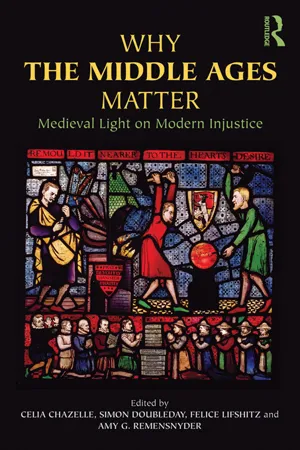
Why the Middle Ages Matter
Medieval Light on Modern Injustice
- Celia Chazelle, Simon Doubleday, Felice Lifshitz, Amy G. Remensnyder, Celia Chazelle, Simon Doubleday, Felice Lifshitz, Amy G. Remensnyder(Authors)
- 2012(Publication Date)
- Routledge(Publisher)
Discipline and Punish with a lurid account of the torture and drawing and quartering of Damiens, the would-be regicide (king-killer), in Paris in 1757. For Foucault, this scene harked back to a medieval emphasis on punishing the body, an approach to crime for which, he asserts, modernity has substituted the equally coercive punishment of prison. We now realize physical torture is still with us; but most Americans would agree that prisons illustrate our modernity, and most – unlike Foucault – believe these institutions are far more humane than any penalties of the middle ages.Medieval records, however, reveal a more nuanced situation. The majority of the sources for studying medieval penalties date from the twelfth and later centuries. The evidence is sparser for the early middle ages, yet people then, too, were familiar with a host of painful practices. Early medieval lawcodes enjoin execution for offenses ranging from homicide to adultery to relapsing into paganism. Narrative sources tell of kings and aristocrats who condemned enemies to exile or death, and of lords who commanded that dependents be branded, blinded, or lose noses or ears. Courts ordered torture and ordeals – such as trial by fire, where the suspect walked on burning coals, or trial by water where he or she picked an object out of boiling water. Skeletons unearthed from burial grounds show the effects of decapitation, amputation, and limbs bound possibly for hanging.6 Furthermore, while imprisonment was unusual, it was not absent, and again the experience must have been decidedly unpleasant. Nobles who rebelled against kings, priests who disobeyed bishops, and slaves or serfs (people of servile or unfree status) who tried to escape were sometimes confined in monasteries; some religious houses had a special room called a carcer
- Hostettler, John(Authors)
- 2009(Publication Date)
- Waterside Press(Publisher)
The punishment for rape has been severe or lenient in different ages. Some activities which were not crimes in the past but have been made so today include drug abuse, white-col-lar crimes, drink driving and some types of pollution of the environment. Punishments for gambling, debt and for sexual immorality such as adultery were severe in the Puritan Commonwealth but are relaxed today, if they exist at all. Protestants and witches are no longer burnt at the stake or, indeed, punished at all. The mere idea would seem ludicrous to the modern mind. Nevertheless, not only ancient lawgivers, but also such influential writers on penal law as Bentham and Stephen, have proceeded in the belief that punishments should be brought to bear on moral as well as legal guilt and this view has persisted until recent times and, indeed, still exists. Another viewpoint is that since it is one of the foundations on which ordered society rests, any system of criminal law and punishment must depend upon subtle methods of coercion, and in extremis upon force for its survival. This raises the question of whether punishment is merely a fluid ad hoc means of social control of the dangerous and politically dissident elements in society. Hugo Grotius defined punishment as, ‘the infliction of an ill for an ill done’ 3 which tells us nothing about who is responsible for the punishing and why. It does, however, presuppose a victim who is in a subordinate position to the punisher. Clearly, in the Middle Ages, local social control was to the fore and punishments crudely reflected that fact. Subsequently, the philosophers of the Enlightenment concentrated on humanism and society’s duty to protect the rights of man, property and personal welfare against the brutality of the still dominant feudal penal laws and institutions. In modern times should this not be extended to seeing the primary aim of punishment as resolving social frictions? Legal punishment often flows from the power of the state. eBook - PDF
Flogging Others
Corporal Punishment and Cultural Identity from Antiquity to the Present
- G. Geltner(Author)
- 2014(Publication Date)
- Amsterdam University Press(Publisher)
It may suggest a prescriptive swing away from corporal punishment, but it may also indicate a class bias in the application of such commutations: Those who could af ford to pay, remained intact, while those who could not, did not. In other words, in certain contexts certain bodily marks would brand a person as belonging to a lower socioeconomic status rather than as merely a criminal. The Middle Ages, a period out of which Western civilization was allegedly reborn, having rejected many of its shared assump-tions and values, is hard to typify in terms of princely rulers’ or urban regimes’ recourse to corporal punishment. On the one hand, diverse evidence from this long era strongly suggests that, as in preceding periods, court-issued corporal punishment as well as the measure’s use in private settings is dif ficult to shoehorn into a particular mold. On the other, and as the next and final section will demonstrate, modern societies in and beyond Europe continued to practice corporal punishment, and in certain cases even expanded its use. In this sense, the period known as early modernity did indeed operate as a watershed moment in the history of corporal punishment, but in ways that depart from its traditional image. As we shall see, from a global perspective, European corporal punishment achieved a renais-sance of sorts with the expansion of European powers into the Americas, Africa, and Asia. Modernity to the Present The evidence surveyed in the previous section undermines a prevalent view, especially outside specialist circles, that associ-ates the demise of corporal punishment with the West’s transi-tion into modernity. Moreover, it implies that Enlightenment 69 figures such as Cesare Beccaria (1738-1794) and Jeremy Bentham (1748-1832), the founding fathers of modern penology, developed their reformist blueprints in response to the specif ic penal prac-tices of the early modern period rather than to any perennial premodern state of af fairs. eBook - ePub
Crime in Medieval Europe
1200-1550
- Trevor Dean(Author)
- 2014(Publication Date)
- Routledge(Publisher)
However, in the fourteenth and fifteenth centuries, the option often existed to pay a fine instead. 45 The pillory, ladder or stocks was often used for minor offences: the offender was attached to it for a set number of hours on a market day, to the general ridicule of bystanders. In Aberdeen in 1405 a cuckstool was instituted for insults to urban or royal officers: for a first offence, the miscreant was to kiss the stool; for a second, he or she was to be placed on it and defiled with eggs, dung and muck. 46 In France in 1397 the king ordered that for a first offence of blasphemy, the culprit was to stand in the pillory from early morning to mid-afternoon, so that people could throw mud and other filth at them, and then spend a month in prison on bread and water. 47 Monetary penalties The dominant forms of punishment in the Middle Ages were in fact the money fine and banishment or exile, penalties that depleted the convict’s assets or expelled him from the community. This has been amply demonstrated by the French historian Robert Muchembled in his book Le temps des supplices. In contrast to Foucault’s focus on horrific pain, Muchembled shows that ‘judicial fines were at the heart of the system’ in the later Middle Ages. It was not until the sixteenth century that ‘the real period of tortured bodies arrives’, with more and greater ‘punitive festivals, offering to the crowds of spectators a liturgy based on a new sacrality of public power’. Muchembled’s study is limited to the town of Arras and its region in northern France, but as we shall see, his conclusion regarding the role of fines applies more generally to western Europe. From 1400 to 1436 the judicial authorities in Arras, a town of some 14,000 inhabitants, imposed over 1,600 fines, equivalent to one for every seven to ten inhabitants. ‘The effectiveness of the Arras penal system was largely founded on pecuniary penalties.’ The only other major penalty in frequency of incidence was banishment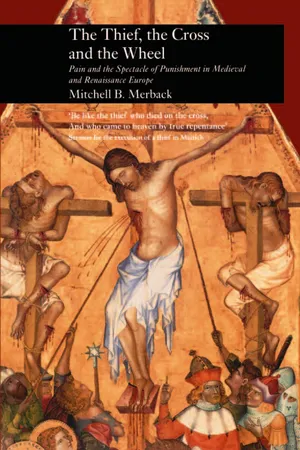 eBook - ePub
The Thief, the Cross and the Wheel
Pain and the Spectacle of Punishment in Medieval and Renaissance Europe
- Mitchell B. Merback(Author)
- 2013(Publication Date)
- Reaktion Books(Publisher)
22Shortly we will return to the central role of the community, where we will see how the forms of spectatorship they collectively enacted went as much beyond passive witnessing as the clergy’s participation in executions went beyond rote sanctification. But first we must address the medieval view of the purpose of punishment, which turns out to be as multiple and mutable as the penalties deployed in the course of justice’s performance.Authors of medieval customaries, or books of common law, generally took it for granted that the provincial authorities who used them would grasp the rationales of criminal prosecution, and even specific capital sanctions, so there is a notable dearth of commentary on these subjects. One exception comes from Anjou, the Coustumez, usaigez et stillez . . . ou pais d’Anjou, written c. 1440. Its author enumerates the purposes of punishment as follows: to pay retribution upon the malefactor, to serve as a deterrent and warning to future transgressors, to eradicate evil from society, and to prevent future evil from afflicting it.23 Which purposes were paramount in the minds of jurists, authorities, clergy and the people respectively?Elemental to ‘the punishment response’ of practically every society that institutes criminal sanctions is retribution, a nice legalistic word meaning revenge.24 Traditionally revenge has functioned to express outrage at transgressions, balance the tipped scales of justice, and restore personal and family honour. Old Germanic law codes (leges barbarorum), heavily preoccupied with honour, left plenty of room for revenge, although they also offered means to adjudicate disputes, including the use of monetary compensations. This prerogative of free, land-owning men (liberates), who were also men of arms, to exact retribution on those who wronged them or their kin was also a touchstone of feudal justice. As one Anglo-Saxon law code put it, the injured party could either ‘buy off the spear or bear it’.25 Up to the high Middle Ages, retribution could alone justify the use of deadly force against enemies and law breakers. But the consolidation of jurisdictions, so critical to the process of state formation, meant that the right of private vengeance, and with it private violence in general, had to be repressed. Increasingly, Europe’s monarchs sought ‘to impress upon their subjects, by whittling away, or even abolishing, the ancient rights of the relatives to compensation, that the State, and not the individual, was responsible for punishing the law breaker’. This was not easily accomplished; as Andrew McCall rightly remarks, ‘the atavistic conviction that a personal injury should in fact be personally avenged would die hard’.26 It can be argued that it never died at all, but was only monopolized by the state and thus repressed elsewhere in the social body. In absolutist political theory transgressions against the sovereign’s laws basically amounted to personal attacks upon the body of the sovereign himself, and only the most exquisite cruelties could avenge it. ‘In every offence,’ writes Michel Foucault, ‘there was a crimen majestatis and in the least criminal a potential regicide.’27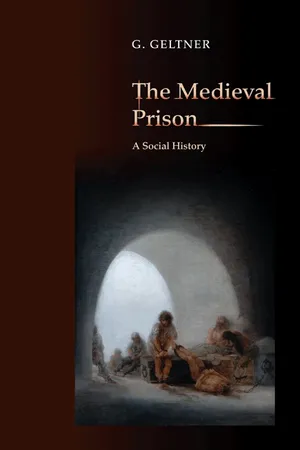 eBook - PDF
The Medieval Prison
A Social History
- G. Geltner(Author)
- 2018(Publication Date)
- Princeton University Press(Publisher)
51 The impact of modern penology, then, was not in devising or applying punitive imprisonment per se, but rather in establishing the measure as the basis of state penal systems and, equally important, as a means to effect culprits’ personal reform. The revised chronology holds true for late medieval Italy, although it would be hard to illustrate these developments solely by recourse to jurisprudential literature. Indeed, both theoretical and prescriptive texts offer a skewed view of penal practices in the period. And while it would be wrong to dub late-medieval lawyers, especially in Italy, as detached or “academic,” 52 it seems that they only gradually came to grips with the use of punitive imprisonment outside ecclesiastical jurisdiction. The literature of medieval jurisprudence—glosses and, later, commentaries on Roman and canon law, individual treatises, ques-tiones , and monographs—is mostly silent on the matter; 53 and when it is not, the pertinent writings exhibit a shared aversion to penal incarcera-tion, in keeping with the ancient dictum by Ulpian (d. 228) that “the prison is meant for the detention of men, not their punishment.” 54 What appears to be a communis opinio among medieval jurists did not stem from ignorance or detachment. Outside Venice imprisonment was not a frequent penalty precociously introduced into local statutes: most inmates were, at least technically, debtors or prisoners awaiting their sentences. Such limited formal recourse to penal incarceration gener-ated no major public or learned debate on the matter, and it is likely that 46 CHAPTER TWO most academic lawyers perceived (or wished to regard) it as a minor, if not altogether temporary, phenomenon: insofar as jurists discussed imprisonment, their focus remained its coercive and administrative aspects.
- Louis Knafla(Author)
- 2006(Publication Date)
- Wilfrid Laurier University Press(Publisher)
As can be seen in Table II, more than 15''' of the penalties in-flicted was that of confinement although most of these cases concerned punishment of a mixed character: confinement combined with p u b l i c cor-poral p u n i s h m e n t or followed by banishment. This also reflects a m i x -ture of traditional and modern ways of dealing with deviants. The pure traditional penalties--public corporal punishment and banishment—accounted for almost half of all penalties in the period 1701-1810. These figures concern 2,750 cases from seven regions and cities in the Dutch R e p u b l i c . The sentence is m i s s i n g in 15?' of this total either because of a lack of archival material or because the charge was dismissed without a formal acquittal. More than 3' 1 ' ended up in official acquittal and 15 were sentenced by default. Of the re-m a i n i n g 67/; h a l f of the penalties were traditional: p u b l i c and corpor-al or banishment. And that is the percentage in Table II. It seems reasonable to omit the sentences passed in the absence of the d e l i n -quent from the calculations; the judge u s u a l l y (but not always) made the easiest choice—banishment. Some of the persons sentenced for breaking the harm were condemned before by default. A sentence made in the absence of thn delinquent was necessary in the event that he/she came back to the city or renion. A general problem concerning the development of the practice of criminal justice d u r i n g the eighteenth century is the influence of humanitarian ideas. The practice of criminal justice should have be-come more humane, moro lenient. Separate from the question as to whether the prison was uc-ed at a l l , an increase d u r i n g the eighteenth century might be supposed to indicate this tendency, w h i c h is more or loss evident in Graphs 1 and II, I say nicrci or less evident because the picture presented by the grauhs can be biasod by the way the fig-ures are c a l c u l c t e d .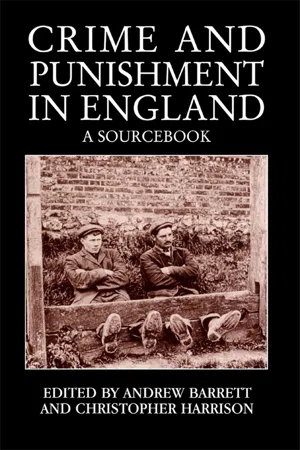 eBook - ePub
Crime and Punishment in England
A Sourcebook
- Andrew Barrett, Chris Harrison(Authors)
- 2005(Publication Date)
- Routledge(Publisher)
Chapter 1 Crime and Punishment in Medieval England
This chapter illustrates some of the basic concepts and practices of English medieval law, in particular the “criminal” law in the counties.1 The origins of the English criminal legal system
“The origin of the criminal law [was] the assumption by the state of the responsibility for avenging personal injuries.”1 What, in the case of England, did this mean in practice? The Anglo-Saxon system of criminal justice was mainly concerned to prevent feuds provoked by violent or serious crime. The system was designed to force the victim or, if he was dead or incapacitated, his family to accept compensation rather than turn to violence. The levels of compensation were established by the kings in consultation with their secular and ecclesiastical counsellors. This initiated some of England’s earliest criminal legislation, as illustrated by these early seventh-century laws of Aethelbert.1.1 Anglo-Saxon Laws
The Laws of Aethelbert2
10. If a man lies with a maiden belonging to the king, he shall pay 50 shillings compensation. 14. If a man lies with a nobleman’s serving maid, he shall pay 12 shillings compensation. 16. If a man lies with a commoner’s serving maid, he shall pay 6 shillings compensation.21. If one man slays another, the ordinary wergeld to be paid as compensation shall be 100 shillings.322. If one man slays another, he shall pay 20 shillings before the grave is closed, and the whole of the wergeld within 40 days. 23. If a homicide departs from the country, his relatives shall pay half the wergeld. 40. If an ear is struck off, 12 shillings compensation shall be paid. 41. If an ear is pierced, 3 shillings compensation shall be paid. 42. If an ear is lacerated, 6 shillings compensation shall be paid. 43. If an eye is knocked out, 50 shillings shall be paid as compensation.
Index pages curate the most relevant extracts from our library of academic textbooks. They’ve been created using an in-house natural language model (NLM), each adding context and meaning to key research topics.

