History

Whitechapel Workhouse
The Whitechapel Workhouse was a Victorian-era institution in London, England, providing housing and employment for the destitute. It was known for its harsh living conditions and strict work requirements, often seen as a symbol of the social issues and poverty prevalent during that time. The workhouse system was a controversial aspect of social welfare in the 19th century.
Written by Perlego with AI-assistance
Related key terms
1 of 5
5 Key excerpts on "Whitechapel Workhouse"
 eBook - ePub
Residential Institutions in Britain, 1725–1970
Inmates and Environments
- Jane Hamlett(Author)
- 2015(Publication Date)
- Routledge(Publisher)
2Tim Hitchcock’s doctoral thesis is still the starting point for those interestedin the early history of London’s workhouses. Green’s recent magisterialPauper Capital (2010) contains the first modern analysis oftheir role in London’s welfare system from the end of the eighteenth century.Other recent work focuses on their contribution to the care of particular socialgroups, such as children, the elderly or the sick.3 The experience of those living in London’s workhouses is likely to havediffered significantly, in some respects, from that of those inhabiting provincialinstitutions.4 London establishments were often much bigger than their counterparts inthe country; they contained an average of 201 inmates in 1776 compared to thenational average of between twenty and fifty.5 Large workhouses required more extensive regulation, were run on heavilybureaucratic lines and wereusually governed and operated by experienced (if not always competent)professionals.6Although towns and cities had long had hospitals, in the eighteenth centuryinstitutional life came to be experienced much more frequently. The wave of newlyfounded voluntary hospitals, asylums and especially workhouses transferred asignificant amount of what had been essentially domestic, household-based activityto a non-familial, institutional setting. It was the London poor, more than anyother social group, who were first to experience this sea-change in livingarrangements. By the end of the eighteenth century, the care of the sick, elderly,lunatic, orphaned and foundlings, together with the relief of the destitute, hadbeen transferred from household to institution in most parts of the capitalcity.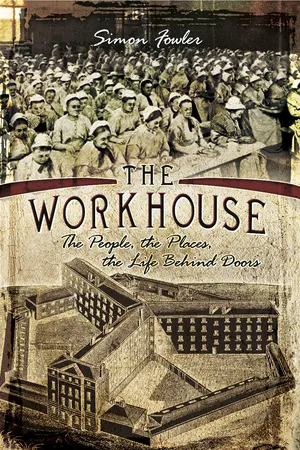 eBook - ePub
The Workhouse
The People, the Places, the Life Behind Doors
- Simon Fowler(Author)
- 2014(Publication Date)
- Pen & Sword History(Publisher)
And yet, for every enlightened union with imaginative Poor Law Guardians and dedicated staff, there were perhaps half-a-dozen places where the guardians were more concerned with keeping the rates low and, perhaps as a result, the staff were unresponsive to the conditions of those in their charge. Most workhouses, of course, fell somewhere between the two. An imaginative and a determined guardian, together with a dedicated master and matron, could make a big difference to the care offered.A significant problem facing the central authorities was that the standard of food and accommodation, let alone the medical care or schooling offered to the children, varied tremendously, even between neighbouring workhouses. The British government had few real powers; officials in Whitehall might argue, persuade and on occasion embarrass but, particularly before the 1870s, they could be – and often were – ignored.Poor Laws and PaupersThe greatest of all the paradoxes associated with the New Poor Law and the workhouse is that the workhouses were largely designed for able-bodied paupers, that is men and women between the ages of 16 and 60, who were judged fit enough to work for their living and therefore, should not require any assistance. There was certainly a huge pool of unemployed and semiemployed men, women and children who were casualties either of the economic downturn following the Napoleonic Wars or radically changing agricultural practices, which required fewer men on the land. Yet, within a decade of the establishment of the national system of workhouses, these people had largely ceased to be a burden on the Poor Law. Most had found work as a result of the ending of the economic depression from the mid- 1840s onwards. The workhouse thereafter became the refuge of the elderly, the sick, orphans and those who were incapable of earning a living.To understand this paradox, we need to look at the origins of the New Poor Law. The Poor Law originated in the dying days of Elizabeth I’s reign, and it remained much the same until the early 1830s. Each parish became responsible for looking after those who were too ill, young or old to work, and the cost of so doing had to be paid for by a tax or rate on the property of the wealthier residents in the parish. Overseers of the poor were elected by the ratepayers each year to administer the system and maintain the accounts. In the more populous parishes, officials were paid to help. eBook - ePub
Pauper Capital
London and the Poor Law, 1790–1870
- David R. Green(Author)
- 2016(Publication Date)
- Routledge(Publisher)
4The iconic significance of these new workhouses was not lost on the working class, particularly outside London. In East Anglia and elsewhere attacks on workhouses and assaults on officers were only the most obvious indication of antipathy towards the new poor law.5 Almost as soon as the new union workhouses were erected they acquired the epithet of bastilles on the grounds that they reflected not only the unjust incarceration of the poor but also the exercise of what many considered was the despotic power of the centrally appointed Poor Law Commissioners to override the wishes of local ratepayers.6 Just as the storming of the Bastille had proved to be a symbolic rallying cry against the French monarchy, so the attacks on workhouses and intimidation of poor law officials in various parts of the country hinted at larger political concerns about representation of the people. Those links were made clear at the huge anti-poor law demonstrations that took place in Yorkshire and other northern counties in 1837 where placards calling for universal suffrage were as prominent as those condemning the new poor law.7In London, however, as the previous chapter demonstrated, opposition was directed less at buildings and officials than the changes associated with the exercise of political power. The iconographic significance of the new poor law workhouse was of less importance there by virtue of the fact that fewer new buildings were constructed. It was also different because of the range of new types of institutions that were built. The close proximity of unions and the relatively large numbers of different categories of pauper meant that economies of scale could be achieved that made it possible to construct separate institutions for each category of pauper rather than having to construct new workhouses. As well as the workhouse itself, county asylums, licensed madhouses, children’s establishments and district schools comprised a system of institutions to deal with the able-bodied, aged, infirm, sick and casual paupers, and also children and lunatics for whom the parish similarly had a responsibility of care. Only the reluctance of guardians to develop shared provision with other districts hindered this possibility. In London, therefore, new workhouse construction was delayed whilst separate types of institution for different categories of pauper were constructed. Both helped diffuse anti-poor law sentiment in the capital by removing the physical reminder of the new relief regime that underpinned working-class resentment elsewhere. Discovering the way in which this range of institutional provision operated is the key, therefore, not just to understanding the pattern of workhouse construction in London but also to explaining the absence of concerted working-class opposition in the capital to the new ‘bastilles’. eBook - ePub
A Caring County?
Social Welfare in Hertfordshire from 1600
- Steven King, Gillian Gear, Steven King, Gillian Gear(Authors)
- 2013(Publication Date)
- Hertfordshire Publications(Publisher)
59 There is no doubt that many of the gentlemen who served on Cheshunt’s workhouse committee took their role seriously. They operated a strict regime, but at no time does this regime appear to have been unnecessarily harsh. In all nine years there was only one case of whipping recorded, that of a runaway boy. Those being admitted were expected to bring their goods with them and to work and abide by the rules; and those who broke them were punished. Stealing and violence resulted in legal action, but these cases seem to have been very rare. Those who behaved well and did their work were rewarded with gratuities and occasional privileges, such as being allowed leave to visit relatives. One old man was allowed extra beer to take with his medicine, and one destitute widowed mother had her pawned goods redeemed by the overseers to enable her to bring them in with her.Cheshunt workhouse acted as a children’s home for the orphaned and abandoned, as a refuge for women in distress and as a care home for the sick and elderly. There was also continuity of regime over this period; the workhouse master and mistress, Richard and Mary Neale, remained in place until August 1762, when Richard Neale’s scandalous behaviour with one of the young female inmates resulted in the couple’s dismissal. Until this time his diligence had been regularly rewarded. The workhouse also provided personal care, medical care and funeral care. In terms of food, clothing and shoes the physical well-being of the inmates seems to have been well catered for. However, on one occasion the committee appeared to be sensitive to the suggestion that their treatment of an elderly inmate was lacking. In March 1755 70-year-old Joseph Starling, one of the few inmates whose words were recorded, described the care he received in the workhouse. When ‘complaint [was] made without Doors that [he] has not proper care taken of him nor proper food for his Disorder he was call’d in said that he had no Complaint to make and that he had every thing Done for him that he desired’. This optimistic reading of the care offered by the poor law echoes recent work (outlined in Chapter 1 by Steven King) that has begun to emphasise the flexibility and often generosity of the Old Poor Law.Notes
1. Although on workhouses see M. Fissell, Patients, power and the poor in eighteenth-century Bristol (Cambridge, 1991); T. Hitchcock, ‘The English workhouse: a study in institutional poor relief in selected counties, 1696–1750’, D.Phil. thesis (Oxford, 1985); T. Hitchcock, ‘Paupers and preachers: the SPCK and the parochial workhouse movement’, in L. Davison et al. (eds), Stilling the grumbling hive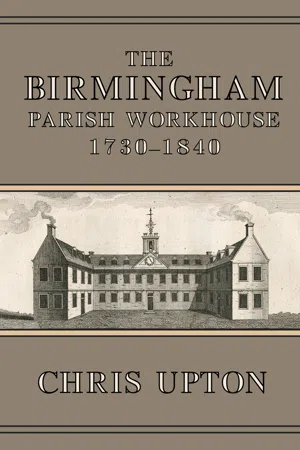 eBook - ePub
- Chris Upton(Author)
- 2019(Publication Date)
- University Of Hertfordshire Press(Publisher)
5 The Ghost of a Workhouse In chapter 2 a rough chronology, admittedly imprecise in some details, was established for the creation of the Birmingham workhouse in Lichfield Street. It is this institution, with its many ups and downs, which will occupy the pages of much of the rest of this book. However, it could also be argued that the erection of the workhouse in 1734 or 1735 marked, not the beginning of a process, but the end of one. The workhouse in Birmingham had a back story – a ghost, as it were – and one with a remarkably long and chequered history. And to uncover that we must take a sideways step from the Poor Law and into the criminal law. Firstly, we need to examine more carefully the provisions of the Elizabethan Poor Act of 1601. The legislation of 43 Elizabeth had set out, in its twenty tightly argued paragraphs, a template for more than two centuries of Poor Law provision. Yet the 1601 Act was itself the culmination of a series of Elizabethan Poor Acts, enacted in 1572, 1576 and 1597, which laid down the terms under which the poor were to be treated across England and Wales. In essence the Act of 43 Elizabeth did little more than combine and streamline those earlier statutes. Both the 1597 and 1601 Acts placed upon the shoulders of parochial overseers and local Justices of the Peace the burden of enacting the legislation. It made the newly established overseers and churchwardens responsible, not only for supporting the poor, but also for ‘setting to work all such persons married or unmarried, having no means to maintain them, or no ordinary and daily trade of life to get their living by’. 1 As for the kind of labour the legislators envisaged, money raised from the ratepayers was, at least in part, to be spent on ‘a convenient stock of flax, hemp, wool, thread, iron, and other necessary ware and stuff to set the poor on work’
Index pages curate the most relevant extracts from our library of academic textbooks. They’ve been created using an in-house natural language model (NLM), each adding context and meaning to key research topics.

