History

Edwin Chadwick
Edwin Chadwick was a 19th-century social reformer known for his work in public health and sanitation. He played a key role in the implementation of the Public Health Act of 1848 in England, which aimed to improve living conditions and reduce the spread of diseases in urban areas. Chadwick's efforts helped pave the way for significant advancements in public health and sanitation practices.
Written by Perlego with AI-assistance
Related key terms
1 of 5

11 Key excerpts on "Edwin Chadwick"
 eBook - ePub
The River Pollution Dilemma in Victorian England
Nuisance Law versus Economic Efficiency
- Leslie Rosenthal(Author)
- 2016(Publication Date)
- Routledge(Publisher)
The Journal of American History , 65 (1978): 389–411.6 Many fine accounts of Chadwick and his work exist: Finer, Life and Times ; Richard A. Lewis, Edwin Chadwick and the Public Health Movement (London: Longmans, 1952); Anthony Brundage, England’s Prussian Minister: Edwin Chadwick and the Politics of Government Growth, 1832–1854 (Pennsylvania: Pennsylvania State University Press, 1988); Christopher Hamlin, Public Health and Social Justice in the Age of Chadwick: Britain 1800–1854 (Cambridge: Cambridge University Press, 1988).7 Finer, Life and Times , 2.8 Tristram Hunt, Building Jerusalem: The Rise and Fall of the Victorian City (London: Phoenix, 2005), 34.9 Anthony S. Wohl, Endangered Lives: Public Health in Victorian Britain (London: J.M. Dent, 1983), 143.10 Some see him as a technocratic social administrator responding to pressure to cut the costs of welfare, see Christopher Hamlin and Sally Sheard, ‘Revolutions in public health: 1848, and 1998?’, British Medical Journal , 317 (1998): 587–91.11 Hamlin, Public Health , 14.12 For which he was widely reviled.13 Edwin Chadwick, Sanitary Report : Report on an Inquiry into the Sanitary Condition of the Labouring Population of Great Britain , Report Of Poor Law Commissioners, Nos. 006, 007, 008, 1842.14 This was to expand two earlier reports to the Poor Law Commission in 1838 on the causes of disease (fever) in London (Poor Law Commissioners, Fourth Annual Report , 1837–38, No. 147; and Poor Law Commissioners, Fifth Annual Report , 1839, No. 239). The whole scheme originated with Chadwick, who had both encouraged the original London fever reports and also encouraged Charles Blomfield, Bishop of London, to make the request to extend these London enquiries to cover the whole country. See Finer, Life and Times , 155–63; and M.W. Flinn, ‘Introduction’ in Report on the Sanitary Conditions of the Labouring Population of Great Britain by Edwin Chadwick, 1842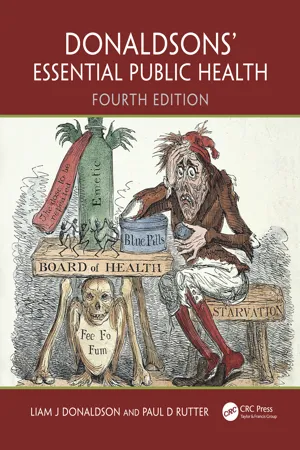 eBook - ePub
- Liam J. Donaldson, Paul Rutter(Authors)
- 2017(Publication Date)
- CRC Press(Publisher)
Lancet called the Board ‘a buccaneering piracy against medicine’. When the epidemic came, the Board’s preventive measures to remove filth had not been carried out in many local areas and the policy of house-to-house visits of cholera victims was largely abandoned by local Boards of Guardians. Chadwick made the disastrous decision to begin in March 1848 to flush out the sewers that drained into the Thames. The practice continued into the summer of 1849. Through this misguided miasmatist decision, he unleashed a waterborne disease on the population of London. Monthly mortality increased from 246 in June to 1952 in July to 4251 in August to 6644 in September. Still, there was no recognition of the true nature of the disease. Following through after the epidemic had passed, the Board of Health renewed its sanitary improvements, the right policy for the wrong reasons. The Board was soon abolished.Chadwick was arguably the most important figure in the sanitary revolution. Fiercely determined, an unremitting advocate for reform, he was able to command and dominate this field of public policy. As his biographer S E Finer wrote, ‘His religion was the public good’. Counterbalancing this ability to upend the status quo of an establishment firmly committed to maintaining it were deep character flaws that tragically became his undoing. Arrogant, egotistical and thin skinned, he was quick to form an opinion that immediately became unshakeable. Finer also said, ‘Although when his mind was open, it was more open than most, it was never open for very long’. Chadwick was pensioned off in 1854 at the age of 54 years. In his long retirement (he died at the age of 90 years), he continued to write, speak, sit on committees and preside over learned societies. Towards the end of his long life, he received many honours in recognition of the enormity of his contribution to public health and the health of the nation.As Chadwick’s influence was removed, the mantle of sanitary reform was taken on by others. Notable among them was Sir John Simon (1816–1904). He had been the first medical officer of health for the city of London. It was his appointment as medical officer to the General Board of Health in 1855 and shortly after as the first medical officer to the Privy Council that made him the country’s first chief medical officer. Essentially, with Chadwick gone, he was the most senior public health figure in the country. Simon’s determination to pursue the sanitary ideal was as strong as Chadwick’s, but he had the ease of manner, the persuasive powers and the ability to work the political system that the former had lacked. He served for 21 years and oversaw the introduction and implementation of public health acts and a strong system of vaccination. In his early reports, he criticized the conditions of the female factory labourer and the difficulty she had in sustaining healthy motherhood. He spoke of ‘Herodian’ districts of the major industrial towns and cities where infant mortality was very high. He broadened and deepened the scope of national public health. Other chief medical officers were to follow, but Simon’s health legacy for the country was immense. eBook - ePub
Victorian Contagion
Risk and Social Control in the Victorian Literary Imagination
- Chung-jen Chen(Author)
- 2019(Publication Date)
- Routledge(Publisher)
Report on the Sanitary Condition , his personal faith in state medicine became the guiding principle of British public health policy. After that, the national campaigns for sanitary improvements became inescapable. The drive to construct drains and sewers in order to fight dirt and diseases not only raised mass awareness of these problems but also gave leaders of public health campaigns considerable political power. Under Chadwick’s leadership during the 1840s, the Poor Law Commission and the General Board of Health launched a localist approach toward eradicating all dirt, filth, and stench in the physical environment. At the core of these public health campaigns was a “totalizing worldview” and a central source of authority—that is, Chadwick himself.The Public Health Act of 1848 marked the peak of influence for miasma theory in the crafting of public legislation that demanded the power “to change the habits of the sensual, the vicious, the intemperate” and “to provide cleanly and comfortable dwellings for all classes in community.”124 The law established the General Board of Health, a central public health authority that would ensure that local boards of health upheld the correct hygienic standards. Chadwick had long called for such a central health authority, and he was named as one of its original three members. The Board was authorized to whitewash urban spaces and to require the formation of local boards of health “if petitioned by 10 percent of the local ratepayers or if the locality’s death rate exceeded 23 per 1000” (the national average was 21 per 1,000).125 Even though most of the Board’s powers were “advisory” instead of “compulsory,” they nevertheless succeeded in pushing through a panoply of sanitary regulations.126 eBook - ePub
- Denis Smith(Author)
- 2017(Publication Date)
- Routledge(Publisher)
12Edwin Chadwick and the engineers, 1842-1854: systems and antisystems in the pipe-and-brick sewers war Christopher HamlinTo the English sanitary reformer Edwin Chadwick, author of the famous Report of an Inquiry into the Sanitary Condition of the Labouring Population of Great Britain (1842), goes credit for recognizing the central importance of public works—waterworks, sewers, better-ventilated streets and houses—to public health. Chadwick’s career as a public health official lasted only from 1848 to 1854, yet his influence was great. In a broad sense, the administrative structures, the sanitary sensibilities, and the technologies (e.g., indoor running water and water closets) he developed or endorsed were adopted, and on great scale: by 1905, local authority debt in England and Wales for waterworks and sewers was nearly one hundred million pounds.1One might think engineers would have aligned themselves with Chadwick’s programs—he brought them business. In fact, however, Chadwick’s relations with engineers were wretched. For Chadwick, mid-century British civil engineers were part of the problems, not the solutions. He saw them as both loyal to a primitive laissez-faire and in cahoots with the most corrupt and irrational institutions of local government: the ancient municipal corporations, sewers commissions, and navigation trusts. He represented their works as hyperexpensive, uninformed by science, even dangerous. Worse, they clung to obsolete doctrines and rejected truths from outsiders. Historians, even those critical of Chadwick, have shared this view. They have seen engineers as key actors in Chadwick’s downfall, collaborating with tightfisted politicians to block needed improvement.2At the center of Chadwick’s troubles with engineers is an obscure technical controversy over sewer design, the “pipe-and-brick” sewers war of 1852-54. On one side were Chadwick and a handful of marginal engineers who advocated a novel system of small-bore pipe sewers; on the other, prominent members of the Institution of Civil Engineers, notably Thomas Hawksley, a leading water engineer, and Joseph Bazalgette, later builder of London’s main drainage, who opposed this novelty.3 eBook - PDF
Public Health and Politics in the Age of Reform
Cholera, the State and the Royal Navy in Victorian Britain
- David McLean(Author)
- 2005(Publication Date)
- I.B. Tauris(Publisher)
Chadwick’s real rise to prominence came in 1842 with the appearance of his Report on the Sanitary Condition of the Labouring Population of Great Britain . It was a monumental study in which the author broadened his case for the role of the state as the arbiter of public health, using both scientific data and the accounts of scores of medical officers extracted from Poor Law reports. The 1842 Report sold over 100,000 copies. Drains, sewers, dirt and disease were henceforth not only matters of public awareness but rising higher on the political agenda. It was a milestone in the history of public health in Britain. Chadwick followed this with a report on the highly emotive issue of interments and burial practices in 1843. Even Chadwick’s admirers conceded that he was a difficult man with whom to work. Tactless, high-handed, uncompromising and self-opinionated, he was also easy prey for opponents, both in Whitehall and in the provinces, who resented his centralising inclinations. But by 1847 a momentum for public health provision had been achieved and Chadwick had extended his expertise further to the Health of Towns Royal Commission, the reports of which he largely wrote and produced in 1844 and 1845. Pressure for sanatory improvement in Britain was also stimulated at grassroots level by the Health of Towns Association, founded in London in December 1844 but within three years with 8 . Public Health and Politics in the Age of Reform thirteen branches in most major urban centres. 10 Though a purely voluntary movement, the Health of Towns Association brought together clergy, medical experts and local and even national political figures and it did much in the mid-1840s to disseminate knowledge and to educate public opinion at large on the relationship between squalor and disease. eBook - PDF
The Origins of the British Welfare State
Society, State and Social Welfare in England and Wales, 1800-1945
- Bernard Harris(Author)
- 2018(Publication Date)
- Red Globe Press(Publisher)
Chadwick was simply voicing a common attitude of mind when he commented “how much of rebellion, of moral depravity and of crime has its root in physical disorder and depravity … The fever nests and seats of physical depravity are also the seats of moral depravity, disorder and crime”.’ 18 PUBLIC HEALTH IN THE 19TH CENTURY 107 Although the Sanitary report provided a devastating critique of existing sani-tary arrangements, there were still a large number of technical questions which needed to be addressed before legislation could be introduced, and in 1843 the Home Secretary, Sir James Graham, appointed a Royal Commission to investi-gate these issues as part of its enquiry into the state of large towns and populous districts. 19 During the next two years, the Commission surveyed the existing state of sanitary legislation and interviewed 65 expert witnesses, including Thomas Hawksley, the Engineer for the Trent Waterworks Company in Nottingham, on such issues as the supply of pure water to all houses, the disposal of urban refuse, the reduction of overcrowding, and the regulation of common lodging houses. The Commission endorsed Chadwick’s calls for the creation of some kind of central body to supervise the activities of local authorities, and said that the pow-ers of these authorities should be expanded, and their boundaries extended so that they would correspond with the natural areas for drainage. It also recom-mended that the responsibility for all matters relating to public health, namely drainage, paving, cleansing and the provision of an ample water supply, should be vested in a single local authority body, and that Parliament should frame national regulations for the construction of new buildings, the width of streets, and the inspection and control of common lodging houses. eBook - PDF
Managing the Environment, Managing Ourselves
A History of American Environmental Policy, Second Edition
- Richard N. L. Andrews(Author)
- 2008(Publication Date)
- Yale University Press(Publisher)
Particularly important for English and American policies was the work of Jeremy Bentham and his Philosophical Radicals, who advocated addressing all public problems on a rational scientific basis and called for fundamental reforms including free trade, birth control, legal and parliamentary reform, and educational reform. The legacy of these ideas remains an important current in American environmental policy today (Winslow 1923; Rosen 1958, 131–37, 192–201). The sanitary reform movement began in England in the 1830s, prompted by reform of England’s Poor Laws. Edwin Chadwick, secretary of the Poor Law Commission and an ardent Benthamite, commissioned a systematic survey of the sanitary conditions of the urban poor and of preventable causes of their sicknesses, arguing that the cost of disease prevention could be shown to be less than the costs of widespread disease. The resulting 114 Public Health and Urban Sanitation three-volume report, published in 1842 under the title The Sanitary Condition of the Labour-ing Population of England, o√ered a compelling case that high incidence of disease and mortality was related to the filthy environmental conditions to which the urban poor were subjected: lack of ventilation and drainage, lack of safe water supplies, and lack of means to remove refuse regularly from houses and streets (Rosen 1958, 192–216). It led eventually to passage in 1848 of Britain’s Public Health Act, which charged the government with responsibility for safeguarding the health of its population (Okun 1996, 453). The Chadwick Report is generally recognized as the most important document in the history of the public health movement (Winslow 1923; Barnes 1935, 451–53; Rosen 1958, 214). Its underlying theory of disease causation was later proven incorrect: Chadwick, like many in his day, believed that disease was caused not by contagion but by ‘‘miasmas,’’ the foul gases arising from poor drainage and stagnant wastes. eBook - ePub
- S. E. Finer(Author)
- 2016(Publication Date)
- Routledge(Publisher)
For the Institute examined its candidates in such matters as The Elements of Sanitary Science, Sanitary Construction, and The Law of Public Health; and it did this under the auspices of the veterans of the First Board of Health. As Vice-Presidents of the Institute, there were not only the new allies like Douglas Galton, Sir B. W. Richardson, and Sir John Lubbock, but the ' Band'—Shaftesbury and Rawlinson, William Farr and Earl Fortescue, and of course, Edwin Chadwick himself. He was now the Grand Old Man, the ' father of the sanitary idea '. Each Congress of the Institute was a personal triumph. ' Edwin Chadwick though not a civil engineer has done more to found and promote the true principles of town sewerage than any other individual in this generation', said Rawlinson. ' It is to him ', said another member, ' that we owe, more than to any one else, that sanitary awakening which has now become so general and so widespread '. Fortescue 1 demanded that he be knighted. Similar tributes were paid him, now before the British Medical Association, now at the banquet of the Association of Sanitary Inspectors. His name began to appear more and more frequently in the public magazines. In 1887, for the first time, a collected rèsumè of his work was put before the public in the ' Health of Nations ', edited by his adulator Sir B. W. Richardson eBook - PDF
The Development of Modern Medicine
An Interpretation of the Social and Scientific Factors Involved
- Richard Harrison Shryock(Author)
- 2017(Publication Date)
81 In some cases medical investigators cooperated effectively 2» Hutchins, op. cit., p. 58. The Poor Law Act of 18)4, of course, had itself possessed public health significance. See Sir Allen Powell, The Relation of Public Assistance to Public Health, Amer. Jour. Pub. Health, X X I (1931). 1315 ft-8° Report on an Inquiry into the Sanitary Condition of the Labouring Pop-ulation of Great Britain (Lon., 1842). The English narrative history can best be followed in Sir John Simon, English Sanitary Institutions (Lon., 1897), pp. 183 ff. 31 Amer. Med. Assn. Trans., I (1848), 305-310. PUBLIC H E A L T H M O V E M E N T 219 with lay reformers. T h u s the reports of the English poor law doctors were directed and interpreted by the great lay sani-tarian, Edwin Chadwick. In like manner a public health survey of Massachusetts made in 1850—in some ways the most complete study of the period—was inaugurated in part by the Massachusetts Medical Society, but was carried out by the layman, Lemuel Shattuck. 32 Such lay sanitarians as Chadwick and Shattuck viewed their work in a manner quite as scientific as that of the physicians, although their approach was usually a mathe-matical rather than a medical one. T h u s Chadwick, influ-enced by Bentham and his humane utilitarianism, became interested in health conditions through a study of benefit societies among English workingmen. 33 In the course of this work, he noted the difficulties experienced in securing mor-tality data necessary to voluntary insurance projects. This led him into a study of vital statistics, which in turn drew his attention to the general field of public hygiene. 34 Shat-tuck, a school teacher, became interested in vital statistics in the course of writing a history of the town of Concord. He later made statistical and sanitary studies of Boston, Law-rence, and Lynn. eBook - PDF
Novel Possibilities
Fiction and the Formation of Early Victorian Culture
- Joseph W. Childers(Author)
- 2015(Publication Date)
- University of Pennsylvania Press(Publisher)
By the early 18405 the social force of novels was well remarked; and as the novel established itself as a significant interpretive enterprise, it drew an increasing number of admirers who a few years before would not have admitted to reading novels, to say nothing of acknowledging their potential as instruments of social change. One of these admirers was the prominent social reformer Edwin Chad-wick, co-author of the notorious Poor Law Report of 1834, secretary of the Poor Law Commission that was established as a result of that report, and, arguably, Britain's first professional bureaucrat. Upon completing his fa-mous Report on the Sanitary Condition of the Labouring Population of Great Britain^ Chadwick not surprisingly attempted a communique to perhaps 72 The Sanitary Condition Report the most powerful literary man in England, and certainly the most visible, Charles Dickens. And though his message was sent through Dickens's brother-in-law, reformer and Utilitarian Henry Austin, clearly Chadwick's attempt to reach Dickens and ascertain his state of mind on the issue of sanitation—and the Irish—is a bid to establish a link with one he believes to be like himself—one who sees clearly and represents what he sees in ways calculated to instigate change. Thus in the September 1842 letter to Austin he writes: I think Mr Hickson mentioned to me that Mr Dickens is your brother-in-law. I perceive it announced in the newspapers that he has in preparation notes of his tour in North America. ... I have directed a copy of the [Sanitary Con-dition] report to be sent to you and I should be obliged to you if you would present it to him as a mark of my respect .... eBook - ePub
Body and Mind
Historical Essays in Honour of F.B. Smith
- Pat Jalland, Graeme Davison, Wilfrid Prest(Authors)
- 2009(Publication Date)
- MUP Academic Digital(Publisher)
2Politics and Public Health in the Age of Lord Palmerston
M. J. D. RobertsLord Palmerston is not widely recognised as a sanitary reformer, rather the reverse. Two relatively well-known ‘sanitary facts’ have combined to ensure this. The first is the fact that it was under Palmerston’s stewardship of the Home Office that the pioneer sanitary reformer, Edwin Chadwick, was driven from office by his opponents, never to return to state employment. (He tendered his resignation to Palmerston in July 1854 in the hope that this would help to preserve the General Board of Health of which he had been a commissioner since its foundation in 1848.) The second is the fact that the period following Chadwick’s dismissal was a period of considerable political frustration in moves to find a stable structure of public health administration in Britain—a period redeemed in the eyes of most public health historians only by the heroic improvisation and experimentation of the government’s professional medical advisers, most notably John Simon (medical officer to the General Board of Health, 1855–59; medical officer to the Privy Council, 1859–71). Indeed, so far as ‘the age of Palmerston’ has a reputation in the history of sanitary reform, it is a reputation based on the rise of the professionally qualified civil servant as compensation for the ignorance, lack of determination, and apathy of political elites.1It is the purpose of the exploration which follows to reassess this pivotal period in public health history—not necessarily in the hope of rehabilitating a minor aspect of Lord Palmerston’s historical reputation, but rather in the hope of finding in the evidence of the relationship between professional and political elites some understanding of the ‘cultural politics’ of public health reform at mid-century. In this task I have been assisted by the work of historians who have relatively recently begun the work of reappraising the rise of the sanitary science expert as something more than the dissipation of public ignorance by the professionally qualified. The aim here is to take the approach a stage further and to explore what may be found when the emergence of agendas of public action is taken to be inherently ‘problematic’ and necessarily ‘political’.2 This will be attempted by three linked case studies: first, by an appraisal of the part played by politicians in securing the cultural and institutional foundation on which sanitary reformers might build in order to assert a politically effective claim to public authority; second by an exploration of the meanings and implications of the status of the ‘professional’ in mid-Victorian public life; and third, by a demonstration of the way in which mid-Victorians sought to reconcile respect for professional expertise with continuing aspirations to self-manage-ment, both individual and communal.3
Index pages curate the most relevant extracts from our library of academic textbooks. They’ve been created using an in-house natural language model (NLM), each adding context and meaning to key research topics.
