History

Sheppard Towner Act
The Sheppard Towner Act, passed in 1921, was the first federal legislation in the United States to provide funding for maternal and child health programs. It aimed to reduce high infant and maternal mortality rates by supporting education and healthcare services for mothers and children. The act marked a significant step in recognizing the importance of public health initiatives for women and children.
Written by Perlego with AI-assistance
Related key terms
1 of 5

6 Key excerpts on "Sheppard Towner Act"
 eBook - ePub
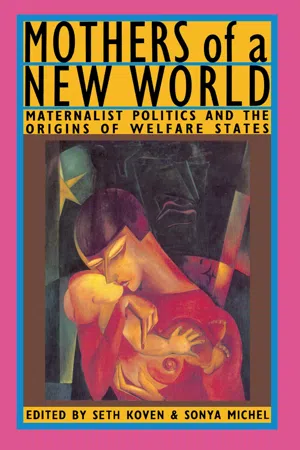
Mothers of a New World
Maternalist Politics and the Origins of Welfare States
- Seth Koven, Sonya Michel(Authors)
- 2013(Publication Date)
- Routledge(Publisher)
9 “My Work Came Out of Agony and Grief”: Mothers and the Making of the Sheppard-Towner Act Molly Ladd-Taylor DOI: 10.4324/9781315021164-9Several months after the 1921 Sheppard-Towner Maternity and Infancy Protection Act was passed, an Alabama mother wrote the federal Children's Bureau to inquire if the stories about the bill's provisions were true. "If so I sure am glad," she wrote. "I do hope it will help us Poor Country people who need help. We live on a farm and have very hard work to do. I am 27 yrs. old and have Five Little one's to Care for besides my husband an[d] his Father."1 Many other working-class and farm mothers wrote similar letters asking the government for help with child care and expressing hope that the "maternity bill" would improve their health and make their work easier. Indeed, the Sheppard-Towner Act was the product of an unusual alliance between grass-roots mothers, club women, and Children's Bureau officials. Children's Bureau chief Julia Lathrop learned from her correspondence and personal contacts with poor women about their ill health and suffering, and she designed the Maternity and Infancy Act, which provided education for pregnant women and new mothers, with their needs and requests in mind. Grass-roots mothers thus played an important if indirect role in the creation of one of the earliest United States social-welfare measures.Scholars of women's role in the formation of American maternal-and child-welfare policy have stressed the interaction between women's voluntary associations and female reformers in government.2 However, we know less about the part women clients played in policy formation. The extensive correspondence between grass-roots mothers and the federal Children's Bureau staff makes the Sheppard-Towner Act a promising starting point for investigation. The Children's Bureau correspondence shows that public maternal- and child-health services were not simply imposed by middle-class maternalists on an unwilling (or even willing) population. Sheppard-Towner grew partly out of what one historian called a "powerful if unsteady pressure" from poor and working-class women who struggled with the arduous work of reproduction and caregiving and sought more control over their health and working lives.3 eBook - PDF
Responsive States
Federalism and American Public Policy
- Andrew Karch, Shanna Rose(Authors)
- 2019(Publication Date)
- Cambridge University Press(Publisher)
the origins and enactment of the sheppard–towner act The Sheppard–Towner Act can be traced to intellectual and cultural shifts that began in the latter half of the nineteenth century. Rapid advances in medicine and the creation of state and local health departments drew heightened attention to issues of maternal and child health (Schmidt 1973, 419). Social settlement reformers, female professionals, and others developed a “feminine vision of public preventive health care” that legitimated government activity in this policy arena by drawing upon the cultural resources of the “separate sphere” of nineteenth-century American women (Skocpol 1992, 511; see also Rothman 1978). Their wide-ranging efforts had many important consequences, but the creation of a federal Children’s Bureau in 1912 was especially significant. One of its earliest activities was the collection of systematic data on infant and maternal mortality, and the bureau found that rates in the United States were worse than those in many other countries. 1 In 1917 Children’s Bureau Director Julia Lathrop recommended that Congress establish a federal-state matching grant program with the goal of improving child and maternal health. This recommendation launched the 1 For more on the creation and early activities of the federal Children’s Bureau see Lemons (1990), Lindenmeyer (1997), Meckel (1990), Rothman (1978), and Skocpol (1992). In 2012, the agency produced an e-book called The Story of the Children’s Bureau: 100 Years of Serving Our Nation’s Children and Families that also discusses the origins and early years of the bureau. http://cb100 .acf.hhs.gov/CB_ebrochure. Date of access: August 29, 2016. The Origins and Enactment of Sheppard–Towner 59 congressional struggle that eventually led to the passage of the Sheppard– Towner Act. Representative Jeannette Rankin (R-MT) introduced legislation based on the bureau’s recommendation a year later.
- Jan Wilson(Author)
- 2010(Publication Date)
- University of Illinois Press(Publisher)
In recent years, De Normandie observed, Congress had passed nine national acts embodying the principle of federal aid to the states in conditions affecting the public welfare; yet only one of these—the Sheppard-Towner Act—had earned the criticism of the AMA, whose members were doing their best to convince physicians and the public that the act was a dangerous and socialistic piece of legislation. Such a claim was illogical, De Normandie argued, for the act merely provided funds to the states for maternity and infancy programs created and administered by state and local officials and trained doctors and nurses under the supervision of the federal Board of Maternal and Infant Hygiene. One of the most positive benefits of these programs, he noted, was the improvement of obstetrical conditions in local hospitals and maternity centers, as well as a growing awareness among expectant mothers of the need for proper prenatal care. “If the medical profession had accepted the act in the spirit in which it was put forth,” he concluded, “greater evidence of good would be present today.” 29 While the members of the WJCC and their allies struggled to defend the maternity act from the charges of its opponents, the Sheppard-Towner subcommittee carried on its lobby for the extension bill in Congress. After several interviews with the bill’s congressional supporters, subcommittee members agreed that Morris Sheppard would serve as the best champion of the measure in the Senate. Sheppard not only had authored and supported the original maternity act in 1921 but had also been an early advocate of the extension bill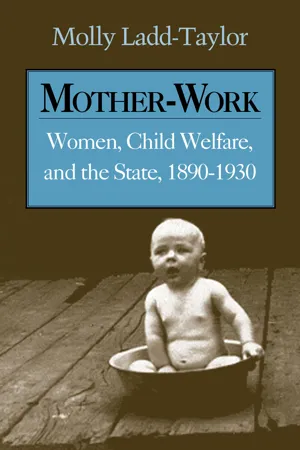 eBook - ePub
Mother-Work
Women, Child Welfare, and the State, 1890-1930
- Molly Ladd-Taylor(Author)
- 2022(Publication Date)
- University of Illinois Press(Publisher)
Although twenty-one states tried to continue maternity and infancy work after Sheppard-Towner was repealed, the removal of federal funds reduced public support for the program. “In other words,” observed the Children’s Bureau, “the participation of the Federal Government contributed something else as important as money.” The financial constraints of the Depression forced some states to drop maternity and infancy work entirely, making health care once again unavailable to women who could not afford private physicians or who lived in remote areas—the women who benefited most from the Maternity and Infancy Act. Federal monies for maternal and infant care were restored under the 1935 Social Security Act, but maternal and child health services were no longer considered an entitlement for women of all classes. Instead, they were needs-based and limited to the poor. 63 Maternalists lost their battle to dignify motherhood and make children’s welfare a societal concern, but their campaign for the state protection of mothers and children left a permanent mark on women’s work of reproduction and caregiving and on the future welfare state. The Sheppard-Towner Act eased the burden of countless mothers by improving the health of their children, and it served as a bridge between Progressive-era maternalism and public welfare expansion during the New Deal. Yet, like maternalism itself, it left an ambiguous legacy. Sheppard-Towner expanded employment opportunities for professional women while leaving women’s responsibility for child care unquestioned. It extended some health services to women and children of color, but demanded that they follow Anglo-American prescriptions about childrearing and medicine. It created a women-controlled public health system and mobilized thousands of women activists to help run it, but set up a public health bureaucracy that eventually supplanted them No longer available |Learn more
Maternalism Reconsidered
Motherhood, Welfare and Social Policy in the Twentieth Century
- Marian van der Klein, Rebecca Jo Plant, Nichole Sanders, Lori R. Weintrob, Marian van der Klein, Rebecca Jo Plant, Nichole Sanders, Lori R. Weintrob(Authors)
- 2012(Publication Date)
- Berghahn Books(Publisher)
Skocpol shows how and why the women’s movement in the United States managed to achieve so much more with its campaign for the interests of mothers and children than did the labour movement, which campaigned for social insurance for workers. The concerted efforts of the General Federation of Women’s Clubs, the National Congress of Mothers and the Women’s Christian Temperance Union – all middle-class women’s organizations – resulted in the establishment of mothers’ pensions in numerous states (1911–13), the founding of the Children’s Bureau (1912) and the passage of the Sheppard-Towner Act (1921). The mothers’ pensions were state-controlled, regular benefits for impoverished – often widowed – mothers with dependent children. The Children’s Bureau was financed by the federal government. It registered as many births as possible, as well as the socioeconomic situation of the mother and child. The aim was to improve maternal and child health and to reduce infant mortality in the United States, which was quite high compared to other industrialized nations. The Bureau, run by well-educated and reform-minded women, in turn successfully lobbied for the Sheppard-Towner Infancy and Maternity Protection Act. This federal law required states to provide expectant mothers with health information and support from professionally trained nurses.Skocpol states that the American women’s movement in the early twentieth century was a maternalist movement, though she does not precisely define the term. This maternalist women’s movement managed to capitalize on the opportunities that the middle-class doctrine of the separate spheres offered women at a time when they still lacked the right to vote. Women’s responsibility for the domestic domain formed the basis of their success in obtaining social and political power in the public domain. eBook - PDF
- David J. Rothman, Stanton Wheeler, David J. Rothman, Stanton Wheeler(Authors)
- 2013(Publication Date)
- Academic Press(Publisher)
These judgments came to the fore as the specialists in the late 1920s, for all the shift in Children's Bureau views, threw their weight against the continuation of the Sheppard-Towner program. They pervaded, for example, the testimony of Dr. George Kosmak, a prominent obstetrician active in the New York Academy of Medicine. Kosmak defined preg-nancy as a medical problem and therefore objected to a strictly medi-cal problem being turned over to lay organizations for a solution. 43 The proper and the best method for reducing maternal mortality was to improve the training and facilities of obstetricians. Kosmak did not in-tend to eliminate the role of government in reducing maternal mortality but to alter it. He told the House of Representatives committee hearings on extending Sheppard-Towner that he was not opposed to the federal government participating in any movement to improve the care of preg-nant women and their offspring; rather, he believed these patients would be best served through federal support of medical training and research. 44 Pregnant women, he argued, died primarily from sepsis in-fection and the toxemias of pregnancy. By understanding the etiology of these infections, which originated in individual pathology and not in 42 U.S., Children's Bureau, Bulletin, No. 154, Standards for Physicians Conducting Confer-ences in Child Health Centers, p. 5. There is evidence to suggest that the number of infants bottle-fed rose just this time. See New York City Department of Health, Annual Report, 1925, pp. 76-77. 43 U.S., Congress, House of Representatives, Committee on Interstate and Foreign Commerce, Child Welfare Extention Service, 70th Cong., 2d sess., 1929, p. 126. I have not gone into detail on the efforts of the Children's Bureau to keep the program going. They did point to a reduction in infant mortality over the decade they had served the cause.
Index pages curate the most relevant extracts from our library of academic textbooks. They’ve been created using an in-house natural language model (NLM), each adding context and meaning to key research topics.

