History

Tenement Housing
Tenement housing refers to multi-occupancy buildings, typically in urban areas, that were historically known for their overcrowded and unsanitary living conditions. These buildings often housed low-income families and immigrants, and were characterized by poor ventilation, inadequate sanitation, and limited access to natural light. Tenement housing played a significant role in shaping urban living conditions and housing policies in the late 19th and early 20th centuries.
Written by Perlego with AI-assistance
Related key terms
1 of 5

12 Key excerpts on "Tenement Housing"
 eBook - PDF
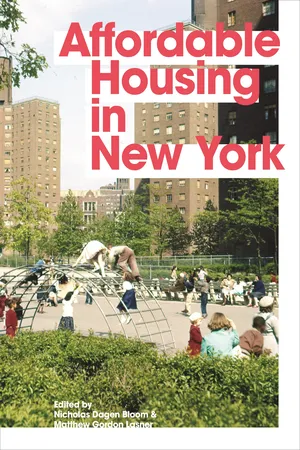
Affordable Housing in New York
The People, Places, and Policies That Transformed a City
- Nicholas Dagen Bloom, Matthew Gordon Lasner, Nicholas Dagen Bloom, Matthew Gordon Lasner(Authors)
- 2019(Publication Date)
- Princeton University Press(Publisher)
16 In common parlance, however, a tenement came to be understood as a speculatively built, multiple dwelling for the poor, set on a narrow lot, housing many families with little light and air and few of the amenities, such as running water, gas, and private toilets (fig. 1.7). The form that tenements took and the character of the city’s tenement neighbor-hoods was determined by a variety of factors, including the limited size and nar-row dimensions of typical New York City lots, the desire of speculative builders to maximize profits, the succession of laws that regulated the size and shape of build-ings, and the extraordinary influx of poor European immigrants to New York willing to abide poor conditions, at least briefly upon arrival. 17 As poor immigrants began flooding into New York in the 1830s, older single-family row houses were subdivided for six or more households. Owners soon realized that they could make even more money by replacing houses with purpose-built structures containing twenty or more apartments. The result was the beginning of the tenement as a housing type. By the 1860s neighborhoods closest to the commercial center of Lower Manhattan, notably the Lower East Side, were being transformed by such buildings. As the Citizens’ Council of the City of New York noted in 1866 in the first report to examine hous-ing conditions in the city, for the poor and working class, “a degree of crowding has been attained which by itself has become a subject of sanitary inquiry and public concern.” 18 Conditions were exacerbated in the late 1860s and 1870s by the construc-tion of scores of new tenements each year, not only on the Lower East Side but in 1.7: Tenements model, Tenement House Exhibition, 1900 46 Greenwich Village, on the blocks close to the East River as far north as East Harlem and along the Hudson River up to Columbus Circle. German and Irish immigrants built large numbers of these early tenements.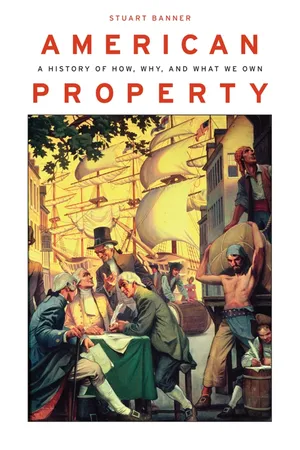 eBook - PDF
American Property
A History of How, Why, and What We Own
- Stuart Banner(Author)
- 2011(Publication Date)
- Harvard University Press(Publisher)
8 By the 1850s, however, the word was largely reserved for the new multifamily rental housing sprouting up in the working-class neighbor-hoods of the nation’s largest cities, especially New York. More than half a million New Yorkers lived in tenements by 1864. 9 The tenements were often crowded and unsanitary. A committee of the state legislature inspecting them in 1856 found some with residents packed “like sheep into pens,” with as many as ten people sharing a sin-gle small room. “Next to Intemperance and Licentiousness,” worried the New York Times, “the greatest curse to the lowest class of New- York is, the houses they dwell in.” The problem, as well-intentioned reformers would insist for decades, was not just the material conditions created by high housing prices. There was also something immoral about having to share 166 American Property a home with others. “The truth is, not even a virtuous and industrious family could long preserve its chastity and good character in company with three other virtuous families, in a room 15 feet by 18. Men are not made to live so near to each other,” the Times lectured. eBook - PDF
From Tenements to the Taylor Homes
In Search of an Urban Housing Policy in Twentieth-Century America
- John F. Bauman, Roger Biles, Kristin M. Szylvian, John F. Bauman, Roger Biles, Kristin M. Szylvian(Authors)
- 2000(Publication Date)
- Penn State University Press(Publisher)
By the 1850s in New York and Philadelphia, tenement houses-defined as resi- dential buildings where three or more families cooked and slept on the prem- ises-had become a commonplace habitation of the working poor. Families crammed every inch of formerly one-family dwellings, including cellars and jenybuilt courtyard or back alley additions. Moreover, as early as the 1830s in New York's Lower East Side, a new specialized multifamily dwelling unit arose tailored to exploit the crush of new immigration. Flimsily constructed three- and four-story "railroad flats," plagued with internal, windowless, closet-sized sleeping rooms, were jammed onto twenty-five-by-one-hundred-foot lots and housed twelve to twenty-four families. An 1865 report titled "Sanitary Condi- tions in New York described 500,000 New Yorkers living in such tenements." Not all cities endured the same congested housing conditions: In 1845, investi- gators in Boston found less than one-fourth of workers living in tenements. Nevertheless, many cellar dwellings, alley housing, and other unsanitary condi- tions rendered the housing of the working classes there wretched.'* The Birth of Urban Reform The war against these urban slums began early, in the 1830s, led by both evan- gelical Christians and "sanitarians," early apostles of the importance of public health. Nineteenth-century philanthropists and social reformers identified slum I conditions with slum dwellers and distinguished between the undeserving poor, whose sloth, intemperance, immorality, and other sinful behaviors condemned them by their own action to a wretched existence, and the deserving poor, widows and orphans not responsible for their poverty. Influenced by English social theorists such as Adam Smith, William Cobbett, and Thomas Malthus, Americans generally subscribed to the idea that materially helping undeserving poor people encouraged indolence and improvidence. eBook - ePub
- Sir Percy Alden(Author)
- 2016(Publication Date)
- Routledge(Publisher)
Chapter III The Housing of the CitizenI am certain that I speak the truth, and a truth which can be confirmed by all experienced persons —clergy , medical men, and all who are conversant with the working class —that until their housing conditions are Christianized all hope of moral or social improvement is utterly in vain.LORD SHAFTESBURYCLEARLY linked with the question of health, whether of the child or the adult, is the problem of the proper housing of the people and especially of the working classes. During the last fifty years, a great change has come over the feeling of the nation with regard to this urgent problem. We have deliberately set ourselves to the work of rehousing our citizens. One of the many perplexities of the modern State is the unequal growth of the population and especially the population of the town. This question of the unequal distribution whether of people or of wealth, like the "black care" of the Roman poet, is always with us. We are constantly discovering that less than we want is more than we will ever have. The industrial revolution caused a rush to the town and the urban population increased at the expense of the country. This marked exodus from the country districts made it necessary both for the local authority and for the Government to take steps to counteract the centripetal force which attracted men to the city and incidentally compelled them to live in overcrowded conditions. The result was that large towns became unwieldy. The original cottages and tenement houses inhabited by a forgotten people were allowed to remain and became derelict, while new houses and cottages, built at a time when housing regulations and by-laws were almost unknown, were erected 40 or 50 to the acre with inadequate air space, insufficient sanitary accommodation, and in many cases were shoddily constructed. In fact you hardly dared take down the scaffolding until the walls had been papered.Not so the houses of the middle classes or the rich. The real problem is, of course, the housing of the working classes, the millions of people who cannot do without shelter even if the rent which they pay is far too great a drain upon their weekly earnings. It is unfortunate that, as a result of the factory system and the introduction of machinery, no sufficient effort was made to assimilate the populations that poured into the urban areas. There was no planned attempt to supply proper housing accommodation and the result was that the worst forms of jerry-building were pardoned or condoned because of the necessity for more houses. This housing problem has not been seriously dealt with until the last two decades. It will explain many of the evils which have sprung from insanitary accommodation, evils that are cumulative and doubtless account for much of the disease and the ill-health that our medical officers are trying to overcome. eBook - PDF
Landlord and Tenant Law
Past, Present and Future
- Susan Bright(Author)
- 2006(Publication Date)
- Hart Publishing(Publisher)
11 The classic histories are: R Lubove, The Progressives and the Slums: Tenement House Reform in New York City 1890–1917 , 2 nd edn, (Westport, CT, Greenwood, 1962); and S Andrachek, ‘Housing in the United States: 1890–1929’ in G Fish, (ed), The Story of Housing (New York, NY, Macmillan, 1979). enactments, which required that buildings be constructed with fire escapes and windows in each room, lacked enforcement mechanisms, and, there-fore, only had marginal impacts. By the end of the century, widespread dis-cussion arose about housing conditions in New York City. The publication of Jacob Riis’ ‘ How the Other Half Lives ’ in 1890, generated widespread discussion of tenement house districts. In response to Riis’ work, as well as scandals arising from ownership of large numbers of tenement houses by the Trinity Church, a major institution with many famous members, the New York General Assembly’s Tenement House Committee, produced a massive report during the 1894 session of the state legislature. 12 Despite many calls for the enactment of reform legislation, the first major reform, largely generated by Lawrence Veiller and his work with the Charity Organisation Society of the City of New York, was not adopted until 1901. The Charity Organisation Society installed an exhibition about tenement house life which ran for only two weeks in 1900. Despite its short lifespan, the exhibit was seen by thousands of visitors, many of whom lived far from the slums and had no prior exposure to the plight of their resi-dents. Veiller and the Society also put together a major report with detailed legislative recommendations. The exhibition and report caused widespread discussion, and led the state legislature to act. 13 The statute, adopted in 1901, imposed room size requirements, and required the installation of plumbing facilities in new buildings. But, most importantly, it also established a Tenement House Commission to enforce both the previously adopted and new regulations. eBook - PDF
From the Puritans to the Projects
Public Housing and Public Neighbors
- Lawrence J. Vale, Lawrence J. VALE(Authors)
- 2009(Publication Date)
- Harvard University Press(Publisher)
Ultimately, Bowditch concluded that the whole concept of the “large tenement house, occupied by the lowest classes who are accustomed to filth” was not worth perpetuating even in a redeveloped state because it was “in itself bad for the health and morality of the community.” The directors placed some blame on the inadequacy of police protection and on the unchecked depredations of outsiders, but mostly they blamed the apartment house itself: “A building of so great a size and constructed as the Lincoln Building is, with passages, stairways, and water conveniences in common,” they charged, “was totally unfit for the proper lodging of those human beings who need the oversight of others to keep them.” Model tenement or not, “such a place must necessarily lead to filth, vice, and crime; and with filth, will come disease and death.” The common corridors and shared facilities of the tenement house engendered contact that was both un-wholesome and unsupervisable, the worst possible combination for public neigh-bors in need of “oversight.” 89 Although Boston’s model tenement movement gained some renewed impetus in the 1880s with the establishment of the Im-proved Dwellings Association, many housing reformers believed that the only real model for tenements was the single-family home; anything less would only unleash the worst aspects of the tenants. 90 Still, sanitarians and housing reformers saw no easy exit from the tenement house problem itself, as documented by such reports as, “Sanitary Inspection of Certain Tenement-House Districts,” 1887–88, and a more exhaustive “Tenement Census” conducted in 1891. The first investigation, led by Dwight Porter, an as-sistant professor of civil engineering from MIT, called for greater care in the en-forcement of sanitary regulations, but stopped short of proposing mandatory de-struction of those places found to be in worst violation. eBook - PDF
Accommodating Poverty
The Housing and Living Arrangements of the English Poor, c. 1600-1850
- J. McEwan, P. Sharpe, J. McEwan, P. Sharpe(Authors)
- 2010(Publication Date)
- Palgrave Macmillan(Publisher)
Despite the fact that ongoing debates within social and economic history about the standard of living in industrialising England find rent to account for a large proportion of the expenditure of labouring people, surprisingly little can be said about it with any certainty. In this sense, the essay here by Jeremy Boulton is a pioneering effort. While historians over the last few decades have been interested in mate- rial culture and consumption, the accoutrements used by the poor in domestic settings have still received little scholarly attention. Housing 2 Introduction remains an area of study that will benefit from an interdisciplinary approach. Archaeological and historical studies still do not often inform each other (though Adrian Green’ s chapter in this book marries both approaches). Architectural historians have only rarely (and recently) interested themselves in small or multi-occupied dwellings. The history of interiors and exteriors seem to be scarcely studied together. It is a still a rare scholarly endeavour to find art history and economic or social history blended together in pursuit of a common problem. If studies have drawn on a combination of historical, archaeological and architec- tural records, as for ‘The Rocks’ area of early Sydney, they remain absent from mainstream history journals. 3 The spaces inhabited by the poor in the period from the seventeenth to the nineteenth century were small and sometimes of ephemeral construction. As a result they have been overlooked by historians and leave too few traces on the ground for adequate analysis. Green finds one or two room houses in the countryside. In the cities, poor families often inhabited one room and sometimes shared this with fellow lodgers. In workhouses or almshouses, private space was similarly restricted. The poor must have spent much of their time out of the home: either in the dwellings of others, in workplaces, on the streets or in the fields. eBook - PDF
The Origins of the British Welfare State
Society, State and Social Welfare in England and Wales, 1800-1945
- Bernard Harris(Author)
- 2018(Publication Date)
- Red Globe Press(Publisher)
Engels summed this up more pithily when he wrote: Of the irregular cramming together in ways which defy all natural plan, of the tangle in which they are crowded literally one upon the other, it is impossible to convey an idea. And it is not the buildings surviving from the old times of Manchester which are to blame for this; the confusion has only recently reached its height when every scrap of space left by the old way of building has been filled up and patched over until not a foot of land is left to be further occupied. 13 The most notorious examples of nineteenth-century housing were the com-mon lodging-houses. These dwellings had originally been designed to provide temporary accommodation for young men seeking one or two nights’ accom-modation whilst they searched for work, but ‘[they] all too often … became per-manent homes for the near-destitute and near-criminal classes and almost indistinguishable from a normal tenement house except by their gross over-crowding and promiscuity.’ 14 James Phillips Kay described them as ‘fertile sources of disease and demoralisation’, whilst Peter Gaskell thought they were ‘deplorable in the extreme’. 15 Henry Mayhew complained that ‘the sanitary state of [the cheapest] houses is very bad. Not only do the lodgers generally swarm with vermin, but there is little or no ventilation in the sleeping rooms, in which sixty persons, of the foulest habits, usually sleep every night.’ He esti-mated that there were 221 lodging houses in London of this type, with accom-modation for between 10,000 and 12,000 inhabitants. 16 In 1854, an official survey suggested that the total number of lodging houses in the capital was 10,824, with a combined population of more than 82,000. 17 If the common lodging-houses were the worst kind of Victorian housing, the cellar-dwellings were not much better. eBook - ePub
- Richard Plunz(Author)
- 2016(Publication Date)
- Columbia University Press(Publisher)
4 Beyond the TenementP HILANTHROPIC tenements built in New York City between 1880 and 1920 were minuscule in number, compared with the overall tenement construction: however, they received considerable notice among reformers and architects. Usually their design was carefully and scientifically studied, and correlated very carefully with social programs for their tenants. For these projects, the exploration of a conscious “social architecture” could be dealt with more concretely than for most other buildings.Figure 4.1 Henry Roberts. Model working-class housing erected at the Great Exhibition of 1851 in London; the system of open stair and gallery access eventually found its way to philanthropic projects in New York City.Much of the earliest design investigation for philanthropic tenements looked to precedents in England, especially in London, by organizations such as the Improved Dwellings Company, the Peabody Trust, and the Metropolitan Association.1 The rationalized form for the improved English tenement included several unusual practices. Public stairs tended to be open to the exterior, frequently with “gallery access” to each dwelling, eliminating the dark, unventilated internal stair found in most row housing. The open stair and gallery on the front facade of the building did not hinder the penetration of light and air to the rooms behind it. This device dated from the model dwellings designed by Henry Roberts and built at the Great Exhibition of 1851 in London by Prince Albert, at the instigation of the Society for Improving the Condition of the Laboring Classes (figure 4.1 ).2 Within each dwelling, the area containing the water supply or water closet was usually placed against the rear facade, with a window for ventilation. Frequently, this area actually protruded from the facade, in order to further improve light and ventilation. The first such English plan published in New York appears to have been in the Report of the Council of Hygiene in 1865.3 The plan was for the first building by the Improved Dwellings Company, organized by Sir Sydney Waterlow (figure 4.2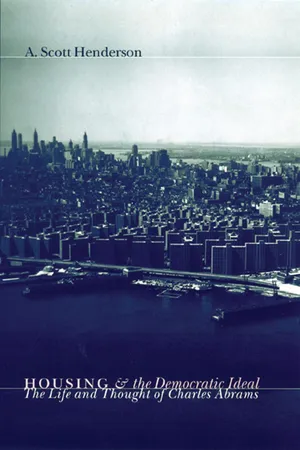 eBook - PDF
Housing and the Democratic Ideal
The Life and Thought of Charles Abrams
- A. Scott. Henderson(Author)
- 2000(Publication Date)
- Columbia University Press(Publisher)
In practice, this translated into legislative centralization and administrative decentralization. A growing number of city officials, sens-ing the limitations of such an arrangement, lobbied for extended police powers. 4 This is exactly what happened in Abrams’ home state of New York, where reformers slowly succeeded in augmenting sanctions against the most egregious examples of urban contagion. Tenement house laws enacted in 1867 , 1884 , 1895 , and 1901 legitimized state and sometimes municipal use of police powers to regulate construction and manage-ment of private housing. Living standards did improve, though only 46 from tenement laws to housing authorities twentieth-century legislation effectively outlawed construction of “dumbbell” tenements (commonly called “old law tenements” because they were the prevailing dwelling type prior to the “new” Tenement Law of 1901 ). Restrictive legislation could make these dark, poorly ventilat-ed buildings safer, but not necessarily desirable, places to live. 5 An additional, more significant drawback of restrictive legislation was its inability to increase the supply of affordable housing. Some contem-poraries advocated “model tenements” to meet this objective. As a func-tion of their voluntarily limited profits, these tenements charged rela-tively modest rents; on the other hand, their structural integrity remained fairly high since they conformed to and sometimes even exceeded building standards of the day. Enlightened capitalists were supposed to find this combination appealing. Public officials and some reformers certainly did. For municipal decisionmakers still wedded to Gilded Age notions of self-help and private charity, model tenements illustrated a method of channeling investment into social uplift without involving public funds. eBook - PDF
- Ronan Paddison(Author)
- 2000(Publication Date)
- SAGE Publications Ltd(Publisher)
A RETROSPECTIVE: PROGRESS IN THE TWENTIETH CENTURY? The past hundred years has seen enormous changes in housing standards and conditions in the developed North but the reality for millions of households in developing countries remains one of absolute housing deprivation, subsistence living and marginality. At the beginning of the new millennium we are, it seems, finally entering the urban age, when the majority of people will be living in cities of varying scale. In the developing and newly industrializing countries, many of these cities will be on a mega scale, with mega problems of environmental pollution, transport congestion, poverty and shantyism. The acceler-ated pace of urbanization and the commercial-ization of land markets in the cities of the South are creating new pressures of eviction and displacement. From a European perspective, it would appear that housing policy over much of this century has been concerned with the legacy of the rapid urban growth of the nineteenth and early twen-tieth century. Issues of housing conditions and their impact upon health and the economy, subsequent slum clearance and, in some coun-tries, the associated rise of social housing, the decline of private landlordism, the growth of individual home ownership and the development of contemporary financial mechanisms and insti-tutions are all rooted in that period. Two centuries later, the nations which were at the core of the Industrial Revolution confront very different urban conditions and housing systems. But rural–urban migration and the related housing pressures remain dominant forces in the world. As Sudjic (1996) has neatly observed, 6 Housing in the Twentieth Century RAY FORREST AND PETER WILLIAMS Peter Williams has co-authored this chapter in a personal capacity. The views expressed do not necessarily reflect those of any organization with which he is associated. Between 1810 and 1850, Manchester’s population increased by 40 per cent every 10 years.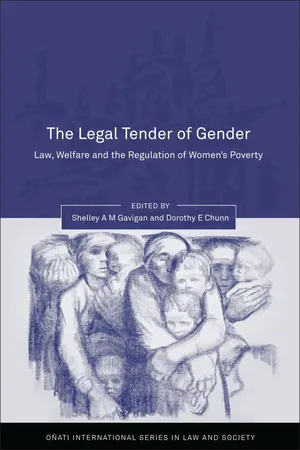 eBook - PDF
The Legal Tender of Gender
Law, Welfare and the Regulation of Women's Poverty
- Shelley A. M. Gavigan, Dorothy E Chunn, Shelley A. M. Gavigan, Dorothy E Chunn(Authors)
- 2010(Publication Date)
- Hart Publishing(Publisher)
Many settlement houses never tired of creating model tenement house apartments, demonstrating to immigrant women an appropriate interior and how the proper American wife created the sani-tized American home. To varying degrees, part of the settlement geist was an understanding that a proper domestic space would itself create American citizens. Yet settle-ment houses, which were open to all who lived in the neighbourhood, while also providing living space to often single middle-class women settlement workers, shared with tenements the porous boundaries between the public and private. Where settlement workers might hope to impress upon immi-grant women the importance of an American household with American standards of cleanliness, housekeeping, food preparation, childrearing and privacy, in actuality they further blurred the distinction between the public and the private, domestic space and work space. Yet settlement workers ultimately became comfortable with an intense ambiguity as to where such lines could be drawn. What is crucial to understand is that as the influence and activities of settlement houses grew, they became deeply connected to municipal gov-ernment. Settlement houses often created model programmes such as those that provided free and pure milk, kindergarten classes, recreation, public baths, home nursing services and health care within the schools. It is no coincidence that so many of these programmes involved children, as women settlement workers were able to assert jurisdiction most easily over those issues understood to be within a women’s sphere of concern. 81 Many of these programmes and initiatives eventually would be taken over by the municipal government. A significant and early point of contact between the settlement houses and the city developed within the context of the policing and regulation of tenement houses. This makes sense, as the settlement houses were located in the heart of the tenement district.
Index pages curate the most relevant extracts from our library of academic textbooks. They’ve been created using an in-house natural language model (NLM), each adding context and meaning to key research topics.

