Psychology

Situational Influence
Situational influence refers to the external factors that can impact an individual's behavior, thoughts, and feelings in a given situation. These factors can include the physical environment, social norms, cultural expectations, and other situational cues. Situational influence is an important concept in understanding how individuals respond and adapt to different contexts and settings.
Written by Perlego with AI-assistance
Related key terms
1 of 5
10 Key excerpts on "Situational Influence"
 No longer available |Learn more
Psychological Criminology
An Integrative Approach
- Richard Wortley(Author)
- 2011(Publication Date)
- Willan(Publisher)
The examination of Situational Influences on criminal behaviour was begun in the previous two chapters. In those chapters, situations were viewed largely through the eyes of the offender, that is, we examined the way that individuals interpret and react to their personal environment. The situational factors contributing to crime tended to be specific to the individual, based on his/her particular learning history and/or cognitive style. In this chapter we work in the other direction, beginning with situational factors and examining their impact on individuals. Theories that examine situations in this way tend to be concerned with the way that immediate environments affect people generally rather than with individual differences in situational effects. Two psychological perspectives – social psychology and environmental psychology – are dedicated to the examination of the effects on behaviour of the immediate environment. Social psychology focuses on the social environment, examining the psychological effects on individuals of the presence of others. Environmental psychology focuses on the physical environment, examining the psychological effects on individuals of factors associated with built and natural environment. A third perspective, this time from criminology, is also relevant to the analysis of situations, and that is the focus on opportunity. Opportunity theories – which may examine both social and physical environmental factors – simply assert that crime occurs where it can occur, a principle summed up in the well-known saying ‘opportunity makes the thief’. Before examining these three perspectives, we will have a closer look at just what a ‘situation’ is.What is a Situation?A situation is the setting in which behaviour occurs. Situations have both spatial and temporal dimensions: they are specific locations at particular points in time. Situational factors include tangible elements such as the physical aspects of the immediate environment and the behaviour of the people who are present. Somewhat less tangibly, situations can also refer to a state of affairs or set of circumstances at a given moment. A funeral and a wedding, for example, both may involve friends and relatives packed into a church, but the behaviour of the respective congregations will be shaped by the circumstances of the occasion. A clearer idea of what a situation is can be gained by examining the ways in which the term has been operationalised in psychological and criminological research. eBook - ePub
- Robert G. Jones(Author)
- 2020(Publication Date)
- Routledge(Publisher)
Our neurophysiology, developmental patterns in families, and, most obviously, the fact that we have lived near other humans throughout our history are all testimony to this. However, scientific study of how this social context affects individual psychology is a fairly recent phenomenon, with an explosion of research starting in the middle of the twentieth century. Although psychology generally concerns itself with individuals as the unit of analysis, social psychologists have taken a leadership role among scientists who are trying to understand how social context influences behavior. The understanding of social behavior as an essential component of human adaptation is even more recent (Cacioppo & Hawkley, 2012; Cialdini, 1988; Wilson, 2012). Much of the early research has helped us to understand how social context serves as a direct input (independent variable) that leads to behavioral outcomes. In a very short time, we have accumulated convincing evidence about the behavioral effects of authority, small social groups, crowds, minorities, and a host of other social contextual variables (Aronson, 2004; Cialdini, 1988, 2007). Not surprisingly, it turns out that our behavior and thinking are often very strongly influenced by social inputs eBook - ePub
Toward A Psychology of Situations
An Interactional Perspective
- D. Magnusson, David Magnusson(Authors)
- 2013(Publication Date)
- Psychology Press(Publisher)
By selecting (or being born in) a city, as opposed to a rural area, we are more likely to encounter subways, tall buildings, and areas of high population density and less likely to encounter farm animals and unpolluted air. By deciding to go to the university we are probably eliminating (manual) labor occupations such as farm hands, assembly line operators, or taxi drivers and minimizing the opportunity of interacting with persons in these occupations. By deciding to go into graduate school, in psychology, for example, we are further limiting the situations (including other persons) we encounter. Most of us are creatures of habit and except for vacations and other unusual events (e.g., sabbaticals, marriage) we routinely interact in the same types of situations from day to day and from weekend to weekend. Therefore, if there is any consistency in behavior, it is due, to a fair extent, to the fact that we encounter similar situations (both at work and during our leisure hours) from day to day. All of us go through similar routines from day today. Although we shape our environment, our environment shapes us.We are subject to complex stimuli at various levels. According to Magnusson (1978): “the total environment influencing individuals’ lives consists of a complex system of physical–geographical, social, and cultural factors which are continuously interacting and changing, at different levels of proximity to the individual [p. 1].” Stimulation affects behavior not only in terms of information being processed at the moment but also by interacting with previously stored information: “The total environment influences individual development and behavior [but] the influence of environment is always mediated via actual situation [p. 1].”Differential Psychology: Persons and Situations
The term differential psychology has typically and usually referred to individual differences. Magnusson (1978) has recently suggested that we need a differential psychology of situations to complement the differential psychology of persons. What direction should a differential psychology of situations take? Can we scale situations in terms of impact, complexity, relevance, objectiveness, subjectiveness?There is an inherent danger of overemphasizing taxonomies of situations. Different investigators may focus on different attributes and produce different taxonomies. This has happened with respect to traits, in that different trait theorists have produced different taxonomies or classifications of traits. Any taxonomy of situations and/or environments must fit into a theoretical context and should not be arbitrary. It is our contention that a classification system should be based primarily on the situations that people encounter and on the perception or meaning that the situations have for them. Pervin (1977) has sampled situations ecologically, in terms of natural habitats that persons encounter. Pervin examines free responses of individuals on the basis of their perceptions and behavioral and affective responses to their daily situations, and he classifies his variables via factor analysis. He has concluded that one should focus on the person–situation interaction as the unit of analysis. eBook - PDF
Family Situations
An Introduction to the Study of Child Behavior
- James H. S. Bossard, Eleanor S. Boll(Authors)
- 2016(Publication Date)
. . . The emphasis turns out to be, quite naturally, on personality development within our own cul-ture. . . , 14 In other words, while the role of situational factors is recognized, the chief emphasis is upon the effect of the situational factor or factors upon the personality development of the child. Concern with the situational obviously is incidental: its understand-ing is tacitly assumed. It is the whole emphatic insistence of this volume that a situa-tional approach to human behavior is a wholly different matter. Social situations differ from mechanical or physical situations, and in a number of respects. In the first place, social situations are not created artificially as are those of physiologists and psychologists; they are accepted by the student as they are found. This changes the whole relationship of the student to the situation. In the one case, he creates a situation to see how the organism will react; in the case of social situations, he finds them ready-made, and must learn to deal with them as they are. Second, social situations are more complex than the physical, non-human situations which have Koshuk, of. cit., p. ι . MEANING: SITUATIONAL APPROACH been dealt with prevailingly in behavior studies. The physiologists and psychologists combine customarily a small number of elements to create their situations. In the case of social situations, the very nature of the human personalities involved excludes any such sim-plicity. The human personality is a very complex product, so that the simple combination of a man, a woman, and a child, in a family situation, would be far more complex than the combination of three chemical agents, for example. Again, the elements involved in a social situation cannot always be identified with clarity, nor can their role in the situation be expressed with the precision of a mathematical formula. eBook - ePub
Household Waste in Social Perspective
Values, Attitudes, Situation and Behaviour
- Stewart Barr(Author)
- 2017(Publication Date)
- Routledge(Publisher)
3 The Social Psychological Perspective II: structural and situational variablesIntroduction
The second set of factors that are related to environmental behaviour, outlined above in Chapter One , concerns the variables that are essentially the objective circumstances of the individual. An excellent review of these factors has been given by Schultz et al. (1995) and the reader is referred to this paper for a brief inventory of the data presented below. The variables have been used in differing ways and with varying frequency to express the impact of non-personal characteristics upon environmental behaviour. Four key categories can be used to encompass the diverse factors involved:- Context : The extent to which geographical and/or contextual factors affect behaviour;
- Socio-demographics: The extent to which distinct populations behave differently;
- Knowledge : The extent to which global and specific knowledge impacts upon action; and
- Experience : The extent to which behavioural experience affects current activity.
In addition, the reader is referred to what is now becoming somewhat of a dated article, but one that is often quoted as the authority on determinants of environmental behaviour –the meta-analysis by Hines et al. (1987).Context and Environmental Behaviour
In the arena of waste management, 'context' essentially concerns two aspects of recycling behaviour that have largely been ignored in the literature. First, there is often an issue concerning the provision of a kerbside recycling facility to residents. Second, there is the issue of how far residents must travel in order to use facilities such as bottle banks. In essence, the former is a question of either being with or without a given service, whereas the latter is a function of both actual and perceived distance to recycle wastes. The second of these concepts (perceived distance) is dealt with in Chapter Four eBook - ePub
Psychological Criminology
An Integrative Approach
- Richard Wortley(Author)
- 2023(Publication Date)
- Routledge(Publisher)
The examination of Situational Influences on criminal behaviour was begun in the previous two chapters. In those chapters, we examined the psychological processes by which an individual experiences, interprets, and reacts to the immediate environment. In learning theory, the immediate environment is the source of rewards and punishment that encourage or discourage the performance of learned behaviours. In cognitive models of behaviour, immediate environmental data feed into the decision of how to act in a given circumstance. In this chapter, we shift focus to the situational factors themselves; specifically, we examine the sorts of immediate environmental conditions that are conducive to crime. We examine the role of situational factors through three theoretical lenses – social psychology, environmental psychology, and opportunity theory. Social psychology focuses on the social environment, examining effects on behaviour of the presence of others. Environmental psychology focuses on the physical environment, examining the effects on behaviour of the built and natural environment. Opportunity theory – which includes both social and physical environmental factors – simply asserts that crime occurs where and when it can occur, a principle summed up in the well-known saying ‘opportunity makes the thief’. Before examining these three perspectives, we take a closer look at just what a ‘situation’ is.What is a situation?
A situation is the setting in which behaviour occurs. Situations have both spatial and temporal dimensions – they are specific locations at specific points in time. Situational factors include tangible elements such as the physical aspects of the immediate environment and the behaviour of the people who are present. Less tangibly, situations can also refer to the social or symbolic context. A funeral and a wedding, for example, may involve friends and relatives packed into a place of worship, but the behaviour of the respective congregations will be shaped by the circumstances of the occasion. A clearer idea of what a situation is can be gained by examining the ways in which the term has been operationalised in psychological and criminological research. eBook - ePub
- Neil Christiansen, Robert Tett(Authors)
- 2013(Publication Date)
- Routledge(Publisher)
19 Assessing Personality With Situational Judgment Measures Interactionist Psychology Operationalized Michael C. Campion and Robert E. PloyhartDOI: 10.4324/9780203526910-21Interactionist psychology refers generically to a research paradigm that seeks to simultaneously model the behavioral consequences of individual characteristics (e.g., traits) and situational characteristics. Lewin’s (1936) proposition, Behavior = f(Person, Environment), is classic shorthand for this type of research. Many applied psychologists today assume behavior is a function of individuals (P) and their environments (E), or more specifically, their immediate situation (S). For example, research on the attraction–selection–attrition model, person–environment fit, leader–member relationships, organizational identification, and climate strength are all based on a premise that behavior is affected by the joint relationship between the person and the situation.Despite such beliefs, most applied personality psychologists tend to focus purely on the “person” side of the function, utilizing relatively context-free assessments of personality and rarely providing a serious consideration of situations or contexts (cf. Cappelli & Sherer, 1991 ; Johns, 2006 ). That is, most applied psychologists (particularly those in the individual differences and personnel selection fields) adopt a model where Behavior = f(Person). If situations are “considered,” it is usually limited to meta-analyses where situations are treated as sampling error or variance to be accounted for by moderators. However, a moderating effect for situations is not what Lewin proposed. Lewin did not mean Behavior = f(Person × Situation). The moderating effect of situations is a mutation of Lewin, and a consequence of framing theory and research in terms of statistics (e.g., moderated regression). Lewin instead proposed a simultaneous and dynamic relationship between the person and the situation—he did not propose interactionism occurred after eBook - PDF
Moral Selves, Evil Selves
The Social Psychology of Conscience
- S. Hitlin(Author)
- 2008(Publication Date)
- Palgrave Macmillan(Publisher)
Personality, alone, turns out to be relatively unhelpful in predicting behavior. 9 By “person,” then, we do not simply mean knowing about personality predispositions. We need to know how a person sees the world, how they construct what is going on around them, and what outlooks, worldviews, and “if/then” orientations they bring to a situation. For example, a man might be a low-status employee in his company and act subserviently at work. But at home, that same man might be a tyrannical husband and father. He is the same person with the same personality traits. But the situations are different and activate different intuitions and judgments about what is expected and acceptable. The situation is not everything, of course; his neighbor might have the same job but be less assertive at home as well as at work. A person’s behavior is an interaction between their sit- uated status, personal predispositions, life expectations, and environment. Certainly some people are more likely to be subservient across situations and others to be more calculating about whether appearing subservient is beneficial; individual differences do exist. But the research suggests that these individual differences matter much less than we think. 94 M o r a l S e l v e s , E v i l S e l v e s Situation and person are not, in practice, distinct variables, since any particular situation only makes sense insofar as we understand how its properties are interpreted by the people interacting within it. 10 But situ- ations have some inherent properties regardless of people’s interpretation, with some situations being so powerful that nearly everyone will make sense of them in the same way. 11 Common social situations call forth frames (discussed in the last chapter) that determine what facts people notice and what if/then response patterns feel socially appropriate. These frames implicate different values, 12 which in turn contribute to different responses, both consciously and nonconsciously.
- Philip J. Corr, Gerald Matthews(Authors)
- 2009(Publication Date)
- Cambridge University Press(Publisher)
Last but not least, situational exposure can affect personality traits over the long run. This is at least the assumption of traditional socialization research, with its one-sided look on personality as a consequence of situational exposure in the family. Although we know today that things are much more complex due to personality effects on the environment (see e.g., Asendorpf and Wilpers 1998; Lytton 1990), there is clear evidence that long-term situational exposure can change traits (e.g., effects of parenting or of the intellectual climate in the family on children’ s social-emotional and intellectual development even when indirect genetic influences on both the situational exposure and children’ s personality are controlled because only adoptive children or only within-family differences are studied; see Rutter 2006 for an overview). It should be noted, however, that these are situational effects on a different timescale than the personality effects on situations that were described before. Effects of exposure to just one situation Personality: traits and situations 51 on personality traits are rare and concern only extremely critical life events with long-lasting effects, such as natural disasters, sudden death of a beloved spouse or child, and other traumatic events. Conclusion To what extent situations present a problem for personality research very much depends on the specificity of the traits in terms of behaviour and situations. Everything else being equal, the more narrowly a trait is defined, the more likely are person-situation interactions and a low cross-situational consistency of the inter-individual differences in the trait-descriptive behaviours. Many of the result- ing problems can be resolved by aggregating across more and more heterogeneous behaviours and situations. This leads, however, to the new problem that we will increasingly lose our hold of what the aggregate means.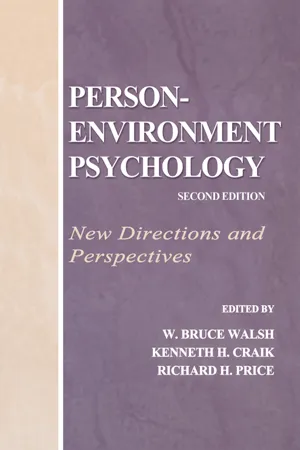 eBook - ePub
Person-Environment Psychology
New Directions and Perspectives
- W. Bruce Walsh, Kenneth H. Craik, Richard H. Price, W. Bruce Walsh, Kenneth H. Craik, Richard H. Price(Authors)
- 2000(Publication Date)
- Psychology Press(Publisher)
1 A Socioanalytic Perspective on Person–Environment Interaction Robert HoganBrent W. Roberts University of TulsaMischel’s (1968) behaviorist critique of personality psychology challenged the intellectual legitimacy of the field and set off the so-called person–situation debate. This debate concerned the locus of causation for social behavior—are our actions a function of factors inside us or factors in “situations”?—and the controversy was one of the most intense of the post-World War II era. What is the status of that once heated argument 25 years later? Some (Kenrick & Funder, 1988) suggest it is over. Others (Jones, 1990; Ross & Nisbett, 1991) maintain that personality is largely irrelevant as an explanation of social behavior. Still others (Ickes et al., 1997) conceptualize the problem in a way that synthesizes the valid points of both sides of the controversy. Although the person–situation debate may seem like a minor squabble between factions of an academic subdiscipline, it has major implications for environmental psychology in general, because when we summarize situations, we get the environment. Situations are specific environments, and the causal significance of environments is part of this discussion.This chapter has three goals. First, we argue that the person–situation debate was a red herring that did little to improve our understanding of the links between personality and environment, primarily because it left the meaning of situations unspecified. Second, we provide a perspective on person–environment interaction based on socioanalytic theory (Hogan, 1996). Earlier discussions of the person–situation debate were largely empirical and atheoretical; socioanalytic theory provides a framework for defining and classifying persons and situations and specifying the important components of both. Third, we argue that the most important situations many people face are found at work; that bosses’ personalities are the primary determinants of occupational situations, and this is a major source of stress and unhappiness for many people.
Index pages curate the most relevant extracts from our library of academic textbooks. They’ve been created using an in-house natural language model (NLM), each adding context and meaning to key research topics.

