Geography

Global Influence
Global influence refers to the impact and power that a country, organization, or culture has on a worldwide scale. It encompasses economic, political, social, and cultural influence that extends beyond national borders. In geography, global influence is often studied in terms of how different regions and countries shape and are shaped by global interconnectedness and interdependence.
Written by Perlego with AI-assistance
Related key terms
1 of 5
7 Key excerpts on "Global Influence"
 eBook - PDF
Bringing Geography to Book
Ellen Semple and the Reception of Geographical Knowledge
- Innes M. Keighren(Author)
- 2010(Publication Date)
- I.B. Tauris(Publisher)
POPULAR AND SCHOLARLY REVIEWS OF INFLUENCES 51 studied scientifically, or understood correctly, without consideration being given to ‘the ground which he tills, or the lands over which he travels, or the seas over which he trades.’ 19 The body of the first chap-ter is devoted, therefore, to a wide-ranging summary of human/ environment interactions in historical context. In a series of case ex-amples, drawn from her wider reading, Semple outlines her perspec-tive on various components of geographical influence (topographical, climatological, geological, hydrological, among others), describing the different ways in which these factors have affected human soci-ety, psychology, and physiology. Despite her noted desire to speak of geographical influence rather than of geographical determinant, the section dealing with climate attributes to it controlling influence on aspects of human life: ‘Climatic influences are persistent, often ob-durate in their control.’ 20 In its second chapter, Influences details at greater length the classes of geographical influence previously identified. Here, again, Semple’s tone is rather more deterministic than might be expected given her protestations against this line of argument. eBook - PDF
- Kevin R Cox, Murray Low, Jennifer Robinson, Kevin R Cox, Murray Low, Jennifer Robinson(Authors)
- 2007(Publication Date)
- SAGE Publications Ltd(Publisher)
But a comprehensive genealogy of the global would require a lengthy volume. Likewise, understand-ing of the global dimensions of the discipline of geography, which supposedly should have the globe as its object of analysis, is beyond the scope of this chapter (see Taylor, 1993). That said, it is worth noting the proliferation of texts within the discipline that now invoke global phenomena as a frame of reference for writing and teaching (Johnston et al., 2002). Even Peter Haggett’s (2001) discipline-defining textbook has changed its title from Geography: A Modern Synthesis to Geogra-phy: A Global Synthesis over the last three decades. Instead what follows in this chapter is a focus on the implicit politics of the term, and the forms of politics that the term itself helps make possible. In short, understanding global as discourse, or more specifically a series of discourses, allows its poli-tics to be discussed and some of the implications of invoking the term examined. The global is a specification of place, an arena of conflict, and much else too. Its utility as a desig-nation of the location of various forms of politics makes its analysis unavoidable in contemporary discussions of political geography. This is espe-cially important because the global’s invocation of the globe suggests a naturalism, a taken-for-granted, obvious space and political context. But in so doing it also frequently suggests a commonality of condition, a shared residence on Earth, and with that a series of political and economic priorities and concerns that are universal. Local manifestations of these phenomena are of course part of the diversity of the human experience, but given the common-ality of all being in some sense global, then the global is frequently coded as being much more important than the merely local (Gibson-Graham, 2002). eBook - PDF
- Amrita Pandey(Author)
- 2019(Publication Date)
- Delve Publishing(Publisher)
As with any other activity of the economy, the international trade has a geography. In spite of this geographic nature of international trade, it is a relatively unknown topic by economic geographers. World Regional Geography 188 This is not to state that the economic geographers do not examine the international economic activity, only that they do not research the more general procedures of international trade. In this topic, three facets of international trade have been reviewed that indicate the significance of geography that is taken on by economists and geographers: theory, borders, and regions. The current hypothetical investigation implicates the significance of geography as an essential element of trade theory; the political geography of trade (boundaries) is demonstrated to have diverse impacts in the diverse areas; and the creation of provincial trading blocs discloses that the geography is still considered as significant for recognizing the global relations. All three of these features are essentially geographical. It is claimed here that the discipline of economic geography must widen its scope in order to put on a geographical imagination to the recognition of global trade. How can geographical aspects have the influence on the economic growth? In the initial phase, let’s inspect that query by the use of a simple instance. Trains increased the speed with which goods made it from manufacturer to the customer in the nineteenth century. But in order for the route of the train to be cost effective (meaning that the price of the making the track would be covered by the products that would be traded as an outcome of the rail being formed), it had to follow a specific topography. Topography is fundamentally how land heaves and dips in hills and valleys, and how it slopes to allow streams and rivers to flow. eBook - PDF
- Ashley Kent(Author)
- 2000(Publication Date)
- SAGE Publications Ltd(Publisher)
Globalisation refers to processes which increase the scale of social life, and therefore increasingly involve processes which operate across borders at multiple scales. In recent years many commentators – academics, journalists, politicians, activists – have begun to talk about a variety of globalisations (Anderson, Brook and Cochrane, 1995). Prominent examples include: the spread of financial activity across state borders, as seen in the exit of the pound sterling from the European Exchange Rate Mechanism in 1992 and the ongoing East Asian financial crisis; the near-worldwide take-up of a Reaganite/Thatcherite political ideology in the 1980s; the diffusion of American culture worldwide through products such as Coca-Cola, McDonald’s, MTV and CNN; the increasingly important role of transnational corporations in the world economy; the development of the Internet, a social space which is relatively placeless; and the globalisation of environmental issues as illustrated through global problems such as the hole in the ozone layer, biodiversity loss and global warming. So, there are multiple globalisations, some of which seem economic, some political, some cultural and some environmental. However, these multiple globalisations do have a common denominator, a common denominator which is intrinsically geographical. What all these processes of globalisation have in common is that they involve an upward shift in the scale of social life, changes in the meaning and porosity of national boundaries and increases in the volume, velocity and importance of cross- border flows, no matter whether these are flows of money, goods, ideas, images or pollutants. In this way, processes of globalisation lend themselves to geographical analyses. In fact, I would go so far as to say that we cannot understand processes of globalisation unless we understand their geographies. eBook - PDF
Globalization
Theory and Practice Second Edition
- Eleonore Kofman, Gillian Youngs, Eleonore Kofman, Gillian Youngs(Authors)
- 2003(Publication Date)
- Continuum(Publisher)
PARTI Globalization, International Relations and Political Geography This page intentionally left blank CHAPTER 1 International Relations as we Enter the Twenty-first Century GILLIAN YOUNGS Globalization has become the new term for signifying dramatic changes in the nature of international relations in the latter part of the twentieth century and the dawning of the new century. It has become increas-ingly pervasive in the practices of politics, economics and culture as well as in their mediated communications. But are its meanings any clearer now that it has become so commonplace than when the first edition of this collection was published seven years ago (Kofman and Youngs, 1996)? Not necessarily. This chapter investigates how globalization might be considered to have replaced international relations as a description of not only how the world is, but also how we as individuals and collectivities of different kinds understand our place within it, and the diverse communications processes and tools intrinsically linking inner reflexive and communal symbolic aspects to concrete events and developments. Globalization signals a number of things in contrast to international relations. It emphasizes a global rather than a national context. This is not to deny national settings but to indicate that they themselves sit within a larger context, and that a notion of them as bounded separate entities is not necessarily the best conceptual priority for thinking about the world. Globalization also suggests a processual approach to world affairs: that we are dealing with realities in motion on the large scale of the globe. It is more dynamic than international relations, which identifies the relations between the defined entities of states as the key focus for assessing what is happening in the world. Globalization leaves it more open as to which relations, sited where, might be important to any particular social process.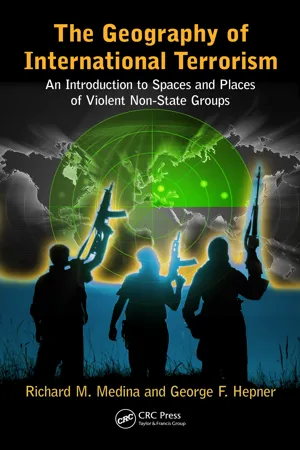 eBook - PDF
The Geography of International Terrorism
An Introduction to Spaces and Places of Violent Non-State Groups
- Richard M. Medina, George F. Hepner(Authors)
- 2013(Publication Date)
- CRC Press(Publisher)
Nations, regions, cities, and people have become more interconnected and interdependent. Presently, much of the globalization is driven by the West and, in many cases, led by the United States. This is in part due to US economic standing and its serving Influences on the Future Geography of Terrorism • 213 as a base for media outlets fostering cultural diffusion. Globalization is often seen negatively by the non-Western world and referred to as Westernization, secularization, and democratization (Cronin 2002/2003). Globalization has geographic implications. Although the term alludes to the merging of all world units into a unified entity, the truth is that the degree and impacts of globalization are geographically variable. In processes of what some call premodern globalization (i.e., colonization in Africa, Asia, and the Middle East), animosity was generated from colonial imposition of political boundaries and mixing of ethnicities that are still in place today. On an economic platform, inclusion in the benefits of globalization requires that a region has properties of complementarity (i.e., that region must have something to offer in the global market). This can be cheap labor, natural resources, technology, capital, or a receptive market. On a cultural platform, globalized communications and media assist in the diffusion of ideas, technology, and people. There are two major negative impacts of globalization processes that fundamentally drive conflict on all geographic scales. First, citizens of many regions, other than the power elite, are in adapt-or-die situations, where adaptation means acceptance of a globalized economy and cultural redefinition. The second impact of globalization is the redistribution of wealth, which creates or worsens poverty in many regions throughout the world. As globalization processes take place, conditions of poor and disenfranchised populations in marginalized regions are worsened. eBook - ePub
- Cynthia Metcalf, Rhonda Atkinson(Authors)
- 2017(Publication Date)
- Research & Education Association(Publisher)
The study of culture and Earth interactions is called cultural ecology. Political ecology is a multi-disciplinary study of how social and environmental change occurs in the context of power relations, social structures, economic issues, and human–environment interactions. Humans depend on the environment to provide them with their basic needs: food, shelter, and clothing. Humans also modify that same environment in order to meet their needs. For instance, people build dams to change the way water flows, plow and irrigate fields to grow food, clear forests to build houses, and dig mines for minerals and natural resources that help sustain life. Humans adapt to their environment if they cannot change it. For instance, people put on warm coats and use heaters when they live in cold climates. How people adapt to their environment depends to a large extent on their ability to do so—and it reflects their economic and political circumstances and their technological abilities. Human–environment interaction has also shaped Earth’s physical systems and features. For example, building on oceanfronts may increase erosion and alter the landscape. Clearing forests to make room for agriculture or cities changes the appearance of the landscape. Building dams and canals changes the way water flows. Geographers approach the study of human–environment interaction in a variety of ways: Environmental determinism: This is the view that the environment can overpower people and determine their culture and the direction and extent of their development. This is widely considered a “not politically correct” belief in geography. The main train of thought in environmental determinism is that an area’s physical characteristics, like climate, impact how people develop over time
Index pages curate the most relevant extracts from our library of academic textbooks. They’ve been created using an in-house natural language model (NLM), each adding context and meaning to key research topics.

