Social Sciences

Fundamentalism
Fundamentalism refers to a strict adherence to the basic principles of a religious or political ideology, often rejecting modern interpretations and advocating for a return to traditional beliefs. It is characterized by a literal interpretation of sacred texts and a resistance to change or secular influences. Fundamentalist movements can be found in various religions and political systems around the world.
Written by Perlego with AI-assistance
Related key terms
1 of 5

12 Key excerpts on "Fundamentalism"
 eBook - PDF
Politics, Society, Self
Occasional writings
- Geoff Gallop(Author)
- 2012(Publication Date)
- UWA Publishing(Publisher)
2. Politics or Fundamentalism? On Fundamentalism Speech delivered at The Fourth Global Conference on Buddhism Perth, 10 June 2006 Fundamentalism was first used in our theological discourse to refer to that tendency in early twentieth-century Protestantism that rebelled against science and secularism. For the fundamental- ists the Bible was to be read literally (it meant what it said despite the contradictions) and what it said was the truth without qualification.1 Today, however, the term has a much broader application and refers to similar tendencies in all religions. Sometimes the term “Strong Religion” is used as a substitute.2 This broadening of the application of the term makes sense as we observe the same commitment to a literal reading of the texts, their inerrancy and their uses as the basis for a radical critique of modernisation in some if not all of its features. In recent decades we have seen Fundamentalism make a dramatic comeback as a theological, social and political force. In working out how to address the questions it poses we need to look at three elements. 26 POLITICS, SOCIETY AND SELF • Fundamentalism as belief • Fundamentalism as a way of life • Fundamentalism as politics. Belief The beliefs associated with Fundamentalism represent a full-scale attack on the Enlightenment and the commitment to science and human welfare that went with it.3 After being liberated from dogma, science has again been reduced to the handmaiden of theology by the new fundamental- ists. Human self-expression has again been straitjacketed. Fallibility has been replaced with certainty and pragmatism with dogmatism. Just as there is no dialogue with their texts over what is the truth, there is very little dialogue with others. That would be to assume doubt, and doubt has no place in Fundamentalism. eBook - PDF
A Future for Religion?
New Paradigms for Social Analysis
- William H. Swatos, Jr., William H. Swatos(Authors)
- 1992(Publication Date)
- SAGE Publications, Inc(Publisher)
In specific circumstances, neotraditionalist religiosity can flourish and become 19 20 Global Fundamentalism publicly influential, but the experience of fundamentalist movements does not portend a brighter future for religion in general. Lest I represent the research on Fundamentalism as a closed program that provides answers to all questions, I hasten to add that social analysis in this area is very much an open and evolving enterprise that has as yet produced relatively few firm conclusions. In part, the open-ness stems from the fact that Fundamentalism can be defined and approached in different ways. In addition, while scholars have made strides in debunking various misconceptions about Fundamentalism, the picture is by no means complete. The comparative work on fundamen-talism in different contexts has just begun; efforts to interpret funda-mentalism as a global phenomenon with global ramifications are also in their infancy. Rather than as a source of intellectual frustration, this incompleteness should be taken as an incentive to extend the study of Fundamentalism beyond the stage of fashion. Ideally the following se-lective overview of relevant aspects of social analyses of fundamental-ism will convey both lessons learned and things to be done. Problems of Definition Modern, secular scholars often learn to practice a kind of method-ological atheism, bracketing the very question of the “truth” of the be-liefs and traditions they investigate. Religion in its various forms can then be studied like anything else, regardless of the actual values of the observer. At the same time, these scholars also often feel duty-bound to understand the other in his or her particularity, to engage in Verstehen, to do justice to the point of view of the actors under study. In the case of Fundamentalism, these impulses have given rise to at least three types of definitions.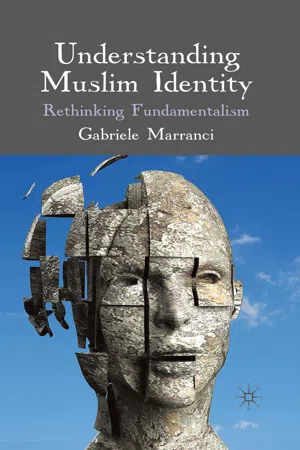 eBook - PDF
Understanding Muslim Identity
Rethinking Fundamentalism
- G. Marranci(Author)
- 2009(Publication Date)
- Palgrave Macmillan(Publisher)
In the theories discussed, Fundamentalism is a religious social phenomenon, character- ised by a deviance from the acceptable way of living in the contemporary (Western/Westernised?) world. As we have seen, some students of fun- damentalism focus on the text as the main inspiration for the ideology of fundamentalists (Lawrence 1990); others instead focus on dynamics that enclave social groups in an impossible battle aimed at maintaining secure and unchallenged anachronistic identities (Marty and Appleby 1991–5, Herriot 2007). Others, such as the sociologist Bruce (2000), see fundamentalists as the real coherent religious believers, the only ones who correctly respect their inerrant texts and are not ready to compro- mise; or, as Ruthven has suggested (2004), they cannot accept the domi- nant Western liberal philosophy of tolerance, relativism and human rights. Nonetheless, it is my contention that the reason for the ‘family resemblance’ in the study of Fundamentalism has other reasons, among which the most relevant is the process of ‘imagining civilisations’. If we observe critically the studies I have presented in this chapter, we can notice that in reality these analyses tell us more about how Western authors conceive Western liberalism than what that mysterious phe- nomenon they have labelled ‘Fundamentalism’ might be. Most scholars from different academic fields have described fundamen- talism as if it were a real, cultural, social political entity possessing certain universal characteristics. Of course, all the authors discussed acknowledge that Fundamentalism features, much like the mythic hydra, different col- ours and multiple heads. Nonetheless, Marty and Appleby (1991, 1993b) and others 8 have emphasised that Fundamentalisms, despite their vari- egate origins and reasons, show ‘family resemblances’ or common traits. eBook - PDF
Pious Passion
The Emergence of Modern Fundamentalism in the United States and Iran
- Martin Riesebrodt(Author)
- 1993(Publication Date)
- University of California Press(Publisher)
Nevertheless, his study has laid a cornerstone on which a sociological work can also build, because here for the first time Fundamentalism, as a transcultural phenomenon, has been located in a developmental historical framework. Fundamentalism: TOWARD DEFINITION AND TYPOLOGY Because Fundamentalism has become established, it makes little sense to replace it by another term. Nor would anything be gained by its replacement. The problem lies not in the concept itself but in its capacity to generate necessary distinctions. We need a clear definition of relevant criteria, not more neologisms, which proliferate in the literature. An attempt to make the conception of Fundamentalism more precise confronts the immediate problem of integrating academic and collo-quial usage. If we define the Fundamentalism concept too narrowly, to make it operable sociologically, there is the danger that everyone will formulate their own definitions that no one else will follow. Conceived broadly, in correspondence with colloquial usage, it remains sociologi-cally amorphous. For that reason my definition encompasses a typologi-cal differentiation that refers to the broad understanding of the concept as it has become widely established in the academic literature on reli- 16 Fundamentalism as a Sociological Problem gion. This path seems to me preferable both for pragmatic reasons and from a theoretical point of view. As a first step I would like to take up the identification of fundamen-talism with biblical or koranic literalism. Fundamentalist thinking is marked by a profound experience of crisis. The cause of the crisis is society's desertion of eternally valid, divinely revealed, and textually literal received principles of order, which had once been realized in an ideal community—the Golden Age of original Christian, Islamic, or other communities. 30 Overcoming the crisis is possible only by a return to these divine statutory prescriptions. eBook - PDF
- Andrew Vincent(Author)
- 2009(Publication Date)
- Wiley-Blackwell(Publisher)
11 In this context it is difficult not to think that most ideologies and thought struc-tures, of many and various types, have their fundamentalist components. As Malise Ruthven puts it: ‘Virtually every movement, from animal rights to feminism, will embrace a spectrum ranging from uncompromising radicalism or “extremism” to 272 Fundamentalism pragmatic accommodationism’ (Ruthven 2004, 32). In all such movements there are those who are unwilling to negotiate their fundamental principles. However, whereas some see Fundamentalism as something which characterizes our age (religion being but one potential fundamentalist offender), other commentators are much less certain. In my own reading I contend that Fundamentalism is something that – at the present moment – is more predominantly associated with religion. This is the general line of scholarly reasoning which developed from the Fundamentalism Project of the 1990s, with which I concur. To draw it beyond religion is to make the category too broad. Thus, my response to this more comprehensive use of Fundamentalism is to sug-gest that it has more purchase, as an ideological concept, if we think of it in the context of religion. However, and this is where things begins to get messy, if we are addressing Fundamentalism as an ideology, then we have to think of religion and politics in tandem in some manner. What does this relation imply in practice? Second, an even more awkward question which has been blithely neglected to date, what do we mean by religion? Third, one of the critical issues mentioned by most commenta-tors on religious Fundamentalism – including the bulk of the sociological commen-tary – is that it tends to be a reaction or challenge to a crisis of secularization and modernization. What, then, is meant by secularization and modernization in this context? This first question is important in terms of delineating the precise area for analysis of Fundamentalism. eBook - PDF
Globalization and Security
An Encyclopedia [2 volumes]
- G. Honor Fagan, Ronaldo Munck, G. Honor Fagan, Ronaldo Munck(Authors)
- 2009(Publication Date)
- Praeger(Publisher)
Fundamentalists are people whose desire to reiterate a particular version of the basics of their beliefs intertwines with a political agency to act in the secular world. Many theorists also argue (Munson 1995) that we cannot apply to different religious movements a word that was originally used to refer to specific theo- logical concerns within American Protestantism—‘‘fundamentalist,’’ for exam- ple. Can we really compare the Taliban with the Moral Majority? And should we? Similarly, as Dipankar Gupta (1993) notes, in lumping different groups to- gether under a common label, do we overemphasize commonalities over impor- tant differences? The semantic debate around Fundamentalism has even led to calls for an outright rejection of the word within academic fields (Elias 1999). As both Steve Bruce (2000) and Martin E. Marty and R. Scott Appleby (1991) note, however, academics often become too preoccupied with semantics, over- looking the utility of preexisting words, which are already commonly used and generally understood. Marty and Appleby (1991) took this approach in their five-volume analysis of global Fundamentalism, The Fundamentalism Project. They labeled their approach to definitions the ‘‘Family Resemblances’’ model, arguing that all fundamentalists groups shared enough resemblances to be grouped together while still offering an opportunity to appreciate local 138 Social and Cultural Aspects differences. Marty and Appleby (1991) used the analogy of cousins, wherein one can detect the resemblances of a common ancestor though the cousins are not necessarily all identical. The Family Resemblances model has become the mainstream approach to defining and researching Fundamentalism, and it is the approach used in this chapter. Key Theological and Social Characteristics of Religious Fundamentalism There are two levels of definition for religious Fundamentalism: the theological and social and the political. eBook - ePub
- Andrew Vincent(Author)
- 2023(Publication Date)
- Wiley-Blackwell(Publisher)
2004 , 32). In all such movements, there are those who are unwilling to negotiate their fundamental principles. However, whereas some see Fundamentalism as something which characterizes our age (religion being but one potential fundamentalist offender), other commentators are much less certain. In my own reading, I contend that Fundamentalism is something that – at the present moment – is more predominantly associated with religion. This is the general line of scholarly reasoning which developed from the Fundamentalism Project of the 1990s, with which I concur. To draw it beyond religion is to make the category too broad.Thus, my response to this more comprehensive use of Fundamentalism is to suggest that it has more purchase, as an ideological concept, if we think of it in the context of religion. However, and this is where things begins to get messy, if we are addressing Fundamentalism as an ideology, then we have to think of religion and politics in tandem in some manner. What does this relation imply in practice? Second, an even more awkward question which has been blithely neglected to date, what do we mean by religion? Third, one of the critical issues mentioned by most commentators on religious Fundamentalism – including the bulk of the sociological commentary – is that it tends to be a reaction or challenge to a crisis of secularization and modernization. What, then, is meant by secularization and modernization in this context?This first question is important in terms of delineating the precise area for analysis of Fundamentalism. Crudely put, there are a number of ways in which the relation of politics and religion can be configured. On one count, religion can be completely separated from politics. This can be done for religious or political motives. Thus Augustine’s two cities idea is one well‐established form of the religious argument. Politics in this latter context is a hopeless realm of irremediable imperfection and a mere staging post to a more perfect existence in the heavenly city. It can also be argued, from the politics side, by those who see, for example, religious civil war as something to leave well behind, that religion and the secular state should be completely separated. However, one other dimension here is the possible fusion or subtle linkage of politics with religion. This can again be initiated from the religious or political side. Put at its simplest, in one reading religion colonizes or subjugates politics and in the other reading politics colonizes or subjugates religion. eBook - PDF
Fool's Gold?
Utopianism in the Twenty-First Century
- L. Sargisson(Author)
- 2012(Publication Date)
- Palgrave Macmillan(Publisher)
A website dedicated to these essays defines Fundamentalism as follows: Please note that the word ‘fundamental’ or ‘fundamentalist’ should not be confused with that of a militant religious fanatic or the like, as is implied by the word in the media and elsewhere ... What should be understood is the premise that there are essential doctrines of Christianity that should not in any way be set aside or tampered with, these doctrines are ‘funda- mental’ to true Christianity. A fundamentalist in this sense of the word is one who upholds these doctrines without compromise. (http://www. xmission.com/~fidelis/ accessed 06.08.2011) Scholars of Fundamentalism commonly identify a core of key characteristics that mark a fundamentalist group (Caplan, 1987, Marty and Appleby, 1991 and 1995, Percy, 1996 and Ruthven, 2004). There is some dispute about the exact content of these characteristics. For example, Martyn Percy tells us that Fundamentalism has five core features: backward-looking legitimization for present forms of ministry and belief, opposition to trends in modern- ist society, a set of core beliefs, cross-denominationalism and, finally, an impact on the material world (Percy, 1996). This is similar to and yet dif- ferent from Almond, Siran and Appleby’s definition, which identifies nine core features (Almond et al., 1995). Some are related to beliefs: reactivity against marginalization, selectivity, moral manicheanism, absolutism and Religious Fundamentalism 43 inerrancy, millenarianism and messianism. Others are organizational: an elect membership, sharp group boundaries, authoritarian structures, and stipulated behavioural codes. Notwithstanding these variations, all of the research agrees on one shared defining feature, which concerns the group’s raison d’être: to protect and preserve the core of its belief system. This core of fundamentals is perceived to be under threat. These groups seek to protect, preserve and re-establish the core of their belief system. eBook - PDF
Fundamentalism in the Modern World Vol 1
Fundamentalism, Politics and History: The State, Globalisation and Political Ideologies
- Ulrika Martensson, Jennifer Bailey, Priscilla Ringrose, Asbjorn Dyrendal, Ulrika Martensson, Jennifer Bailey, Priscilla Ringrose, Asbjorn Dyrendal(Authors)
- 2001(Publication Date)
- I.B. Tauris(Publisher)
Even trying to say, in the opening sentences of a book, what the con-cept ‘commonly refers to’ leads into an endless chain of reservations and qualifications. Still, the concept has been usefully employed to refer to a religious, anti-capitalist and anti-secular ideology that can be identified in movements all over the world (Lawrence 1990). Here the dimension of methodology is also considered. If ‘fundamental-ism’ signifies ‘a return to the sources’ and an objective of re-forming society and individual lives according to what these sources are believed to dictate, the corresponding methodology is to interpret those sources according to a specific doctrinal authority, which guarantees that the interpretation produces an outcome in line with the objective. Awareness of Fundamentalism has much to do with globalisation. As a world-wide religious ideology it first became visible in the early 1980s, thanks to the global reach of mass-media and communications technology. So even though these movements existed long before that time, they were not perceived by the general public as a global phe-nomenon before then. Academia has followed suit: beginning in the late 1980s, Fundamentalism has been constituted as a distinct topic in the social sciences and in religious studies, where it is often explained as a reaction to globalisation’s many dimensions – political, moral, economic, cultural and technological. The fact that the global public became aware of Fundamentalism just as globalisation itself became a matter of public debate, makes it tempting to explain Fundamentalism as being caused by globalisa-tion. But fundamentalist movements also draw on religious beliefs and methodologies which are very much older than modern globalisation and which have traditionally functioned as narratives and practices challenging the established orders. These traditional strategies of com-munity and state formation are simply given new shapes under mod-ern Fundamentalism. eBook - PDF
An Introduction to Religion and Politics
Theory and Practice
- Jonathan Fox(Author)
- 2018(Publication Date)
- Routledge(Publisher)
Essentially, Fundamentalism is a reaction against modernity. As I discuss in more detail in Chapter 2, modernity has created a number of challenges to religion. These challenges are unavoidable, and all religious movements must react to them. There are only three viable reactions to the challenges of modernity. The first is to accept modernity and rationalism and reject religion—the secular option, which I discuss in more detail in Chapter 12. The second is to find some way to accept both modernity and religion. The third is to reject rationalism and modernity but embrace religion—the fundamentalist option. Thus, Fundamentalism, at its most basic, is a type of a religious framework of belief designed or evolved to defend religion against modernity through the rejection of modernity. Fundamentalists see modernity and secularism as a threat to religion. As discussed in Chapters 2 and 12, this is arguably an accurate assessment. Elements of modernity undermine traditional religion, RELIGIOUS Fundamentalism 99 and secularism clearly competes with religion. Given this, it is not surprising that most of the unique, as well as the not so unique, characteristics of Fundamentalism are geared toward protecting religion from modernity and secularism. Almond et al. (2003: 17) recognize this when they define Fundamentalism as “a discernible pattern of religious militancy by which self-styled ‘true believers’ attempt to arrest the erosion of religious identity, fortify the borders of the religious community, and create viable alternatives to secular institutions and behaviors.” While there is no agreement in the literature as to the exact mix of characteristics associated with Fundamentalism the following characteristics are associated with it in the literature: Anti-modern: As already noted, Fundamentalism is a reaction against secularism, rationalism, and modernity.
- Nina Käsehage(Author)
- 2021(Publication Date)
- transcript Verlag(Publisher)
The Problem of Salafism, the Problem with ’Salafism’. An Essay on the Usability of an Academic Category to understand a Political Challenge. In Klaus Hock & Nina 252 Peter Antes The intention of this article is to show that Religious Fundamentalism is such a cat-egory which not only describes reality but also evaluates and produces it. 2 There-fore, the article starts with a reference to the original meaning of Fundamentalism in religion, and it then widens its use to a much broader understanding of the term in order to finally come to some of the consequences of such a narrative. Conse-quently, the conclusion expresses a strong warning to all not to be too quick with those general interpretative terms but to pay attention to local peculiarities as well. 2. The original meaning of the term In 1983 Wilfert Joest published his article on Fundamentalismus in the 11 th volume of the “Theologische Realenzyklopädie (TRE)” wherein he exclusively deals with the American Protestant Group of the end of the 19 th and the beginning of the 20 th cen-turies. Fundamentalism in this context refers to a collection of 90 texts published between 1910 and 1915 by the Bible Institute of Los Angeles under the title of The Fundamentals. A Testimony To The Truth , often quoted simply as The Fundamentals . The aim of these publications was to reject liberal tendencies in the Protestant theol-ogy of that time and to insist instead on the traditional teachings of the Christian creed. The Fundamentals are opposed to the idea of an evolution of the human being in line with other species of animals and primates as suggested by Darwin. They also maintain the classical understanding of the virgin birth of Christ and his bod-ily resurrection and physical return. They confess Christ as the Son of God and hold true all miracles as described in the Bible. eBook - PDF
Fundamentalism or Tradition
Christianity after Secularism
- Aristotle Papanikolaou, George E. Demacopoulos, Aristotle Papanikolaou, George E. Demacopoulos(Authors)
- 2019(Publication Date)
- Fordham University Press(Publisher)
Furthermore, in order to bring together moral cognition and religion in this particular way, the following supposi-tions apply: 1. A religious movement, denomination, or sect is a social group. A fundamentalist movement satisfies the same requirement. 2. Religious groups are not special. Individuals bind together to form religious groups and religious groups split into sects or come into conflict with other religious groups on the basis of the same mechanisms that cause all social groups to bind, split, or generate conflict. 3. It is not religion per se but morality that is the primary force that binds social groups. 19 Morality lies beneath and shapes politics, economics, and religion. 20 A religion can be strongly moral but morality can exist without religion. 21 4. Morality in this sense is distinct from ethics or religious values. It is not about what we should or should not do (determining the mor-ally correct approach to a situation or what is ideally good) but about social-functional values, that is, about the unconscious values and moral judgments that inform our everyday actions and behavior. These suppositions are open to contestation. Taken together, however, they build a strong foundation for understanding why fundamentalist move-ments respond to perceived threats in the ways that they do, why those behaviors are shared across such a large range of religions, and why for Prot-estant fundamentalists authority is invested primarily in the Bible, and for Catholic and Orthodox Christians in tradition. When we look at some of the recent work on terrorist actors and on re-ligious and political conflict emerging from within the disciplines of so-cial and moral psychology, it is no accident that the ideological characteristics of Fundamentalisms express in specific common social organizational be-haviors.
Index pages curate the most relevant extracts from our library of academic textbooks. They’ve been created using an in-house natural language model (NLM), each adding context and meaning to key research topics.

