Social Sciences

Robert K. Merton
Robert K. Merton was an influential American sociologist known for his contributions to the study of sociology and the development of sociological theory. He is particularly recognized for his work on the concepts of manifest and latent functions, role strain, and the self-fulfilling prophecy. Merton's theories have had a lasting impact on the field of sociology and continue to be widely studied and applied.
Written by Perlego with AI-assistance
Related key terms
1 of 5
10 Key excerpts on "Robert K. Merton"
 eBook - PDF
American Sociological Theory
A Critical History
- Robert Bierstedt(Author)
- 2013(Publication Date)
- Academic Press(Publisher)
CHAPTER 10 Robert K. Merton It would seem reasonable to suppose that sociology will advance in the degree that its major concern is with developing theories of the middle range and will be frustrated if attention centers on theory in the large. — Social Theory and Social Structure, p. 9 Robert K. Merton was born on July 5, 1910, in the slums of South Philadelphia to parents of Eastern European origin. He remembers the slum as a lively, noisy, and interesting place, and as a child he participated with zest in the gang warfare—largely ceremonial, he says—that was a constant feature of the city streets. At the age of eight he had already discovered the public library and had begun to devour its delights. At the age of twelve he was introduced to delights of a different kind, namely, the art of conjuring, at which he became so proficient that he was able to earn from $5 to $10 a performance at various school and neighborhood groups. 1 In 1927 he went to Temple University on a scholarship and almost immediately distin-guished himself by the caliber of his academic work. Two of his teachers there were James Dunham, the philosopher, and George E. Simpson, the sociologist, and it was the latter's discipline, of course, to which he made his career commitment. In 1931, at the age of twenty one, Merton won a fellowship that took him to Harvard and graduate work in sociology. The department had been founded by Sorokin only a year before, and Merton became a member of the first group of students to whom instruction was offered. Among impor-tant influences there, in addition to Sorokin, were L. J. Henderson, the biochemist, George Sarton, the historian of science, and the young Talcott Parsons, then an assistant professor. Merton began to publish early in such journals as Social Forces, the American Journal of Sociology, the American Sociological Review, the Quarterly Journal of Economics, Sociology and Social Research, Isis, and the Scientific Monthly.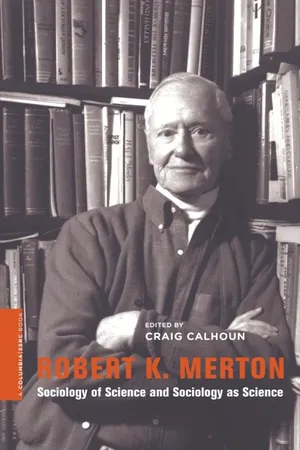 eBook - ePub
Robert K. Merton
Sociology of Science and Sociology as Science
- Craig Calhoun(Author)
- 2010(Publication Date)
- Columbia University Press(Publisher)
4 The Contributions of Robert K. Merton to Culture Theory CYNTHIA FUCHS EPSTEINFar from being exclusively a functional social structuralist as he has been characterized by several generations of academic critics, Robert K. Merton was, ultimately, a theorist of cultural sociology. Unfortunately, Merton is neglected today by serious analysts and theorists of cultural sociology, such as Jeffrey Alexander, Karen Cerulo, Eviatar Zerubavel, and the networks of cultural sociologists around them, and his name is hardly to be found in the references of the most recent textbooks and articles on cultural sociology.1 Yet many of Merton’s key concepts for the analysis of social life centered on the cultural domain, mated with structural variables. In this paper I shall point out how a number of Merton’s concepts and theoretical perspectives have contributed to cultural analysis. With a bow to Merton’s last work—the 2003 afterword to the work written in 1958 with Elinor Barber, The Travels and Adventures of Serendipity: A Study in the Sociological Semantics and the Sociology of Science—I serendipitously (not, alas, systematically) conjure up a number of concepts and perspectives that I believe locate Merton among the seminal sociologists of culture.Usually, Merton’s line of intellectual descent is traced to Durkheim’s Suicide ([1897] 1951) for its analysis of the power of group affiliation, but it is instructive also to consider the influence of Durkheim’s The Elementary Forms of Religious Life (1928) and the power of values in his perspective. And of course, Merton was inspired by W. I. Thomas and his famed aphorism, “If men define things as real, they are real in their consequences” (Thomas and Thomas 1912:571–2). Merton’s agreement that cultural definitions of reality were powerful may also be traced to Weber’s The Protestant Ethic and the Spirit of Capitalism (1904–1905), the model for Merton’s dissertation on science and the impact of Puritan values on the early members of the Royal Society of London and his later work on the ethos of science. Reference to “The Thomas theorem” reappears in the 1995 article “The Thomas Theorem and the Matthew Effect” in which, with his customary reach into old archives, Merton traces “recognition of the subjective component in human action” to Epictetus’s observation that “what disturbs and alarms man are not actions, but opinions and fancies about actions” (382). In this article he notes that George Herbert Mead observed this phenomenon in purely sociological terms, saying that “If a thing is not recognized as true, then it does not function as true in the community” (383). Merton’s observations about the ways in which beliefs are transmitted and held by social groups were a function of, and an extension of his interest in, science and scientific communities.2 eBook - ePub
- Sandro Segre(Author)
- 2016(Publication Date)
- Routledge(Publisher)
10 Robert K. Merton (1910–2003) DOI: 10.4324/9781315573946-10Preliminary Remarks
This presentation of Robert Merton’s sociological work will roughly follow the order which this author has given to his subject matter in his celebrated work on social theory and social structure (1968). The first part will accordingly consider, first separately, then jointly, Merton’s notions of social structure, sociological theory and middle-range theory. Merton’s discussion of latent and manifest functions, the relationship between sociological theory and empirical research, and Merton’s re-examination of functional analysis will be presented. Subsequently, Merton’s well-known theory of social structure, as exposed in Social Theory and Social Structure and anomie, will be recapitulated. His studies on the relationship between bureaucratic structure and personality, on the role of the intellectual in public life, and on the self-fulfilling prophesy, will be then briefly illustrated. This text will subsequently dwell on Merton’s contributions to the sociology of knowledge and of the mass media, and to his sociology of science. Other, possibly less well-known, works by Merton that also deal with social structure and related notions will be also touched upon here (see especially Merton 1976b ). Finally, some information will be provided on the reception of Merton in an attempt to give a balanced consideration of appreciative and critical appraisals.Sociological Theory, Middle-Range Theory, and Social Structure
As the author makes clear in the introduction (Merton 1968 : 39), theory and sociological theory in particular are words that have been used so frequently that their meaning may have become unclear. Merton’s sociological theory is middle-range, in the sense that it consists of a set of logically consistent conceptions which have a limited explanatory scope. They are accordingly neither simple working hypotheses, nor largescale speculations having a conceptual apparatus of their own. These speculations should be instrumental in formulating empirically grounded generalizations on social conduct,1
- George Ritzer(Author)
- 2008(Publication Date)
- Wiley-Blackwell(Publisher)
His theoretical and methodo-logical orientations of functional analysis and structural analysis are widely applied, often without recognition of the authorship. This sort of acceptance is perhaps the strongest proof of Merton's impact on contemporary sociology. In chronological order one may distinguish a number of phases in his lifelong work (Crothers, 1987, pp. 34±40; Clark, 1990, p. 15). In the 1930s, during his Harvard years, Merton was involved in empirical projects on the homeless of Boston, and prepared his doctoral dissertation on the link between Protestant pietism and the origins of science, to be published in 1938. He also worked on major theoretical articles: ``Civilization and Culture'' (1936), ``The Unantici-pated Consequences of Purposive Social Actions'' (1936), and ``Social Structure and Anomie'' (1938). His early interest in European sociology is documented by two review articles: ``Recent French Sociology'' (1934) and ``Durkheim's Divi-sion of Labor in Society'' (1934). He was to become one of the most cosmo-politan of American sociologists, acquiring a deep knowledge of the European heritage, and long after retirement insisted on his yearly routine of a summer tour of European capitals, savoring their cultural riches and rekindling his vast personal and professional networks of collaborators and friends. In the 1940s he took part in a number of empirical projects carried out in the Bureau of Applied Social Research, including the study of a radio campaign known as the ``war-bond drive,'' summarized in 1946 in the volume Mass Persuasion . Another of his contributions was the reinterpretation of the findings of wartime studies carried out by Samuel Stouffer and his team on the ``American soldier,'' which resulted in an article (with A. Kitt Rossi) on reference groups, published for the first time in 1950 (Merton, 1968, pp. 279±334). The concept R obert K. M erton 19 eBook - PDF
- Richard Giulianotti(Author)
- 2004(Publication Date)
- Palgrave Macmillan(Publisher)
John Loy and Douglas Booth 35 Merton made substantive theoretical and empirical contributions to a variety of areas, including the sociology of knowledge, sociology of science, reference group theory, organizational sociology, the sociology of deviant behaviour and the sociology of time. Perhaps most significantly, Merton’s careful and considered scholarship and involvement in the development of sociology as a discipline places him on equal footing with leading social theorists past and present. Stinchcombe, for example, ranks Merton with Durkheim, Marx, and Trotsky as a classical writer (1968, p. vii). He also believes that “of all [the] contemporary theorists of social structure, Merton has had the greatest impact on empirical research” (1975, p. 11). Merton’s two main theoretical perspectives Throughout his career Merton studied social structure. Initially he approached it from the viewpoint of functional analysis but in the latter stages of his career he adopted structural analysis. In this section we highlight the main features of his two perspectives of social structure. Functional analysis Merton’s form of functionalism grew from his attempt to codify the many existing varieties of functional analysis. He believed that func- tionalism had “developed on [too] many intellectual fronts” and “grown in shreds and patches rather than in depth” (1957, p. 19). Merton commenced the task of codification by dissecting the prevailing postulates of functional analysis developed in anthropology by Emile Durkheim (Loy & Booth, 2000b), A.R. Radcliffe-Brown (1952) and Bronislaw Malinowski (1945). According to Merton, anthropological forms of functionalism rested on three erroneous postulates: “first, that standardized social activities or cultural items are functional for the entire social or cultural system; second, that all such social and cultural items fulfil sociological functions; and third, that these items are consequently indispensable” (1957, p. 25). eBook - ePub
- Carlo Mongardini(Author)
- 2018(Publication Date)
- Routledge(Publisher)
The choices made by the conference participants indicated without doubt that it was one particular part of Merton’s work, not necessarily the best known or the type of analysis classically associated with it, that attracted most interest. It is enough to recall that only one chapter took as its subject the famous concept of anomie, for so many years at the heart of all research on deviance and, beyond deviance, not a single chapter on group theory and mass communications, and only two dealing with questions associated with the field of study Merton is most identified with, the history and sociology of science.The Mertonian themes which proved most attractive were those linked with the criticism of classical functionalism, either as the abandonment of aspirations to global theory or as the progression beyond a prevalently structural, normativist position or, more especially, as the preparation of tools suited to registering the most fleeting and paradoxical aspects of social reality.Briefly, there were three research areas where the assembled sociologists showed most interest in further exploration: (a) the proposal for a pluralistic theoretical approach; (b) the development of a series of concepts leading to a sociology that might be described as dealing with the subliminal in society. These concepts, apart from considerably extending the analytical field of classical functionalism and countering the most obvious instances of its shortcomings, define in various ways a single, fundamental intuition central to Merton’s work which finds its most general expression in the essay on ambivalence; and (c) an innovative analysis of classic concepts such as anomie, made for the purpose of demonstrating its relevance within the general theory. No longer then as concepts that throw light on particular areas of sociological research but as theoretical tools that, taken over the whole range of their implications, show that Mertonian structuralism can provide satisfying answers to the central dilemmas of sociological theory. Many of Merton’s concepts constitute lines of conjunction, for example, between theories of structure and theories of action, between theories of order and theories of change.R.K. Merton is a great theorist who has never wished to link his name to any single theory of society, to any final, exhaustive answer to the big questions of sociological theory. His aversion to monumental works, grand theory, his preference for empirical research, elaborations of theories of the middle range, constructions which are never completed but are constantly being updated and further explored, for cognitive tools to use in the field, these are the most obvious and characteristic features of his style, as Filippo Barbano’s chapter elucidates. His thinking gives an important place to the awareness of the many forms that rationality can assume, the profound irony, the ambivalence, the paradoxes contained in the norms and models of social behavior.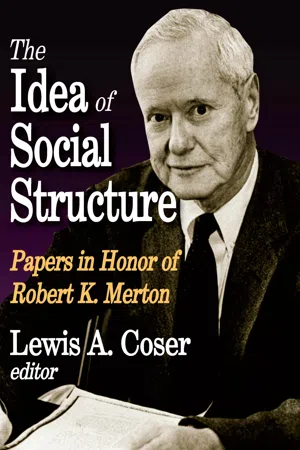 eBook - ePub
The Idea of Social Structure
Papers in Honor of Robert K. Merton
- Lewis A. Coser(Author)
- 2017(Publication Date)
- Routledge(Publisher)
Merton’s magisterial essay on “Manifest and Latent Functions” is an attempt to systematize a method of analysis through a critical evaluation of the methods of his predecessors. While registering his deep indebtedness to the tradition of functional analysis as originated by Durkheim, and as pursued by such British luminaries as Radcliffe-Brown and Malinowski, Merton pays them the type of homage that alone befits one’s ancestors in the world of science: he shows how by profiting from their vision a later generation can, from its vantage point, afford to correct and extend it.Merton’s strictures against a global panfunctionalism, his crucial distinctions between latent and manifest functions, his highlighting of dysfunctional consequences, his insistence on the imperative necessity of specifying precisely what unit is subserved by what function, his distinction between motivation or purposes and objective consequences, his insistence on the search for functional alternatives—these, and many other aspects of functional analysis that he codified in his “Paradigm for Functional Analysis in Sociology”33 reveal his building upon the analytical strategies of his predecessors. By putting them to his own uses, he modifies them in the light of his analytical experience and immensely increases the opportunity to put them to creative uses.Merton’s discussion of the sociology of knowledge proceeds in a parallel manner. Here again, he pays homage to a tradition of which he is proud to be a part. And here again he shows how methodical reflection and immersion in concrete research have led him to modify what he feels are the overly general propositions of Mannheim, Scheler, Durkheim, and others by a more modulated, more modest, and altogether more defensible set of formulations about the relation between mental products and the location of their producers in the social structure. Warning against the variety of highly ambiguous terms that have served in the past to designate the relations between mental products and their societal basis, stressing the need to distinguish between different types and aspects of mental products, emphasizing the requirement clearly to demarcate what such notions as social or cultural basis specifically connote and denote, Merton developed a “Paradigm for the Sociology of Knowledge.”34 eBook - PDF
Concepts and the Social Order
Robert K. Merton and the Future of Sociology
- Yehuda Elkana, György Lissauer, Andras Szigeti, Yehuda Elkana, György Lissauer, Andras Szigeti, Yehuda Elkana, György Lissauer, András Szigeti(Authors)
- 2011(Publication Date)
- Central European University Press(Publisher)
Robert K. Merton and the Transformation of Sociology of Knowledge and Possible New Directions Shmuel Noah Eisenstadt This chapter discusses the place of Robert K. Merton in the transfor-mation of Sociology of Knowledge (SoK) and some indications for possible future directions. The basic sources are the three articles included in Part III of Social Theory and Social Structure , “The Soci-ology of Knowledge and Mass Communications” (Merton 1957), and a second direction indicated in Merton’s thesis on Puritanism in Sci-ence, Technology and Society in Seventeenth Century England (Mer-ton 1970)—or as Harriet Zukermann (1989) has shown, two Merton theses. I shall briefly discuss whether these two directions of Merton’s work on the Sociology of Knowledge are complementary or contra-dictory, and whether a meeting between them indicates possibilities for the future. Significant from this perspective is the great corpus of Merton’s work on sociology of science that manifests one of the trans-formations of SoK. A less well known article co-authored by Merton with Sorokin on social time (Sorokin and Merton 1937) is seeming-ly—but only seemingly—out of kilt from both directions indicated above. Thus the paper also discusses Sorokin’s influence on both Mer-ton and SoK in general. 1 The first question to consider is whether SoK was really transformed from the period when Merton was writing the articles included in Social Theory and Social Structure as well as his dissertation, and, if so, what was the essence of this transformation. Charles Camic wrote an instructive article on SoK in the new international encyclopedia of the Social and Behavioral Sciences (Camic 2004), which, compared with the article written by Lewis Coser about 40 years before (Coser 1968), indicates that Sociology of Knowledge was greatly transformed from the middle or late 1920s and the 1930s onwards in Europe (Shils eBook - ePub
- Freda Adler, William S. Laufer, Freda Adler, William S. Laufer, Freda Adler(Authors)
- 2020(Publication Date)
- Routledge(Publisher)
dysfunction, from the fields of medicine and biology where it had long since become thoroughly domesticated. I note that W.J.H. (“Sebastian”) Sprott, the friend and lover of Maynard Keynes and E.M. Forster, who was surely the only psychologist and autodidactic sociologist in the Bloomsbury set, welcomed not only the SS&A paradigm but the concept of social dysfunction as well, but faithful to his Oxbridge education and associates, quietly transcribed it as disfunction. See his Science and Social Action (London: Watts & Co., 1954), 60, 113–16. This I suppose, in accord with the knowing and witty lexicographer H.W. Fowler who reminds us on page 42 of his knowing and witty Modern English Usage (Oxford University Press, 1926), “that barbarisms [such as bureaucracy, pleistocene, and scientist] should exist is a pity; to expend much energy on denouncing those that do exist is a waste.” But as author of the paper on the multiple origins and epicene character of the much needed Greek-and-Latin hybrid scientist (cited in the first footnote of this chapter), I cannot accept Fowler’s further judgment that “to create [barbarisms] is [necessarily] a grave misdemeanor; & the greater the need of the word that is made, the greater its maker’s guilt if he miscreates it.” Barbarisms such as scientist and sociology, the one coined by the historian and philosopher of science, William Whewell, and the other coined by Auguste Comte at almost the same time, were much needed and have yet to be improved upon by the most zealous of purists. Alas, as is often the way with technical terms-and-concepts that diffuse into the vernacular, social dysfunction, particularly as adapted in the term dysfunctional family, has become “modish and boringly reiterated with successive diminution of meaning.” See R.K. Merton, “Our Sociological Vernacular,” Columbia 50 (November 1981): 42–44.29 . Social Theory and Social Structure (1949 ed.), 50.30 . Ibid., 53–54.31 . Ibid., 115 (emphasis added).32 . Emile Durkheim, Les règles de la méthode sociologique (Paris: Alcan, 1895), passim; a concept further developed and variously applied, of course, in DurkheinTs other foundational books.33 . Peter Blau, “Structural Constraints and Opportunities: Merton’s Contributions to General Theory,” in Robert K. Merton: Consensus and Controversy, ed. Jon Clark et al., 147 (London & New York: Falmer Press, 1990).34 . Arthur Stinchcombe, in Coser, The Idea of Social Structure, 11–33; Piotr Sztompka, Robert K. Merton: An Intellectual Profile (New York: St. Martin’s Press, 1986), 142–90; for anomie-and-opportunity-structure theory, esp. pp. 182- 91; Charles Crothers, Robert K. Merton (London: Ellis Harwood and Tavistock Publications, 1987), 120–26; Peter M. Blau, “Structural Constraints of Status Complements,” in Coser, The Idea of Social Structure, 117–38 and “Structural Constraints and Opportunities,” in Clark et al., Robert K. Merton, 141–55. Earlier observations on the basically structural character of this mode of sociological theorizing have been set forth by Charles and Zona Loomis, Modern Social Theories (New York: D. Van Nostrand, 1965), chap. 5 , 246–326; Filippo Barbano, “Social Structures and Social Functions: The Emancipation of Structural Analysis in Sociology,” Inquiry 11 (1968): 40–84; Walter Wallace, Sociological Theory (Chicago: Aldine Press, 1969), 1–60; Raymond Boudon, The Uses of Structuralism (London: Heinemann, 1971). See also R.K. Merton, “Structural Analysis in Sociology,” in Approaches to the Study of Social Structure eBook - PDF
The Rise of the Quants
Marschak, Sharpe, Black, Scholes and Merton
- C. Read(Author)
- 2012(Publication Date)
- Palgrave Macmillan(Publisher)
Harvard accepted him, no doubt as a result of the intervention of Sorokin, who promptly hired Robert as his new research assistant and collaborator. Robert King Merton completed his PhD in sociology at Harvard and became renowned in and beyond sociology circles for his bril- liant insights and methodologies. He spent most of his professional career in New York City at Columbia University. He was the former President of the American Sociological Association and, in 1994, was awarded a National Medal of Science by President Bill Clinton, the first sociologist to be granted this award. He also coined such terms as “self-fulfilling prophecy,” “role model” and “focus groups,” which are still used today. And in his epic but undertitled essay, “A Note on Science and Democracy,” he quoted Isaac Newton as having said “If I have seen farther, it is by standing on the shoulders of giants.” He may have anticipated the work of his son and of a finance discipline grap- pling with uncertainty through the last book of his life, The Travels and Adventures of Serendipity. Robert King Merton, the first-generation son of Jewish immigrants, married Suzanne Carhart in 1934. While his parents arrived in the USA only a few years before he was born, Suzanne’s ancestors were some of the first families to arrive in North America from England in the 1600s. Her namesake, Thomas Carhart, was born in 1650 in Antony, Cornwall, England, and settled in New York. Their first son, Robert Carhart Merton, was born on July 31, 1944 in New York City and shared the names of those from the first and the last big wave of European immigrants. The couple also had two daughters, Stephanie and Vanessa. 138 The Rise of the Quants The younger Robert was raised in one of the most intellectually stimulating environments imaginable, at the family home in Hastings- on-Hudson, a small village of 8,000 people just outside New York City. The community was middle income and blue collar in Westchester County.
Index pages curate the most relevant extracts from our library of academic textbooks. They’ve been created using an in-house natural language model (NLM), each adding context and meaning to key research topics.

