Technology & Engineering

Channel Tunnel
The Channel Tunnel, also known as the Eurotunnel, is a 31.4-mile undersea rail tunnel that connects the United Kingdom and France. It is one of the longest undersea tunnels in the world and is a significant engineering achievement. The tunnel allows for the transportation of passengers and freight between the two countries, playing a crucial role in international travel and trade.
Written by Perlego with AI-assistance
Related key terms
1 of 5

11 Key excerpts on "Channel Tunnel"
 eBook - ePub
Project Financing
Asset-Based Financial Engineering
- John D. Finnerty(Author)
- 2013(Publication Date)
- Wiley(Publisher)
Chapter 20 Case Study: The Eurotunnel ProjectThe first recorded plans for a cross-English Channel link between the United Kingdom and France date back to 1753.1 Since the early nineteenth century other plans for linking Britain with the mainland have periodically been drafted and then shelved. Tunneling actually started on the British side in 1882. But it was abandoned soon after. The mouth of the unfinished tunnel still yawns from the chalk bedrock near Dover.The Eurotunnel Project was initiated in 1984. The construction was planned as a twin-bore rail tunnel with associated infrastructure, rolling stock, and terminals. Upon completion, scheduled for 1993, it would join the rail systems of the United Kingdom, France, and the rest of mainland Europe. Its comfortable, fast, frequent, and reliable service would furnish a valuable link between the United Kingdom and France, beneath the English Channel. The construction was technically straightforward from an engineering standpoint. However, the enormity of the undertaking would require close logistical coordination.The project had symbolic value. It was initiated at about the time members of the European Economic Community (EEC) were ratifying the Single European Act to create, by 1992, a single integrated European economic system. The project was also innovative. The method of financing, which provided for private capital to bear the long-term infrastructure development risk, had not been tested in the world capital markets for decades.Historical Background
In 1973, French President Georges Pompidou and British Prime Minister Edward Heath signed a treaty to construct a twin-bore rail tunnel under the English Channel. Tunneling began in 1974. But when Heath's Conservative government was defeated, the treaty lapsed without ratification by the British Parliament, and tunneling was again abandoned. eBook - ePub
- John Whitelegg(Author)
- 2021(Publication Date)
- Routledge(Publisher)
10 The Channel TunnelThe Channel Tunnel is probably the single most important development in European transport this century. Its significance is as symbolic as it is practical, but in a growing European Community seeking to become more unified and economically successful, symbol and reality are not easily disentangled.The Channel Tunnel’s contribution to European transport and the wider objectives which transport must serve lies in six main areas:- The Unking of Britain’s transport system with mainland Europe and eradication of a major bottleneck for both road and rail transport
- The economic development possibilities which arise from such a stimulus, always bearing in mind the job losses which will result from technological change and the geographic restructuring of economic activity which might work in favour of northern France and to the disadvantage of Kent
- The environmental consequences of a Tunnel, which if properly secured could bring about a transfer from road to rail in Britain and a much improved market share for British Rail (BR) with consequent reduction in lorry traffic on roads
- The much-improved travel opportunities for European citizens with the possibility of frequent and fast journeys from many links in France, Germany, and Italy to important cities in Britain
- The consequences for BR of improved freight and passenger revenue brought about by the exploitation of new business opportunities could mark a turn around in its fortunes
- The Tunnel will almost certainly bring about a strengthening of European ties and European coherence, even if this is more symbolic than actual.
The Channel Tunnel idea
Proposals for a Channel Tunnel go back over 100 years and the project has come very close to fruition on more than one occasion; construction was actually begun in 1974 before the project was cancelled. eBook - ePub
- Robert Wearing(Author)
- 2005(Publication Date)
- SAGE Publications Ltd(Publisher)
1TENThis chapter examines, using a principal–agent framework, the case of Eurotunnel, which operates the Channel Tunnel and provides a permanent rail link between the UK and France. The main services consist of passenger and freight shuttles, as well as through passenger trains (Eurostar) and freight trains. Eurotunnel has recently widened its operations to encompass retailing (as a competitor to ferry operators), property development and even telecommunications.Plans for a fixed link between the UK and France go back some 200 years. The earliest feasible plan is reckoned to have been devised by Albert Mathieu in 1802.2 Mathieu envisaged twin bored tunnels between Cap Gris Nez near Calais and Eastwell Bay near Folkestone, surprisingly close in design and location to the present Eurotunnel. During the nineteenth century various schemes were proposed, many spurred on by the development of the railways. However, apart from obvious considerations such as construction cost, one of the stumbling blocks proved to be the issue of national defence and the question of the security of the UK from possible invasion. By the mid-1970s, it seemed that the issue of national security was no longer a major obstacle and that a collaborative project for a twin bored tunnel might actually go ahead. However, the plan was finally cancelled by the UK government in 1975, mainly on the grounds of rapidly escalating costs, disruption to the parliamentary timetable caused by two general elections in 1974, and environmental considerations (Holliday, Marcou and Vickerman, 1991).By the 1980s the UK government had made it clear that it would support a fixed link only if public funding was not involved. In April 1985 the French and UK governments invited tenders for the construction and operation of a fixed link and, from a shortlist of four consortia, the two governments selected the Eurotunnel proposal in early 1986. In July 1987 the governments ratified a treaty to regulate the construction and operation of the system. The original concession (since extended) was signed in August 1987 and was for the construction and operation of a Channel Tunnel link until July 2042.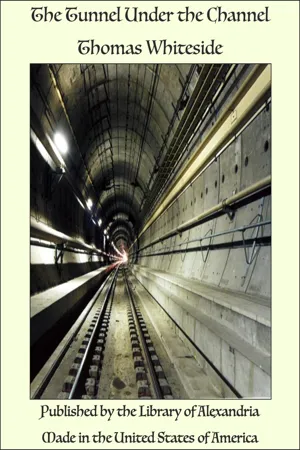 eBook - ePub
- Thomas Whiteside(Author)
- 2021(Publication Date)
- Library of Alexandria(Publisher)
virgo intacta."If the proponents and promoters of the tunnel have never quite succeeded in putting their project across in all the years, they have never quite given up trying, either; and now, in a new strategic era of nuclear rockets, a new era of transport in which air ferries to the Continent carry cars as well as passengers, and a new era of trade, marked by the emergence and successful growth of the European Economic Community, or Common Market, the pro-tunnel forces have been at it again, in what one of the leading pro-tunnelers has called "a last glorious effort to get this thing through." This time they have encountered what they consider to be the most encouraging kind of progress in the entire history of the scheme. In April, 1960, an organization called the Channel Tunnel Study Group announced, in London, a new series of proposals for a Channel Tunnel, based on a number of recent elaborate studies on the subject. The proposals called for twin parallel all-electric railway tunnels, either bored or immersed, with trains that would carry passengers and transport, in piggyback fashion, cars, buses, and trucks. The double tunnel, if of the immersed kind, would be 26 miles long between portals. A bored tunnel, as planned, would be 32 miles long and would be by far the longest traffic tunnel of either the underwater or under-mountain variety in the world. The longest continuous subaqueous traffic tunnel in existence is the rail tunnel under the Mersey, connecting Liverpool and Birkenhead, a distance of 2.2 miles; the longest rail tunnel through a mountain is the Simplon Tunnel, 12.3 miles in length. The Channel Tunnel would run between the areas of Sangatte and Calais on the French side, and between Ashford and Folkestone on the English side. Trains would travel through it at an average speed of 65 miles an hour, reaching 87 miles an hour in some places, and at rush hours they would be capable of running 4,200 passengers and 1,800 vehicles on flatcars every hour in each direction. While a true vehicular tunnel could also be constructed, the obviously tremendous problems of keeping it safely ventilated at present make this particular project, according to the engineers, prohibitively expensive to build and maintain. The train journey from London to Paris via the proposed tunnel would take four hours and twenty minutes; the passenger trains would pass through the tunnel in about thirty minutes. Passengers would pay 32 shillings, or $4.48–$2.92 cheaper than the cost of a first-class passenger ticket on the Dover-Calais sea-ferry—to ride through the tunnel; the cost of accompanied small cars would be $16.48, a claimed 30 per cent less than a comparable sea-ferry charge. The tunnel would take four to five years to build, and the Study Group estimated that, including the rail terminals at both ends, it would cost approximately $364,000,000. eBook - ePub
Macro-Engineering
MIT Brunel Lectures on Global Infrastructure
- F P Davidson, E G Frankl, C L Meador(Authors)
- 1997(Publication Date)
- Woodhead Publishing(Publisher)
- the rolling stock has to accommodate three types of electrical current - picked up in the UK from a third rail and, on the continent, from a catenary. It also has to accommodate three different signalling systems - in Belgium, the UK and France;- the width of the normal TGV carriages has to be reduced to be compatible with the distance between tracks prevalent in the UK; - it uses the heaviest rolling stock ever built; - it has unusual aerodynamic problems resulting from the fact that the Channel Tunnel is really three tunnels connected with each other at intervals.Fig. 3.1 The Channel Tunnel Train(photograph reproduced by permission, from Le Tunnel sous la Manche by Bertrand Lemoine, Le Moniteur, Paris, 1994)The concept of a Channel Tunnel has been alive for a long time. The first detailed proposal came from a French engineer, Mathieu-Favier, who presented his plans to Napoleon soon after the Treaty of Amiens in 1802. His idea was a tunnel ventilated by chimneys rising above the waves and lit by gas lamps. Then there was the scheme of Thomé de Gamond 150 years ago, who attempted the first geological survey by diving from a boat to take samples - with weights on his feet (pig bladder floats), ears full of fat and fabric and a mouth full of olive oil against water pressure. In the process, he had to fight a number of enemies: the cold, the sea, his contemporaries’ skepticism and also some large conger eels who were not enlightened enough to understand the importance of his endeavors.Since then, there have been several more attempts to progress a fixed crossing of the Channel. One of them led to tunnelling that began on both the British and the French coasts with Colonel Beaumont’s machine, a forerunner of today’s Tunnel Boring Machines. None of them proceeded very far, principally because the British military establishment considered a tunnel to be a threat to Britain through invasion. It was not until 1955 that the British government announced that a tunnel was no longer a threat to the country’s security.Fig. 3.2 Col. Beaumont’s original tunnel boring machine, 1881(photograph reproduced by permission, from Le Tunnel sous la Manche eBook - ePub
Voice and Involvement at Work
Experience with Non-Union Representation
- Paul J. Gollan, Bruce E. Kaufman, Daphne Taras, Adrian Wilkinson(Authors)
- 2014(Publication Date)
- Routledge(Publisher)
The chapter is structured as follows. We begin with a presentation of company information and the methodology followed over the course of this research. We continue with a brief literature review on the topic of partnership. This is followed by the empirical data, presented in chronological order: we begin with the first wave of the research that was conducted in 1999, the second wave in 2002, and the third wave in 2010 through 2011. A discussion of the empirical findings follows.Methodology and Company Background
Eurotunnel manages the infrastructure of the Channel Tunnel and runs accompanied truck shuttle and passenger (car and coach) services between Folkestone in the UK and Coquelles in France. The company started operations through the tunnel on 6 May 1994. It is a market leader for cross-channel transporting, handling nearly 50 per cent of passenger traffic. Eurotunnel also earns toll revenue from other train operators: Eurostar for rail passengers and English, Welsh and Scottish Railway (EWS) and the Societé Nationale des Chemins de Fer Français (SNCF) for all rail freight which use the Tunnel—and for coaxial and digital cable links through the tunnel. It operates 24 hours a day, 365 days a year. Since its opening, more than 325 million people have travelled through the tunnel, a figure which includes cars, shuttles, and trucks as well as Eurostar passengers. In addition, more than 300 million tonnes of goods have also been transported, with 88 per cent carried on trucks loaded onto Eurotunnel Truck Shuttles and 12 per cent on goods trains of the rail freight operators (Eurotunnel Group 2012) .Eurotunnel has the lease to operate the Channel Tunnel link between Britain and France until 2086. The company has a complex structure consisting of two legal entities to meet requirements in the UK and France. The UK Head Office is in Folkestone (Longport), with a separate office nearby for some administration activities and the call centre. Between 1993 and 2005, Eurotunnel employed approximately 1,400 staff in Britain. However, in 2005, Eurotunnel management announced a round of voluntary redundancies which left the workforce at approximately 850 staff. eBook - ePub
History of Engineering and Technology
Artful Methods
- Ervan G. Garrison(Author)
- 2018(Publication Date)
- Routledge(Publisher)
Shown in Figure 13.8 the sediments of the Channel overlay Jurassic age rocks in thick layers of chalk and marl. The so-called Lower Chalk was considered to be the best stratum for tunneling purposes as littie or no siliceous deposits such as flint or chert had formed in it. The Upper and Middle Chalks had such deposits creating fissures and water infiltration. The first effort to build a cross-Channel Tunnel begun in 1880 demonstrated the correctness of this assumption by, before it was abandoned for political more than financial reasons, completing 2,040 yards of the English side and 1,840 meters on the French side of the Channel. Examined in the 1980s the 2.1 m (7 ft) tunnel in the Lower Chalk was dry and this without reinforcing. 113 Figure 13.8 Geology of the Channel Tunnel route; overall length 49.4km (31 miles), average depth 40 m (131 ft) (Modified from Hunt, 1994). The next attempt followed the decision by Britain to join the EEC. A pilot tunnel was begun in 1974 and then unilaterally abandoned by the British government in 1975 for financial reasons. To build a Channel Tunnel the financial aspects had to be free from political change. This came to pass in 1987 with the guarantee of 5 billion pounds from fifty international banks to the Eurochannel consortium. 114 The Eurotunnel design is surprisingly like that proposed by William Low. Instead of two tunnels there would be three — two rail tunnels and a middle service tunnel — that would total 151.4 kilometers (93.2 miles) of concrete-lined tunnels. Along the route of the tunnels there would be two cross-overs resulting in rooms 163 m long, 21 m wide and 15 m high before reinforcement and architectural amendments. The service tunnel is diverted, at the crossovers, down and away. 115 British crossover is located 7.8 km (5 miles) down-tunnel from the U.K. portal and the Erench cross-over is 12 km (7.5 miles) from the eastern portal. The tunnels met at 7:30 p.m No longer available |Learn more
Transnational Railway Cultures
Trains in Music, Literature, Film, and Visual Art
- Benjamin Fraser, Steven D. Spalding(Authors)
- 2021(Publication Date)
- Berghahn Books(Publisher)
At the same time that it invites an outward-looking gaze, the Chunnel forcibly turns the national historical gaze within. The Chunnel functions as a predictable site of struggle based not only on how it promises to reshape the political and social geography of the nations it joins but also over how movement through it is to be regulated; in doing so, it shows how “issues of movement, of too little movement or too much or of the wrong sort or at the wrong time, are central to many lives, organisations and governments” (Hannam, Sheller, and Urry 2006, 1)—particularly on the British side as the island nation grapples not only with becoming conjoined to the continent but also with what it means to be a postimperial nation. The Chunnel is also a powerful reminder that “mobilities cannot be described with-out attention to the necessary spatial, infrastructural and institutional moorings that configure and enable mobilities” (3); “detachment” entails “reterritorializations” in part because of how the Chunnel itself draws attention to “re-arrangements of place and scale” (3) by virtue of how it is implicated in a “nexus” of travel—“an expanding system” that “makes places relational” (Urry 2007, 101) and is also bound up with a symbolic “shift from land to landscape” (102) that critics associate with rail travel. Mapping how political and cultural scripts converge in the Chunnel on the British side, then, entails unravelling the representational value it has accrued through its close association with railways. Notably, the rhetoric of Eurostar picks up on the “drive to speed” and the “time-tabling of social life” that are legacies of the “nineteenth-century rail-way” that continue to “cast long shadows over the forms of movement that emerge in subsequent centuries” (Urry 2007, 100). The Rail Europe website notes that Eurostar “specialises in speedy travel” and provides “sleek and effi cient service” as it connects London to “Amsterdam, Brus- eBook - ePub
- Audley Genus(Author)
- 2017(Publication Date)
- Routledge(Publisher)
How should performance be determined, ultimately? Some may suggest the delivery of a complex major European transport system within a year of the date fixed at its inception compares favourably compared to other infrastructure systems. Doubtless the Channel Tunnel represents a major engineering achievement directly linking the UK with the European mainland for the first time. It clearly provides a service to millions of cross-Channel travellers and some spin-off benefits (and costs) to Kent and South-East England. However, the project economics tells another story of the performance of the investment - especially in the light of the project’s near collapse due to financing costs. In the paragraphs below the Channel Tunnel’s performance is assessed in terms of: a) the cost of building the tunnel, mostly capital costs; and b) the revenue gained from the traffic passing through the tunnel once it is operational.With the financing costs on the debt amounting to approximately £700 million per year, Eurotunnel desperately needed quick, substantial and sustained positive cash flows. The traffic passing through the tunnel therefore is a critical component in maintaining Eurotunnel’s existence. However, in addition to underestimating capital costs and lead times, traffic and revenues generated have been overestimated. The build-up of traffic and new services through the tunnel have been delayed, affected in part by the fire in 1996, and revenues per passenger have been slashed by a price war with the ferries. A forecast of 6 million passengers in 1995 has been reduced to 4 million, and then again to 2.5 million (Financial Times, 1998). Freight traffic has also been lower than forecast (The Independent, 1995).The Channel Tunnel project supports the proposition that inflexible technology projects perform badly. Table 3.5 eBook - PDF
Modern Governance
New Government-Society Interactions
- Jan Kooiman(Author)
- 1993(Publication Date)
- SAGE Publications Ltd(Publisher)
Here the questions to ask are: why and how could the Channel Tunnel have been agreed upon and built in two areas where at first so many people were not really in favour of it? The sym-bolic aspect of any fixed link is stronger in Britain than in France. So the legitimacy of the project comes first under scrutiny: once they virtually agreed on the concept of a fixed link, both central governments wanted this project to be implemented quickly, efficiently and at lower costs in order to at trac t the private sector's fina nces. They could either impose their solution on the local authori ties or embark on a kind of bargaining process to reach an acceptable and feasible solution. In fact, imposing one centrally-decided scheme would have surely proved the worst at a time when citizens and sub-national governments claim more participation and local democracy. The Politics of the Channel Tunnel: a Franco-British Compro-mise As mentioned in the previous section, the decision to build a tunnel across the Dover Straits may be controversial because the cost-benefit analysis does not demonstrate an unquestionable balance to its opponents ' eyes. The ferry companies conte nded tha t they could have coped with the whole of the increasing Channel traffic at much lower costs, financially, econ-omically and socially s pe aking. On the question of environmental damages, it must be stressed that in both countries the construc tion and operation sites are situated within conservation areas. The damaging effects of the Channel Tunnel may still increase to the size of what is seen by TGV opponents as an unbearable disaster when the Rail Link spreads 'destruc tion and nuisances' throughou t Kent and Northern France along a five hundred kilometres-long corridor. So finally the two Governments' decision could only be based on a polit ical will asserted on fmancial and technical feasibility much more than on purely socio-economic benefits. eBook - ePub
- David Banister(Author)
- 2003(Publication Date)
- Routledge(Publisher)
It is this failure to recognize the importance of supporting infrastructure which is the major failure of UK policy towards the Tunnel. Here there is a major contrast with France. French trade does not need improved communications through a single narrow corridor to the same extent as the UK (whether this is ultimately ferry or Tunnel traffic is irrelevant). In France national and regional policy responses to the Tunnel largely coincide in Nord-Pas de Calais. In the UK the potential beneficiaries are spread out over a large number of more distant regions, but they all need improvements of communications with markets in the same general direction. To this can be added the Irish demands for improved access to continental markets across the UK. In summary, the Tunnel is not just the 50km of the distance from Folkestone to Calais, it is as important as the total networks it serves.The Tunnel as an Instrument of European Integration
It would be unreal to consider the decision to construct the Tunnel as being principally an instrument of either government’s European policy despite the obviously European context of the UK government’s original commitment. The European Commission was also kept at arm’s length by the private finance decision, although the Commission continued to seek a role as did the European Parliament. The Tunnel has nevertheless become a symbol of integration through its sheer size, its cross-border context, its role as a pioneer private finance scheme, and its contribution to the increasing emphasis being placed on rail in the development of European networks. Where the Commission has had a direct policy role is in the development of the networks which connect to the Tunnel. New road schemes in both countries have been aided from the Infrastructure Fund, as has a considerable part of the British Rail investment in upgrading infrastructure for initial Tunnel services. This is increasingly dealt with within the context of trans-European networks.Three broad policy issues emerge at the wider European level: transport policy, regional and cohesion policy, and competitiveness. The transport policy issues concern both infrastructure provision and inter-modal competition. The European Union has begun to recognize the need for a clear framework for both of these because of the important spillovers between member states. We have already discussed the potential for centralization occasioned by the Tunnel and its connecting high speed rail networks, but this has to be set in context, Although there is a bias towards the major metropolitan centres, other parts of the central regions (including Kent and Nord-Pas de Calais) may be disadvantaged. Similarly major centres in more peripheral regions may achieve better accessibility through improved connectivity of networks (Vickerman, 1994b
Index pages curate the most relevant extracts from our library of academic textbooks. They’ve been created using an in-house natural language model (NLM), each adding context and meaning to key research topics.

