Technology & Engineering

Compressor
A compressor is a mechanical device that increases the pressure of a gas by reducing its volume. It is commonly used in various applications, such as refrigeration, air conditioning, and industrial processes, to compress and transport gases. Compressors come in different types, including reciprocating, rotary, and centrifugal, each suited for specific purposes.
Written by Perlego with AI-assistance
Related key terms
1 of 5

5 Key excerpts on "Compressor"
 eBook - PDF
Reciprocating Compressors:
Operation and Maintenance
- Heinz P. Bloch, John J. Hoefner(Authors)
- 1996(Publication Date)
- Gulf Professional Publishing(Publisher)
CHAPTER 1 Reciprocating Compressors and TheirApplications INTRODUCTION The purpose of Compressors is to move air and other gases from place to place. Gases, unlike liquids, are compressible and require compression devices, which although similar to pumps, operate on somewhat different principles. Compressors, blowers, and fans are such compression devices. 9 Compressors. Move air or gas in higher differential pressure ranges from 35 psi to as high as 65,000 psi in extreme cases. 9 Blowers. Move large volumes of air or gas at pressures up to 50 pounds per square inch. 9 Fans. Move air or gas at a sufficient pressure to overcome static forces. Discharge pressures range from a few inches of water to about 1 pound per square inch. WHAT IS A Compressor? BASIC GAS LAWS Before discussing the types of Compressors and how they work, it will be helpful to consider some of the basic gas laws and the manner in which they affect Compressors. By definition, a gas is a fluid having neither independent shape nor form, which tends to expand indefinitely. 2 Reciprocating Compressors: Operation and Maintenance Gases may be composed of only one specific gas maintaining its own identity in the gas mixture. Air, for example, is a mixture of several gases, primarily nitrogen (78% by volume), oxygen (21%), argon (about 1%), and some water vapor. Air may also, due to local conditions, contain vary- ing small percentages of industrial gases not normally a part of air. The First Law of Thermodynamics This law states that energy cannot be created or destroyed during a process, such as compression and delivery of a gas. In other words, when- ever a quantity of one kind of energy disappears, an exactly equivalent total of other kinds of energy must be produced. The Second Law of Thermodynamics This law is more abstract, but can be stated in several ways: 1. Heat cannot, of itself, pass from a colder to a hotter body. eBook - PDF
Handbook of Lubrication and Tribology
Volume I Application and Maintenance, Second Edition
- George E. Totten(Author)
- 2006(Publication Date)
- CRC Press(Publisher)
Gas Compressors are used in nearly every industry sector including: automotive, steel, mining, food, gas and petroleum production, and storage and energy conversion. Global demand for Compressor pumps is expected to grow and additional market opportunities exist for Compressor manufacturers in the global energy production sector due to increasing consumption. Similar equipment market opportunities are expected in the natural gas extraction and transportation industries. Compressors are used not only for gas compression but also for cooling air conditioning and refriger-ation. Refrigeration is that process used to remove heat from a material or gas so that its temperature is less than that of its surroundings. A refrigerant is the working fluid used to transmit heat in a refrigera-tion Compressor, which is used to remove heat from the heat-laden refrigerant vapor in the evaporator 9 -1 9 -2 Handbook of Lubrication and Tribology and which compresses the refrigerant gas to a pressure that will liquefy in the condenser. Refrigeration Compressors are either electrically or mechanically driven and they are used in stationary applications such as home and business air-conditioning and in mobile applications which include automotive and truck air conditioning and refrigeration. Rapid and significant market growth is expected for most types of refrigeration Compressors. Compressors are loosely related to vacuum pumps. A Compressor is used to reduce the volume of a gas, whereas a vacuum pump is essentially a Compressor which operates with an intake pressure below atmospheric pressure. Vacuum pumps are vitally important equipment for nearly every indus-trial sector including the electronic semiconductor industry, steel making, automotive manufacturing, forestry, aerospace, and many others. Compressor manufacture is not only an enormous and growing industry, nearly all Compressors require a lubricant to assure adequate cooling, sealing, and lubrication of internal components.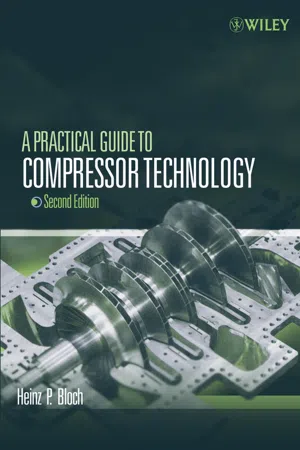 eBook - PDF
- Heinz P. Bloch(Author)
- 2006(Publication Date)
- Wiley-Interscience(Publisher)
6 METAL DIAPHRAGM CompressorS * 121 A Practical Guide to Compressor Technology, Second Edition, By Heinz P. Bloch Copyright © 2006 John Wiley & Sons, Inc. 6.1 INTRODUCTION Gas Compressors are mechanical devices that convert energy from one form to another. Energy conversion can be accomplished by the use of different types of machines, but the net result is the same. The pressure of the gas is increased, and therefore the energy level of the gas is increased. All Compressors have an element that increases the energy level of the gas. It can take the form of a volume reduction element as in the case of positive displacement Compressors or a velocity element as in the case of dynamic Compressors. Metal diaphragm Compressors are positive displacement machines in which the compress- ing element is a metal diaphragm or diaphragm group. The displacing element is a piston hav- ing a reciprocating motion within a cylinder. The metal diaphragm reduces (compresses) the volume of the gas causing the gas pressure to be increased. Thermodynamically, this type of compression is considered flow-type work, and it is an adiabatic or polytropic process of a nonideal gas. 6.2 TERMINOLOGY Metal diaphragm Compressors share many basic elements with positive displacement piston Compressors. Some terms unique to metal diaphragm Compressors are defined below. ● Cavity: a contour of either single or multiple radii machined in a flat plate or disk. Contours are machined in both the process and hydraulic cavity plates and are usually * Developed and contributed by Pressure Products Industries, Inc., Warminster, Pa. mirror images. The sum of the volume of these two cavities is the displacement of the diaphragm group. ● Cavity plate: the plate in which the cavity is machined. Cavity plates are either process or hydraulic. Process cavity plates also contain cooling passages for removing the heat of compression. eBook - PDF
- Rex Miller, Mark Richard Miller, Edwin P. Anderson(Authors)
- 2004(Publication Date)
- Audel(Publisher)
Chapter 7 Compressors for Air Conditioners The components necessary for operating a gas-compression refrig-eration system may be divided into two parts: mechanical and elec-trical. The mechanical components are the Compressor, condenser, receiver, evaporator, and various types of refrigerant controls. In ad-dition, suitable pipelines with the necessary shutoff valves, strain-ers, driers, heat interchangers, fans, pumps, and so on are required, depending on the size of the system and other factors. The elec-trical components consist of such items as the Compressor motor, Compressor contactor or relay, Compressor starter, overload protec-tor, capacitor, potential relay, pressure switch, transformers (when used), evaporator fan, condenser fan, evaporator-fan relay, thermo-stat, and so on, as shown in Figure 7-1. Mechanical Components The most common mechanical components for air conditioners con-sist of the following: Compressors Condensers Receivers Evaporators Refrigerant controls Expansion valves Compressors Compressors are manufactured in various sizes (depending on re-quirements) and are classified according to their method of opera-tion as reciprocating, rotary, and centrifugal. The function of any Compressor is to provide the necessary pumping action to remove the refrigerant gas from the evaporator, compress the gas, and fi-nally discharge the gas into the condenser, where it is liquefied. The pumping action of the Compressor provides the means of lifting the gas from the condition of low to that of high pressure, and the vol-ume of gas to be compressed is dependent on the Compressor piston displacement. The Compressor and component parts are shown in Figure 7-2. 171 172 Chapter 7 R U N MOTOR PROTECTOR WHITE BLACK BLACK BLACK TR. RED R C S RT 3 RED TR. RED RED RED S T A R T B B TERMINAL BOX CONNECTOR T BLOCK TO CONTROLLER YELLOW YELLOW YELLOW YELLOW BLUE JUNCTION BOX POTENTIAL RELAY START CAPACITOR CAP. eBook - PDF
Industrial Gas Handbook
Gas Separation and Purification
- Frank G. Kerry(Author)
- 2007(Publication Date)
- CRC Press(Publisher)
10.3 Compressors 10.3.1 CompressorS 10.3.1.1 G ENERAL When the industrial application of gas separation began, especially with air separation by Linde, it initiated an interest in high-pressure reciprocating air Compressors with a target of 200 bar. This target was lowered to 40 bar, and even to 25 bar when the expander was introduced by Claude in 1902. In the 1930s, when air separation plants began to get larger in capacity, centrifugal machinery began to be used, which did away with the main problem of oil entrainment by reciprocating units used previously. Since the 1950s, even for small plants, centrifugal Compressors have replaced reciprocating machines almost completely for basic air separation. Reciprocating machines of the labyrinth, oil-free type, are still being used, but only for small, high-pressure systems for oxygen compression, or for gases that cannot tolerate contamination. Subsequently, there has been a perennial tug-of-war between com-pressor manufacturers and gas separation designers in trying to fit existing Compressors to preset designs and the demands of new process cycles that change ever so quickly. 10.3.2 DEFINITIONS* 1 In order to set an acceptable standard for terms normally used by the Compressor industry, the following terms are defined: Mass is slightly different from weight. Mass is a quantity of matter. Weight, the force exerted on a given mass by the attraction of gravity, will vary with its distance from the center of the Earth. The difference may be small, but may be important in some cases. Absolute temperature is related to Celsius by the equation K ¼ 8 C þ 273.15 K (Kelvin). Barometric pressure is the absolute atmospheric pressure existing at the surface of the Earth. It varies with altitude and weather (see Appendix). Capacity is the quantity of gas actually delivered when operating between specified inlet and discharge pressures.
Index pages curate the most relevant extracts from our library of academic textbooks. They’ve been created using an in-house natural language model (NLM), each adding context and meaning to key research topics.

