Technology & Engineering

Centrifugal Pump
A centrifugal pump is a mechanical device that uses a rotating impeller to increase the pressure of a fluid. It works by converting the rotational kinetic energy of the impeller into hydrodynamic energy in the fluid. This type of pump is commonly used in industrial, agricultural, and municipal applications for moving liquids.
Written by Perlego with AI-assistance
Related key terms
1 of 5

10 Key excerpts on "Centrifugal Pump"
 eBook - PDF
Power Plant Centrifugal Pumps
Problem Analysis and Troubleshooting
- Maurice L. Adams(Author)
- 2017(Publication Date)
- CRC Press(Publisher)
Section I Primer on Centrifugal Pumps http://taylorandfrancis.com 3 1 Pump Fluid Mechanics, Concepts, and Examples Centrifugal Pumps are used in the majority of all fluid flow processes. The complexities of the fluid flow patterns and design practicalities for these pumps have involved intensive engineering endeavors for well over 100 years. The requirements of these pumps vary considerably for different industries and applications. Power plant requirements for Centrifugal Pumps are among the most demanding of any industry. With the advent of modern computational fluid mechanics (CFM), finite element analyses (FEA), mea- surement sensors, and digital data processing, the evolution of Centrifugal Pump technology development still continues to advance. 1.1 Flow Complexity and Flow-Path Geometry The flows in both stationary and rotating internal flow passages of cen- trifugal pumps are quite complicated. Even when operating at the best effi- ciency point (BEP) 100% design flow, Centrifugal Pump internal flow fields are somewhat unsteady. At off-design operating flows the internal flows are highly unsteady. Showing still pictures like Figure 1.1 does not convey this flow unsteadiness, providing only instantaneous snap shots of typical flow fields within and around the rotating impeller flow passages. Centrifugal Pumps are closely related to hydro turbines, the fundamental distinction being that in turbines mechanical energy is extracted from the fluid, whereas in pumps mechanical energy is transferred to the fluid. This distinction results in a major fluid dynamical difference between Centrifugal Pumps and hydro turbines, namely that within turbine impellers the fluid is accelerated like in a nozzle, while within pump impellers the fluid is decel- erated like in a diffuser . This fundamental difference makes highly efficient hydraulic design considerably more challenging for Centrifugal Pumps than for turbines.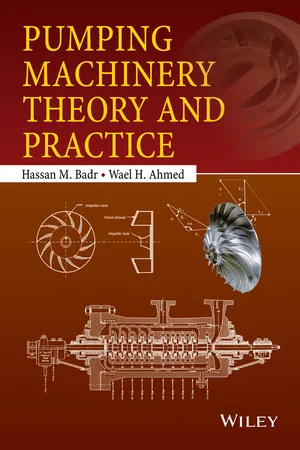 eBook - ePub
- Hassan M. Badr, Wael H. Ahmed(Authors)
- 2014(Publication Date)
- Wiley(Publisher)
3 Fundamentals of Energy Transfer in Centrifugal PumpsUnderstanding the process of energy transfer from mechanical input work to output fluid power occurring inside the pump is essential, not only for designing a new pump but also for optimizing the operation of an existing one. As we know, the main function of a pump is to increase the energy content of the pumped fluid in the form of increasing pressure, kinetic energy, or both. The only place where energy is added to the fluid is inside the impeller through the work done by the impeller vanes to rotate the fluid. Accordingly, the number and shape of these impeller vanes have direct effect on the pump performance characteristics and its overall efficiency. A detailed analysis of the mechanism of energy transfer and the associated flow processes is important for reducing various types of losses. In principle, the amount of energy loss occurring inside the pump depends on the fluid properties, pump size and geometry, pump speed, and flow rate. These losses are divided to three main types: hydraulic, leakage, and mechanical. Each one of these will be studied in detail because of their direct effect on the pump overall efficiency. In this chapter, the main pump components are first introduced and the details of energy transfer from the pump impeller to the fluid are presented. In addition, various means for improving the overall pump efficiency are discussed.3.1 Main Components of the Centrifugal Pump
The design features and main components of each pump depend on the required performance and the actual operating conditions. Some of the pump components are common for all types of pumps and some others are added either to solve an operational-type problem or to add a required feature. The main components of a Centrifugal Pump and the function of each component are given below: eBook - PDF
Water and Wastewater Conveyance
Pumping, Hydraulics, Piping, and Valves
- Frank R. Spellman(Author)
- 2016(Publication Date)
- CRC Press(Publisher)
In many cases, the double suction, closed impeller, or turbine pump will be used. 10 2 6 5 1 4 8 3 9 7 74 Water and Wastewater Conveyance: Pumping, Hydraulics, Piping, and Valves REFERENCES AND RECOMMENDED READING AWWA. (2003). Water Transmission and Distribution , 3rd ed. Denver, CO: American Water Works Association. Card, O.S. (1987). Seventh Son . New York: Tor Books. Cheremisinoff, N.P. and Cheremisinoff, P.N. (1989). Pumps, Compressors, Fans: Pocket Handbook . Boca Raton, FL: CRC Press. Garay, P.N. (1990). Pump Application Desk Book . Lilburn, GA: Fairmont Press. Lindeburg, M.R. (1986). Civil Engineering Reference Manual , 4th ed. San Carlos, CA: Professional Publications. OCDDS. (1986). Basic Maintenance Training Course . North Syracuse, NY: Onondaga County Department of Drainage and Sanitation. Tchobanoglous, G., Ed. (1981). Wastewater Engineering: Collection and Pumping of Wastewater . New York: McGraw-Hill. 75 6 Centrifugal Pump Components All Centrifugal Pumps utilize but one pumping principle: the impeller rotates the water at high velocity, building up a velocity head. Garay (1990) INTRODUCTION The chapter’s opening statement succinctly points out the very basic operating prin-ciple of a Centrifugal Pump. On the surface, the simplicity of this statement points to the simplicity of the Centrifugal Pump itself; however, we must keep in mind that, although it is a “simple” hydraulic machine, it is also a composite of several major components, which should be familiar to water/wastewater maintenance operators who must perform routine maintenance on the pump. Earlier we briefly touched upon the components making up a simple Centrifugal Pump. In this chapter, we describe in greater detail each of the major components of Centrifugal Pumps (i.e., casing, impeller, shafts and couplings, stuffing boxes, and bearings), including their construction and function. K EY T ERMS AND D EFINITIONS Axial load —A load parallel to the shaft. eBook - PDF
Pumping
Fundamentals for the Water and Wastewater Maintenance Operator
- Frank R. Spellman, Joanne Drinan(Authors)
- 2001(Publication Date)
- CRC Press(Publisher)
[Note: The term water includes both freshwater (potable) and/or wastewater, unless otherwise specified.] Because the pump will not operate if there is no low-pressure zone created at the cen-ter of the impeller, it is important that the casing be sealed to prevent air from entering the casing. To ensure the casing is airtight, the pump includes some type of seal (mechanical or conventional packing) assem-lntroduction to Centrifugal Pumps 55 VI 0 ~ a ~ g· 0 ~ S. ~ a ~ -a Shaft Thrust bearing PwDp frame Radial bearing Packing gland Discharge Volute wear ring Rgure3.1L---------------------------------------------------------------------~ Centrifugal Pump-major components. bly at the point where the shaft enters the casing. This seal also includes some type of lubrication (water, grease, or oil) to prevent excessive wear. When the water enters the casing, the spinning action of the impeller transfers energy to the water. This energy is transferred to the water in the form of increased speed or velocity. The water is thrown outward by the impeller into the volute casing where the design of the casing (Section 4.2.1) allows the velocity of the water to be reduced, which, in turn, con-verts the velocity energy (velocity head) to pressure energy (pressure head). The process by which this change occurs is described in Section 3.3. The water then travels out of the pump through the pump discharge. The major components of the Centrifugal Pump are shown in Figure 3.1. THEORY The volute-cased Centrifugal Pump provides the pumping action nec-essary (i.e., converts velocity energy to pressure energy) to transfer water from one point to another (see Figure 3.2). The rotation of a series of vanes in an impeller creates pressure. The motion of the impeller forms a partial vacuum at the suction end of the impeller. Outside forces, such as the atmospheric pressure or the weight of a column of liquids, push water into the impeller eye and out to the periphery of the impeller. eBook - PDF
- Paresh Girdhar, Octo Moniz(Authors)
- 2011(Publication Date)
- Newnes(Publisher)
2 Centrifugal Pump design and construction In the previous chapter, we have studied different types of centrifugal and positive displacement pumps and their various distinguishing external features. In this chapter, we will learn about various types of internal components of Centrifugal Pumps. The diversity among pumps does not only limit itself to the external features of the machines but also extends to its internal components. This is especially true in the case of Centrifugal Pumps. The basic components are essentially the same in almost every design but depending on the design and its applications, the construction features of the internal components differ to meet various requirements. 2.1 Impellers The impeller of the Centrifugal Pump converts the mechanical rotation to the velocity of the liquid. The impeller acts as the spinning wheel in the pump. It has an inlet eye through which the liquid suction occurs. The liquid is then guided from the inlet to the outlet of the impeller by vanes. The angle and shape of the vanes are designed based on flow rate. The guide vanes are usually cast with a back plate, termed shroud or back cover , and a front plate, termed front cover . Impellers are generally made in castings and very rarely do come across fabricated and welded impellers. Impellers can have many features on them like balancing holes and back vanes. These help in reducing the axial thrust generated by the hydraulic pressure. This is covered in Chapter 4. In order to reduce recirculation losses and to enhance the volumetric efficiency of the impellers, they are provided with wearing rings. These rings may be either on the front side or on both the front and backsides of the impeller. It is also possible to have an impeller without any wearing rings. The casting process, as mentioned above, is the primary method of impeller manufacture. Smaller size impellers for clean water maybe cast in brass or bronze due to small section thickness of shrouds and blades. eBook - PDF
- H.H. Anderson(Author)
- 2012(Publication Date)
- Elsevier Science(Publisher)
Reciprocating pumps are, therefore, confined to duties where quantity is low and pressure high, for example, quantities up to lOlls and pressures up to 2 000 bar. Field of Operation of Centrifugal Pumps Centrifugal Pumps are used for duties varying in quantity from the smallest to the largest, the upper limit being dictated only by the ability to manufacture and to transport. At the present time, the maximum flow achieved is of the order of a hundred cubic metres per second or ten million tonnes a day, the maximum stage head is 2000 m and the maximum pressure ifs 600 bar. Site welding of casings are splitting of impellers for transport has permitted the installation of water turbines of 700 MW and pumps of 200 MW each. In short, the Centrifugal Pump is second only to the electric motor in frequency of use in the world, and in this application has virtually no limits other than reasonable shape of impeller, and with it a reasonable efficiency. This latter aspect is discussed later under the heading of Shape Number. General Construction A Centrifugal Pump comprises, basically, an impeller and a casing together with dri ving shaft. The point at which the shaft enters the casing require a stuffing-box with gland or a seal. Sleeves, neckrings, wearing rings, etc. are provided at points where stationary and rotating parts are close together. The shaft will require journal and thrust bearings and a coupling from the driving unit. The impeller may be of the single entry type (with hydraulic or mechanical balancing devices) or the double entry type. Single entry impellers are generally fitted to casings which are split on a plane normal to the shaft axis. Double entry impellers are generally fitted to casings split on the horizontal centre line, ie in the plane containing the shaft axis. The latter arrangement permits the placing of the branches below the centre line so that, by removing the upper half casing, the pump can be examined without disturbing pipes. eBook - PDF
- R. Keith Mobley(Author)
- 2011(Publication Date)
- Butterworth-Heinemann(Publisher)
17 PUMPS C ENTRIFUGAL P UMPS Centrifugal Pumps basically consist of a stationary pump casing and an impeller mounted on a rotating shaft. The pump casing provides a pressure boundary for the pump and contains channels to properly direct the suction and discharge flow. The pump casing has suction and discharge penetrations for the main flow path of the pump and normally has a small drain and vent fittings to remove gases trapped in the pump casing or to drain the pump casing for maintenance. Figure 17.1 is a simplified diagram of a typical Centrifugal Pump that shows the relative locations of the pump suction, impeller, volute, and discharge. The pump casing guides the liquid from the suction connection to the center, or eye, of the impeller. The vanes of the rotating impeller impart a radial and rotary motion to the liquid, forcing it to the outer periphery of the pump casing, where it is collected in the outer part of the pump casing, called the volute . The volute is a region that expands in cross-sectional area as it wraps around the pump casing. The purpose of the volute is to collect the liquid discharged from the periphery of the impeller at high velocity and gradually cause a reduction in fluid velocity by increasing the flow area. This converts the velocity head to static pressure. The fluid is then discharged from the pump through the discharge connection. Figure 17.2 illustrates the two types of volutes. Centrifugal Pumps can also be constructed in a manner that results in two distinct volutes, each receiving the liquid that is discharged from a 180-degree region of the impeller at any given time. Pumps of this type are called double 331 volute pumps. In some applications the double volute minimizes radial forces imparted to the shaft and bearings because of imbalances in the pressure around the impeller.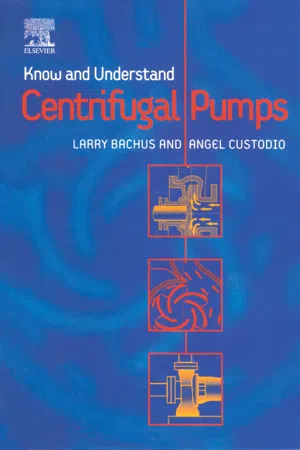 eBook - PDF
- L. Bachus, A Custodio(Authors)
- 2003(Publication Date)
- Elsevier Science(Publisher)
Know and Understand Centrifugal Pumps Figure 6-12 9 The can may fracture (see advantages). 9 Less efficient than conventional pumps. 9 May consume more energy (BHP) than conventional pumps. 9 Cannot see the direction of rotation. Pump impellers The pump impeller receives the pumped liquid and imparts velocity to it with help from the electric motor, or driver. The impeller itself looks like a modified boat or airplane propeller. Actually, boat propellers are axial flow impellers. Airplane propellers are axial flow impellers also, except that they are adapted to handle air. As a general rule, the velocity (speed) of the impeller and the diameter of the impeller, will determine the head or pressure that the pump can generate. As a general rule, the velocity and the height of the impeller blades, will determine the flow (gpm) that the pump can generate (Figure 6-13). Remember that pumps don't actually generate flow (no pump in the world can convert three gallons per minute at the suction nozzle into four gallons per minute out of the discharge nozzle), but this is the term used in the industry. Pump impellers have some different design characteristics. Among 64 I ....... ~r L? ............... ~_ I I rll IIIIIII IIIIInll Pump Classification Figure 6-13 them is the way that the impeller receives the liquid from the suction piping. A classic pump impeller receives the liquid at the impeller's ID. By centrifugal force and blade design, the liquid is moved through the blades from the ID to the O D of the impeller where it expels the liquid into the volute channel. Turbine impellers On the other hand, turbine impellers receive the liquid at the outside diameter of the impeller, add velocity from the motor, and then expel the liquid, also at the OD to the discharge nozzle. Because these impellers have little available area at the OD, these impellers don't move large quantifies of liquid. eBook - PDF
- Heinz P. Bloch, Claire Soares(Authors)
- 1998(Publication Date)
- Butterworth-Heinemann(Publisher)
Chapter 7 Centrifugal Pumps There are two main types of Centrifugal Pumps in process plant service: volute pumps and turbine pumps. The former is more common. Some important pump types, applications and ratings are listed in Table 7.1. Although pump designs have not progressed as noticeably as gas turbine devel- opment, innovative manufactures are constantly finding ways to do a dirty or difficult job for less cost. This is particularly true in applications where abrasive, corrosive, variable content (in terms of liquid versus solid percentage), and variable flows are concerned. As industry becomes more diverse, it becomes more practical to consider models that have fewer moving parts, and avoid more expensive (often larger capacity) conventional designs that have some universal (common to all applications) features. In universal applications, main components such as casing and impeller dimensions might be identical. Other components, such as special seals to handle hazardous fluids, wear plates and rings to handle erosive particles are then added to adapt the pump for the application. The reader is therefore encouraged to use Table 7.1 as the basis for exploring different manufacturers and new proven designs when plant expansion or retrofit needs so dictate. This is an increasingly competitive market, however. Hence, the operator might save on initial capital as well as operational and maintenance costs and yet retain operational flexibility for variable flows by selecting smaller, less expensive units that are tailored for very specific applications. In the case of turbine pumps, one welcome development has been the development of variable vane pumps. Large power savings of over 20% are realized, greater flow variations with an increase in upper volume transmitted are possible, giving the turbine pump access to further fields of application (see Appendix 7D). eBook - PDF
- Michael Volk(Author)
- 2013(Publication Date)
- CRC Press(Publisher)
41 4 Centrifugal Pump Types and Applications I. Overview Now that the reader has been introduced to pumps in Chapter 1 and has developed a solid foundation in hydraulic theory related to Centrifugal Pumps from Chapters 2 and 3, it is time to begin looking at hardware. This chapter devotes itself to a discussion of the mechanical features and applica-tions of the most important types of Centrifugal Pumps. The chapter begins with a discussion on impeller types, because the impel-ler is the most important component of the pump. The chapter describes the two most common types of impellers (open and closed), with a discussion on the physical features, types of leakage joint, and applications most suited to each type of impeller. Single and double suction impellers are described. The explanations of these major impeller types lead into discussions of impeller wear rings, suction specific speed, axial thrust and thrust balancing, filing of impeller vane tips, and solids handling impellers. Following the introduction to impellers, the bulk of the remainder of Chapter 4 examines the most common types or configurations of Centrifugal Pumps. Each pump type is described as to its physical configuration and to its important hydraulic and mechanical design features. The applications for which each pump type is best suited are described. Note that discussions on sealing systems are presented separately in Chapter 5. The reader is again referred to Appendix A at the end of this book, which lists the major suppliers of centrifugal and positive displacement pumps in the United States, along with an indication of the types of pumps they manufacture. As mentioned in Chapter 1, Appendix A should by no means be considered all-inclusive, but merely a listing of the manufacturers with whom the author is familiar. The reader should be able to use an Internet search, a Thomas Register , or similar directory to locate particular manufac-turers shown in Appendix A.
Index pages curate the most relevant extracts from our library of academic textbooks. They’ve been created using an in-house natural language model (NLM), each adding context and meaning to key research topics.

