Technology & Engineering

Dynamic Pump
A dynamic pump is a type of pump that uses rotating or reciprocating parts to move fluid. It operates by converting mechanical energy into fluid flow. Dynamic pumps are commonly used in various applications, such as in industrial processes, water treatment, and HVAC systems, due to their efficiency and ability to handle a wide range of flow rates and pressures.
Written by Perlego with AI-assistance
Related key terms
1 of 5
9 Key excerpts on "Dynamic Pump"
 eBook - PDF
- Michael Volk(Author)
- 2013(Publication Date)
- CRC Press(Publisher)
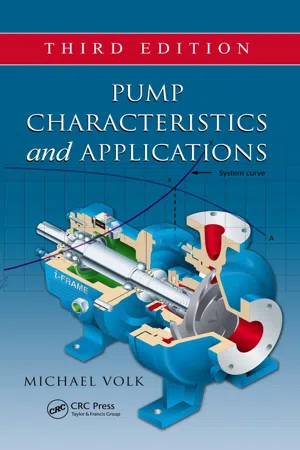
1 1 Introduction to Pumps I. What Is a Pump? Simply stated, a pump is a machine used to move liquid through a pip-ing system and to raise the pressure of the liquid. A pump can be further defined as a machine that uses several energy transformations to increase the pressure of a liquid. The centrifugal pump shown in Figure 1.1 illus-trates this definition. The energy input into the pump is typically the energy source used to power the driver. Most commonly, this is electricity used to power an electric motor. Alternative forms of energy used to power the driver include high-pressure steam to drive a steam turbine, fuel oil to power a diesel engine, high-pressure hydraulic fluid to power a hydraulic motor, and compressed air to drive an air motor. Regardless of the driver type for a centrifugal pump, the input energy is converted in the driver to a rotating mechanical energy, consisting of the driver output shaft, operating at a certain speed, and transmitting a certain torque. The power transmit-ted from the driver to the pump is a function of the rotating speed times the torque. The remaining energy transformations take place inside the pump itself. The rotating pump shaft is attached to the pump impeller (see Figure 1.4). The rotating impeller causes the liquid that has entered the pump to increase in velocity. This is the second energy transformation in the pump, where the input power is used to raise the kinetic energy of the liquid. Kinetic energy is a function of mass and velocity. Raising a liquid’s velocity increases its kinetic energy. After the liquid leaves the impeller, but before exiting the pump, the final transformation of energy occurs in a diffusion process. An expansion of the flow area causes the liquid’s velocity to decrease to more than when it entered the pump, but well below its maximum velocity at the impel-ler tip. This diffusion transforms some of the velocity energy to pressure energy. eBook - PDF
- Theunis Christoffel Robberts(Author)
- 2013(Publication Date)
- CRC Press(Publisher)
85 © 2010 Taylor & Francis Group, LLC Chapter 5 Pumps 5.1 Introduction Transfer of liquids and gases is a basic operation in many manufacturing plants and is frequently taken for granted. We accept water flowing from a faucet as normal, the way it should be. We seldom think about the process to pump water from a well, through various treatments, and into an elevated reservoir from where it flows into our homes. Pipelines and pumps are efficient means of transferring liquids and gases from one operation to another. For robotic and automated processes, operations frequently involve hydraulic fluid transfer and control. Many components in high-speed machinery require constant lubrication by special pumps to keep them working. 5.2 General Principles No matter what needs to be pumped, the pump selected should be able to do the work at minimum cost and maximum efficiency and reliability. The pumping of wide varieties of fluids through the different pieces of equipment adds to the com-plexity of the pumping process. A pump is a machine that transfers mechanical energy to a fluid. The term “pump” is reserved for machines that handle incompressible fluids. The machines that handle compressible fluids are called compressors. In a pumping operation, the pressure of the fluid will increase and cause it to flow downstream in a direc-tion of lower pressure. On the intake side, we can also think of a pump as a classic suction system, where the pressure is reduced to a level at which fluid flows toward the pump. 86 ◾ Food Plant Engineering Systems © 2010 Taylor & Francis Group, LLC To transport fluid, it is essential that enough energy be added to overcome fric-tional losses. Many factors are considered when the size and type of pump are selected: 1. The pressure required (pressure head) 2. Volumetric flow rate (velocity head) 3. Properties of the fluid handled a. Density b. Viscosity c. Oxidation sensitivity d. Abrasiveness e. Flow properties (Newtonian or non-Newtonian) f. eBook - PDF
- Heinz P. Bloch, Claire Soares(Authors)
- 1998(Publication Date)
- Butterworth-Heinemann(Publisher)
For the purpose of this discussion, it is appropriate to organize the pump universe by classifying pumps based on the method by which the pump imparts energy to the liquid being pumped. This results in two basic classes of pumps dynamic and displacement. Dynamic Pumps encompass those shown on the left-hand side of Figure 8-1, and these impart energy to the liquid in a steady fashion. Displacement pumps encompass the remaining pumps in Figure 8-1, and these impart energy to the liquid in a pulsating fashion. The usual basic characteristics of the dynamic and displacement pumps are shown in Table 8.1. By examining this table, it is possible to identify the class of pump required for the job from its characteristics. This segment of our text is primarily concerned with the world of metering pumps, which is within the positive displacement, reciprocating class of pumps. * Source: Metering Pump Handbook, Industrial Press, Inc., New York, NY, 1984. Adapted by permission. 309 eBook - PDF
Turbomachinery
Design and Theory
- Rama S.R. Gorla, Aijaz A. Khan(Authors)
- 2003(Publication Date)
- CRC Press(Publisher)
2 Hydraulic Pumps 2.1 INTRODUCTION Hydraulics is defined as the science of the conveyance of liquids through pipes. The pump is often used to raise water from a low level to a high level where it can be stored in a tank. Most of the theory applicable to hydraulic pumps has been derived using water as the working fluid, but other liquids can also be used. In this chapter, we will assume that liquids are totally incompressible unless otherwise specified. This means that the density of liquids will be considered constant no matter how much pressure is applied. Unless the change in pressure in a particular situation is very great, this assumption will not cause a significant error in calculations. Centrifugal and axial flow pumps are very common hydraulic pumps. Both work on the principle that the energy of the liquid is increased by imparting kinetic energy to it as it flows through the pump. This energy is supplied by the impeller, which is driven by an electric motor or some other drive. The centrifugal and axial flow pumps will be discussed separately in the following sections. 2.2 CENTRIFUGAL PUMPS The three important parts of centrifugal pumps are (1) the impeller, (2) the volute casing, and (3) the diffuser. 2.2.1 Impeller The centrifugal pump is used to raise liquids from a lower to a higher level by creating the required pressure with the help of centrifugal action. Whirling motion is imparted to the liquid by means of backward curved blades mounted on a wheel known as the impeller. As the impeller rotates, the fluid that is drawn into the blade passages at the impeller inlet or eye is accelerated as it is forced radially outwards. In this way, the static pressure at the outer radius is much higher than at the eye inlet radius. The water coming out of the impeller is then lead through the pump casing under high pressure. eBook - PDF
- William Graebel(Author)
- 2018(Publication Date)
- CRC Press(Publisher)
533 chapter 11 Hydraulic Machinery Chapter Overview and Goals Hydraulic machinery is an important engineering application of the material we have covered in earlier chapters. In studying the behavior of hydraulic machines, we first present the suitable dimensionless parameters needed to describe the machines, and select those suitable for a given application. Descriptions of several types of pumps are then presented, along with a discussion of turbines used for electric power generation. Other issues involved in the design of a pumping system are discussed in Appendix G. 1. Pump Classification and Selection The use and design of hydraulic machinery is important to many engineering tasks. Hydraulic machinery can be broadly divided into two classes: pumps and turbines. A pump converts mechanical or electrical energy from an outside source into hydraulic energy, often in the form of a pressure rise. Many hydraulic machines used in engineering applications are centrifugal machines, where an essential part of the machine is a rotating member. This member is called an impeller, or a rotor, or a runner, depending on the type of machine. The pressure rise across the pump is due to the kinetic energy imparted to the fluid by the rotation. Positive displacement pumps on the other hand use pistons or rotary vanes to increase the pressure by compressing the fluid. In a sense a turbine is a pump running backward, in that it converts hydraulic energy into mechanical energy. Most turbines are centrifugal machines. There are many varieties of pumps available, each satisfying different needs or a different range of operating conditions. They may be divided two main classifications of pumps, the positive displacement pump and the turbomachine pump. a. Positive displacement pumps A positive displacement pump is used when it is necessary to develop high heads or create a suction lift.
- Steven Vogel(Author)
- 2009(Publication Date)
- Princeton University Press(Publisher)
It elim-inates contact between fluid and pump housing and tolerates flows of variable viscosity and of fluids with suspended solids. But the technologi-cal versions perform inefficiently and are not particularly reliable, so they remain uncommon. The flows produced by displacement pumps range 188 • Chapter 10 from nearly steady to severely pulsatile unless paired with some external buffer. Those in the other category are called “dynamic,” “fluid dynamic,” or “rotodynamic” pumps; this last name recognizes their ordinarily rota-tional operation. All depend on fluid dynamics rather than fluid statics. The commonest drive fluids with axial or centrifugal fans and are most familiar as propellers and squirrel-cage air blowers. Another type is the jet pump, in which fluid gets pushed through a channel or duct by an axial squirt through a jetting orifice or “eductor” into its stream. While generally lower in efficiency than rotary pumps, jet pumps need no mov-ing solid parts. Related to jet pumps are other devices in which one flow induces another. A vacuum pump that attaches to a tap water outlet is a kind of inverse version—the main flow draws air out of the orifice. Old-fashioned carburetors drew in gasoline this way, and we sometimes ven-tilate buildings by using ambient wind to draw air through themselves. Two points motivate this focus on the two categories. First, displace-ment pumps operate best at higher and Dynamic Pumps at lower pres-sures. Not that a sharp value of pressure marks the transition—the sim-plicity of displacement pumps makes them preferable for some low-pressure applications and the smooth operation of Dynamic Pumps underlies their use, often with multiple stages, to produce high pressures. And second, precisely these same distinctions of modus operandi and character of out-put apply to the pumps found in organisms. eBook - PDF
- John Ward-Smith(Author)
- 2018(Publication Date)
- CRC Press(Publisher)
In a turbine there is a reduction of the tangential momentum of the fluid in the direction of movement of the rotor; thus energy is transferred from the fluid to the rotor and hence to the output shaft. In a pump, energy from the rotor is used to increase the tangential momentum of the fluid; subsequent deceleration of the fluid produces a rise in pressure. Rotodynamic machines have several advantages over the positive-displacement type. The flow from most positive-displacement machines is unsteady whereas, for normal conditions of operation, that from a roto-dynamic machine is essentially steady. Most positive-displacement machines require small clearances between moving and stationary parts, and so are unsuited to handling fluids containing solid particles; in general, roto-dynamic machines are not restricted in this way. If discharge from a positive-displacement pump is prevented – for example, by the closing of a valve – the pressure within the pump rises and either the pump stops or some part of the casing bursts; if the discharge valve of a rotoDynamic Pump is closed, however, the rotating impeller merely churns the fluid round, and the energy consumed is converted to heat. Moreover, for dealing with a given overall rate of flow a rotodynamic machine is usually less bulky than one of positive-displacement type. 13.2 RECIPROCATING PUMPS From the point of view of mechanics of fluids a positive-displacement machine holds interest principally because of the unsteady nature of the Reciprocating pumps 593 Fig. 13.1 flow. By way of illustration we shall consider briefly a reciprocating pump handling a liquid. The motion of the piston outwards (i.e. towards the right in Fig. 13.1 ) causes a reduction of pressure in the cylinder, and thus fluid flows into the cylinder through the inlet valve. eBook - PDF
- Carl J. Schaschke(Author)
- 2015(Publication Date)
- CRC Press(Publisher)
118 Solved Practical Problems in Fluid Mechanics Solution A centrifugal pump is a mechanical device used to transport fluids by way of an enclosed impeller rotating at high speed. This widely used device involves the fluid being fed in axially at the centre or eye of the impeller and thrown out in a roughly radial direction by centrifugal action. The large increase in kinetic energy which results is converted into pressure energy at the pump outlet either by using an expanding volute chamber or a dif-fuser, which can be measured using gauges such as those in Figure 5.10. There are considerable variations in impeller design, but virtually all have blades, which are curved, usually backward to the direction of rotation. This arrangement gives the most stable flow characteristic. The head developed depends not only on the size and rotational speed of the pump but also on the volumetric flow rate. The bench testing of equipment is routinely used for the validation of new process equipment or for the testing of existing equipment parameters. It can be carried out under controlled conditions, and the data obtained can be analysed in detail. The testing of the performance of centrifugal pumps typi-cally involves mounting the pump such that the flow and pressure across the FIGURE 5.10 Pressure Gauges on a Centrifugal Pump (Photo from C.J. Schaschke.) 119 Pumps suction and delivery side can be measured. With a wide variation in their design and performance, the most efficient form of operation is limited to a range of flows. The power exerted on the fluid by the pump is the product of the angular velocity of the impeller and its torque: P T o = ω (5.16) where the angular velocity is ω π = 2 60 N (5.17) and the torque is T = Fr (5.18) For a torque arm of 0.179 m, the power input is therefore P NF NF o in ( ) . eBook - PDF
Variable Speed Pumping
A Guide to Successful Applications
- Europump & the Hydraulic Europump & the Hydraulic Insti, Europump & the Hydraulic Insti(Authors)
- 2004(Publication Date)
- Elsevier Science(Publisher)
CHAPTER 9 FOUR Pumps 4.1 Classification of pumps The classification used in this guide first considers the principle by which energy is added to the fluid, i.e. by dynamic action or by displacement, and then identifies different pump geometries by which this principle is implemented. This approach therefore relates the classification to the pump itself and not to liquids handled, materials of construction, method of drive, or shaft orientation. All pumps are divided into the two major categories of rotodynamic and positive displacement. Minor categories are excluded. All the rotoDynamic Pumps shown are centrifugal. Positive displacement pumps are essentially divided into reciprocating and rotary types, depending on the nature of movement of the pressure-producing members. Each of these major clas- sifications is subdivided into several specific types of commercial importance, see Figure 4.1, p. 16.1 4.2 RotoDynamic Pumps 4.2.1 Pump principles and performance characteristics A rotodynamic (centrifugal) pump is a dynamic device for increasing the pressure of a liquid. In passing through the pump, the liquid receives energy from the rotating impeller. The liquid is accelerated circumferential- ly in the impeller, discharging into the casing at high velocity, which is converted into pressure as effectively as possible. The actual shapes of the hydraulic passages of the impeller and the casing are extremely important in order to attain the highest efficiency possible. 1 The form of this classification acknowledges ANSI/HI Pumps-General Guidelines 9.1-9.5 and Pump Handbook by Karassik, Krutzsch, Fraser and Messina. 15 16 Pumps Figure 4.1: Classification of pumps Since the pump is a dynamic device, it is convenient to consider the head generated rather than the pressure. The pump generates the same head of liquid whatever the density of the liquid being pumped.
Index pages curate the most relevant extracts from our library of academic textbooks. They’ve been created using an in-house natural language model (NLM), each adding context and meaning to key research topics.

