Technology & Engineering

Positive Displacement Pump
A positive displacement pump is a type of pump that moves fluid by trapping a fixed amount and forcing it into a discharge pipe. Unlike centrifugal pumps, positive displacement pumps deliver a constant flow regardless of changes in pressure. They are commonly used in applications requiring precise and consistent fluid delivery, such as in hydraulic systems and oil processing.
Written by Perlego with AI-assistance
Related key terms
1 of 5
12 Key excerpts on "Positive Displacement Pump"
 No longer available |Learn more
- Jean Riescher Westcott, A.K. Gupta, S.K. Arora(Authors)
- 2023(Publication Date)
- Mercury Learning and Information(Publisher)
fixed or variable displacement . The output of a fixed displacement device remains constant during each pumping cycle and at a given pump speed. The output of a variable displacement device can be changed by altering the geometry of the displacement chamber. Generally, these devices are used for low volume and high lift.Non positive displacement devices are those where fluid is compressed by the dynamic action of rotating vanes or impellers imparting velocity and pressure to the fluids. These devices are also called as Rotodynamic or hydrodynamic devices .CLASSIFICATION OF HYDRAULIC PUMPS
All pumps may be classified as either positive displacement or non Positive Displacement Pumps.Most pumps used in hydraulic systems are positive displacement. Figure 4.1 shows the classification of pumps.FIGURE 4.1 Classification of Pumps.Positive Displacement PumpS
The word displacement refers to how much fluid a pump can move in a single rotation. Positive Displacement Pumps displace a known quantity of liquid with each revolution of the pumping elements. This is done by trapping fluid between the pumping elements and a stationary casing. Pumping element designs include gears, lobes, rotary pistons, vanes, and screws. Positive Displacement Pumps are found in a wide range of applications such as chemical processing, liquid delivery, marine, pharmaceutical, as well as food, dairy, and beverage processing. These pumps are used when higher head increases are required. Their versatility and popularity are due to their relatively compact design, high-viscosity performance, continuous flow regardless of differential pressure, and ability to handle high differential pressure. Positive Displacement Pumps can be classified as: eBook - PDF
- Heinz P. Bloch, Claire Soares(Authors)
- 1998(Publication Date)
- Butterworth-Heinemann(Publisher)
Chapter 8 Positive Displacement Pumps Positive Displacement Pumps can be divided into two major categories: recipro- cating and rotating. Reciprocating pumps include steam pumps and power pumps, as defined later. Many reciprocating pumps use a flexible membrane or diaphragm and are collectively called diaphragm pumps. Every one of the various types comes in a wide range of sizes, or with modifications, additions, and perhaps auxiliary support equipment. The same is true for the many different types of rotating Positive Displacement Pumps. They include gear pumps, screw pumps, and peristaltic pumps, to name just a few. Each pump category, reciprocating and rotating, can be found in virtually every process plant we would typically encounter in the industrialized world. Not surprising, each has a definite application range, and the vast majority of these application ranges overlap each other. RECIPROCATING Positive Displacement PumpS* Reciprocating Positive Displacement Pumps incorporate a plunger or piston that displaces, or feeds forward, a given volume of fluid per stroke. The basic principle of a reciprocating Positive Displacement Pump is that moving a solid component into the space occupied by a liquid will result in an equal volume of liquid being moved out of that space. To better understand reciprocating Positive Displacement Pumps and their subgroup metering pumps, we must investigate their place within the universe of pumps. The pump universe could be organized in a variety of ways, such as by design, materials of construction, or the liquids pumped. For the purpose of this discussion, it is appropriate to organize the pump universe by classifying pumps based on the method by which the pump imparts energy to the liquid being pumped. This results in two basic classes of pumps dynamic and displacement. Dynamic pumps encompass those shown on the left-hand side of Figure 8-1, and these impart energy to the liquid in a steady fashion.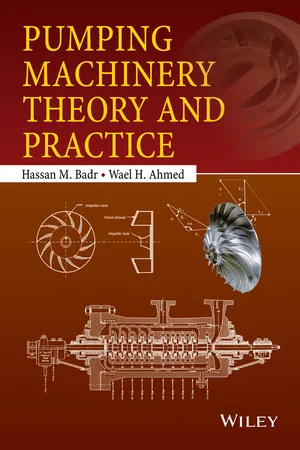 eBook - ePub
- Hassan M. Badr, Wael H. Ahmed(Authors)
- 2014(Publication Date)
- Wiley(Publisher)
7 Displacement Pumps7.1 Introduction
Displacement pumps represent a large category of pumps in which a fixed volume of the pumped liquid is delivered every revolution of the pump shaft (or every cycle if the pump is pneumatically operated). That volume depends on the pump geometry and size. In these pumps, energy is added to the fluid by the direct application of a force that moves the fluid from the low pressure side (suction side) to the high pressure side (delivery side). For applications in which a small flow rate is required to be supplied at high pressure, the use of displacement pumps becomes unavoidable. This is mainly because the total head per stage developed by a centrifugal pump is limited by the impeller diameter, speed of rotation, and impeller vane shape. As the impeller diameter increases, the size of the pump increases and the mechanical losses become very high. On the other hand, the pump speed has a limit because of the prime mover speed limitation and the severe increase in hydraulic losses. Moreover, the head developed by centrifugal pumps is drastically reduced when pumping liquids of high viscosity.Displacement pumps are designed to handle a wide variety of liquids (or mixtures) for a wide range of capacity and pressure. Liquids (or mixtures) handled range from very clean liquids of low viscosity such as diesel fuel in fuel injection pumps (as in diesel engines) to concrete mixtures in concrete handling pumps. The delivery pressure may be very small as in rotary pumps used in food processing or gasoline pumps (in gas stations) and may reach 40 000 psi or higher as in reciprocating pumps utilized in water jetting equipment and also in the petroleum and petrochemical industries. Displacement pumps (such as plunger or diaphragm pumps) are also used for the dual purpose of pumping and metering whenever accurate and reliable metering of liquids is required. This is mainly because the number of revolutions of the pump shaft is an accurate indicator of the volume of fluid supplied. Unlike centrifugal pumps, displacement pumps can be used for handling liquids of high viscosity while maintaining high overall efficiency. They also maintain sufficiently high efficiency when operating at flow rates lower or higher than their normal capacities. The specific speed range for displacement pumps (Ns eBook - ePub
Biermann's Handbook of Pulp and Paper
Volume 2: Paper and Board Making
- Pratima Bajpai(Author)
- 2018(Publication Date)
- Elsevier(Publisher)
One must consider the properties of the fluid to be controlled (abrasiveness, viscosity, corrosiveness, and specific gravity), the flow rates involved, the pressure of the system, the temperature range and gradient to which the pump will be exposed, and the length and frequency of cycling. The suction conditions are also very important. If a pump is being replaced, consider the reason the old pump is no longer suited to the job.23.3. Positive Displacement Pumps
Positive Displacement Pumps actually enclose the fluid to be moved through the system. The pressure and volume at which the liquid can be discharged depend only upon the mechanical strength and size of the properly operating pump and the energy supplied to the pump (neglecting leakage). Pressure relief valves are used to prevent damage to the system or buildup of high, dangerous pressures. Priming of Positive Displacement Pumps may or may not be required.Reciprocating and Diaphragm Pumps
Reciprocating pumps use a piston moving back and forth in a cylinder (see Fig. 23.16 ). Two check valves for the input and output at one end of the cylinder allow one-way flow; this gives a pulsed output. Because rotational motions of engines are not easily converted to reciprocating motions, this type of pulp is seldom used on mobile equipment. Two cylinders can be used to give a continuous output as in pumps for high-performance liquid chromatography, or one cylinder can be made to deliver with either stroke. The diaphragm pump (Fig. 23.1 ) is similar in principle, except that the piston assembly is replaced by a diaphragm and housing; diaphragm pumps are often powered by compressed air and occur as double diaphragm pumps.Figure 23.1 Cutaway of a diaphragm pump with two check valves. Courtesy of Gorman–Rupp.Rotary Pumps (Gear and Lobe Types)
Rotary pumps use a variety of means to generate flow. A pair of gears with many teeth (external to the gear and called an external gear pump) in gear pumps or a few lobes in lobe pumps is demonstrated in Fig. 23.2 . Internal gear pumps use a gear within a gear design; internal means the teeth of one gear are on the inside, projecting inward. Gear pumps are useful for pumping viscous liquids or slurries, but highly viscous liquids will require relatively large, slow-moving pumps to keep NPSHA greater than NPSHR. Helical screws (like a screw press shown in Chapter 15
- Ravi Doddannavar, Andries Barnard, Jayaraman Ganesh(Authors)
- 2005(Publication Date)
- Newnes(Publisher)
The advantages of Positive Displacement Pumps over non-Positive Displacement Pumps are: • Capability to generate high pressures • High volumetric efficiency • Small and compact with high power to weight ratio • Relatively smaller changes in efficiency throughout the pressure range • Wider operating range i.e. the capability to operate over a wide pressure and speed range. As discussed earlier, it is important to understand that pumps do not produce pressure; they only produce fluid flow. The resistance to this flow as developed in a hydraulic system is what determines the pressure. If a Positive Displacement Pump has its discharge port open to the atmosphere, then there will be fluid flow, but no discharge pressure above that of atmospheric pressure, because there is no resistance to flow. If the discharge port is partially blocked, then the pressure will rise due to the resistance to flow. In a scenario where the discharge port of the pump is completely blocked, theoretically an infinite resistance to flow is possible. This will result in a rapid rise in pressure which will result in breakage of the weakest component in the circuit. This is exactly the reason why Positive Displacement Pumps are provided with safety controls, which help prevent the rise in pressure beyond a certain value. A detailed classification of pumps is shown in Figure 3.3. 3.4 Gear pump Gear pumps as the name suggests make use of the principle of two gears in mesh in order to generate pumping action. They are compact, relatively inexpensive and have few moving parts. Gear pumps are further classified as: • External gear pumps • Internal gear pumps • Lobe pumps and • Gerotor pumps. Hydraulic pumps 41 Figure 3.3 Classification of pumps 3.4.1 External gear pump A schematic of an external gear pump is shown in Figure 3.4. An external gear pump consists of two gears usually equal in size, which mesh externally and are housed in a pump case. eBook - PDF
- William Graebel(Author)
- 2018(Publication Date)
- CRC Press(Publisher)
They may be divided two main classifications of pumps, the Positive Displacement Pump and the turbomachine pump. a. Positive Displacement Pumps A Positive Displacement Pump is used when it is necessary to develop high heads or create a suction lift. It can also be used as a metering device. Positive Displacement Pumps are built either in the reciprocating configuration (or alternatively the piston configuration) or the rotary configuration. 534 Hydraulic Machinery The reciprocating or piston pump is usually a low flow rate pump with a given delivery capacity to any required head. They may be single or multiple piston devices. They are used with low to moderate viscosity fluids and will pull a vacuum (suction), i.e. they can be considered self-priming. Some examples of these types of pumps are automobile fuel pumps, reactor charging pumps that deliver 100 gpm at 2,000 psi, ship bilge pumps that deliver 700 gpm at 125 psi with a 15-ft suction lift, and multipiston pumps for use with large die-casting machines that deliver 10 gpm at 2,000 psi. Rotary-type Positive Displacement Pumps are available in various mechanical designs. They can be the wobble plate piston type, the gear type, the sliding vane type, the lobe type (which is a modified gear type), and the screw type. All these pumps are for low flow rates at any given head. They can handle fluids of any reasonable viscosity, such as fuel oils, lubricating oils, hydraulic oils, barnyard sewage, etc. An example of a lobe pump is the oil pump in an automobile. The wobble plate piston type and the sliding vane type are usually built as variable volume-pressure compensated pumps. These operate at a constant speed. When the system’s volume requirements are changed, the position of the pump’s internal mechanical components automatically change, altering the delivery volume. eBook - PDF
- L. Bachus, A Custodio(Authors)
- 2003(Publication Date)
- Elsevier Science(Publisher)
Pump Classification Introduction In Figure 6-1, Pump Classification, we see two principal families of pumps: Kinetic Energy pumps and Positive Displacement Pumps. These two families arc further divided into smaller groups for specific services. Both pump families complete the same function, that is to add energy to the liquid, moving it through a pipeline and increasing the pressure, but they do it differently. Positive Displacement Pumps Positive Displacement Pumps perform work by expanding and then compressing a cavity, space, or moveable boundary within the pump. In most cases, these pumps actually capture the liquid and physically transport it through the pump to the discharge nozzle. Inside the pump where the cavity expands, a zone of low pressure, or vacuum, is generated that causes the liquid to enter through the suction nozzle. Then the pump captures and transports the liquid toward the discharge nozzle where the expanded cavity compresses. In this sense, because the available volume of space at any point inside the pump is a constant, we can say that in theory, these pumps are considered a 'constant volume device' with every revolution or reciprocating cycle. Theoretically, the curve of a Positive Displacement Pump should appear as in (Figure 6-2). 51 Know and Understand Centrifugal Pumps Figure 6-1 Figure 6-2 Pump Classification Figure 6-3 In reality, there are small losses in volume delivered as the pressure or resistance increases, so a more representative PD pump curve appears in Figure 6-3. The flow through a PD pump is mostly a function of the speed of the driver or motor. It is important to note that a pump cannot generate flow. The flow must be available to the pump suction nozzle. In this sense the flow in a PD pump is actually energy, called net positive inlet pressure. The pressure or head that a PD pump can generate is mostly a function of the thickness of the casing and the strength of the associated accompanying parts (seals, hoses, gaskets). eBook - ePub
- R. Rayner(Author)
- 1995(Publication Date)
- Elsevier Science(Publisher)
SECTION THREE Positive Displacement Pumps ROTARY PUMPS: NOMENCLATURE, CHARACTERISTICS, COMPONENTS AND TYPES Rotary pumps Rotary pumps make up the second largest group of pumps in terms of numbers. They also represent the second most economical selection, next to centrifugals. Most rotary pumps are self-priming and along with that have the ability to handle fluids consisting of liquids with entrained gas or vapour. Compared with the high pulsations and definitive batched flow of the reciprocating types, the rotary has a more continuous flow with lower pulsation levels. They are available in types that can handle fluids of extremely high viscosity. However, the most efficient speed drops as viscosity increases above a certain point. This is a function of clearance and the shear action. With high viscosity fluids the clearance is generally opened up by the manufacturer to reduce the power consumption and maintain the low shear effects on the product. Their capacity varies with speed but is affected by pressure to some extent due to its affect on slip in the low viscosity ranges but as viscosity increases this effect continues to diminish to a point. If, at some viscosity, the latter impedes the intake of the fluids into the displacement compartment then the capacity and efficiency will drop off. The operation of rotary pumps has been described 1 aptly as having a suck and squeeze action. They suck the fluid in and then squeeze it out. Rotary pumps are designed to operate with close clearances and wetted internal surfaces. Therefore they are sensitive to fluids containing abrasive solids. Because they are Positive Displacement Pumps they should not for safety sake be run with a closed discharge. The preferred term for rotary units is pressure as opposed to head. Rotary pumps should be sized to provide the capacity required when handling the lowest viscosity expected. While their drivers are sized for the power requirements with the maximum viscosity expected
- Melvyn Kay(Author)
- 2017(Publication Date)
- CRC Press(Publisher)
243 Chapter 7 Pumps 7.1 INTRODUCTION Few water supply systems have the benefit of a gravity supply, most require some kind of pumping. Pumps are a means of adding energy to water. They convert fuel energy, such as petrol or diesel, into useful water energy using combustion engines or electric motors. In the typical pipe flow problem in Chapter 5, the energy to drive water along the pipeline to the town was from a reservoir located high above the town. The energy line drawn from the reservoir to the town indicated the amount of energy available. Adding a pump to this system increases the available energy and raises the energy line so that the discharge from the reservoir to the town can be increased (Figure 7.1). Pumps have been used for thousands of years. Early examples were largely small hand or animal-powered pumps for lifting small quantities of water. It was not until the advent of the steam engine, only two centuries ago, that the larger rotating pumps were developed and became an impor- tant part of the study of hydraulics. Consequently, there are two main types of pump: Positive Displacement Pumps, which are mostly small hand and animal-powered pumps still in common use in developing countries; and roto-dynamic pumps, those driven by diesel or electric motors and used in all modern water supply and irrigation systems. Because of the importance of pumping, most of this chapter is devoted to pumps, but mention is also made of turbines which are hydraulic machines for generating energy. 7.2 Positive Displacement PumpS Positive Displacement Pumps usually deliver small discharges over a wide range of pumping heads. Typical examples are hand-piston pumps, rotary pumps, airlift pumps and Archimedean screws (Figure 7.2). 244 Practical Hydraulics and Water Resources Engineering 7.2.1 Typical pumps Hand-piston pumps (Figure 7.2a and e) are used extensively in developing countries for lifting groundwater for domestic water supplies. eBook - PDF
Hermetic Pumps:
The Latest Innovations and Industrial Applications of Sealless Pumps.
- Robert Neumaier(Author)
- 1997(Publication Date)
- Gulf Professional Publishing(Publisher)
4.2 Rotary piston pumps [4.1] In the class of rotary positive-displacement pumps, the rotary piston pump is a type which nowadays covers a wide spectrum as regards both the delivery product and potential deli- very parameters. Nowadays these pumps are mainly used in the chemical, petrochemical, cosmetic, foodstuffs, paper processing and bitumen processing industries. Their ability to continuously deliver single and multi-phase mixtures with and without solid ingredients or gas inclusions as well as fibrous admixtures in high concentration opens up a wide area of application for pumps of this type. Within this rotary piston pumps family, moreover, there is a seemingly infinitely wide variety of displacer shapes in terms of geometry and kinematics. Again and again, inventors have been inspired to create new types of displacer. This is an indication that this type of pump has been thought-out to a degree uncommon among operational machines. In his description of the Classification of the Rotary Piston Machine, Wankel lists no fewer than 332 possible designs for parallel-axis rotary piston machines with working chamber walls made of rigid materials. It is understandable that not all of these designs have been able to make their mark - neit- her would this be reasonable in pure economical terms. The following will therefore only deal with displacer systems which have proved themselves to be expedient and economical as regards their use and their manufacture. First, however, we shall take a short look at the history of the development of the rotary piston pump. 391 4.2.1 History Our knowledge of the progress of technical development up to the beginning of the 15th century is fairly vague. It is only the invention of printing that gave us access to reliable documents reporting the invention of machines and appliances and this enables us to trace the history of the rotary piston pump up to the present. eBook - PDF
Flow of Industrial Fluids
Theory and Equations
- Raymond Mulley(Author)
- 2004(Publication Date)
- CRC Press(Publisher)
By its nature, the Positive Displacement Pump, or volu- metric pump, moves a fixed volume of fluid with each cycle or revolu- tion. Increasing backpressure does cause slip to occur. Slip is leakage past cylinders and rotary members that reduces the forward flow on increasing backpressure. It is an incidental phenomenon; it cannot be used for con- trol purposes. 134 F I O W o f i n d u s t r i a ~ ~ ~ u i d s -~ h e o r y a n d ~ q u a t i o n s The constant speed positive-displacement pump discharges a fluid that is essentially incompressible at an average rate that is fixed.The average rate is pulsating or it can be quite smooth, depending on the type of pump. For a Positive Displacement Pump, the head is strictly a function of the system backpressure. Head influences capacity only through slip. P u m p s - T h e o r y a n d E q u a t i o n s 111-7: C O N T R O L L I N G F L O W T H R O U G H P U M P S C H A P T E R T H R E E When we talk of controlling flow through pumps, we tend to concentrate on the flow control devices.We tend to neglect the aspects of control that are part of the design decision-mahng process. In this section, we will dis- cuss pumps as they interact with the system in which they are installed. Fixed speed centrifugal pumps When operating at a fixed speed, the volumetric flow through a cen- trifugal pump is a function only of the total dynamic head imposed on the pump by the system.This mechanical energy is exactly equal to that transferred to the fluid by the pump. The system resistance is made of dynamic elements (such as control valves and varying pressures in vessels) and static elements (such as pipe and equipment friction drops). Self-regulation As has been pointed out by Les riske ell^ (Control Valve Siting and Selection, ISA), the ideal method of control, when feasible, is self-regula- tion. He also points out self-regulation does not come without thought. eBook - PDF
- B.E.A. Jacobs(Author)
- 1991(Publication Date)
- CRC Press(Publisher)
In a reciprocating pump (e.g. piston, plunger, diaphragm), the pumping chamber alternately becomes part of the suction and discharge system volumes; hence inlet and outlet valves are required to isolate the suction and discharge cycles. Such pumps necessarily give a pulsating flow, although pulsations can be reduced with multi-cylinder pumps, or by using damping devices. Rotary pumps (e.g. helical rotor, gear, lobe rotor, vane, screw, etc), on the other hand, usually rely on the geometric shape of the rotor and casing, with relatively fine clearances between them, to create the displacement volume between suction and discharge. Thus, the resulting flow is substantially continuous. However, not all types of rotary pump are suitable for handling slurries, particularly if they are abrasive. 4.2 CURRENT PRACTICE - Positive Displacement PumpS 4.2.1 Conventional types Multi-cylinder reciprocating plunger and piston pumps are used for high-pressure appli-cations, e.g. long pipelines, involving mineral slurries (1-3,8). Typical sizes of piston iireL i = de me N. 07'qm /e4 46111111.1.' -'11111111111111M vi7m • N. Cylinder head packing adjustment Liner packing adjustment Liner retention Pumps and pumping systems 85 pumps (Figure 9) range from 140 to 200 mm to 8 inches) cylinder bore and 200 to 450 mm (8 to 18 inches) stroke (3), although much larger sizes are available (up to 300 to 325 mm (12 to 13 inches) bore), e.g. the Wilson-Snyder (USA) pumps used on the 'Black Mesa' pipeline (2). Typical flow rates vary from about 6.1 to 531/s (80 to 700 Igpm), and pressures from 26.5 to 176 bar (370 to 2550 p.s.i.) (2,3); however, the largest sizes of pump can give flows up to 1701/s (2250 Igpm), though not at maximum pressure (2). These units are mainly of the horizontal cylinder 'duplex' or 'triplex' type, with geared motor drive. Some makes of piston pump use a piston flushing arrangement to reduce wear with abrasive duties.
Index pages curate the most relevant extracts from our library of academic textbooks. They’ve been created using an in-house natural language model (NLM), each adding context and meaning to key research topics.

