Technology & Engineering

Fundamentals of Engineering Thermodynamics
"Fundamentals of Engineering Thermodynamics" is a foundational textbook that covers the principles and applications of thermodynamics in engineering. It explores topics such as energy, heat transfer, and the behavior of gases and vapors. The book provides a comprehensive understanding of thermodynamic concepts and their relevance to engineering systems and processes.
Written by Perlego with AI-assistance
Related key terms
1 of 5
10 Key excerpts on "Fundamentals of Engineering Thermodynamics"
 eBook - PDF
- Gerard Olivier, Vincent Lemort, Georges de Pelsemaeker(Authors)
- 2023(Publication Date)
- Wiley(Publisher)
1 1 Fundamentals 1.1 Introduction This textbook deals with the study of different vehicle thermal systems and components from an energy engineering point of view. It is therefore necessary to recall the fundamentals of heat trans- fer as well as thermodynamics and some elements of fluid mechanics for a good understanding of the content of the next Chapters 2, 3, and 4. This is the objective of the present chapter, the content of which has been largely summarized from major reference textbooks, especially those of Incropera and DeWitt (2002), Çengel and Boles (2006), Braun and Mitchell (2012), and Klein and Nellis (2016). 1.2 Fundamental Definitions in Thermodynamics Thermodynamics is the branch of physics that studies conversions between heat and work in one or the other direction. Thermodynamics is particularly useful for the analysis of components and systems presented in this book. Thermodynamics makes use of some important notions to which the reader should become familiar. 1.2.1 System, Surroundings, and Universe In thermodynamics, a system is defined as a delimited region of space or a quantity of matter that is investigated. The concept of “investigation” may still be a little bit fuzzy and will progressively develop. Let’s say that investigating a system means quantifying its energy performance and the relation between this performance and operating conditions. The system is delimited by a boundary (Figure 1.1). A boundary has neither mass nor thickness. The surroundings of the system are the region of space or the quantity of matter that is outside the system. Hence, the boundary is the sur- face that separates the system from its surroundings. The system and its surroundings constitute the universe. Among the systems, one can distinguish the closed systems and the open systems. A closed system does not exchange any mass with its surroundings. eBook - ePub
- Ibrahim Dincer, Marc A. Rosen, Pouria Ahmadi(Authors)
- 2017(Publication Date)
- Wiley(Publisher)
Chapter 1 Thermodynamic Fundamentals1.1 Introduction
Energy plays a critical role in driving almost all practical processes and is essential to sustain life. Energy exists in several forms, for example, light, heat, and electricity. Energy systems are widespread and used in diverse industries such as power generation, petrochemical processing, refrigeration, hydrogen production, chemical processing, and manufacturing. Interest is growing in producing superior energy products at minimal cost, while satisfying concerns regarding environmental impact, safety, and other issues. It is no longer adequate to develop a system that simply performs a desired task. For various reasons, it is often important to optimize processes so that a chosen quantity, known as the objective function, is maximized or minimized. For example, the output, profit, productivity, product quality, and so on, may be maximized, or the cost per item, financial investment, energy input, and so on, may be minimized. The success and growth of industries today is strongly based on their ability to optimize designs and systems.When an engineer undertakes the analysis of an energy system and/or its application, she or he should deal with several basic factors first. These depend on the type of the problem being studied, and often involve such disciplines as thermodynamics, fluid mechanics, and heat transfer. Consequently, it is helpful to introduce several fundamental definitions and concepts before moving on to detailed energy systems applications, especially for readers who lack a background in thermodynamics, fluid mechanics, or heat transfer.This chapter provides such a review, and is intended to give novice and practicing energy systems engineers a strong understanding of fundamentals, including physical phenomena, basic laws and principles, and governing relations, as well as a solid grounding in practical aspects. This introductory chapter covers relevant fundamentals involved in the optimization of energy systems. We begin the chapter with a summary of fundamental definitions and physical quantities, with their units, dimensions, and interrelations. We then consider introductory aspects of thermodynamics, with a particular focus on energy, exergy, and heat transfer.
- Allan D. Kraus, James R. Welty, Abdul Aziz(Authors)
- 2011(Publication Date)
- CRC Press(Publisher)
2 Thermodynamics: Preliminary Concepts and Definitions Chapter Objectives • To briefly introduce the subject of thermodynamics. • To provide precise definitions of some of the working terms used in a study of thermodynamics. • To consider the dimensions and units that pertain to thermodynamics. • To examine density and its related properties. • To define pressure and consider how it is measured. • To define temperature and to present the zeroth law of thermodynamics. • To outline a problem-solving methodology. 2.1 The Study of Thermodynamics When most people think about thermodynamics, they think about the transfer of energy and the utilization of such energy transfer for the useful production of work. This often leads many engineering students in fields such as computer science and electrical or civil engineering to wonder why this particular subject is relevant to them. In reality, thermody-namics deals with much more than the study of heat or energy transfer and the development of work. Indeed, it deals with virtually all aspects of our lives, from the combustion pro-cesses that run our automobiles and produce our electric power in power plants to the refrigeration cycles that cool our beer, from the cryogenic pumping of liquids and gases in space to the distillation processes used to produce the gasoline that runs our automobiles. Thermodynamics is important to electrical engineers so that they can better understand that the limiting factor in the microminiaturization of electronic components is the rejec-tion of heat. It is important to civil engineers because a knowledge of thermal expansion and thermal stresses is requisite to the design of structures and to the computer scien-tists who need to thoroughly understand the systems that they are trying to model and develop. eBook - PDF
Solar Energy
Renewable Energy and the Environment
- Robert Foster, Majid Ghassemi, Alma Cota(Authors)
- 2009(Publication Date)
- CRC Press(Publisher)
55 3 Fundamentals of Engineering Thermodynamics and Heat Transfer 3.1 INTRODUCTION This chapter provides an introduction to heat transfer and engineering thermodynamics. The sci-ence of thermodynamics deals with energy interaction between a system and its surroundings. These interactions are called heat transfer and work. Thermodynamics deals with the amount of heat transfer between two equilibrium states and makes no reference to how long the process will take. However, in heat transfer, we are often interested in rate of heat transfer. Heat transfer processes set limits to the performance of environmental components and systems. The content of this chapter is intended to extend the thermodynamics analysis by describing the different modes of heat transfer. It also provides basic tools to enable the readers to estimate the magnitude of heat transfer rates and rate of entropy destruction in realistic environmental applications, such as solar energy systems. The transfer of heat is always from the higher temperature medium to the lower temperature medium. Therefore, a temperature difference is required for heat transfer to take place. Heat trans-fer processes are classified into three types: conduction, convection, and radiation. Conduction heat transfer is the transfer of heat through matter (i.e., solids, liquids, or gases) with-out bulk motion of the matter. In other words, conduction is the transfer of energy from the more energetic to less energetic particles of a substance due to interaction between them. This type of heat conduction can occur, for example, through the wall of a boiler in a power plant. The inside surface, which is exposed to gases or water, is at a higher temperature than the outside surface, which has cooling air next to it. The level of the wall temperature is critical for a boiler. Convection heat transfer is due to a moving fluid. The fluid can be a gas or a liquid; both have applications in an environmental process.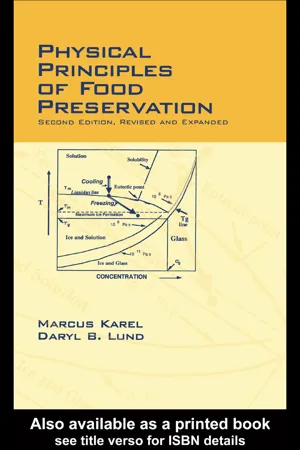 eBook - PDF
Physical Principles of Food Preservation
Revised and Expanded
- Marcus Karel, Daryl Lund(Authors)
- 2003(Publication Date)
- CRC Press(Publisher)
1 Thermodynamics I. INTRODUCTION The development of chemical engineering occurred in part because the fundamental laws of cause and effect associated with chemical transformations and phenomena were expressed quantitatively and codified. For food engineering, significant progress occurred in engineering design of food processes when these same fundamental principles were applied to complex mixtures of chemicals and biochemicals calledfood. Unfortunately, with food the mixtures are very complex and the chemical and thermodynamic parameters are not easily estimated from first principles or easily determined experimentally. Although this situation has led to empiricism, nonetheless, knowledge of physical-chemical principles is essential to enhance our understanding of unit operations and behavior of foods. II. THERMODYNAMIC FUNDAMENTALS Food engineering requires an appreCIatIOn for the fundamental laws of thermodynamics even though some principles apply in only highly select conditions. Here we will briefly introduce the laws of thermodynamics recognizing that the reader may wish to refer to more extensive treatments elsewhere [e.g., Chang (1977), Tinoco et al. (2002), Baianu (1992)]. 1 2 Chapter 1 A. Definition of Systems When an operation is described, frequently it is helpful to envision a physical boundary around the operation. The elements contained within the boundary is called a system. If no mass or energy crosses the boundary of the system, the system is said to be isolated; if mass and energy crosses the boundary, the system is open; and if no mass crosses the boundary, the systems is said to be closed. A system with no heat flow across the boundary is adiabatic, whereas one with no work transfer is anergic. If the pressure does not change, the system is isopiestic or isobaric and if the temperature of the system does not change, the system is isothermal. eBook - PDF
Entropy Generation Minimization
The Method of Thermodynamic Optimization of Finite-Size Systems and Finite-Time Processes
- Adrian Bejan(Author)
- 2013(Publication Date)
- CRC Press(Publisher)
1 THERMODYNAMIC CONCEPTS AND LAWS The subject of engineering thermodynamics revolves around two pivotal state-ments, the first and the second laws of thermodynamics. Both laws are old, relative to our lifetime experience, the first law being the product of a vehement debate started approximately 200 years ago. Because the objective of all introductory thermodynamics courses is to explain the meaning and usefulness of the two laws and their related concepts (Moran, 1989), in the present treatment it is assumed that the laws are known and accepted. However, in order to provide a common language and ground for the issues to be debated in this book, the basic concepts introduced in engineering through thermodynamics are reviewed in this chapter. The review is limited to the thermodynamics of a pure substance. 1.1 DEFINITIONS A key concept in thermodynamic analysis, often abused, is the concept of system. A thermodynamic system is the region or collection of matter in space that is selected for analysis. The concept of system requires the recognition of an envi-ronment, which is the space, or system, external to the system of interest. Separating the two systems is the system boundary (frontier), which, in general, is a real or imaginary surface delineating the contour of the system of interest. The system boundary may or may not possess special features that, as a matter of consequence, lead to a hierarchic ordering of thermodynamic systems for the purpose of analysis. For example, a boundary that is impermeable to mass flow defines a closed system. Naturally, in a closed system the matter (mass inventory) is conserved. On the other hand, a boundary that is permeable (has openings, ports) for mass transfer defines an open system. The flow of mass through the system boundary is only one of the three transfer effects (interactions) commonly encountered in engineering applications. The other two effects are heat transfer and work transfer. eBook - PDF
Thermo and Fluid Dynamics
Recent Advances
- Dritan Hoxha(Author)
- 2019(Publication Date)
- Arcler Press(Publisher)
Thermo and Fluid Dynamics: Recent Advances 10 More specifically, Thermodynamics is important because: • It provides a mathematical framework to understand how energy transfer inside a system; hence help us to design, predict, and calculate the efficiency of better heat engine. • It gives a framework to predict the behavior of matter in different situation. • It gives a framework to predict if any reactions can happen at all. • It gave us the 2nd law which helps us understand the spontaneity of some process. Some describe it as the arrow of time. Hence thermodynamics is one of the few basic branch of science which gives us some notion of time. • People started to understand the universe in a deeper level (in atomic level) from calculation in classical thermodynamics even before they were able to see it in microscope. • All the rockstars in science have considered it very important. 1.4. A SHORT VIEW OF THE QUANTITIES INVOLVED IN THERMODYNAMICS a) Heat: Thermodynamics, is concerned with several properties of matter where the most important one is heat. Heat is the energy transferred between bodies or systems due to a temperature difference between them, according to many well-known scientists [5]. As it is a form of energy, heat, therefore, is conserved, i.e., it can neither be created nor destroyed [5]. However, it can be transferred from one place to another [5]. Furthermore, heat can be converted to and from other forms of energy. For instance, a steam turbine can convert heat into kinetic energy to make a generator work. On the other hand, this generator converts kinetic energy to electrical energy. Later, a light bulb converts this electrical energy to electromagnetic radiation (light), which, when absorbed by a rough, black, and dull surface, is converted back into heat [5]. b) Temperature : The amount of heat transferred by a substance depends on two factors: the speed and the number of atoms or molecules in motion of that substance [5]. eBook - PDF
Thermodynamics
Processes and Applications
- Jr. Logan, Jr., Earl Logan, Earl Logan Jr.(Authors)
- 1999(Publication Date)
- CRC Press(Publisher)
4 Chapter 1 1.2 Basic Concepts The above example illustrates some important concepts in ther-modynamics. A thermodynamic system interacts with its envi-ronment when energy is transferred across its boundaries thereby undergoing changes of state known as processes. The return of the of the system to its original state corresponds to the completion of a thermodynamic cycle, the net effect of which is the production of a net amount of work and the transfer of a net amount of heat. The concepts of state, process, cycle, work and heat will be dis-cussed at length in subsequent chapters. They are useful in the analysis of many practical problems when the first law of thermo-dynamics, viz., the law of conservation of energy, which states that energy is neither created nor destroyed, is applied. The second law of thermodynamics is also important, but it will be necessary to introduce a new and abstract thermodynamic property called entropy before the second law can be stated and applied to practical problems; this will be done after the versatility of the first law has been demonstrated using a variety of prob-lems. Thermodynamics employs other artifiices as well, e.g., the con-cept of equilibrium. Equilibrium implies balance of mechanical, thermal or chemical forces which tend to change the state of a system; it also implies an equality of properties such as pressure and temperature throughout the entire system. Faires and Sim- mang (1978) explain the concept of thermal equilibrium as the condition attained after two bodies, originally at different tempera-tures or degrees of hotness, reach the same temperature or degree of hotness, i.e., any flow of energy from the hotter body to the cooler body has ceased, and no further change of state of either body is evident. The concept is utilized in the zeroth law of ther-modynamics from Faires and Simmang: “. eBook - PDF
Fundamentals of Heat Engines
Reciprocating and Gas Turbine Internal Combustion Engines
- Jamil Ghojel(Author)
- 2020(Publication Date)
- Wiley-ASME Press Series(Publisher)
Jamil Ghojel. © 2020 John Wiley & Sons Ltd. This Work is a co-publication between John Wiley & Sons Ltd and ASME Press. Companion website: www.wiley.com/go/JamilGhojel_Fundamentals of Heat Engines Introduction I: Role of Engineering Science 3 and developing new types of engine processes for superior economy and reduced emis-sions. At the same time, the heat engine, particularly the reciprocating ICE, has become an ideal tool for teaching mechanical and automotive engineering, as it features, in addition to thermodynamics, fundamental principles of engineering mechanics and fluid mechanics as discussed earlier. A chapter on thermochemistry (Chapter 2) is included in Part I, dealing with fuel proper-ties and the chemistry of combustion reactions and the effect of control of the combustion temperature through control of air-fuel ratios in order to preserve the mechanical integrity of engine components. Extensive numerical data on gas properties and adiabatic flame temperature calculations are included, which can be used for preliminary design-point calculations of practical piston and gas turbine engine cycles. 4 1 Review of Basic Principles 1.1 Engineering Mechanics Mechanics deals with the response of bodies to the action of forces in general, and dynam-ics is a branch of mechanics that studies bodies in motion. The principles of dynamics can be used, for example, to solve practical problems in aerospace, mechanical, and automo-tive engineering. These principles are basic to the analysis and design of land, sea, and air transportation vehicles and machinery of all types (pumps, compressors, and reciprocating and gas-turbine internal combustion engines). A review of some principles relevant to heat engines is presented here. 1.1.1 Definitions Particle . A conceptual body of matter that has mass but negligible size and shape.
- S. Bobby Rauf(Author)
- 2021(Publication Date)
- River Publishers(Publisher)
Chapter 1 Introduction to Energy, Heat and Thermodyna mics INTRODUCTION The term “thermodynamics” comes from two root words: “ther-mo,” which means heat, and “ dynamic, ” meaning energy in motion, or power. This also explains why the Laws of Thermodynamics are some-times viewed as Laws of “Heat Power.” Since heat is simply thermal energy, in this chapter, we will review energy basics and lay the foundation for in depth discussion on heat en-ergy and set the tone for discussion on more complex topics in thermody-namics. ENERGY The capacity of an, object, entity or a system to perform work is called energy. Energy is a scalar physical quantity. In the International System of Units (SI), energy is measured in Newton-meters (N-m) or Joules, while in the US system of units, energy is measured in ft-lbf, Btu’s, therms or calories. In the feld of electricity, energy is measured in watt-hours, (Wh), kilowatt-hours (kWh), Gigawatt-hours (GWh), Terawatt-hours (TWh), etc. Units for energy, such as ft-lbs and N-m, point to the equivalence of energy with torque (moment) and work . This point will be discussed later in this chapter. Energy exists in many forms. Some of the more common forms of energy, and associated units, are as follows: 1) Kinetic Energy 1 ; measured in ft-lbf, Btus, Joules, N-m (1 N-m = 1 Joule), etc. Where, Btu stands for British thermal units 1 2 Thermodynamics Made Simple for Energy Engineers 2) Potential Energy 1 ; measured in ft-lbf, Btus, Joules, N-m, etc. 3) Thermal Energy 1 , or heat (Q); commonly measured in calories, Btus, Joules, therms, etc. 4) Internal Energy 1 , (U); commonly measured in Btu’s, calories or Joules. 5) Electrical Energy ; measured in Watt-hours (Wh), killowatt-hours (kWh) and horsepower-hours (hp-hrs), etc. 6) Gravitational Energy ; measured in ft-lbf, Joules, N-m, etc. 7) Sound Energy ; measured in Joules. 8) Light Energy ; measured in Joules. 9) Elastic Energy ; measured in ft-lbf, Btus, Joules, N-m, etc.
Index pages curate the most relevant extracts from our library of academic textbooks. They’ve been created using an in-house natural language model (NLM), each adding context and meaning to key research topics.

