Technology & Engineering

Gustave Eiffel
Gustave Eiffel was a French civil engineer and architect best known for designing the iconic Eiffel Tower in Paris, which was completed in 1889. He also contributed to the construction of several other notable structures, including the framework for the Statue of Liberty in New York. Eiffel's innovative use of iron and steel revolutionized the field of structural engineering.
Written by Perlego with AI-assistance
Related key terms
1 of 5

3 Key excerpts on "Gustave Eiffel"
 eBook - ePub
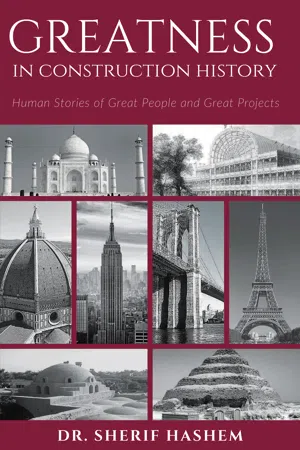
Greatness in Construction History
Human Stories of Great People and Great Projects
- Sherif Hashem(Author)
- 2022(Publication Date)
- Business Expert Press(Publisher)
Compagnie des Établissements Eiffel Title Managing Director Legacy A French tycoon and Ironwork Constructor. A symbol of the Industrial Revolution. Best known for his iconic Eiffel Tower in Paris and fabricating the structure of the Statue of Liberty in New York. PM Role Project Sponsor, Design and Construction Maurice Koechlin [3 ] NameMaurice KoechlinParty Compagnie des Établissements Eiffel Title Chief Structural Engineer Legacy A Franco–Swiss Civil and Structural Engineer who excelled in innovative designs of ironwork structures including concept and structural design of Eiffel Tower, Garabit Viaduct, and Statue of Liberty. PM Role Project Manager, Design and Construction Stephen Sauvestre [4 ] NameStephen SauvestreParty Compagnie des Établissements Eiffel Title Head of Architectural Department Legacy A French Architect who played a key role in the decoration and beautification of the Eiffel Tower. He worked closely with Gustave Eiffel and Civil Engineers Maurine Koechlin and Emile Nouguier. PM Role Project Architect, Design and ConstructionGustave Eiffel eBook - ePub
Eiffel
The Genius Who Reinvented Himself
- David I Harvie(Author)
- 2006(Publication Date)
- The History Press(Publisher)
The structure required for the exhibition was almost certain to be a tower, of one sort or another; in the late nineteenth century, towers were becoming, at least in concept, all the rage. Engineers and entrepreneurs had been considering ways and means of erecting towers – usually characterised as ‘the tallest building in the world’ – for many years. They are still doing it today. Eiffel was eager to take up the challenge:Without rebuilding the Tower of Babel, one can see that the idea of constructing a tower of very great height has for a long time haunted the imagination of mankind. This kind of victory over the terrible law of gravity which attaches man to the ground always appeared to him a symbol of the forces and the difficulties to be overcome. To speak only of our century, the thousand-feet tower which would exceed by twice the highest monuments it had been possible to hitherto construct, was a problem set down to be solved in the minds of English and American engineers. Besides, the new use of metals in the construction industry made it possible to approach it with chance of success.7In the nineteenth century alone, there were several proposals for spectacular towers, the first of which, and the one most closely related to the Eiffel Tower, was that of the ingenious eccentric English mining and railway engineer Richard Trevithick. ‘The father of the locomotive engine’, Trevithick had carried passengers by a steam engine named Catch-me-who-catch-can at a shilling a ride on a circular track at Euston Square in London in 1808. He was an innovative inventor of steam engines for countless purposes; he was involved in an abortive Thames tunnel project; he lived in Peru for ten years, where he was fêted as a national hero for engineering the country’s silver mines; he had adventures galore and energetically made and lost fortunes. In a letter to the Morning Herald of 11 July 1833 he proposed to build a 1,000ft open-lattice, cast-iron tower in London to commemorate the passage through parliament of the First Reform Bill which, despite opposition from the House of Lords, transformed parliamentary representation. The tower, resting on a 60ft masonry plinth, was to be 100ft in diameter at the base and 10ft wide at the top, surmounted by a 49ft-wide platform carrying a gigantic 38ft statue; twenty-five passengers at a time would be carried to the top by a compressed-air lift inside the column travelling at the speed of three feet per second. Trevithick intended that his tower should be assembled from 1,500 symmetrical 3-ton segments, each with internal flanges enabling them to be bolted together; each section was to be pierced by a large, circular opening to reduce both the weight and wind pressure; the total weight was to be 6,000 tons, and he envisaged construction lasting only six months and costing £80,000.8 eBook - ePub
- Robert M. Vogel(Author)
- 2010(Publication Date)
- Perlego(Publisher)
The great confidence of the Tower’s builder in his own engineering ability can be fully appreciated, however, only when notice is taken of one exceptional way in which the project differed from works of earlier periods as well as from contemporary ones. In almost every case, these other works had evolved, in a natural and progressive way, from a fundamental concept firmly based upon precedent. This was true of such notable structures of the time as the Brooklyn Bridge and, to a lesser extent, the Forth Bridge. For the design of his tower, there was virtually no experience in structural history from which Eiffel could draw other than a series of high piers that his own firm had designed earlier for railway bridges. It was these designs that led Eiffel to consider the practicality of iron structures of extreme height.Larger ImageFigure 1.—The Eiffel Tower at the time of the Universal Exposition of 1889 at Paris. (From La Nature, June 29, 1889, vol. 17, p. 73.)Figure 2.—Gustave Eiffel (1832-1923). (From Gustave Eiffel, La Tour de Trois Cents Mètres, Paris, 1900, frontispiece.)There was, it is true, some inspiration to be found in the paper projects of several earlier designers—themselves inspired by that compulsion which throughout history seems to have driven men to attempt the erection of magnificently high structures.One such inspiration was a proposal made in 1832 by the celebrated but eccentric Welsh engineer Richard Trevithick to erect a 1,000-foot, conical, cast-iron tower (fig. 3 ) to celebrate the passing of the Reform Bill. Of particular interest in light of the present discussion was Trevithick’s plan to raise visitors to the summit on a piston, driven upward within the structure’s hollow central tube by compressed air. It probably is fortunate for Trevithick’s reputation that his plan died shortly after this and the project was forgotten.One project of genuine promise was a tower proposed by the eminent American engineering firm of Clarke, Reeves & Company to be erected at the Centennial Exhibition at Philadelphia in 1876. At the time, this firm was perhaps the leading designer and erector of iron structures in the United States, having executed such works as the Girard Avenue Bridge over the Schuylkill at Fairmount Park, and most of New York’s early elevated railway system. The company’s proposal (fig. 4
Index pages curate the most relevant extracts from our library of academic textbooks. They’ve been created using an in-house natural language model (NLM), each adding context and meaning to key research topics.

