Technology & Engineering

Empire State Building
The Empire State Building is a famous skyscraper located in New York City. It was completed in 1931 and was the tallest building in the world until 1970. Known for its Art Deco design and innovative construction techniques, the building is an iconic symbol of American engineering and architecture.
Written by Perlego with AI-assistance
Related key terms
1 of 5

6 Key excerpts on "Empire State Building"
 eBook - ePub
Greatness in Construction History
Human Stories of Great People and Great Projects
- Sherif Hashem(Author)
- 2022(Publication Date)
- Business Expert Press(Publisher)
It’s a symbol of pride and inspiration for the entire construction community all over the world. Although not the world’s tallest building anymore, the Empire State Building is certainly one of the greatest buildings in human history. The way it was designed, managed, funded, constructed, marketed, and maintained is just unique and just great. The record short time it took to build is simply miraculous given the technology of the time is was built, and even by today’s most modern standards. Many statements were made by world architects, business men, artists, professionals, celebrities, and historians trying to praise such a piece of art and glory, for example: The building was originally a symbol of hope in a country devastated by the Depression, as well as a work of accomplishment by newer immigrants. The renowned writer Benjamin Flowers states that the Empire State was “a building intended to celebrate a new America, built by men (both clients and construction workers) who were themselves new Americans.” The architectural critic Jonathan Glancey refers to the building as an “icon of American design.” Moreover, in a recent survey, the American Institute of Architects found that the Empire State Building was “America’s favorite building.” Construction greatness is fully embodied in the story of the Empire State Building. The lessons learned from its story are just endless and enough to guide the entire construction industry today and in the future. It highlights the powers of planning, willpower, and teamwork. I remember myself in October 2008 walking around the Empire State Building in Manhattan (Figure 3.11). I was staring at the great building from different angles with a great deal of respect and appreciation that can only be felt by a construction engineer like myself. I would hear the sounds and see the sights of the busy and high construction site, in dawns or dusks, days and nights eBook - PDF
Skyscraper
The Politics and Power of Building New York City in the Twentieth Century
- Benjamin Flowers(Author)
- 2012(Publication Date)
- University of Pennsylvania Press(Publisher)
When completed the Empire State Building was the “era’s ultimate skyscraper,” and it took great advantage of the compositional elements that made the setback form so dramatic: good proportions, a soaring central tower, and careful detailing, all on a steel frame. 51 While some argue that setback skyscrapers “did not express the skeleton frame,” Talbot Hamlin wrote that the building has “that feeling of delicacy which is pe-culiarly the spirit of steel construction.” 52 Furthermore, in his assessment of the prizewinning buildings of 1931, Hamlin stated that the Empire State Building, winner of the Gold Medal Award of the Architectural League of New York, was one of the few to “stand out from the mass as exceptional.” He applauded the tower above all, espe-cially for its use of “masonry, but obviously as a skin, not as a support.” The “proportions of the setbacks are fine,” he continued; “there is strength and dignity in them.” The use of metal in the façade also met with his approval for “the manner in which they pick up the color of the sky, or flash back the brilliance of the sun, as though the whole tower itself were hung on a framework of light itself.” In sum the building revealed a “deeper quality, an authentic beauty that is a new note, a new creation.” 53 It is interesting to note that Hamlin’s assessment of the building ignores its world record height; in this he was not alone. In his appraisal of the building in his “Skyline” column in the New Yorker , T-Square (the pseudonym of architecture critic George Shep-pard Chappell) wrote: “That it is the world’s highest is purely incidental. eBook - PDF
Structural Analysis and Design of Tall Buildings
Steel and Composite Construction
- Bungale S. Taranath(Author)
- 2016(Publication Date)
- CRC Press(Publisher)
In fact, it has stimulated the structural engineering profession to give almost total freedom to architectures in their quest of new and exciting avatars for tall and ultra tall buildings. Today, with the use of computers, buildings are planned and designed that have little or no historic precedent. New structural systems are conceived and applied to extremely tall buildings in a practi-cal demonstration of the engineer’s confidence in the predictive ability and reliability of computer solutions. 9.3 TALL BUILDINGS Nine years after many soothsayers predicted the indelible images of September 11, 2001, would stifle humanities enthusiasm for iconic skyscrapers it is now certain they are wrong. Contrary to their prophecy, the landscape not only in the United States but also in the entire world is moving up. Buildings that would either eclipse or stand spire-to-spire with the 1.250 ft tall Empire State Building of the 1930s, are promising to reshape skylines. The collective introspective analysis of the topology that begged the question “are tall buildings a viable part of our cities—or they are not?” seems to have resulted in a resounding “yes.” Compared to the skyscrapers that were erected in the 1970s and 1980s, the new crop of high rises is more likely to be expressions of civil or even national pride than symbols of corporate wealth. Their purpose is to project a certain status for a city on a world stage. This has become especially true as developing countries in Asia and the Middle East started erecting super-tall skyscrapers that made the iconic American Towers, the Empire State Building, the Sears Tower (now called Willis Tower), and the nonexistent World Trade Center Towers, look average in comparison. In today’s high-rise architectural vocabulary, remarkably, the repetition of structural and archi-tectural elements is losing importance. No longer available |Learn more
- (Author)
- 2014(Publication Date)
- The English Press(Publisher)
________________________ WORLD TECHNOLOGIES ________________________ Chapter-5 Architecture of New York The Empire State Building (foreground) and Chrysler Building, are some of the finest examples of Art Deco architecture ________________________ WORLD TECHNOLOGIES ________________________ The building form most closely associated with New York City is a skyscraper (a pioneering urban form first used in New York and Chicago) that saw New York buildings shift from the low-scale European tradition to the vertical rise of business districts. Surrounded mostly by water, the city's residential density and high real estate values in commercial districts saw the city amass the largest collection of individual, free-standing office and residential towers in the world. New York has architecturally significant buildings in a wide range of styles. These include the Woolworth Building (1913), an early Gothic revival skyscraper built with massively scaled gothic detailing able to be read from street level several hundred feet below. The 1916 Zoning Resolution required setback in new buildings, and restricted towers to a percentage of the lot size, to allow sunlight to reach the streets below. The Art Deco design of the Chrysler Building (1930), with its tapered top and steel spire, reflected the zoning requirements. The building is considered by many historians and architects to be New York's finest, with its distinctive ornamentation such as replicas of the 1928 Chrysler eagle hood ornaments and V-shaped lighting inserts capped by a steel spire at the tower's crown. A highly influential example of the international style in the United States is the Seagram Building (1957), distinctive for its facade using visible bronze-toned I-beams to evoke the building's structure. The Condé Nast Building (2000) is an important example of green design in American skyscrapers. eBook - ePub
Tall Buildings
Structural Systems and Aerodynamic Form
- Mehmet Günel, Hüseyin Ilgin(Authors)
- 2014(Publication Date)
- Routledge(Publisher)
STRUCTURAL ENGINEER: H.G. Balcom & Associates; Post and McCord; Strong & Jones EngineersSTRUCTURAL SYSTEM: Shear trussed frame system/steel(courtesy of Antony Wood/CTBUH)Empire State Building: architectural and structural informationThe 102-storey, 381 m high Empire State Building in New York (USA) was designed by Shreve Lamb & Harmon Associates. It is a steel building with a shear trussed frame system. The Empire State Building gained the title of “the world’s tallest building” in 1931. Currently, it has held the title of “the world’s tallest building” for the longest period (41 years, 1931–1972).Legendary as a national historical monument symbolising American courage and skill, the Empire State Building, with the style of its facade and its long-held title of “the world’s tallest building”, shaped the city’s skyline as the spirit of the Art Deco period and New York’s international architectural icon.The concrete-encased braced frames (shear trusses), which give the Empire State Building’s structural system its basic character (Figure 4.1 ), were designed to resist the entire vertical and lateral loads with the help of a stone cladding on the facade. Although it is not included in the calculations for the structural analysis, the concrete encasement makes a significant contribution to the shear-trussed frame’s strength against wind induced lateral loads.BibliographyFIGURE 4.1Empire State Building plan and sectionEmpire State Building, http://www.ctbuh.org , accessed May 2012.Empire State Building, http://www.emporis.com , accessed May 2012.Taranath, B., Steel, Concrete & Composite Design of Tall Buildings, New York: McGraw-Hill Book Company, 1998.Taranath, B., Wind and Earthquake Resistant Buildings: Structural Analysis and Design, A Series of Reference Books and Textbooks (Editor: Michael D. Meyer), Department of Civil and Environmental Engineering, Georgia Institute of Technology, Atlanta, Georgia, 2005.Zaknic, I., Smith, M. and Rice, D., 100 of The World’s Tallest Buildings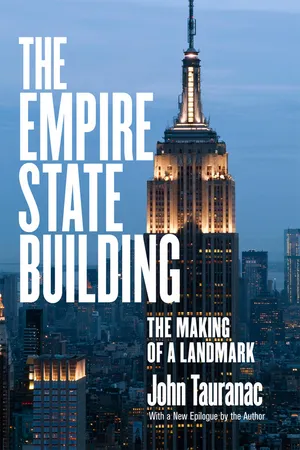 eBook - ePub
The Empire State Building
The Making of a Landmark
- John Tauranac(Author)
- 2014(Publication Date)
- Cornell University Press(Publisher)
When the whistle blew at four-thirty, the sudden quiet, which bordered on silence, became more noticeable to the observer than all the noise of the day. Work ceased almost instantly. The rhythm of forge and hammer and trowel and torch and riveting gun wavered, then stopped. Tools were put away. Coats were found, lunch pails picked up. From their high stations the workers began to make the long descent to the street that had meant nothing to them during the day but a foreshortened picture.The last day was different. For those workers who could proudly stand atop this masterful piece of work and gaze out over the city that many of them had helped build, there was little to look forward to. At the dinner commemorating the completion of the building, Al Smith was given a drawing showing a woman standing on the roof of a tenement with her son. Below them, at street level, are the mundane signs of everyday life—a laundry, a delicatessen, even a billiard parlor. Rising above the gritty scene, and seemingly reaching for the heavens, rises the Empire State Building. The caption read: TONY, YOUR OLD MAN’S BUILDIN’ THAT . The irony is that the ironworkers laboring away on the steel cage of a skyscraper had no share in the ideals of their enterprise, whereas their ancestors, the stonemasons who had built the great Gothic cathedrals, at least had a part in their church. After they built their cathedral, there was a place—and it was not a negligible place—for them within.17What was there for the workers on the Empire State Building, who had striven so hard, who had set practically every record in the books, and who had built a masterpiece? Granted, thirty-two of the best of the forty-two hundred were awarded Craftsmanship Awards and had their names inscribed in the lobby for posterity, the way a church might honor a choirboy and call him “optimus,” and Smith was undoubtedly sincere when he said at the “consecration of the house” ceremony that he hoped the honored workers would come back and share the glory of the place with their grandchildren, the way he had shared the opening-day celebrations with his. But although stonemasons had a place within their cathedrals and honored choirboys have one within their church, workmen usually feel out of place in the lobbies of great office buildings. When construction workers revisit the scenes of their triumphs, they feel obliged to wear ill-fitting suits. They stand around awkwardly, shifting from one foot to another, not knowing where to put themselves. They don’t feel as if they belong. They are fish out of water. Earl Sparling wrote a fictional monologue from one ironworker to another—“sky boys,” he called them—for the World-Telegram. The narrator talked about the emptiness and depression that ensued when the big job was done and life held nothing but a vague thought of the next tower to be built. He tried to pick out the shaft where a carpenter had been killed and couldn’t find it. “All the shafts look alike now, and the elevator operators are all dressed up in swell uniforms….”18
Index pages curate the most relevant extracts from our library of academic textbooks. They’ve been created using an in-house natural language model (NLM), each adding context and meaning to key research topics.

