Technology & Engineering

James Watt
James Watt was a Scottish inventor and mechanical engineer known for his improvements to the steam engine, which played a crucial role in the Industrial Revolution. His development of the separate condenser significantly increased the efficiency and power of steam engines, leading to widespread adoption in various industries. Watt's innovations revolutionized the field of engineering and had a profound impact on the advancement of technology.
Written by Perlego with AI-assistance
Related key terms
1 of 5

10 Key excerpts on "James Watt"
 eBook - ePub
- Arne Hessenbruch(Author)
- 2013(Publication Date)
- Routledge(Publisher)
W Watt, Jamcs 1736–1819 British engineer and inventorArago, M., Historical Eloge of James Watt, translated from the French by James Patrick Muirhead, London: John Murray, 1839Dickinson, H.W., James Watt, Craftsman and Engineer, Cambridge: Cambridge University Press, 1936; New York: Kelley, 1967Dickinson, H W. and Rhys Jenkins, James Watt and the Steam Engine, Oxford: Clarendon Press, 1927Dickinson, H.W. and H.P. Vowles, James Watt and the Industrial Revolution, London and New York: Longmans Green, 1943Muirhead, James Patrick, The Origin and Progress of the Mechanical Inventions of James Watt Illustrated by His Correspondence with His Friends and the Specifications of His Patents, 3 vols, London: John Murray, 1854Musson, A.E. and Eric Robinson, Science and Technology in the Industrial Revolution, Manchester: Manchester University Press, and Toronto: Toronto University Press, 1969Robinson, Eric and A.E. Musson, James Watt and the Steam Revolution: A Documentary History, London: Adams and Dart, and New York: Kelley, 1969Robinson, Eric and Douglas McKie (eds), Partners in Science: Letters of James Watt and Joseph Black, London: Constable, and Cambridge, Massachusetts: Harvard University Press, 1970Smiles, Samuel, Lives of the Engineers: The Steam-Engine: Boulton and Watt, revised edition, London: John Murray, 1878Williamson, George, Memorials of the Lineage, Early Life, Education and Development of the Genius of James Watt, London: Constable, 1856James Watt’s crucial improvements to the steam engine have rightly dominated biographical works about him, but this has generally been to the exclusion of most of his other inventions and discoveries. The invention for which he is best remembered is the addition of the separate condenser to the Newcomen engine. Not only did this make a much more powerful and economical engine, but it led to his development of the steam engine from a machine that could only pump water into one that could turn rotating machinery directly. Watt solved the problems he faced by the application of scientific principles, and so he may be said to be the originator of scientific engineering. eBook - ePub
- Stella Davies(Author)
- 2013(Publication Date)
- Routledge(Publisher)
5 The Giant, SteamIN 1769, the same year in which Arkwright patented the water-frame, James Watt patented the steam-engine. It was first used for pumping the water from mines but soon it was adapted to drive machines of many kinds. Steam-engines were installed in water-power mills to run the machines during a shortage of water; new textile-mills using steam instead of water began to be built; steam-engines were used in iron-making; in the early nineteenth century steamships sailed on the River Clyde, many industries, such as brewing, pot- and china-making used steam power in one or other of the processes.An enthusiastic account of the wonders of the steam-engine, written in the early nineteenth century, claimed that the power of four million men had been added, by its aid, to the resources of Britain. Only a guess, it is nevertheless expressive of how people regarded steam. A giant had arrived and the industrial revolution gathered immense speed and force with the added weight. The invention and perseverance of James Watt made this possible. His life will be told in some detail because it enables us to see another aspect of the industrial revolution and brings us into contact with people from many walks of life.Many of the men who, in association with Watt, launched the steam-engine were wealthy and well educated, for to produce it on a large scale needed a great deal of money and business knowledge. To make the engine and keep it in order required more skill than was necessary for the older types of machines. The new technical knowledge gained in developing the steam-engine was the beginning of modern engineering. This can be seen happening at the workshop level and it is possible to gain some knowledge of the life of the metal-worker and mechanic. Moreover, in considering the life of James Watt we cover a large part of Great Britain, beginning in Scotland, following him to Birmingham and making journeys with him to London, Cornwall, Wales and other districts. Something, also can be learnt of the people who bought his engines and the men who worked them.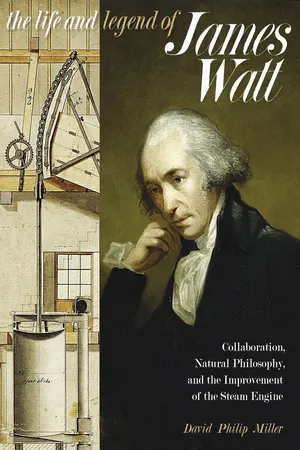 eBook - ePub
The Life and Legend of James Watt
Collaboration, Natural Philosophy, and the Improvement of the Steam Engine
- David Philip Miller(Author)
- 2019(Publication Date)
- University of Pittsburgh Press(Publisher)
Images such as Marcus Stone’s Watt Discovers the Condensation of Steam of 1863 and Robert Buss’s Watt’s First Experiment on Steam of 1845 were engraved and widely distributed as representations of the child genius prefiguring the mature engineer’s accomplishments. James Eckford Lauder’s painting James Watt and the Steam Engine: Dawn of the 19 th Century of 1855 loaded into the image not just the kettle but other popular symbols: the dividers of the geometrician, the basic tools of the craftsman, and the model Newcomen engine of the experimentalist. The viewer could interpret accordingly. 1 Watt became a flexible resource for many groups in British society, including engineers, scientists, and skilled workers, who employed characterizations of him to legitimate and extend their own status and concerns. Nationalisms as well as civic and professional pride competed to collar him as theirs. Educational objectives and the promotion and defense of the patent system were other popular concerns with which he was routinely associated. Anniversaries of Watt’s death and birth, in 1919 and 1936 especially, drew wide attention to the legacy and gave a focus for interplay of many of the ongoing uses of Watt. In that sense he became “a man for all causes.” Until recently, the overall tone of commemorations of Watt, however divergent they might have been in character and substance, was generally positive and celebratory. However, with growing doubts in the late twentieth century about the future of an industrial civilization based on high fossil energy consumption, and concern about its environmental consequences, invocations of Watt’s name have begun to take a different turn. He has been identified as a key progenitor of fossil capitalism and of the Anthropocene, a putative geological era in which humanity’s pursuit of technological mastery began to leave its indelible mark on Earth
- Abraham Wolf(Author)
- 2019(Publication Date)
- Routledge(Publisher)
D-shaped slide valve, which replaced Watt’s poppet-valves. He conceived the use of the gas, evolved in the destructive distillation of coal, as an illuminant. He also introduced the use of a mixture of iron filings and sal-ammoniac as a cement—a cheap and efficient method, long used in mechanical and structural engineering practice, for bedding together surfaces of iron, where accurate machining was prohibitively expensive. Many of the machine tools, with which the Soho Foundry was equipped, were also of Murdock’s design.The importance of Watt’s principal invention, the comprehensive nature of his patents, and the policy of the partnership, assured to James Watt the credit for practically every improvement in the steam-engine from 1769 to 1800. The field left for other inventors was severely restricted. Much less is known of their life and work than of his; in fact, many are remembered by little else than the vituperative correspondence with Watt and his partner relating to their alleged piracy of his ideas.(See James Watt and the Steam-Engine, by H. W. Dickinson and Rhys Jenkins, Oxford, 1927.)D. STEAM -ENGINE INVENTIONS CONTEMPORARY WITH THOSE OF WATTThe original beehive boiler of the Newcomen engine was a large brewing copper on a gargantuan kitchen fire, which by 1780 might require sixty-four bushels of coal to fill the fire-place. With poor quality coal, and a weak draught, the smoke from these furnaces must have formed a dense cloud hovering over the mining areas. By Watt’s time engines were fitted with rectangular cast-iron boilers, and furnaces which held at one time only a tenth as much fuel for the same steaming capacity, the flame practially surrounding the boiler. The most significant improvement, however, was Trevithick’s Cornish boiler, tubular in form, about61 2 eBook - PDF
- Graham Hollister-Short, Frank James, Graham Hollister-Short, Frank James(Authors)
- 2016(Publication Date)
- Bloomsbury Academic(Publisher)
1 Boulton assessed the position correctly when he realized that money, accurate workmanship and extensive correspondence would be needed to make the engine business a success. He was also correct in realizing that high engineering standards might be best attained by keeping control of production themselves and that mass production would re-duce the price. Yet neither Matthew Boulton nor James Watt ever established a place where they themselves built complete engines. This partnership always remained one of essentially consulting engineers and it was left to their sons to set up the Soho Foundry in 1795. This chapter History of Technology, Volume Eighteen, 1996 60 James Watt, Mechanical Engineer suggests that one reason for this was the experience James Watt gained in Scotland as an engineering consultant, which showed that steam engines could be built without having an extensive engineering works. We will examine Watt's career in Scotland first as mathematical instrument maker and then engineering consultant, concentrating on what today we would call the mechanical engineering aspects of these businesses. As a lad, Watt must have had some interest in or aptitude for mechan-ical pursuits. Without any archival records to confirm the anecdotes recorded in Watt's earlier biographies, it is very difficult to determine what is fact. That he had built some models as a child is confirmed through the discovery of some in the attic of his father's house in 1801. By that time only a model of a house and 'a crane or something of that nature' survived, 2 which is far fewer than the miniature pulleys or blocks, pumps, capstans, a crane and a barrel organ recorded by Williamson. 3 Watt was given some carpenter's tools and his own forge so that he helped in his father's shipwrighting business, taking particular interest in the various nautical instruments. eBook - PDF
Icons of Invention
The Makers of the Modern World from Gutenberg to Gates [2 volumes]
- John W. Klooster(Author)
- 2009(Publication Date)
- Greenwood(Publisher)
This development Neither Murdock nor Boulton and Watt as a concern apparently ever made any money from Murdock’s gas inventions and development. In 1814, Boulton and Watt abandoned the gas business. A few decades later in Brit- ain, most towns had their own gasworks and gas lighting. Robert Fulton involved Boulton and Watt as a concern in the making of a Watt engine for his American steamer, the Clermont, which was financed by Robert Livingston. Apparently, Fulton worked with Murdock, and Murdock designed many technical details of this engine, which was built by Boulton and Watt and used by Fulton in 1807 in the United States for powering the Clermont (see chapter on Fulton). In 1817, James Watt, Jr., purchased the ship Caledonia, and the Boulton and Watt company became involved in marine engineering. The ship was refitted and, under Murdock, provided with new steam engines and boilers. Favorable sea usage resulted in about forty to sixty steam engine orders for Boulton and Watt by the U.S. Navy and commercial interests. When he passed away in 1839, Murdock was buried at St. Mary’s Church in Handsworth, Birmington, England, alongside Watt and Boulton. 48 Icons of Invention was characterized by growth of systematized knowledge derived from obser- vation, study, and experimentation that identified the nature or principles involved in what was being studied. Scientific theory and technological prac- tice penetrated and even permeated England throughout the seventeenth and eighteenth centuries. In England, textile production was an important indus- try that became industrialized and that utilized the Watt steam engines. Until about the mid-eighteenth century, cloth in England was made by the so-called putting out system. In this system, a cloth dealer would acquire raw cotton, wool, or flax and provide it to spinners and weavers, who proc- essed the fibers into cloth. eBook - ePub
The Development of Science and Technology in Nineteenth-Century Britain
The Importance of Manchester
- Donald Cardwell, Richard Hills(Authors)
- 2017(Publication Date)
- Routledge(Publisher)
Réflexions was being published. Poncelet, a very able theorist, was quite aware that practical needs must always outweigh the abstract ideal. And, in 1822, G. J. Christian, a writer on industrial mechanics, had strongly criticized the engineer who exalted theory at the expense of practice.This, then, was not a simple matter of practical men versus theorists, of craftsmen against scientists. It had deeper implications. The exemplary engineer, certainly in the field of steam power, was James Watt, the man who combined practice and science and who had thereby given a great impetus to systematic technology. Watt had shown how, by isolating and paying meticulous attention to important factors, it was possible radically to improve the steam engine. No one could have been more scientific than Watt, nor could his success have been greater. Yet it had been achieved without the construction of general theories. Apparently following in this tradition, scientific investigations of the time were concerned either with such problems as the determination of the variation of steam pressure with temperature47 or with empirical inquiries like the extended field studies of Joel Lean into the relative long-term economies of high- and low-pressure steam engines.48It might appear, at first sight, that Carnot's demonstration that the maximum power obtainable from a given fall of caloric is independent of the nature of the working substance would be of interest to engineers and scientists. However, by this time, some knowledge had been gained of the suitabilities of different working substances. Air had been proposed as a working substance by the Niepce brothers,49 Sir George Gayley,50 P. F. Montgolfier,51 and others. According to I. K. Brunel, his father had carried out experiments on Montgolfier's behalf to show that "the amount of mechanical power, derived from the effect of a given amount of caloric on gaseous bodies was not greater than that produced by the expansion of water into steam, and that practically it was not so generally applicable. The researches of Sir Humphry Davy and Mr Davies Gilbert confirmed this result." 52 eBook - ePub
Matthew Boulton
Enterprising Industrialist of the Enlightenment
- Sally Baggott, Kenneth Quickenden(Authors)
- 2016(Publication Date)
- Routledge(Publisher)
This had led people to disbelieve calculations that Boulton supplied to Watt and to dismiss him as incompetent when, in fact, the calculations were correct and just what Watt needed. The important point to take from this for our current concern is that Boulton could not only handle the technical aspects of steam engines but also demonstrated technological knowledge that enabled him to see whether, and how, marketable technologies could be constructed. A critic might argue – in concert with Rupert Hall’s ghost – that these technicalities are not abstract science. Boulton’s work with steam engines was between the technical and the entrepreneurial. Let’s accept the scientific/technical distinction for the moment, much against my inclinations, and pursue Boulton into spaces between abstract science and the entrepreneurial. Boulton could and did take his entrepreneurial gaze deeper into the science of engines. An early example of this concerned the theory and practice of boiler design. Even before Watt came on the scene, Boulton, Benjamin Franklin and Erasmus Darwin were discussing steam engines. As the story goes, Boulton’s worries about the possible lack of water power to sustain his manufactory led him to serious investigation of steam engines from the mid 1760s. He pursued his own steam project until he met Watt in 1768. Boulton had built a model steam engine which, early in 1765, he had transported to London for Franklin, and others, to examine. 27 Writing to Boulton in December 1765, Darwin expressed curiosity about how Boulton’s steam engine had been received by Dr Franklin and what Franklin’s observations on it had been. Darwin, Boulton and Dr William Small had evidently been discussing boilers and their optimal design. This question involved them in considering philosophically the phenomenon of evaporation in general eBook - ePub
Innovation and Technological Diffusion
An economic history of early steam engines
- Harry Kitsikopoulos(Author)
- 2015(Publication Date)
- Routledge(Publisher)
p. 23.BibliographyAlderson, M. A., An essay on the nature and application of steam (London: Sherwood, Gilbert, and Piper , 1834).Arago, M., “History of the steam engine, with a reply to the criticisms to which the first publication of the article gave rise”,Annual of the Board of Longitude,1836.Arago, M.,Life of James Watt,3rd ed. (Edinburgh: A. & C. Black , 1839).Armytage, W. H. G.,A social history of engineering,4th ed. (London: Faber and Faber, 1976).Basalla, G.,The evolution of technology( Cambridge, England and New York: Cambridge University Press , 1988).Bate, J.,The mysteryes of nature and art(London: 1st edition printed by T. Harper for R. Mab, 1634; facsimile edition Norwood, NJ: Walter J. Johnson, 1977).Bourne, J., A treatise on the steam engine in its application to mines, mills, steam navigation, and railways (London: Longman, Brown, Green & Longmans , 1846).Briggs, A., The power of steam: an illustrated history of the world’s steam age (Chicago: University of Chicago Press , 1982).Clark, D. K., An elementary treatise on steam and the steam-engine, stationary and portable (London: Lockwood & Co., 1875).Cohen, H. F., “Inside Newcomen’s fire engine, or: the scientific revolution and the rise of the modern world”,History of Technology,25 (2004), pp. 111–32.Daumas, M., ed., A history of technology and invention, progress through the ages. Vol. 2, The first stages of mechanization (New York: Crown Publishers Inc., 1969).Dickinson, H. W., with a new introduction by A. E. Musson.A short history of the steam engine (New York: Augustus M. Kelley, 1965).Farey, J., A treatise on the steam engine, historical, practical and descriptive (London: Longman, Rees, Orme, Brown and Green, 1827).Ferguson, E. S., “The origins of the steam engine”,Scientific American,210, 1 (Jan. 1964), pp. 98–107.Fletcher, J. M., and A. J. Crowe, An early steam engine in Wednesbury: some papers relating to the coal mines of the Fidoe family, 1727–9 eBook - PDF
- Graham Hollister-Short(Author)
- 2016(Publication Date)
- Bloomsbury Academic(Publisher)
Two Knights at Pandemonium: a Worm's-Eye View of Boulton, Watt & Co., c. 1800-1820 1 J E N N I F E R T A N N The Birmingham-based steam engineering firm Boulton & Watt (known as Boulton, Watt & Co. from 1800) is probably the most intensively researched engineering company in the world. Whether the emphasis is on contributions to engineering design made by the firm, the history of particular engines, the organization of production at Soho Manufactory and Foundry, or the lives, wider business interests and contributions to science and technology of the firm's founders, the manufacturers of the Watt engine are of interest to historians of technology. 2 The reason is twofold: the significance of the firm as manufacturers of the Watt engine and the well-preserved collection of papers of the company and its principals. 3 FAMILY BACKGROUND It is notoriously difficult to map contributions to engineering design by other than a patentee or the company manufacturing the product. This has, in no small measure, contributed to an heroic interpretation of engineering history. 4 Moreover the historians of engineering firms have been prone to treat the organizations as dynasties wherein innovations are attributed corporately rather than individually. 5 Yet, in the case of the steam engine, it is well known that James Watt received considerable assistance from his partner Matthew Boulton, as well as from friends such as Dr William Small. 6 Less well known are the contributions made to the development of the condensing engine by employees, although William Murdoch and John Southern are known to have made a number, while Roll 7 has written of the significant process innovations at Soho Foundry, particularly following the employment of Abraham Storey after the demise of Bersham Ironworks. As engineering firms grew in size and complexity it History of Technology, Volume Twenty, 1998 48 Two Knights at Pandemonium can be inferred that knowledge management became more difficult.
Index pages curate the most relevant extracts from our library of academic textbooks. They’ve been created using an in-house natural language model (NLM), each adding context and meaning to key research topics.

