Technology & Engineering

Steam Train
A steam train is a type of locomotive powered by steam engines, which use steam to generate power. It played a significant role in the industrial revolution and the development of transportation systems. Steam trains were a key technological innovation that revolutionized travel and trade during the 19th and early 20th centuries.
Written by Perlego with AI-assistance
Related key terms
1 of 5

8 Key excerpts on "Steam Train"
 eBook - PDF
- Norman Smith(Author)
- 2016(Publication Date)
- Bloomsbury Academic(Publisher)
It is also the purpose of this study to demonstrate a method of investi-gating the history of technology which affords practically useful lessons for the present-day engineer by deepening his insight into the influences which in the past have shaped design and practice. Evolution of the Machine-Ensemble It was known from the beginning of the steam railway that some forms of locomotive engine worked rail, track bed and civil engineering structures worse than others because there were constant derailments due to broken rails and plates, distorted trackwork and damaged bridges on the pioneer systems between 1804 and 1830. 11 These difficulties led to the withdrawal of locomotive traction in certain cases and the use instead of stationary engines which greatly reduced the rail-working and track-bed disturbing forces. But the ultimate success of locomotive traction was assured by the work of the Stephensons and their associates on the Liverpool and Man-chester Company during the 1830s, where there emerged a form of per-manent way which has become the world standard, together with the archetypal form of steam locomotive. In this phase, engine and track were regarded as a single system, and it was openly declared that there was no sense in studying each in isolation. Though this unified 'overview' was to some extent lost in later decades with the separation of the functions of mechanical and civil engineer, it was always evident in the work of the great railway theoreticians such as Lomonossoff. For the purposes of this paper, the locomotive is treated primarily as a rail-working device. The complex history of the metal rail can be simplified under five main headings: cast-iron plate; wrought-iron plate; cast-iron edge rail; wrought-iron edge rail; and rolled-steel edge rail.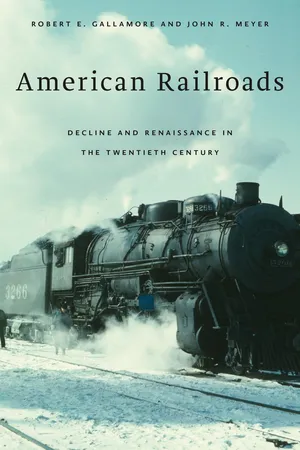 eBook - PDF
American Railroads
Decline and Renaissance in the Twentieth Century
- Robert E. Gallamore, John R. Meyer(Authors)
- 2014(Publication Date)
- Harvard University Press(Publisher)
Technological innovations have helped the railroads remain young despite their old age. 4 Technology is the force driving railroad efficiency and productivity through the decades. External events and influences such as poorly per-forming economies might periodically slow railroad output, and indeed, relief from government economic regulation was needed for the indus-try finally to prosper in recent decades, but historically railroads typi-cally could use technology to find a way to adapt and survive in less than perfect circumstances. Technological advances made over the course of the twentieth century are the underlying reason why the American rail-road enterprise endured in troubled times. Technology improvements touched every aspect of the industry and multiplied the efforts of every worker. An Integrated Engineering System Technologically, and following the proper definition of the term rail-roads used in this book, the industry represent what present-day engi-neering educators call an integrated engineering system. In this concept, railroads are composed of a number of subsystems—the most important being locomotion, track, right-of-way structures, rolling stock, communica-tions and train control, and managerial information systems. Technolog-ical improvement in railroading usually takes the form of upgrading the A D V A N C I N G T E C H N O L O G Y 345 performance characteristics of one or more of these subsystems. Some upgrades are powerful and ingenious innovations designed specifically for the railroad industry. Occasionally, a subsystem upgrade can be so significant, so economi-cally powerful, that several other subsystems find themselves reengineered to accommodate the initial technology deployment. The most important single technological change in railroading in the twentieth century, die-selization, was clearly of this type.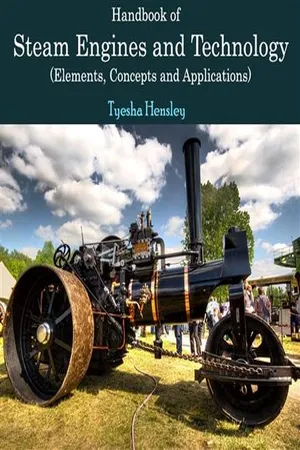 No longer available |Learn more
- (Author)
- 2014(Publication Date)
- Learning Press(Publisher)
________________________ WORLD TECHNOLOGIES ________________________ Chapter- 6 Transport Applications of Steam Engine 1. Steam locomotive Drawing of a Great Western Railway King class locomotive The main components of a steam locomotive ________________________ WORLD TECHNOLOGIES ________________________ A steam locomotive is a locomotive powered by a steam engine. The term usually refers to its use on railways, but can also refer to a road locomotive such as a traction engine or steamroller. Beginning in Britain, steam locomotives dominated railway usage from the start of the 19th century, until the middle of the 20th Century. They were gradually improved and developed in their over 150 years of development and use. Starting in about 1930, other types of engines were developed and steam locomotives were gradually superseded by diesel and electric locomotives. Origins Trevithick's locomotive, 1804 the first successful steam locomotive ________________________ WORLD TECHNOLOGIES ________________________ Stephenson's Rocket 1829, the winner of the Rainhill Trials Aftermath of a boiler explosion on a railway locomotive circa 1850 ________________________ WORLD TECHNOLOGIES ________________________ The earliest railways employed horses to draw carts along railed tracks. As the development of steam engines progressed through the 18th century, various attempts were made to apply them to road and railway use. In 1784, William Murdoch, a Scottish inventor, built a prototype steam road locomotive. An early working model of a steam rail locomotive was designed and constructed by Steamboat Pioneer John Fitch in the United States probably during the 1780s or 1790s. His steam locomotive used interior bladed wheels guided by rails or tracks. The model still exists at the Ohio Historical Society Museum in Columbus. No longer available |Learn more
- (Author)
- 2014(Publication Date)
- Academic Studio(Publisher)
Steam engines can be said to have been the moving force behind the Industrial Revolution and saw widespread commercial use driving machinery in factories, mills and mines; powering pumping stations; and propelling transport appliances such as railway locomotives, ships and road vehicles. Their use in agriculture led to an increase in the land available for cultivation. ____________________ WORLD TECHNOLOGIES ____________________ Very low power engines are used to power models and speciality applications such as the steam clock. The presence of several phases between heat source and power delivery has meant that it has always been difficult to obtain a power-to-weight ratio anywhere near that obtainable from internal combustion engines; notably this has made steam aircraft extremely rare. Similar considerations have meant that for small and medium-scale applications steam has been largely superseded by internal combustion engines or electric motors, which has given the steam engine an out-dated image. However it is important to remember that the power supplied to the electric grid is predominantly generated using steam turbine plant, so that indirectly the world's industry is still dependent on steam power. Recent concerns about fuel sources and pollution have incited a renewed interest in steam both as a component of cogeneration processes and as a prime mover. This is becoming known as the Advanced Steam movement. Steam engines can be classified by their application: Stationary applications Stationary steam engines can be classified into two main types: 1. Winding engines, rolling mill engines, steam donkeys, marine engines, and similar applications which need to frequently stop and reverse. 2. Engines providing power, which rarely stop and do not need to reverse. No longer available |Learn more
- (Author)
- 2014(Publication Date)
- Research World(Publisher)
____________________ WORLD TECHNOLOGIES ____________________ Chapter 12 Steam Engine A 1817 Boulton & Watt beam blowing engine, used in Netherton at the ironworks of M W Grazebrook, re-erected on the A38(M) in Birmingham, UK ____________________ WORLD TECHNOLOGIES ____________________ Preserved British steam-powered fire engine – an example of a mobile steam engine. This is a horse-drawn vehicle: the steam engine drives the water pump ____________________ WORLD TECHNOLOGIES ____________________ A mill engine from Stott Park Bobbin Mill, Cumbria, England A steam engine is a heat engine that performs mechanical work using steam as its working fluid. The idea of using boiling water to produce mechanical motion has a long history, going back about 2,000 years. Early devices were not practical power producers, but more advanced designs producing usable power have become a major source of mechanical power over the last 300 years, beginning with applications for removing water from mines using vacuum engines. Subsequent developments using pressurized steam and converting linear to rotational motion enabled the powering of a wide range of manufacturing machinery. This could be sited anywhere that water and coal or wood fuel could be obtained, whereas previous installations were limited to locations where water wheels or windmills could be used. Significantly, this power source would later be applied to prime movers, mobile devices such as steam tractors and railway locomotives. Modern steam turbines generate about 80% of the electric power in the world using a variety of heat sources. Steam engines are typically external combustion engines, although other external sources of heat such as solar power, nuclear power or geothermal energy may be used. The heat cycle is known as the Rankine cycle. In general usage, the term 'steam engine' can refer to integrated steam plants such as railway steam locomotives and portable engines, or may refer to the machinery alone, as eBook - PDF
- Maksym Spiryagin, Colin Cole, Yan Quan Sun, Mitchell McClanachan, Valentyn Spiryagin, Tim McSweeney(Authors)
- 2014(Publication Date)
- CRC Press(Publisher)
This later became a household name for all trac-tion vehicles running on railways. In addition, the track gauge selected by George Stephenson of 4 ft 8½ in, the so-called ‘Stephenson gauge’ or ‘standard gauge’, quickly became the most common in Western Europe and it is still the standard for most railways around the world. In the second half of the nineteenth century, design of the steam engine had not fundamentally changed; the basic ways for its improvement were sought in the follow-ing directions: more power, increased traction, higher speed and also improvements in energy efficiency and operational performance. The work of many engineers and inventors in different countries resulted in steam locomotives at the last quarter of the nineteenth century being more effective traction vehicles at an appropriate level for the science and technology at that time. The development of industry and com-merce made a big contribution to the rapid construction of railways and rail transport in the world. By the end of the nineteenth century, the entire world railway network served by steam locomotives was more than 800,000 km. At the beginning of the twentieth century, the competitors of steam locomotives were beginning to appear. On railway tracks of mining and metallurgical enterprises 3 28 Design and Simulation of Rail Vehicles it was possible to meet electric traction; on the common railways were locomotives with internal combustion power units, that is, diesel traction or diesel locomotion. These circumstances were the impulse for the further development of the steam engine, but the technical capabilities of the steam locomotive had almost reached its practical limits and could not compete with the fast-growing electric and diesel traction. By this time, the world economy had a powerful locomotive manufacturing base. Steam locomotives were built in large industrial plants. eBook - PDF
Icons of Invention
The Makers of the Modern World from Gutenberg to Gates [2 volumes]
- John W. Klooster(Author)
- 2009(Publication Date)
- Greenwood(Publisher)
The steam locomotive, as developed, comprised a self-contained steam engine complete with a boiler, water supply, and fuel that was associated with two drive wheel–adjacent cylinders, each with a reciprocating piston, one on each locomotive side. Steam at superatmospheric pressure from the boiler was admitted to each of the two cylinders by a valve arrangement. Power was generated by the resulting piston reciprocation in each cylinder, and the power was transmitted from each piston to adjacent drive wheels through an interconnecting main rod arrangement and, typically, crank means. The driving wheels on the same locomotive side were typically con- nected to each other by side rods. Development of railroading and improved steam locomotives continued on a worldwide basis. Mass Transportation: Fitch, Fulton, Stevens, and Trevithick 87 Early American Steam Engine and Railroad Development English Influences American high-pressure steam engine and steam locomotive development was influenced by the pioneering English work begun by Trevithick and car- ried forward by the Stephensons, but because of differences between Amer- ica and England, American steam engine, railroad, and locomotive development was largely and necessarily separate and independent. Ameri- can developments illustrate how a basic innovative idea—a steam locomo- tive driven over rails—can adapt to a new environment. Disappointed Early American Inventors Before and after the Revolutionary War, American steam engine innovators were few. They had little knowledge or wherewithal. These were extraordi- nary individuals. Disappointments were common, but some results achieved were useful. Though little was known in the United States about England’s mammoth stationary Newcomen and Watt atmospheric steam engines, an improved steam engine was needed that was smaller and delivered more power. No longer available |Learn more
- (Author)
- 2014(Publication Date)
- Learning Press(Publisher)
___________________________ WORLD TECHNOLOGIES ___________________________ Chapter- 5 Steam Engine A 1817 Boulton & Watt beam blowing engine, used in Netherton at the ironworks of M W Grazebrook, re-erected on the A38(M) in Birmingham, UK ___________________________ WORLD TECHNOLOGIES ___________________________ Preserved British steam-powered fire engine – an example of a mobile steam engine. This is a horse-drawn vehicle: the steam engine drives the water pump ___________________________ WORLD TECHNOLOGIES ___________________________ A mill engine from Stott Park Bobbin Mill, Cumbria, England A steam engine is a heat engine that performs mechanical work using steam as its working fluid. The idea of using boiling water to produce mechanical motion has a long history, going back about 2,000 years. Early devices were not practical power producers, but more advanced designs producing usable power have become a major source of mechanical power over the last 300 years. Steam engines enabled the Industrial Revolution, beginning with applications for removing water from mines using vacuum engines. Subsequent developments using pressurized steam and converting linear to rotational motion enabled the powering of a wide range of manufacturing machinery. This could be sited anywhere that water and coal or wood fuel could be obtained, whereas previous installations were limited to locations where water wheels or windmills could be used. Significantly, this power source would later be applied to prime movers, mobile devices such as steam tractors and railway locomotives. Modern steam turbines generate about 80% of the electric power in the world using a variety of heat sources. Steam engines are typically external combustion engines, although other external sources of heat such as solar power, nuclear power or geothermal energy may be used.
Index pages curate the most relevant extracts from our library of academic textbooks. They’ve been created using an in-house natural language model (NLM), each adding context and meaning to key research topics.

