- Best-practice guidelines for the clinical management of problem and disordered gambling
- Contains empirically derived findings that translate research into practical clinical applications that clinicians and counselors can use in understanding and treating problem gamblers
- Brings together a distinguished international group of scholars whose contributions discuss gambling as it occurs around the globe
- Clearly organized into sections that cover conceptualization, research, assessment, treatment, and special topics
eBook - ePub
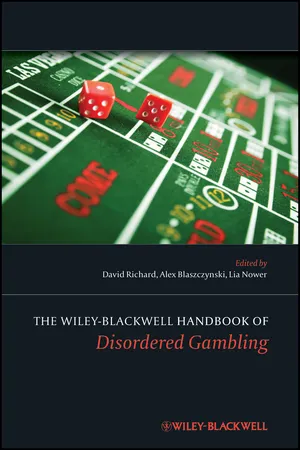
The Wiley-Blackwell Handbook of Disordered Gambling
- English
- ePUB (mobile friendly)
- Available on iOS & Android
eBook - ePub
The Wiley-Blackwell Handbook of Disordered Gambling
About this book
The Wiley-Blackwell Handbook of Disordered Gambling is a complete guide to the current empirical literature relating to the conceptualization, assessment, and treatment of disordered gambling. The international contributors are all experienced, practicing clinicians who discuss gambling within a global context.
Information
1
The Conceptualization and Diagnosis of Disordered Gambling
Introduction
This is an introductory chapter designed to provide a broad overview of conceptual, diagnostic, and epidemiological topics for the treatment professional who may have limited experience with this population. As such, the chapter discusses competing conceptualizations of disordered gambling in the context of recent empirical work and discusses implications for the upcoming publication of the DSM-5. Research discussed in later chapters is touched on here to provide a foundation. Clinicians with significant experience with this population may wish to bypass this chapter and move directly to more specialized foci.
To be consistent with the DSM-5, we use the term “gambling disorder” or “disordered gambling” throughout this volume rather than the archaic terms “pathological gambling” or “pathological gambler.” However, the reader should keep in mind that studies published prior to 2012 used the DSM-IV-TR diagnostic criteria to identify research participants. It is not known at this time how much effect the DSM-5 diagnostic criteria changes will have on the subsequent composition of research samples, although a significant effect is not expected. The vast majority of individuals who would have met the criteria for a DSM-IV-TR diagnosis of “pathological gambling” will also meet the DSM-5 criteria for a diagnosis of “disordered gambling.”
Who is a disordered gambler?
Identifying disordered gamblers is a complex task for several reasons. First, disordered gamblers form a heterogeneous group. Although males are more likely to be diagnosed than females, a casual survey of any casino floor will inventory a dizzying array of players with varied demographic characteristics. Second, disordered gambling may be viewed as a psychiatric disorder in its own right or as the consequence of another underlying psychological condition. In most cases, the relationship is likely reciprocal – disordered gambling probably owes much to associated psychopathology (e.g., depression, anxiety, and substance use) and gambling can exacerbate comorbid conditions. Third, the diagnostic criteria for disordered gambling require considerable clinical judgment. Although extreme cases may reliably be identified, many cases are not so clear cut. Statistical analyses do not always clearly differentiate disordered gamblers from social or recreational gamblers when simply looking at wagers, bets won/lost, or total money lost (e.g., Braverman, LaBrie, & Shaffer, 2011).
Nonetheless, disordered gamblers may be differentiated from social or recreational gamblers, and non-gamblers, in several ways. These differences are observed across a number of dimensions: behavioral, cognitive, social, and neurobiological. Before discussing the diagnostic criteria for disordered gambling, and considering its evolution to DSM-5, it may be useful to contextualize the diagnostic criteria by identifying many of the defining characteristics of disordered gamblers.
Behavioral dimensions
Disordered gamblers evidence a reliable behavioral course: increased frequency and duration of gambling combined with an increase in the amount of money gambled. For example, LaBrie and Shaffer (2011) compared sports bettors on an internet web site who closed their accounts for gambling-related problems to those bettors who closed their accounts because of dissatisfaction with the gambling service or lost interest in betting. They found that the former group made more and larger bets, bet with a greater frequency, and were more likely to bet bigger amounts soon after joining the site. The tendency to increase the frequency and duration of play, along with the amount gambled, is a function of the gambler's predispositions and pre-existing conditions, game play structure, and the reinforcing effects of wins and near misses. Frequency of play has been shown to be related to overall gambling problem severity, especially for slot machines and video lottery terminal games (Holtgraves, 2009).
Increased play often follows a gambling urge that is precipitated by one or more gambling-related cues. Cues are stimuli that elicit a learned response because of associations made through classical and operant conditioning. Gambling-related cues can elicit changes in both measurable autonomic function (e.g., heart rate) and self-reported gambling urges. Wulfert, Maxson, and Jardin (2009) found that disordered gamblers reported stronger urges to gamble than social gamblers when exposed to videos of a horse race and a car race. In addition to well-known classical conditioning processes, all gambling operates on a variable or random ratio schedule of reinforcement that pays off unpredictably. The surprising nature of unpredictable rewards primes the brain for increased dopamine release. Dopamine is integral to motivated, goal-oriented activity. Because surprising rewards are delivered intermittently, gambling behavior is difficult to extinguish.
Cognitive distortions
Disordered gamblers engage in a variety of cognitive biases and errors compared to normal controls (Toneatto, 1999). Many of these errors are associated with other conditions and are not specific to disordered gambling. For example, when choosing between small, immediate rewards or larger rewards that are delayed, disordered gamblers discount larger delayed rewards and are more likely to choose smaller, more immediate rewards, a phenomenon also seen in substance use populations (Petry & Madden, 2010) and initially observed in animal studies (Madden, Ewan, & Lagorio, 2007). Disordered gamblers are also more likely than normal controls to think they can control independent events (Delfabbro & Winefield, 2000), with illusions of control more likely to occur in gamblers who are depressed (Källmén, Andersson, & Andren, 2008). Illusions of control are heightened when individuals perceive patterns in random events and assume that past outcomes predict future outcomes, a phenomenon euphemistically known as the Gambler's Fallacy. In addition to heuristic errors, the overwhelming preoccupation with gambling that disordered gamblers exhibit interferes with cognitive processing. Cognitive interference from gambling has been found in Stroop colorword studies that have shown disordered gamblers have longer latencies to name colors of gambling-related words compared to drug and neutral words (Boyer & Dickerson, 2003; see also Kertzman, et al., 2006) although not all studies have found an effect (e.g., Cooper, 2002).
Social and cultural factors
Because gambling behavior and other leisure activities are often mutually exclusive (e.g., one cannot simultaneously be at a casino and home with family), this means that the disordered gambler's world becomes increasingly constricted over time until sources of reinforcement may only be found in the gambling context. Increased stimulus control of reinforcement, and its strong association with gambling, means that abstaining from gambling becomes increasingly aversive while engaging in previously reinforcing activities becomes less rewarding. Although this phenomenon may be understood in terms of basic learning principles, what occurs within the individual reflects a biological change. In a recent fMRI study, de Greck and colleagues (2010) found that, relative to normal controls, the bilateral nucleus accumbens and the left ventral putamen cortex of disordered gamblers, both of which are involved in the brain's endogenous reward system, were deactivated when subjects viewed stimuli of high personal relevance. In contrast, these areas were activated when viewing gambling-related cues. It is reasonable to hypothesize that many of the social and interpersonal problems that gamblers face reflect underlying neurological sequelae to learning. Social interactions lose their saliency and reward value over time as the gambling addiction progresses.
Cultural influences on disordered gambling are profound and it has long been recognized that the prevalence of disordered gambling is largely a function of both opportunity and the degree to which the culture tolerates the activity. Native American Indian culture, for example, has a long history of gambling that predates the current investment in casinos on reservation land. Historically, those cultures that have been the most accepting of gambling, despite periodic religious tensions and governmental interventions, have been from the industrial west, China, southern India, sub-Saharan Africa, and the western parts of South America (Binde, 2005). In contrast, Muslim countries, because of prohibitions on gambling in Islamic law, have shown far less tolerance for gambling.
Neurobiological substrate and psychophysiology
Over the past ten years, neuro-imaging research has consistently found that the brains of disordered gamblers respond to gambling-related stimuli in ways that are similar to the response patterns of addicted substance users. Specifically, the pleasure centers of the brain that are mediated by dopaminergic transmission (i.e., the mesolimbic dopaminergic system) appear to be active in both substance and behavioral addictions. PET scans have shown disordered gamblers with dopamine release in the ventral striatum during a gambling simulation task reported higher levels of excitement, and exhibited poorer performance, than normal controls (Linnet, Møller, Peterson, Gjedde, & Doudet, 2011). Studies using fMRI technology have recently reported a number of differences in the brains of disordered gamblers, including activation of the dorsolateral prefrontal cortex and the visual processing centers of the brain with corresponding subjective reports of increased craving (Crockford, Goodyear, Edwards, Quickfall, & el-Guebaly, 2005) and decreased activity in the left ventromedial prefrontal cortex (Dannon et al., 2011; Tanabe et al., 2007; Potenza, Leung, et al., 2003). Unfortunately for gamblers, efficient decision-making may require that the ventromedial prefrontal cortex is activated, not deactivated (Northoff et al., 2006). These findings are consistent with results from studies of depressed and alcohol-dependent individuals that show impaired decision-making and resistance to learning, both of which are linked to deactivation of the left lateral orbitofrontal cortex (Jollant et al., 2010; Claus, 2009). Lower neuronal activity in the cortex may be complemented by increased activity in the ventral striatum during gambling, and it is interesting to note that dopamine agonists enhance this effect (Abler, Hahlbrock, Unrath, Grön, & Kassubek, 2009).
Beyond the fMRI evidence that the brain operates a little differently in disordered gamblers, some studies have shown disordered gamblers also exhibit distinctive autonomic arousal relative to normal controls in response to gambling cues and paradigms (Wilkes, Gonsalvez, & Blaszczynski, 2010), although not all studies have found this effect (e.g., Diskin & Hodgins, 2003). In addition to change in autonomic responding, hormonal changes also take place with salivary testosterone increasing in poker players (Steiner, Barchard, Meana, Hadi, & Gray, 2010) and correlated with choosing the riskiest decks in the Iowa Gambling Task, a computerized measure of executive functioning (Stanton, Liening, & Schultheiss, 2011).
Motivational aspects
Although disordered gamblers show a diversity of motivations to gamble, research consistently shows that individuals with the most severe gambling problems gamble to alleviate, avoid, or cope with aversive emotional states and dysphoric mood (Stewart, Zack, Collins, & Klein, 2008). It is, therefore, important not just to focus on the specific symptoms and comorbid conditions evidenced by a disordered gambler, but to consider the function gambling plays as a complex avoidance and escape behavior. Thus, disordered gambling effectively functions in the short-term as a regulatory mechanism for unpleasant emotional states (see Ricketts & Macaskill, 2004).
Diagnosis
Diagnostic critieria for Gambling Disorder
Although the DSM-IV-TR (American Psychiatric Association, 2000) classified pathological gambling (PG) as an Impulse Control Disorder not Elsewhere Classified, the revised DSM-5 version of the diagnostic criteria characterizes it as a behavioral addiction called Gambling Disorder. The name change was in response, partly, to Petry's (2010) suggestion that the new label would be less pejorative. According to the DSM-5, in order to diagnose a Gambling Disorder, the clinician must consider at least four of the following criteria to be present:
1. A need to gamble with increased amounts of money in order to achieve same level of excitement;
2. Restlessness or irritability when attempting to cut down or stop gambling;
3. Repeated efforts to control, cut back, or stop gambling have not been successful;
4. Often preoccupied with gambling (e.g., reliving past gambling experiences, planning one's next gambling experience, thinking of ways to raise funds to gamble);
5. Often gambles when feeling distressed (e.g., helpless, guilty, anxious, or depressed);
...Table of contents
- Cover
- Title Page
- Copyright
- Editors' Foreword
- Foreword
- Contributors
- Chapter 1: The Conceptualization and Diagnosis of Disordered Gambling
- Chapter 2: Epidemiology
- Chapter 3: Contributions from Neuroscience and Neuropsychology
- Chapter 4: Behavioral Risk Factors in Disordered Gambling and Treatment Implications
- Chapter 5: Dopamine and Learning
- Chapter 6: Disordered Gambling and Personality Traits
- Chapter 7: Case Conceptualization with Clients Presenting with Disordered Gambling
- Chapter 8: A Review of Problem Gambling Assessment Instruments and Brief Screens
- Chapter 9: Cognitive-Behavioral Therapy
- Chapter 10: The Cognitive-Behavioral Treatment of Female Problem Gambling
- Chapter 11: Understanding Gamblers Anonymous – A Practitioner's Guide
- Chapter 12: The CARE Model
- Chapter 13: Predictors of Treatment Outcome in Disordered Gambling
- Chapter 14: Gambling Among Teens, College Students and Youth
- Chapter 15: The Technological Convergence of Gambling and Gaming Practices
- Chapter 16: Gambling and Older Adults
- Chapter 17: Internet Gaming and Disordered Gambling
- Chapter 18: Legal and Financial Issues and Disordered Gambling
- Chapter 19: Effects of Nutrition on Mental Health Conditions Associated with a Gambling Disorder
- Chapter 20: Research Directions and Unanswered Questions in the Treatment of Disordered Gambling
- Index
Trusted by 375,005 students
Access to over 1.5 million titles for a fair monthly price.
Study more efficiently using our study tools.
Frequently asked questions
Yes, you can cancel anytime from the Subscription tab in your account settings on the Perlego website. Your subscription will stay active until the end of your current billing period. Learn how to cancel your subscription
No, books cannot be downloaded as external files, such as PDFs, for use outside of Perlego. However, you can download books within the Perlego app for offline reading on mobile or tablet. Learn how to download books offline
We are an online textbook subscription service, where you can get access to an entire online library for less than the price of a single book per month. With over 1.5 million books across 990+ topics, we’ve got you covered! Learn about our mission
Look out for the read-aloud symbol on your next book to see if you can listen to it. The read-aloud tool reads text aloud for you, highlighting the text as it is being read. You can pause it, speed it up and slow it down. Learn more about Read Aloud
Yes! You can use the Perlego app on both iOS and Android devices to read anytime, anywhere — even offline. Perfect for commutes or when you’re on the go.
Please note we cannot support devices running on iOS 13 and Android 7 or earlier. Learn more about using the app
Please note we cannot support devices running on iOS 13 and Android 7 or earlier. Learn more about using the app
Yes, you can access The Wiley-Blackwell Handbook of Disordered Gambling by David C. S. Richard, Alex Blaszczynski, Lia Nower, David C. S. Richard,Alex Blaszczynski,Lia Nower in PDF and/or ePUB format, as well as other popular books in Psychology & Clinical Psychology. We have over 1.5 million books available in our catalogue for you to explore.