
Neuropsychopharmacology and Therapeutics
eBook - ePub

Neuropsychopharmacology and Therapeutics

  1. English
  2. ePUB (mobile friendly)
  3. Available on iOS & Android
eBook - ePub

Neuropsychopharmacology and Therapeutics

About this book

Neuropsychopharmacology is a relatively new subject area in the neurosciences. It is a field of study that describes the effects of drugs from the molecular to the behavioural level and requires integration and synthesis of knowledge from various disciplines including neuroanatomy, physiology, molecular biology, pharmacology and the behavioural sciences. The principal aims of this book are to provide students with a clear understanding of CNS disorders, and an appreciation of how basic and clinical research findings can be translated into therapeutics.
 
After an introduction to the subject area, the remaining chapters are focused on reviewing the main psychiatric and neurological disorders that are covered in most courses. They are discussed in terms of their clinical symptoms, epidemiology, pathology, aetiology, underlying neurobiological and neurochemical mechanisms, pharmacotherapy, adjunctive non-pharmacological treatments, and clinical outcomes. Each chapter of the book is a 'stand-alone' chapter and is written in a clear, accessible style.

Written by an author with many years teaching and research experience, this textbook will prove invaluable for students of  pharmacology,  pharmacy and the medical sciences needing a truly integrated introduction to this exciting field.
Frequently asked questions

Yes, you can cancel anytime from the Subscription tab in your account settings on the Perlego website. Your subscription will stay active until the end of your current billing period. Learn how to cancel your subscription.
At the moment all of our mobile-responsive ePub books are available to download via the app. Most of our PDFs are also available to download and we're working on making the final remaining ones downloadable now. Learn more here.
Perlego offers two plans: Essential and Complete
  • Essential is ideal for learners and professionals who enjoy exploring a wide range of subjects. Access the Essential Library with 800,000+ trusted titles and best-sellers across business, personal growth, and the humanities. Includes unlimited reading time and Standard Read Aloud voice.
  • Complete: Perfect for advanced learners and researchers needing full, unrestricted access. Unlock 1.4M+ books across hundreds of subjects, including academic and specialized titles. The Complete Plan also includes advanced features like Premium Read Aloud and Research Assistant.
Both plans are available with monthly, semester, or annual billing cycles.
We are an online textbook subscription service, where you can get access to an entire online library for less than the price of a single book per month. With over 1 million books across 1000+ topics, we’ve got you covered! Learn more here.
Look out for the read-aloud symbol on your next book to see if you can listen to it. The read-aloud tool reads text aloud for you, highlighting the text as it is being read. You can pause it, speed it up and slow it down. Learn more here.
Yes! You can use the Perlego app on both iOS or Android devices to read anytime, anywhere — even offline. Perfect for commutes or when you’re on the go.
Please note we cannot support devices running on iOS 13 and Android 7 or earlier. Learn more about using the app.
Yes, you can access Neuropsychopharmacology and Therapeutics by Ivor Ebenezer in PDF and/or ePUB format, as well as other popular books in Medicine & Pharmacology. We have over one million books available in our catalogue for you to explore.

Information

Edition
1
Subtopic
Pharmacology

Chapter 1
Introduction to Neuropsychopharmacology

All things are ready, if our minds be so.
Henry V, IV, iii (William Shakespeare)
In omnibus negotiis prius quam aggrediare, adhibenda est praeparation diligens.
(In all matters, before beginning, a diligent preparation should be made.)
(Marcus Tillius Cicero)

1.1 Overview

Neuropsychopharmacology is a relatively new subject area in the neurosciences and may be viewed as the amalgamation of the principals of neuropharmacology and psychopharmacology. Neuropharmacology mainly deals with the effects of drugs on neurones, synapses and brain circuits and their interaction with neurotransmitters and other neurochemicals at their receptors and ion channels, both at a molecular and systems level. Psychopharmacology is the study of drugs that have the ability to alter mental states, such as emotional behaviours and cognition. Neuropsychopharmacology is, therefore, a field of study that describes the effects of drugs from the molecular to the behavioural level and requires integration and synthesis of knowledge from various disciplines, including neuroanatomy, physiology, pharmacology, molecular biology, genetics, psychology, psychiatry, sociology, biochemistry and chemistry. The principals of neuropsychopharmacology are important in (i) discovering more about the workings of the brain and the impact on behaviour, (ii) learning about the cellular, receptor and neurochemical changes that accompany brain dysfunctional states and (iii) the development of drugs to treat central nervous system (CNS) disorders and psychiatric conditions.
The authors of most textbooks on neuropharmacology and psychopharmacology presuppose that the reader has almost no knowledge of basic pharmacology, neurotransmitters and neurotransmission, receptor mechanisms, cell signalling, neuroanatomy, the fundamental principals of molecular biology and genetics. Therefore, they spend the first few chapters of their books explaining the essential principals of these subject areas. Here, on the other hand, I will assume that the reader of this book has a working knowledge of these subjects. However, a lot of the basic information is covered in the different chapters of this book. In this chapter, some of the useful terms and concepts referred to in subsequent chapters are explained and brief overviews are given of (i) the anatomy and functions of the brain, (ii) important neurotransmitters in the CNS, (iii) some of the CNS depressant and stimulant drugs that are used in the treatment of the disorders that are discussed in subsequent chapters, and(iv) the experimental and clinical techniques that are used to obtain information on brain function.

1.2 A Brief Overview of the Anatomy and Function of the Brain

Reviewed briefly in this section are some of the important structures in the brain and their main functions. More detailed information on the anatomy and function of brain areas pertinent to specific CNS disorders are covered in the relevant chapters.

1.2.1 The Brainstem

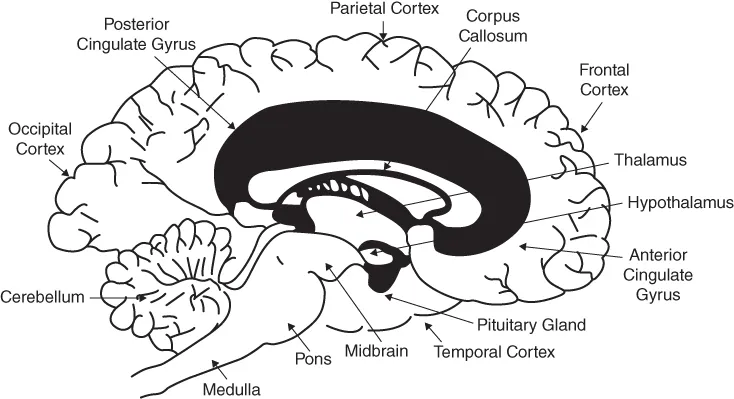
The brainstem is made up of three structures, the medulla oblongata, the pons and the midbrain (Figure 1.1).
  • The Medulla Oblongata (commonly referred to as the medulla) is a division of the brain known as the myelencephalon. It forms the most posterior or lowest part of the brain and is often considered an extension of the spinal cord within the skull. It is a small structure of about one inch (2.5 cm) in length and lies below the pons. It is composed largely of projection tracts carrying information between the body (via the spinal cord) and the rest of the brain. The medulla also has a network of cells that occupy the core of the brainstem, extending through the pons and midbrain, known as the reticular formation (reticulum means ‘little net’). The ascending projections from the reticular formation project to the thalamus and cortex and play an important role in arousal and, for this reason, they are also known as the ascending reticular activating system (ARAS) (Chapter 8). Various nuclei in the medulla's reticular formation have diverse functional roles. There are cardiac, vasomotor and respiratory centres that regulate cardiovascular, circulatory and respiratory reflexes, respectively, as well as other nuclei that regulate reflexes, including vomiting, swallowing, coughing and sneezing.
  • The Pons (which means bridge) is a structure, with a characteristic bulge, that lies above the medulla and is considered a ‘bridge’ between the medulla and the midbrain (which is located above it). Ascending and descending fibre tracts pass through the pons, which is also part of the reticular formation. It is a division of the brain known as the metencephalon. It is connected to another division of the metencephalon, the cerebellum (Section 1.2.2), by bundles of transverse fibre tracts. The pons contains centres for reflexes that are mediated by the fifth (trigeminal), sixth (abducens), seventh (facial) and eighth (vestibulocochlear) cranial nerves. The pons also has the pneumotaxic centres that, together with the medulla, control respiration.
  • The midbrain is a division of the brain known as the mesencephalon and lies above the pons. Ascending and descending fibre tracts pass through the midbrain and it is also part of the reticular formation. The roof or tectum of the midbrain consists of two pairs of folds called colliculi (meaning ‘little hills’); these form the upper part of the midbrain that lies immediately above the cerebellum The two inferior colliculi have auditory centres and are involved in auditory function. The superior colliculi, which lie in front of the inferior colliculi, have visual centres and are involved in the regulation of pupillary reflexes and eye movements that are mediated by the third and fourth cranial nerves, respectively. Under, or ventral to the tectum, is another subdivision of the midbrain, the tegmentum, which contains part of the brainstem reticular formation. In addition, it contains a number of other key nuclei: the periaqueductal grey, which is involved in the regulation of pain and species-specific startle reflexes (Chapter 8); the substantia nigra and the red nucleus, which are involved in the regulation of motor movements (Chapter 2); and nuclei that are involved in the regulation of motivation and reinforcement (Chapters 10 and 11).
c01f001
Figure 1.1 The human brain.

1.2.2 The Metencephalon

The cerebellum (meaning ‘little brain’) is a division of the metencephalon (Figure 1.1). It is a highly convoluted structure that has two hemispheres and is located behind the brainstem, to which it is connected. The cerebellum is the second largest part of the brain after the cerebral cortex and occupies about one-tenth of the brain's volume. It is densely packed with neurones and has more than half the total number of neurones in the brain. It can be divided anatomically into three parts, known as the inferior, middle and superior cerebellar peduncles, which carry nerve fibre tracts between the medulla, pons and midbrain, respectively, and the cerebellum. The cerebellar cortex (outer layer) consists of grey matter (cell bodies) and the central core consists of white matter (myelinated nerve fibres). The cerebellar white matter has nerve fibre tracts that run to and from the thalamus and cortex.
The main function of the cerebellum is the coordination of movement; this operates below the level of consciousness. The cerebellum receives incoming sensory information from the ears (equilibrium receptors), skeletal muscles (proprioceptors), the brainstem and the cerebral cortex. It integrates this information and sends it to the motor cortex and skeletal muscle to coordinate posture, balance and movement. The cerebellum also acts, in conjunction with the cortex, to plan motor movements. In addition, the cerebellum has a role in ‘storage’ and ‘execution’ of motor memories, such as riding a bicycle or playing the piano, which once learnt can be carried out reflexively without conscious thought. More recently, there has been evidence to suggest that the cerebellum may also have a role in the regulation of cognitive functions, such as nonmotor learning and attention.
Damage to the cerebellum, due to haemorrhage, tumours or injury, may result in ataxia (which is loss of muscle coordination), tremor, vertigo (dizziness), slurred speech and an inability to walk. Drugs, such as alcohol, benzodiazepines and barbiturates (Sections 1.6.1 and 1.6.2; Chapters 9 and 11), may depress neural activity in the cerebellum and produce symptoms such as ataxia and slurred speech.

1.2.3 Diencephalon

The diencephalon (which means ‘between brain’) is the division of the brain that is located between the cerebral cortex and the midbrain. The main structures of the diencephalon are the thalamus and hypothalamus (Figure 1.1). There are other smaller structures, such as the pineal gland (Chapter 9), in the diencephalon.
  • The tha...

Table of contents

  1. Cover
  2. Title Page
  3. Copyright
  4. Table of Contents
  5. Dedication
  6. Preface
  7. About the CompanionWebsite
  8. Chapter 1: Introduction to Neuropsychopharmacology
  9. Chapter 2: Parkinson's Disease
  10. Chapter 3: Memory, Dementia and Alzheimer's Disease
  11. Chapter 4: Epilepsy
  12. Chapter 5: Attention Deficit Hyperactivity Disorder
  13. Chapter 6: Affective Disorders 1: Depression
  14. Chapter 7: Affective Disorders 2: Bipolar Disorder
  15. Chapter 8: Anxiety Disorders
  16. Chapter 9: Sleep and Sleep Disorders
  17. Chapter 10: Schizophrenia
  18. Chapter 11: Drug Abuse and Addiction
  19. References
  20. Index
  21. End User License Agreement