eBook - ePub
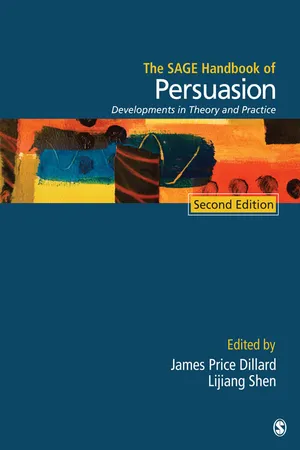
The SAGE Handbook of Persuasion
Developments in Theory and Practice
- 456 pages
- English
- ePUB (mobile friendly)
- Available on iOS & Android
eBook - ePub
The SAGE Handbook of Persuasion
Developments in Theory and Practice
About this book
The Second Edition of The SAGE Handbook of Persuasion: Developments in Theory and Practice provides readers with logical, comprehensive summaries of research in a wide range of areas related to persuasion. From a topical standpoint, this handbook takes an interdisciplinary approach, covering issues that will be of interest to interpersonal and mass communication researchers as well as to psychologists and public health practitioners. Persuasion is presented in this volume on a micro to macro continuum, moving from chapters on cognitive processes, the individual, and theories of persuasion, to chapters highlighting broader social factors and phenomena related to persuasion, such as social context and larger scale persuasive campaigns. Each chapter identifies key challenges to the area and provides research strategies for addressing those challenges.
Information
PART I
Fundamental Issues
CHAPTER 1
Persuasion in the Rhetorical Tradition
The study of persuasion can be traced back to ancient Greece, the birthplace of both rhetoric and democracy. As Dillard and Pfau (2002) noted in the first edition of The Persuasion Handbook, Aristotle “provided the first comprehensive theory of rhetorical discourse” (p. ix) in the fifth century BCE, and persuasion was central to that theory. Yet persuasion has not always been at the center of rhetorical theory. During the Enlightenment, the scope of rhetoric broadened to include aesthetic and psychological concerns, rendering persuasion secondary to considerations of “taste” and “sympathy.” More recently, narrative and dramatistic theories of rhetoric have emphasized identity or “identification” over persuasion, and some rhetorical scholars have even denounced persuasion as a mechanism of “control and domination” (Foss & Griffin, 1995, p. 2). Still, persuasion has remained a dominant theme in the rhetorical tradition, with two broad concerns distinguishing the rhetorical perspective from more scientific or empirical approaches to persuasion: a focus on the political or civic contexts of persuasion, and an overriding emphasis on ethical concerns.
In this chapter, I survey the rhetorical tradition with a view toward illuminating some of the differing, even competing, perspectives on persuasion over the long history of rhetorical studies. In the process I highlight two cultural imperatives that help to account for the emphasis on politics and ethics in the Western rhetorical tradition: (1) the need to educate for citizenship, and (2) an ongoing debate over the rules or norms of democratic deliberation. In the rhetorical tradition, these two imperatives link the study of rhetoric to democratic theory, inspiring normative conceptions of persuasion that emphasize the responsibilities that go along with the right of free speech in a democracy. By surveying how rhetorical theorists historically have distinguished responsible or legitimate free speech from propaganda and demagoguery, I illuminate the intimate connections between rhetorical theories of persuasion and democracy itself.
I begin by revisiting the classical/humanistic roots of the rhetorical tradition, from the sophists of ancient Greece to the Roman rhetoricians, Cicero and Quintilian. I then sketch the history of rhetorical theory through modern times, including the attack on rhetoric in the early modern period and the impact of the belletristic and elocutionary movements on rhetorical theory. Finally, I consider more recent developments in rhetorical theory, including the influence of Burkean “dramatism,” the rise of social movement studies, and the “postmodern” challenge to the rhetorical tradition. As we shall see, many of these more recent developments have been cast as alternatives to the classical/humanistic tradition of persuasion (indeed, some have challenged the very idea of a “rhetorical tradition”). Yet despite these various challenges, the classical tradition’s emphasis on the ethics of civic persuasion remains strong in contemporary rhetorical theory and criticism.
In the second section of the chapter, I reflect on the distinctive contributions of the American tradition of rhetoric and public address to the theory and practice of persuasion. Surveying the linkages between America’s great experiment in democracy and evolving attitudes toward rhetoric and persuasion, I begin by recalling how the founders’ constitutional design reflected a vision of a deliberative democracy grounded in neoclassical rhetorical theory. I then trace how the American rhetorical tradition evolved during the so-called golden age of American oratory, as Jacksonian democracy brought a more populist rhetorical style to American politics and the debate over slavery tested the limits of civic persuasion. I next consider the revival of the American rhetorical tradition during the Progressive Era, as new media, changing demographics, and a culture of professionalization revolutionized the way Americans talked about politics and gave rise to a new “science” of mass persuasion. Finally, I reflect on the impact of new electronic media and the relationship between television and the decline of civic discourse in the closing decades of the 20th century. I conclude with some brief reflections on the contemporary crisis of democracy in America and the efforts of a new, interdisciplinary deliberative democracy movement to revive the public sphere.
The Concept of Persuasion in Rhetorical Theory
The story of rhetoric’s roots in ancient Greece has been told many times—and for a variety of purposes. For generations, that story was used to justify speech programs in American colleges and universities. At the height of the Cold War, for example, W. Norwood Brigance, one of the pioneers of the American speech discipline, invoked rhetoric’s ancient roots to argue that the teaching of speech was one of the distinguishing marks of a free society. Democracy and the “system of speechmaking were born together,” Brigance (1961) wrote, and since ancient times “we have never had a successful democracy unless a large part, a very large part, of its citizens were effective, intelligent, and responsible speakers.” According to Brigance, there were only two kinds of people in the modern world: “Those who in disagreements and crises want to shoot it out, and those who have learned to talk it out.” Brigance concluded that if America hoped to remain a “government by talk,” it needed leaders who knew how to talk “effectively, intelligently, and responsibly,” as well as citizens trained to “listen and judge” (pp. 4–5).
Since Brigance’s day, revisionist scholars have told and “retold” rhetoric’s story to advance a variety of agendas. In Rereading the Sophists, for example, Jarratt (1991) reconsidered the Greek sophists from a feminist perspective and concluded that they were more progressive in their thinking about “social needs” (p. 28) than most of the more prominent figures in the classical tradition. In Jarratt’s rereading of the tradition, the sophists provided an alternative to patriarchal rhetoric by privileging “imaginative reconstructions” over “empirical data” (p. 13) and by broadening the purview of rhetoric beyond canonical texts. The sophists also modeled a more collaborative and democratic model of rhetorical education, according to Jarratt—one more consistent with today’s best research on critical pedagogy and “social cognition” (p. 92).
The sophists were no doubt important to the rhetorical tradition. But so, too, were Plato, Aristotle, and the great Roman rhetoricians, Cicero and Quintilian. It is important to recognize that no single paradigm defines the classical rhetorical tradition. Rather, that tradition consists of ongoing debates over the philosophical status of rhetoric, the best methods of rhetorical education, and the aims, scope, power, and ethics of rhetoric—indeed, over the very definition of “rhetoric” itself. Yet even as we recognize the rhetorical tradition itself as a dynamic and ongoing set of controversies, we can identify two emphases in the classical tradition that have distinguished the rhetorical perspective ever since: (1) an emphasis on the role of persuasion in politics and civic life, and (2) an overriding concern with the moral character of the speaker and the ethics of persuasion.
The Ancient Tradition
The sophists were the original professors of rhetoric in Greece, and they initiated a long tradition of teaching speech and persuasion as education for citizenship. As Hunt (1965) noted, the original sophists were professional teachers who helped meet the need for rhetorical and civic training in Athens, and the term “sophist” initially referred to “any man … thought to be learned” (p. 71). Over time, however, the sophists acquired a negative reputation as arrogant and boastful—a reputation that echoed down through the centuries because of a famous dialogue written by their best-known critic, the philosopher Plato. In the Gorgias, Plato accused the sophists of teaching students to flatter or pander to their audiences, and Plato’s criticisms so impressed succeeding generations that the sophists came to stand for a whole range of human flaws: the “false pretense of knowledge, overweening conceit, fallacious argument, cultivation of style for its own sake, demagoguery, corruption of youth …, and, in general, a ready substitution of appearance for reality” (Hunt, 1965, p. 69).
In the master narrative of the rhetorical tradition, Plato’s student, Aristotle, rescued rhetoric’s reputation by devising an “amoral” or “morally neutral” theory focused purely on techné, or the mechanics of persuasive speaking. Leaving ethical questions to the philosophers, Aristotle defined rhetoric as the faculty of “discovering in the particular case … the available means of persuasion” (Cooper, 1932, p. 7), and he recognized that this power “could be used either for good or ill” (Kennedy, 1991, p. ix). While Aristotle refrained from grand moral pronouncements, however, he did infuse his rhetorical theory with a strong ethical or normative component. Emphasizing moral character as a key element in persuasion and celebrating reasoned argument over appeals to the emotions, Aristotle’s rhetoric was hardly morally neutral about what constituted responsible persuasion in civic life. Moreover, his vision of civic persuasion demanded broad learning in philosophy, history, literature, and human psychology. For Aristotle, rhetoric was not only a moral but also an architectonic art, encompassing all realms of humanistic and scientific understanding.
Similarly, Isocrates, one of the later sophists, responded to Plato’s attack on rhetoric by rejecting both the empty and commercialized speech of his fellow sophists and the abstract philosophizing of Plato and the Socratics. Rather than mere techné, Isocrates viewed rhetoric as a means for educating students to “think and speak noble, virtuous ideas” and to “implement them in civic policy” (Kennedy, 1991, p. 11). For Isocrates, the ultimate goal of a rhetorical education was not to prepare students for personal success, but to train them for public service and “inspire the political life of [the] nation with a higher moral creed” (Jaegar, 1965, p. 108). The ethical and civic spirit of the Greek rhetoricians was even stronger in the writings of the Roman rhetoricians, Cicero and Quintilian. Bringing a more pragmatic, pedagogical emphasis to the study of rhetoric, the Romans added little to the Greeks’ repertoire of persuasive techniques. In systematizing rhetorical instruction and grounding it in a theory of civic republicanism, however, they painted a portrait of the ideal citizen in a free republic and upheld a high moral standard: the “common good.” For the Romans, the ideal orator was not merely one with “exceptional gifts of speech,” but also a “good man” with “all the excellences of character” (Butler, 1969, pp. 9–11). They considered the principles of moral conduct an integral part of the rhetorical art, not something to be left to the ethicists or philosophers.
Cicero’s chief contribution to the theory of civic rhetoric was his emphasis on the practical or functional aspects of the art, which he elucidated from the perspective of a practicing orator. As the “most eminent orator of Roman civilization” (Baldwin, 1924, p. 43), Cicero aspired to restore the art of rhetoric to its exalted status in Greek civilization, and he was “influenced and guided” in this effort “by the doctrines of Isocrates,” whom he regarded as the “father of eloquence” (Thonssen & Baird, 1948, p. 81). Like Isocrates, Cicero painted a portrait of the ideal orator as an engaged citizen of high moral character and broad learning, one devoted not to his own selfish interests but to the “common good.” In the first book of his most important work, De Oratore, Cicero lamented the scarcity of great orators in his own day and blamed that problem on the “incredible vastness and difficulty of the subject” (Sutton & Rackham, 1983, p. 13). In addition to “knowledge of very many matters,” Cicero’s ideal orator mastered the psychology of the human emotions, stocked his memory with “the complete history of the past,” and commanded a “store of precedents” grounded in both “statute law and our national law” (p. 15). Then he had to deliver all that knowledge effectively, with the voice, facial expressions, physical gestures, and the movement of the body all carefully regulated. For Cicero, true eloquence demanded training “in all the liberal arts” (p. 55), as well as mastery of the “moral science” of “human life and conduct” (pp. 50–51).
Like Cicero, Quintilian was concerned about the paucity of great orators in the Roman republic. At a time when politics and public morals in Rome had declined to a “savage low” (Murphy, 1965, p. xiii), he aspired to nothing short of a cultural revolution through rhetorical education. Quintilian’s monumental four-volume work, Institutio Oratoria (Butler, 1969), was the “most ambitious single treatise on education” produced by the ancient world (Murphy, 1965, p. xi), and it set out a program for educating the citizen-orator from cradle to grave. More than just a handbook of rhetoric, Quintilian’s Institutio placed at least as much emphasis on developing moral character as oratorical skills. For Quintilian, it was not enough that young men grew up to be effective orators; they also needed to be broadly educated and morally principled, capable of “analysis, reflection, and then powerful action in public affairs” (Murphy, 1965, p. xx). In the “dissolute society of his time,” Quintilian’s emphasis on “moral principle as a factor in education” made a most “profound impression” (Murphy, 1965, p. viii), and his portrait of the ideal citizen has been passed down through the ages in a phrase familiar to every student of classical rhetoric: the “good man speaking well.”
Much of the modern scholarship on the classical/humanist tradition has emphasized the differences among these various “schools” of rhetoric in the ancient world. Yet a common thread ran through all of classical rhetoric: the need to educate for citizenship. Concerned with the practical and ethical requirements of civic life, the ancient rhetoricians aspired to equip young people with the skills and knowledge they would need to be citizens in a free society. All recognized the need for rules of civic persuasion, and they all imagined some ideal orator—a speaker who embodied civic virtue and a commitment to the “common good.” As Garsten (2006) has concluded, the ancient rhetorical tradition constituted a “politics of persuasion” where both leaders and ordinary citizens possessed “a certain moral compass” that served as a check on demagoguery and allowed for “responsible judgment” in civic affairs (p. 146). It was a tradition that, as we shall see later, had great appeal to America’s founders.
The Modern Era
Over the centuries, there have been a number of challenges to the classical tradition, including alternatives to its emphasis on persuasion in civic life. In this section, I provide a brief overview of the philosophical critique of the classical rhetorical tradition that emerged in the early modern era. I then take a closer look at the alternative paradigm that emerged across the 18th and 19th centuries—a period that Golden and Corbett (1968) have called one of the “most prolific eras in rhetorical history” (p. 7). During this time, British and American rhetoricians shifted the emphasis in rhetorical theory from persuasion to the aesthetic, literary, and performative dimensions of discourse, and they dramatically broadened the scope of rhetoric to include written and literary forms.
The beginnings of what Garsten (2006) has characterized as the early modern “attack on rhetoric” (p. 10) can be traced to the rise of political and religious fanaticism in the sixteenth and seventeenth centuries. Fearing the effects of demagoguery on public opinion, philosophers such as Hobbes, Rousseau, and Kant searched for some unitary and authoritative source of public judgment to replace the everyday opinions of ordinary citizens, in effect “asking citizens to distance themselves from their private judgments and to judge from a sovereign, unitary, public standpoint instead” (p. 11). Hobbes alternative was expressed in a “rhetoric of representation”; for Rousseau and Kant the alternatives w...
Table of contents
- Cover Page
- Dedication
- Title
- Copyright
- Contents
- PART I. FUNDAMENTAL ISSUES
- PART II. THEORIES, PERSPECTIVES, AND TRADITIONS
- PART III. CONTEXTS, SETTINGS, AND APPLICATIONS
- Author Index
- Subject Index
- About the Authors
Trusted by 375,005 students
Access to over 1.5 million titles for a fair monthly price.
Study more efficiently using our study tools.
Frequently asked questions
Yes, you can cancel anytime from the Subscription tab in your account settings on the Perlego website. Your subscription will stay active until the end of your current billing period. Learn how to cancel your subscription
No, books cannot be downloaded as external files, such as PDFs, for use outside of Perlego. However, you can download books within the Perlego app for offline reading on mobile or tablet. Learn how to download books offline
Perlego offers two plans: Essential and Complete
- Essential is ideal for learners and professionals who enjoy exploring a wide range of subjects. Access the Essential Library with 800,000+ trusted titles and best-sellers across business, personal growth, and the humanities. Includes unlimited reading time and Standard Read Aloud voice.
- Complete: Perfect for advanced learners and researchers needing full, unrestricted access. Unlock 1.5M+ books across hundreds of subjects, including academic and specialized titles. The Complete Plan also includes advanced features like Premium Read Aloud and Research Assistant.
We are an online textbook subscription service, where you can get access to an entire online library for less than the price of a single book per month. With over 1.5 million books across 990+ topics, we’ve got you covered! Learn about our mission
Look out for the read-aloud symbol on your next book to see if you can listen to it. The read-aloud tool reads text aloud for you, highlighting the text as it is being read. You can pause it, speed it up and slow it down. Learn more about Read Aloud
Yes! You can use the Perlego app on both iOS and Android devices to read anytime, anywhere — even offline. Perfect for commutes or when you’re on the go.
Please note we cannot support devices running on iOS 13 and Android 7 or earlier. Learn more about using the app
Please note we cannot support devices running on iOS 13 and Android 7 or earlier. Learn more about using the app
Yes, you can access The SAGE Handbook of Persuasion by James Price Dillard,Lijiang Shen, James Price Dillard, Lijiang Shen in PDF and/or ePUB format, as well as other popular books in Languages & Linguistics & Communication Studies. We have over 1.5 million books available in our catalogue for you to explore.