- English
- ePUB (mobile friendly)
- Available on iOS & Android
eBook - ePub
About this book
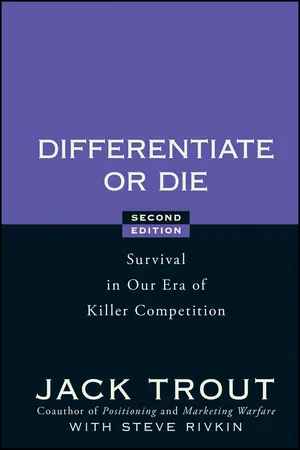
A newly revised and expanded edition of the revolutionary business classic, Differentiate or Die, Second Edition shows you how to differentiate your products, services, and business in order to dominate the competition. Veteran marketing guru Jack Trout uses real-world examples and his own unique insight to show you how to bind customers to your products for long-term success and loyalty. This edition includes new case studies, new research, and updated examples from around the world.
CHAPTER 1
The Tyranny of Choice
In the beginning, choice was not a problem. When our earliest ancestor wondered, “What’s for dinner?” the answer wasn’t very complicated. It was whatever animal in the neighborhood very complicated. It was whatever animal in the neighborhood he could run down, kill, and drag back to the cave.
Today, you walk into a cavernous supermarket and gaze out over a sea of different types and cuts of meats that someone else has run down, killed, dressed, and packaged for you.
Your problem is no longer catching it. Your problem is to try to figure out which of the hundreds of different packages in the case to buy. Red meat? White meat? The other white meat? Make-believe meat?
But that’s only the beginning. Now you have to figure out what part of the animal you want. Loin? Chops? Ribs? Legs? Rump?
And what do you bring home for those family members who don’t eat meat?
Fishing for Dinner
Catching a fish for that early ancestor was simply a matter of sharpening a stick and getting lucky.
Today, it can mean drifting into a Bass Pro Shop, an L.L.Bean, a Cabela’s, or an Orvis and being dazzled by a mind-boggling array of rods, reels, lures, clothing, boats, you name it.
At Bass Pro’s 300,000-square-foot flagship store in Springfield, Missouri, they will give you a haircut and then make you a fishing lure out of the clippings.
Things have come a long way from that pointed stick.
Going to Dinner
Today, many people figure it’s better to have someone else figure out what’s for dinner. But figuring out where to go is no easy decision in a place like New York City.
That’s why, in 1979, Nina and Tim Zagat created the first restaurant survey in New York City to help us with that difficult choice.
Today, the pocket-size Zagat Surveys have become best-sellers, with 300,000 participants rating and reviewing restaurants, bars, and nightclubs in 54 different guidebooks.
An Explosion of Choice
What has changed in business over recent decades is the amazing proliferation of product choices in just about every category. It’s been estimated that there are a million standard stocking units (SKUs) in the United States. An average supermarket has 40,000 SKUs. Now for the stunner: An average family gets 80 to 85 percent of its needs from 150 SKUs. That means there’s a good chance we’ll ignore 39,850 items in that store.
Buying a car in the 1950s meant a choice between a model from GM, Ford, Chrysler, or American Motors. Today, you have your pick of cars, still from GM, Ford, and Chrysler, but also from Acura, Aston Martin, Audi, Bentley, BMW, Honda, Hyundai, Infiniti, Isuzu, Jaguar, Jeep, Kia, Land Rover, Lexus, Maserati, Mazda, Mercedes, Mitsubishi, Nissan, Porsche, Rolls-Royce, Saab, Saturn, Subaru, Suzuki, Volkswagen, and Volvo. There were 140 motor vehicle models available in the early 1970s. There are more than 300 today.
And the choice of tires for these cars is even worse. It used to be Goodyear, Firestone, General, and Sears. Today, at just one retail outlet called The Tire Rack, you can browse the likes of Goodrich, Bridgestone, Continental, Dunlop, Firestone, Fuzion, General, Goodyear, Hankook, Kumho, Michelin, Pirelli, Sumitomo, Toyo, Uniroyal, and Yokohama.
The big difference is that what used to be national markets with local companies competing for business has become a global market with everyone competing for everyone’s business everywhere.
Choice in Healthcare
Consider something as basic as healthcare. In the old days, you had your doctor, your hospital, Blue Cross, and perhaps Aetna/US Healthcare, Medicare, or Medicaid. Now you have to deal with new names like MedPartners, Cigna, Prucare, Columbia, Kaiser, Wellpoint, Quorum, Oxford, Americare, Multiplan, and concepts like Health Maintenance Organizations (HMO), Peer Review Organizations (PRO), Physician Hospital Organizations (PHO), and Preferred Provider Organizations (PPO).
It’s gotten so confusing that magazines like U.S. News & World Report have taken to rating hospitals and HMOs to make our choice easier.
California is even getting into a healthcare public “report card” arena. It started with several physician groups and health plans publishing “report cards” evaluating the performance of network providers. Then the 2.1-million-member PacifiCare of California published its new “Quality Index” report on its web site, rating more than 100 physician-based organizations according to clinical outcome measures, as well as member satisfaction, administrative data, and professional/organizational data.
It’s gotten so confusing that people aren’t worrying about getting sick. They worry more about where you go to get better.
Choice in Consumer Electronics
One keen observer wandered into his local consumer electronics superstore and spent some time in the audio aisle. There were 74 different stereo tuners, 55 CD players, 32 tape players, and 50 sets of speakers. (Do your ears hurt yet?)
Given the fact that these components could be mixed and matched anyway you want, that means there is the opportunity to create 6.5 million different stereo systems. (Now we know your ears hurt.)
Choice Is Spreading
What we just described is what has happened to the U.S. market, which, of the world’s markets, has by far the most choice (because our citizens have the most money and the most marketing people trying to get it from them).
Consider an emerging nation like China. After decades of buying generic food products manufactured by state-owned enterprises, China’s consumers now can choose from a growing array of domestic and foreign brand-name products each time they go shopping. According to a recent survey, a national market for brand-name food products has already begun to emerge. Already China has 135 “national” food brands from which to pick. They’ve got a long way to go, but they are on their way to some serious tyranny.
Some markets are far from emerging. Countries like Liberia, Somalia, North Korea, and Tanzania are so poor and chaotic that choice is but a gleam in people’s eyes.
The Law of Division
What drives choice is the law of division, which was published in The 22 Immutable Laws of Marketing.
Like an amoeba dividing in a petri dish, the marketing arena can be viewed as an ever-expanding sea of categories.
A category starts off as a single entity. Computers, for example. But over time, the category breaks up into other segments: main-frames, minicomputers, workstations, personal computers, laptops, notebooks, pen computers.
Like the computer, the automobile started off as a single category. Three brands (Chevrolet, Ford, and Plymouth) dominated the market. Then the category divided. Today, we have luxury cars, moderately priced cars, and inexpensive cars; full-size, intermediate, and compacts; sports cars, four-wheel-drive vehicles, RVs, minivans, and suburbans (station wagons on steroids).
In the television industry, ABC, CBS, and NBC once accounted for 90 percent of the viewing audience. Now we have network, ...
Table of contents
- Title Page
- Copyright Page
- Dedication
- PREFACE
- CHAPTER 1 - The Tyranny of Choice
- CHAPTER 2 - The Creeping Commoditization of Categories
- CHAPTER 3 - Whatever Happened to the Unique Selling Proposition?
- CHAPTER 4 - Reinventing the Unique Selling Proposition
- CHAPTER 5 - Quality and Customer Orientation Are Rarely Differentiating Ideas
- CHAPTER 6 - Creativity Is Not a Differentiating Idea
- CHAPTER 7 - Price Is Rarely a Differentiating Idea
- CHAPTER 8 - Breadth of Line Is a Difficult Way to Differentiate
- CHAPTER 9 - The Steps to Differentiation
- CHAPTER 10 - Differentiation Takes Place in the Mind
- CHAPTER 11 - Being First Is a Differentiating Idea
- CHAPTER 12 - Attribute Ownership Is a Way to Differentiate
- CHAPTER 13 - Leadership Is a Way to Differentiate
- CHAPTER 14 - Heritage Is a Differentiating Idea
- CHAPTER 15 - Market Specialty Is a Differentiating Idea
- CHAPTER 16 - Preference Is a Differentiating Idea
- CHAPTER 17 - How a Product Is Made Can Be a Differentiating Idea
- CHAPTER 18 - Being the Latest Can Be a Differentiating Idea
- CHAPTER 19 - Hotness Is a Way to Differentiate
- CHAPTER 20 - Growth Can Destroy Differentiation
- CHAPTER 21 - Differentiation Often Requires Sacrifice
- CHAPTER 22 - Being Different in Different Places
- CHAPTER 23 - Maintaining Your Difference
- CHAPTER 24 - Differentiation in the New World of Buzz
- CHAPTER 25 - You Can Differentiate Anything
- CHAPTER 26 - Who Is in Charge of Differentiation?
- EPILOGUE
- NOTES
- Index
Trusted by 375,005 students
Access to over 1.5 million titles for a fair monthly price.
Study more efficiently using our study tools.
Frequently asked questions
Yes, you can cancel anytime from the Subscription tab in your account settings on the Perlego website. Your subscription will stay active until the end of your current billing period. Learn how to cancel your subscription
No, books cannot be downloaded as external files, such as PDFs, for use outside of Perlego. However, you can download books within the Perlego app for offline reading on mobile or tablet. Learn how to download books offline
Perlego offers two plans: Essential and Complete
- Essential is ideal for learners and professionals who enjoy exploring a wide range of subjects. Access the Essential Library with 800,000+ trusted titles and best-sellers across business, personal growth, and the humanities. Includes unlimited reading time and Standard Read Aloud voice.
- Complete: Perfect for advanced learners and researchers needing full, unrestricted access. Unlock 1.5M+ books across hundreds of subjects, including academic and specialized titles. The Complete Plan also includes advanced features like Premium Read Aloud and Research Assistant.
We are an online textbook subscription service, where you can get access to an entire online library for less than the price of a single book per month. With over 1.5 million books across 990+ topics, we’ve got you covered! Learn about our mission
Look out for the read-aloud symbol on your next book to see if you can listen to it. The read-aloud tool reads text aloud for you, highlighting the text as it is being read. You can pause it, speed it up and slow it down. Learn more about Read Aloud
Yes! You can use the Perlego app on both iOS and Android devices to read anytime, anywhere — even offline. Perfect for commutes or when you’re on the go.
Please note we cannot support devices running on iOS 13 and Android 7 or earlier. Learn more about using the app
Please note we cannot support devices running on iOS 13 and Android 7 or earlier. Learn more about using the app
Yes, you can access Differentiate or Die by Jack Trout,Steve Rivkin in PDF and/or ePUB format, as well as other popular books in Business & Sales. We have over 1.5 million books available in our catalogue for you to explore.