The shift towards being as environmentally-friendly as possible has resulted in the need for this important volume on heterogeneous catalysis. Edited by the father and pioneer of Green Chemistry, Professor Paul Anastas, and by the renowned chemist, Professor Robert Crabtree, this volume covers many different aspects, from industrial applications to the latest research straight from the laboratory. It explains the fundamentals and makes use of everyday examples to elucidate this vitally important field.
Acid catalysis as a modern science is less than 150 years old. From its inception, acid catalysis has been explored as a means of producing fuels, lubes and petrochemicals. Ordinary homogeneous acids, both inorganic and organic, never proved industrially useful at temperatures much above 150 °C. The first reports of aluminosilicate solid acid catalysts involved the use of clays after the turn of the century. The inspiration for the first commercial synthetic aluminosilicate catalysts came from work done co precipitating silicon and aluminum salts during WWI by a Sun Oil chemist [1]. The Br
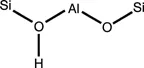
nsted acid site in these materials is most often represented as in Scheme 1.1. Useful features of this novel type of acid versus homogeneous liquid acids were their high temperature stability, moderate acidity (roughly equivalent to a 50% sulfuric acid solution), solid and non-corrosive character and regenerability by air oxidation. These features enabled acid catalyzed reactions of chemicals to be contemplated at a greatly extended range of temperatures (up to 600 °C) and metallurgies.
Scheme 1.1 The Br
nsted acid site of an aluminosilicate.
The first embodiments of many modern refining processes including heavy oil cracking, naphtha reforming and light gas oligomerization did not use catalysts [2]. As soon as these thermal processes commercialized, exploration of the use of solid acid catalysts ensued naturally.
Because of the key role played in the development of the automotive industry, heavy oil cracking to gasoline provided a focal point for the early development of heterogeneous acid catalysis. Temperatures above 400 °C and pressures below 3 atmospheres are thermodynamically favorable for the conversion of heavy oils to light hydrocarbons rich in olefins. Acceptable heavy oil cracking rates are achieved without a catalyst at temperatures above 600 °C. This was the basis of the thermal cracking process. Thermal cracking produces high yields of methane and aromatic hydrocarbons. The goal of researchers was to find a catalyst that could crack heavy hydrocarbons selectively to gasoline with only minimal formation of gases with molecular weights of less than 30. Due to thermodynamic constraints, the catalyst had to be effective at a temperature above 400 °C. In order to avoid unselective thermal cracking, the catalyst had to be effective below 550 °C.
The discovery in the early 1920s by Houdry that acid activated clays were active and selective in this temperature window was a breakthrough [2]. In the 1930s and 1940s methods were developed and commercialized to produce high surface area man-made aluminosilicates that were significantly improved catalysts. Examination of the aluminosilicate catalysts led to the understanding that the active site was a Br
nsted acid [3].
At the time of the discovery of synthetic zeolites in the early 1950s, only two classes of solid Br
nsted acids (solid phosphoric acid and aluminosilicates) were being used commercially to produce commodity fuels or petrochemicals [4]. The commercialization of silica-rich synthetic zeolites in their hydrogen form represented a breakthrough for scientists and organizations interested in the production of fuels, lubes and petrochemicals at temperatures above 200 °C. Like amorphous aluminosilicates, zeolite Br
nsted acid sites are active and stable up to 600 °C. Shortly after Union Carbide's discovery of synthetic zeolites in the late 1940s, Mobil Oil researchers in catalytic cracking of heavy oil investigated zeolites as potential catalysts [5]. The zeolite known as faujasite (FAU) was found to be three to five orders of magnitude more active than amorphous aluminosilicates. Unmodified, FAU was too active to be useful. When the activity of FAU was tuned by ion exchange with rare earth cations and/or by reducing aluminum content, it was found to have a dramatically different selectivity to cracked products. Optimized samples of FAU zeolites produced almost 5% less C2-gases and coke and increased gasoline yields by more than 10 wt%. Over the course of the past 50 years, evolving heavy oil cracking catalysts and hardware have been continuously decreasing coke and C2-gas yields while increasing the yield of gasoline.
The commercialization of zeolite catalysts for heavy oil cracking unleashed the creative abilities of every organization interested in producing fuels and petrochemicals using acid catalysts between 250 and 600 °C. Close to 23 processes have been commercialized (Table 1.1). About two-thirds of the processes had no real precedence using homogeneous acids. The other third involved displacement of homogeneous and amorphous acid cataly...
Table of contents
Cover
Related Titles
Title Page
Copyright
About the Editors
List of Contributors
Chapter 1: Zeolites in Catalysis
Chapter 2: Sol–Gel Sulfonic Acid Silicas as Catalysts
Chapter 3: Applications of Environmentally Friendly TiO2 Photocatalysts in Green Chemistry: Environmental Purification and Clean Energy Production Under Solar Light Irradiation
Chapter 4: Nanoparticles in Green Catalysis
Chapter 5: ‘Heterogreeneous Chemistry’
Chapter 6: Single-Site Heterogeneous Catalysts via Surface-Bound Organometallic and Inorganic Complexes
Chapter 7: Sustainable Heterogeneous Acid Catalysis by Heteropoly Acids
Chapter 8: The Kinetics of TiO2-based Solar Cells Sensitized by Metal Complexes
Chapter 9: Automotive Emission Control: Past, Present and Future
Chapter 10: Heterogeneous Catalysis for Hydrogen Production
Chapter 11: High-Throughput Screening of Catalyst Libraries for Emissions Control
Chapter 12: Catalytic Conversion of High-Moisture Biomass to Synthetic Natural Gas in Supercritical Water
Index
End User License Agreement
Trusted by 375,005 students
Access to over 1.5 million titles for a fair monthly price.
Study more efficiently using our study tools.
Frequently asked questions
Yes, you can cancel anytime from the Subscription tab in your account settings on the Perlego website. Your subscription will stay active until the end of your current billing period. Learn how to cancel your subscription
No, books cannot be downloaded as external files, such as PDFs, for use outside of Perlego. However, you can download books within the Perlego app for offline reading on mobile or tablet. Learn how to download books offline
Perlego offers two plans: Essential and Complete
Essential is ideal for learners and professionals who enjoy exploring a wide range of subjects. Access the Essential Library with 800,000+ trusted titles and best-sellers across business, personal growth, and the humanities. Includes unlimited reading time and Standard Read Aloud voice.
Complete: Perfect for advanced learners and researchers needing full, unrestricted access. Unlock 1.5M+ books across hundreds of subjects, including academic and specialized titles. The Complete Plan also includes advanced features like Premium Read Aloud and Research Assistant.
Both plans are available with monthly, semester, or annual billing cycles.
We are an online textbook subscription service, where you can get access to an entire online library for less than the price of a single book per month. With over 1.5 million books across 990+ topics, we’ve got you covered! Learn about our mission
Look out for the read-aloud symbol on your next book to see if you can listen to it. The read-aloud tool reads text aloud for you, highlighting the text as it is being read. You can pause it, speed it up and slow it down. Learn more about Read Aloud
Yes! You can use the Perlego app on both iOS and Android devices to read anytime, anywhere — even offline. Perfect for commutes or when you’re on the go. Please note we cannot support devices running on iOS 13 and Android 7 or earlier. Learn more about using the app
Yes, you can access Green Catalysis, Volume 2 by Paul T. Anastas in PDF and/or ePUB format, as well as other popular books in Physical Sciences & Environmental Science. We have over 1.5 million books available in our catalogue for you to explore.