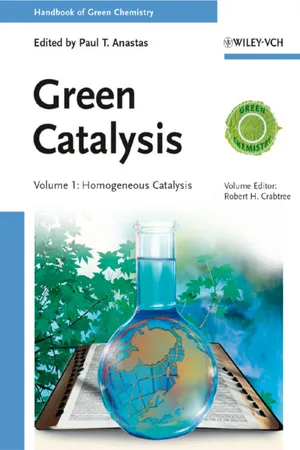
The shift towards being as environmentally-friendly as possible has resulted in the need for this important volume on homogeneous catalysis. Edited by the father and pioneer of Green Chemistry, Professor Paul Anastas, and by the renowned chemist, Professor Robert Crabtree, this volume covers many different aspects, from industrial applications to atom economy. It explains the fundamentals and makes use of everyday examples to elucidate this vitally important field.
An essential collection for anyone wishing to gain an understanding of the world of green chemistry, as well as for chemists, environmental agencies and chemical engineers.
- English
- ePUB (mobile friendly)
- Available on iOS & Android
eBook - ePub
About this book
Information
1
Atom Economy – Principles and Some Examples
Audrey Moores
1.1 Introduction
As many other human activities, chemistry has seen most of its progress being triggered by a constant desire to do things better. The word ‘better’ here is a general term that can encompass concepts as varied as ‘that allows better theoretical understanding’, ‘that allows companies to make significant savings when they use the process in question’ or ‘that saves the experimentalist a lot of strenuous steps in a given synthesis’. Environmental and health-related issues have also been a major drive, in addition to the desire to reduce waste. The Leblanc process [1], one of the first industrial chemical processes, is a good example of this early concern. It provided a route to sodium carbonate, a vital chemical for the development of the textile industry in the early nineteenth century. It was phased out half a century later, due to the combined action of a legislation restricting the right to produce the wasteful hydrochloric acid and calcium sulfide provided by the process, but also to the finding of a cost-effective and less wasteful solution: the Solvay process. The history of chemistry is full of such examples where new methodologies would bring about significant improvements to existing ones. Yet, the main focus of chemists' attention has varied over time, in other words, better has not always meant exactly the same thing. The constant pressure to reach new molecular targets has led to a lot of effort being put into seeking high yields. Activation of specific sites, chemo- and regioselectivity, is also a crucial quality in a process. Synthetic challenges were indeed justifying this trend. ‘Make it work’ was the motto. No doubt it was often followed by ‘make it good, too’ but only ‘if you can’. In 1991, though, Trost suggested starting to look at things with a different approach [2]. He presented a set of guidelines to assess the efficiency of a given process, by looking at the number of atoms of the reagent(s) actually ending up in the desired product(s). Atom economy was introduced. In addition to good yield and selectivity (regio-, chemo- and enantioselectivity), atom economy became the third element of the triadic goal that any synthetic chemist should seek. By analogy with the yield, which is an absolute measure, atom economy needed a quantitative criterion to allow comparison and discussion. In Section 1.2.2, some of the proposed criteria will be introduced. Although atom economy is a very simple concept, it nonetheless implied the development of a new and ambitious chemistry [3]. Making it happen involves a fresh look at molecular reactivity: activating groups should be minimized, such as stoichiometric reagents. In this chapter, the principle of atom economy is first presented. A scientific context will provide an avenue to the definition of its criteria. Impact on industry and the tool box of atom economy will also be discussed. Second, some examples using C–H activation will be described.
1.2 Principle of Atom Economy
1.2.1 Atom Economy: a Pillar of Green Chemistry
The concept of atom economy [4], and the idea of making it a primary criterion for improvement in chemistry, is a part of the green chemistry movement that was impulsed by Anastas from the early 1990s [5–7]. Then, growing environmental awareness pushed chemists to question their practice and led them to reassess the criteria of chemistry evaluation: it then obviously became necessary to look at a chemical reaction in a more global manner [8], considering aspects such as the origin of the reactants, the amount of energy necessary to make it work and the outcome of the generated waste. Thus 12 principles of green chemistry [6] were enounced, and since then chemists have used them as guidelines. The 12 principles as worded by Sheldon et al. [4] are as follows:
- waste prevention instead of remediation
- atom efficiency
- less hazardous/toxic chemicals
- safer products by design
- innocuous solvents and auxiliaries
- energy efficiency by design
- preferably renewable materials
- shorter synthesis – avoiding derivatization
- catalytic rather than stoichiometric reagents
- designing products for degradation
- analytical methodologies for pollution prevention
- inherently safer processes.
Waste minimization (principle 1) stands as one of the pillars of these principles, because it proposes to reduce the amount of ‘unused’ matter – i.e. matter that will not end up in the desired product – in a given process. ‘Unused’ matter, or waste, is of various natures. Solvents (principle 5) fall in that category and research on greener solvents and solventless processes is therefore a significant part of green chemistry. However, waste also comes from the stoichiometric reagents (principle 9) necessary to promote chemical reactions and from the activating groups on reagents (principle 8). This analysis reveals how several of the 12 principles can be intertwined and beneficially interact with one another. In the frame of atom economy (principle 2), we propose to tackle these sources of waste, so that most of the matter introduced in a process is actually present in the final product. By doing that, we obviously reduce the waste generated, but we also improve...
Table of contents
- Cover
- Related Titles
- Title Page
- Copyright
- About the Editors
- List of Contributors
- Chapter 1: Atom Economy – Principles and Some Examples
- Chapter 2: Catalysis Involving Fluorous Phases: Fundamentals and Directions for Greener Methodologies
- Chapter 3: Chemistry and Applications of Iron–TAML Catalysts in Green Oxidation Processes Based on Hydrogen Peroxide
- Chapter 4: Microwave-Accelerated Homogeneous Catalysis in Water
- Chapter 5: Ionic Liquids and Catalysis: The IFP Biphasic Difasol Process
- Chapter 6: Immobilization and Compartmentalization of Homogeneous Catalysts
- Chapter 7: Industrial Applications of Homogeneous Enantioselective Catalysts
- Chapter 8: Hydrogenation for C–C Bond Formation
- Chapter 9: Organocatalysis
- Chapter 10: Palladacycles in Catalysis
- Chapter 11: Homogeneous Catalyst Design for the Synthesis of Aliphatic Polycarbonates and Polyesters
- Chapter 12: The Aerobic Oxidation of p-Xylene to Terephthalic acid: A Classic Case of Green Chemistry in Action
- Index
- End User License Agreement
Trusted by 375,005 students
Access to over 1.5 million titles for a fair monthly price.
Study more efficiently using our study tools.
Frequently asked questions
Yes, you can cancel anytime from the Subscription tab in your account settings on the Perlego website. Your subscription will stay active until the end of your current billing period. Learn how to cancel your subscription
No, books cannot be downloaded as external files, such as PDFs, for use outside of Perlego. However, you can download books within the Perlego app for offline reading on mobile or tablet. Learn how to download books offline
Perlego offers two plans: Essential and Complete
- Essential is ideal for learners and professionals who enjoy exploring a wide range of subjects. Access the Essential Library with 800,000+ trusted titles and best-sellers across business, personal growth, and the humanities. Includes unlimited reading time and Standard Read Aloud voice.
- Complete: Perfect for advanced learners and researchers needing full, unrestricted access. Unlock 1.5M+ books across hundreds of subjects, including academic and specialized titles. The Complete Plan also includes advanced features like Premium Read Aloud and Research Assistant.
We are an online textbook subscription service, where you can get access to an entire online library for less than the price of a single book per month. With over 1.5 million books across 990+ topics, we’ve got you covered! Learn about our mission
Look out for the read-aloud symbol on your next book to see if you can listen to it. The read-aloud tool reads text aloud for you, highlighting the text as it is being read. You can pause it, speed it up and slow it down. Learn more about Read Aloud
Yes! You can use the Perlego app on both iOS and Android devices to read anytime, anywhere — even offline. Perfect for commutes or when you’re on the go.
Please note we cannot support devices running on iOS 13 and Android 7 or earlier. Learn more about using the app
Please note we cannot support devices running on iOS 13 and Android 7 or earlier. Learn more about using the app
Yes, you can access Green Catalysis, Volume 1 by Paul T. Anastas in PDF and/or ePUB format, as well as other popular books in Physical Sciences & Environmental Science. We have over 1.5 million books available in our catalogue for you to explore.