- Provides an accessible, concise narrative history of the Vietnam conflict
- A new final chapter examines Vietnam through the lens of Oliver Stone's films and opens up a discussion of the War in popular culture
- A chronology, a glossary, and a bibliography all serve as helpful reference points for students
- English
- ePUB (mobile friendly)
- Available on iOS & Android
eBook - ePub
About this book
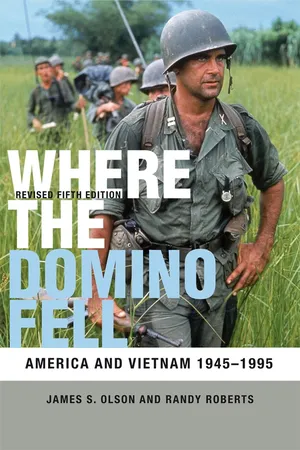
Where the Domino Fell recounts the history of American involvement in Vietnam from the end of World War II, clarifying the political aims, military strategy, and social and economic factors that contributed to the participants' actions.
Information
1
Eternal War: The Vietnamese Heritage
Vietnam is nobody’s dog.
—Nguyen Co Thach, 1978.
He was a wisp of a man, thin and gaunt, frail and seemingly vulnerable, his stringy goatee elongating an already long face. After seventy-six years of world wandering, hiding, and escaping, he was finally declining, wrinkled brown skin now only translucently covering his bones. Over the years his rivals might easily have failed fully to recognize the fire that possessed him. In 1966 Ho Chi Minh was ill, and he calmly waited for eternal rest from a life of boundless striving. It was his peculiar lot that two enemy nations had drawn his very qualified admiration. A lover of much of French culture, he had led Vietnam in a war of national liberation against France, at one point adopting, in a vain hope to get American support, a close version of the American Declaration of Independence. Now that country was his antagonist.
Late in 1966, when the war in Vietnam approached its peak, Ho remarked to Jean Sainteny, an old French diplomat and friend: “The Americans... can wipe out all the principal towns of Tonkin [northern Vietnam].... We expect it, and, besides, we are prepared for it. But that does not weaken our determination to fight to the very end. You know, we’ve already had the experience, and you have seen how that conflict ended.” It was only a matter of time before the Americans went the same way as the Chinese, Japanese, and French. Vietnam was for the Vietnamese, not for anyone else, and that passion had driven Ho Chi Minh throughout his life.
That key to Ho’s passion is the fundamental theme of Vietnamese history. Long ago a Chinese historian remarked, “The people of Vietnam do not like the past.” No wonder. Vietnam developed in the shadow of Chinese imperialism. In 208 B.C. the Han dynasty expanded into southern China and Vietnam, declaring the region a new Chinese province— Giao Chi. Its informal name for the region was Nam Viet, which meant “land of the southern Viets.” Over the centuries the Chinese brought to Vietnam their mandarin administrative system, along with their technology, writing, and Confucian social philosophy. But control did not translate into assimilation. Intensely ethnocentric, the Vietnamese, while welcoming many Chinese institutions, refused to accept a Chinese identity. The historian Frances FitzGerald describes that dilemma in Vietnamese history: “The Vietnamese leaders assumed Chinese political culture while rejecting... Chinese political domination.”
Periodically, the Vietnamese violently resisted, giving Vietnam such national heroes as the Trung sisters, who led an anti-Chinese insurrection in A.D. 40; Trieu Au, the Vietnamese Joan of Arc who led a rebellion in A.D. 248; and Ngo Quyen, the military leader of Vietnam’s successful revolution in 938. An old Vietnamese proverb captures the region’s history: “Vietnam is too close to China, too far from heaven.” Even after they achieved independence in 938, the Vietnamese had to deal periodically with Chinese or Mongol expansionism. Vietnam fought major wars against invaders from the north in 1257, the 1280s, 1406–1428, and 1788. Tran Hung Dao, the great thirteenth-century Vietnamese general, defeated the enemy after having all his soldiers tattoo the inscription “Kill the Mongols” on their right arms. He wrote: “We have seen the enemy’s ambassadors stroll about in our streets with conceit.... They have demanded precious stones and embroidered silks to satisfy their boundless appetite.... They have extracted silver and gold from our limited treasures. It is really not different from bringing meat to feed hungry tigers.”
In the centuries-long struggle against China, Vietnam developed a hero cult that elevated martial qualities as primary virtues. Vietnamese art glorified the sword-wielding, armor-bearing soldiers riding horses or elephants into battle. War, not peace, was woven into the cloth of Vietnamese history. The historian William Turley writes that out of this experience the Vietnamese fashioned a myth of national indomitability.... The Vietnamese forged a strong collective identity... long before the Europeans appeared off their shores.” Vietnam’s enemies learned that lesson the hard way.
But there was also a patience to Vietnamese militarism, an unwillingness to be intimidated, a conviction that a small country could prevail against an empire if it bided its time and waited for its moment. Between 1406 and 1428, led by the great Le Loi, the Vietnamese attacked the Chinese through hit-and-run guerrilla warfare, letting rugged mountains and thick rain forests do much of their work for them, wearing down the enemy, sapping its spirit, confusing its objectives, finally delivering a death blow, a strategic offensive to drive the Chinese back across the border. That story became legendary in Vietnamese military history.
Anti-Chinese resistance became the cutting edge of Vietnamese identity. A prominent eighteenth-century Chinese emperor lamented the stubbornness of the Vietnamese. They are not, he said, “a reliable people. An occupation does not last very long before they raise their arms against us and expel us from their country.” Suspicion of the Chinese permeated Vietnamese history. In 1945, for example, with the French ready to return to Vietnam and Chinese troops occupying much of northern Vietnam, Ho Chi Minh agreed to cooperate temporarily with France. When some of his colleagues protested, Ho remarked that it “is better to sniff French shit for a while than to eat Chinese shit all our lives.”
For Ho Chi Minh, the “French shit” was still bad enough. France had come to Vietnam in two stages, first in the seventeenth century and again in the nineteenth. Father Alexandre de Rhodes, a French Jesuit, traveled to Hanoi in 1627, converted thousands of Vietnamese to Roman Catholicism, and created a Latin alphabet for the Vietnamese language. Although suspicious Vietnamese leaders expelled de Rhodes in 1630 and again in 1645, he planted the seeds of the French empire. The French returned in force to Vietnam in 1847 when a naval expedition arrived at Tourane (later called Danang) and, within a few weeks, fought a pitched battle with local Vietnamese. Two more French warships fought another battle at Tourane in 1856. A French fleet captured Tourane in 1858 and conquered Saigon in 1859. Vietnamese resistance drove the French out, but in 1861 they returned to Saigon to stay. After signing a treaty with Siam (now Thailand) in 1863, France established a protectorate over Cambodia. France extended its control over southern Vietnam, or Cochin China, during the rest of the decade. France then turned north, and in 1883 a naval expedition reached the mouth of the Perfume River, just outside Hue. When the French fleet shelled the city, a Vietnamese leader gave France a protectorate over Annam (central Vietnam) and Tonkin (northern Vietnam), although it took France years to assert its control in those regions. To provide uniform government over the colonies, France established the French Union in 1887. After securing a protectorate over Laos by signing another treaty with Siam in 1893, France had five regions in the Union: Cochin China, Annam, Tonkin, Cambodia, and Laos.
The Vietnamese were no more satisfied with French domination than with Chinese. The most resentful Vietnamese lived in Nghe An Province, located in Annam in central Vietnam, a low coastal plain bordered by the Annamese mountains. Nghe An and the surrounding provinces were the most densely populated areas of Vietnam, and by far the poorest. The soil was leached and dry, the weather alternating between torrential monsoon rains and hot summer winds.
The French called the Nghe Annese the “Buffaloes of Nghe An” because of their reputation for stubbornness. The Vietnamese referred to them as the “People of the Wooden Fish.” The Vietnamese love a special sauce known as nuoc mam. They alternate layers of fish and layers of salt in a barrel and let the brew ferment in the heat several weeks. The fish decompose into a mush and the fluid into a salty brine. Nuoc mam is to Vietnamese fish what catsup is to American french fries. The Nghe Annese were too poor to afford fish, the proverb says, so they carried a wooden fish in their pockets to dip into nuoc mam at restaurants. Nghe Annese, the jesters claimed, licked the wooden fish until they were kicked out, only to repeat the culinary charade somewhere else.
But Nghe An, with its neighboring Ha Tinh Province, was not known only for its poverty. Year after year the prizewinning poets, musicians, and scholars at the imperial court at Hue came from Nghe An and Ha Tinh. They were thinkers and tinkerers, creative people who looked at life from unique perspectives, refused to believe what they were told, and insisted on having things proven to them. Their skepticism bred unhappiness. By the 1800s the best schools at Hue no longer accepted applicants from Nghe An and Ha Tinh, no matter how high their scores. Central Vietnamese, “the people of the wooden fish,” were troublemakers, dreaming of a better world.
Born in 1890 as Nguyen Sinh Cung, Ho Chi Minh grew up in Nghe An. Near his birthplace was the den, a monument to Le Loi. The Vietnamese believe that the spirit of an honored individual lives on in a den. Ho Chi Minh visited the den as a child and listened to tales of how Le Loi had expelled the hated Chinese. His father, Nguyen Sinh Sac, was the son of peasants who became a scholar and a ferocious anti-French nationalist. His sister was a renowned balladeer, and her folk songs railed at China and France. Sac passed the mandarin examinations and found a job at the imperial palace at Hue, but the imperial court was full of pro-French Vietnamese sycophants or tradition-bound mandarins. “The French,” said Phan Boi Chau, an early twentieth-century nationalist, “used honeyed words and great rewards to entice the Vietnamese. They offered high government positions and benefits of all sorts to make some of us into their hunting dogs.”
For a while in the late 1890s and early 1900s Nguyen Sinh Sac was a minor government official in Hue. Ho Chi Minh’s mother died in 1900, and Sac, along with his two sons and a daughter, lived in a tiny, dingy one-room apartment facing the opulent splendor of the Palais de la Censure where the Vietnamese emperor and the mandarin court ruled Vietnam. Ho bore the brunt of ridicule from the children of the court mandarins, and he developed a spontaneous dislike for intellectual snobbery. Throughout his life, he frequently quoted the poet Tuy Vien: “Nothing is more contemptible than to seek honors through literature.”
Although the Vietnamese had thrown off the Chinese yoke in 938, over the centuries they gradually adopted the Chinese mandarin system to govern the nation. Eventually, mandarin teachers and bureaucrats became a self-conscious elite. To pass the civil service examinations and secure the best jobs, Vietnamese scholars immersed themselves in the Chinese language and Confucian values, which gradually distanced them from Vietnamese peasants. The mandarins also adopted many Chinese institutions—a centralized tax system, a judicial hierarchy, and the royal palace architecture complete with gates, moats, bridges, and pools. Confucianism promoted rule by a paternalistic elite committed to morality and fairness, and it demanded unswerving obedience from the governed. The essence of personal behavior is obedience, submissiveness, and peaceful acquiescence in the social hierarchy.
The mandarin system was also conservative to a fault. Mandarins were suspicious of all change. They opposed science, technology, industrialization, and democracy, any one of which might dislodge them from their positions of privilege. A popular late nineteenth-century Vietnamese poem reflected the growing resentment of the mandarin class:
Becoming a mandarin you treat your servants as dirt,
And steal every bit of money the people have.
Although you scoop in who knows how much money,
Do the people get any help from you?
On top of the mandarin elite, the French imposed the colonial bureaucracy. They ruled Vietnam through local clients—French-speaking Roman Catholic Vietnamese, who soon became a new elite, competing with the mandarins for influence. Eventually, the French abolished the mandarin examinations, prohibited the teaching of Chinese, and displaced the mandarins as power brokers. Except for the French bureaucrats themselves, the Francophile Vietnamese enjoyed the finest homes, the best jobs, the fanciest clothes—the good life.
The French viewed the Vietnamese as children at best and savages at worst. They refused to learn the Vietnamese language, and in 1878 they declared French and quoc ngu, the Latin alphabet Father Alexandre de Rhodes had developed, the official languages of the colony. They replaced the local legal code with their own version of Roman law. Convinced that the word “Vietnam” was symbolic of protest, the French outlawed it, insisting that “French Indochina” was the proper term. Centuries-old Buddhist pagodas were often bulldozed when prime land was needed to construct Roman Catholic churches.
The imposition of the French language and French law accelerated the alienation of peasant land. There were widespread poverty and millions of landless peasants in Vietnam before the French, but most peasants owned at least a small plot, and historically the emperor had discouraged the development of large estates. But between 1880 and 1930 the French changed landholding patterns. Many peasants lost their property because they could not pay high French taxes, could not contest claims against the land in French courts, or fell into debt to French or Vietnamese creditors who foreclosed on their property. The number of landless peasants, tenant farmers, and debt peons rose. In Tonkin nine percent of the population came to own 52 percent of cultivated land, and 250 people owned 20 percent. They included French settlers and wealthy Vietnamese. It was the same in Cochin China. Tenant farmers paid up to 70 percent of their harvest to the landlord, and farmers borrowing money to finance production on their own land paid interest rates of 100 percent. French companies had monopolies on the production of alcohol, opium, and salt, robbing peasant farmers of another source of income.
With imported rubber trees, the French created a new industry. By 1940 there were more than six hundred rubber plantations in Vietnam, but a handful of French companies controlled them. Poverty forced thousands of Vietnamese peasants to leave home for years to work the French plantations. The taxes imposed by the top-heavy French bureaucracy added to the poverty. “French imperialism,” Ho Chi Minh declared in 1920, “conquered our country with bayonets. Since then we have not only been oppressed and exploited shamelessly, but also tortured and poisoned pitilessly.... Prisons outnumber schools and are always over-crowded.... Thousands of Vietnamese have been led to a slow death or massacred.” Though not so eloquent, millions of Vietnamese felt the same way. To them France was a nation of police, soldiers, pimps, tax collectors, and labor recruiters.
Almost as bad was the Vietnamese elite who did the French bidding. For any Vietnamese to succeed in the French colony, he or she had to be a French-speaking Roman Catholic who carried out the edicts of the empire. If these Vietnamese were not mandarins in their educational background, they were just as elitist, just as hierarchical, and just as conservative. They got the best government posts, the finest homes, and the largest estates. Ho Chi Minh referred to them as colonis indigeniae [indigenous colonists]: “If you take the largest and strongest member of the herd and fasten a bright substance to its neck, a gold coin or a cross, it becomes completely docile.... This weird... animal goes by the name of colonis indigeniae, but depending on its habitat it is referred to as Annamese, Madagascan, Algerian, Indian.”
Nguyen Sinh Sac’s job at the imperial court had given him a living but no dignity. Indeed, he came to view the post as a dishonor. “Being a mandarin,” he said many times, “is the ultimate form of slavery.” Sac refused to let Ho Chi Minh even study for the examinations. He refused to speak French, arguing that doing so “would corrupt my Vietnamese,” and openly advocated the abolition of the mandarin class and the disintegration of the French empire. Nguyen Sinh Sac was one of Nghe An’s most troublesome children. The French fired him.
The father passed on those passions to his children. His daughter Nguyen Thanh worked in Vinh supervising a French military mess hall and smuggled rifles and ammunition to the De Tham guerrillas, a group already fighting against the French. When French police convicted her of treason, the mandarin judge gave her a life sentence and an epitaph: “Other women bring forth children, you bring forth rifles.” Her brother Nguyen Khiem was just as militant. He repeatedly wrote eloquent letters to French officials protesting Vietnamese poverty and calling for freedom. But it was the other son—Nguyen Sinh Cung, later known as Ho Chi Minh—who realized Sac’s dream.
At five years old, Ho was running messages back and forth to members of the anti-French underground. The house was a beehive of political talk, always around the theme of Vietnamese independence. A frequent visitor, and occasional fugitive, was Phan Boi Chau, the most prominent of Vietnam’s early nationalists. Among other acqaintances of Nguyen Sinh Sac was Phan Chu Trinh, the constitutionalist who wanted to overthrow the mandarin bureaucracy.
The Nguyen Sinh Sac family was also a “brown canvas” household. The traditional dress of the Vietnamese was the ao dai, the non, and the quoc. For women, the ao dai was a long dress worn over black or white trousers that fit loosely around the legs. A rectangular piece of material formed a panel reaching down from the waist in the front and the back. For men the dress was only knee length. The embroidery on the cloth indicated the station in life of the wearer. Gold brocade was reserved for the imperial family. High-ranking mandarins used purple embroidery, and low-ranking mandarins used blue. Peasants could have only the plainest cloth. The non was the ubiquitous conical hat made of latania leaves, and the quoc were the wooden shoes. Radicals adopted brown canvas clothes as a symbolic protest against mandarin authority and a gesture to blur class lines. By the late 1880s large numbers of men in Nghe An wore brown canvas, in spite of mandarin edicts to the contrary. For much of his life Ho Chi Minh wore brown canvas clothes except at the most formal occasions.
Long before Ho Chi Minh ever heard of Karl Marx and communism, he viewed society through the lens of class conflict, a philosophical inheritance from an egalitarian family. Years later, The Communist Manifesto resonated with Ho Chi Minh, fitting nicely into an intellectual schema decades in the making. When the time came for Ho Chi Minh to become a communist, he played the role enthusiastically.
Phan Boi Chau, a nationalist whose ideas formed much of the discussion in the household, had been born in Nghe An in 1867. His father, though passing the mandarin examinations, refused to work for the government, becoming a teacher in a small village. Phan Boi Chau joined the Scholars’ Revolt in 1885, a resistance movement of Vietnam’s emperor Ham Nghi and a number of mandarin officials against French rule. In 1893 he participated in Phan Dinh Phung’s unsuccessful Nghe Tinh uprising against the French.
By the early 1900s Phan Boi Chau was convinced that Vietnam could enter the modern world only if the French were expelled from Indochina. For a teenaged Ho Chi Minh, Phan Boi Chau must have been an imposing figure. Phan Boi Chau’s round face and wire-rimmed spectacles gave him a scholarly, almost mandarin look, as did the full goatee. But he was no simple scholar. He was a man of intense passion and commitment. “The French,” he said, “treat our people like garbage.... The meek are made into slaves, the strong-minded are thrown into jail. The physically powerful are forced into the army, while the old and weak are left to die.... The land is splashed with blood.” There was also an ascetic look to Phan Boi Chau, as if he had transcended mundane pursuits for a grander cause. If Vietnam was to flower, France must fall.
In 1907, a few years after visiting with the family of Nguyen Sinh Sac, Phan Boi Chau led the abortive Poison Plot, in which low-ranking Vietnamese soldiers tried to poison French officers in Hanoi. The conspiracy was uncovered before it took too large a toll, but Phan Boi Chau became known as the first violent revolutionary in modern Vietnam. He spent years moving about in Japan, China, and Siam, with French police always on his trail. The Chinese arrested him in Shanghai in 1913. He was released from prison in 1917 and spent the rest of his life in China. He died there in 1940.
As a nationalist, Phan Boi Chau was rivaled only by Phan Chu Trinh, another Nghe Annese. Born to a well-to-do family in 1872, Phan Chu Trinh passed the mandarin examinations. A meeting in 1903 with Phan Boi Chau changed his life. Phan Chu Trinh resigned his government post two years later, convinced that the Vietnamese emperor and his mandarin “lackeys” would doom Vietnam to oblivion. But he parted company with Phan Boi Chau on two accounts; Phan Chu Trinh did not believe in radical violence, and he was convinced that the imperial court and mandarin bureaucracy, not the French empire, should be destroyed first. He wanted to work with the French in replacing the mandarins with a modern, democratic political and educational system.
Although neither Phan Boi Chau nor Phan Chu Trinh was able to implement his ideas in the early 1900s, they left a rich legacy. From Phan Boi Chau came the conviction that only revolutionary violence would dislodge the French, and from Phan Chu Trinh came the certainty that the mandarin system was rotten, corrupted by its elitism and its hostility to the modern world and its technology. Ho Chi Minh would eventually have to decide which to destroy first—the French empire or the mandarin court—but by the time he was a young man he already knew his destiny. Nghe An had produced yet another radical.
Ho Chi Minh left Nghe An Province at the end of 1910. He spent nearly a year in Phan Thiet teaching at a school financed by a nuoc mam factory. Late in 1911 he headed south to Saigon, where he enrolled in a vocational school, but he was unhappy learning a trade that the French would use only to exploit him. He left school early in 1912, signed up as a mess boy on a French ocean liner, and left Saigon for the other side of the world. Traveling under the alias of “Van Ba,” Ho Chi Minh got a glimpse of much of the world in the next several years. In North Africa he saw what France was doing to the Algerians; in South Africa he noted what the English and the Boers were doing to the blacks; and in other ports of call he observed the imperial rule of the English, French, Dutch, and Portuguese. He worked in New York City, whetting his curiosity about American democracy, and on the eve of World War I, Ho was in London working as a cook at the Carlton Hotel.
Ho Chi Minh moved to Paris in 1918 and quickly immersed himself in anticolonial politics. There were 100,000 Vietnamese in Paris, and Ho found good restaurants in which to eat his favorite dishes. He met the exiled Phan Chu Trinh and listened to him preach against the evils of the Vietnamese imperial court at Hue and the virtues of democracy and industrialization. Ho Chi Minh met frequently with French socialists, pressing them on the question of empire, trying to discern whether they really wanted to change the world. He supported himself by touching up photographs and writing newspaper articles, adopting the name “Nguyen Ai Quoc” (Nguyen the Patriot) or “Nguyen O Phap” (Nguyen Who Hates the French). In the Vietnamese community, Ho became a leading nationalist, and the French secret police kept track of him.
But then overnight, Ho Chi Minh became a genuine hero. At the Paris Peace Conference ne...
Table of contents
- cover
- title
- copyright
- Preface
- Prologue: LBJ and Vietnam
- 1: Eternal War: The Vietnamese Heritage
- 2: The First Indochina War, 1945–1954
- 3: The Making of a Quagmire, 1954–1960
- 4: The New Frontier in Vietnam, 1961–1963
- 5: Planning a Tragedy, 1963–1965
- 6: Into the Abyss, 1965–1966
- 7: The Mirage of Progress, 1966–1967
- 8: Tet and the Year of the Monkey, 1968
- 9: The Beginning of the End, 1969–1970
- 10: The Fall of South Vietnam, 1970–1975
- 11: Distorted Images, Missed Opportunities, 1975–1995
- 12: Oliver Stone’s Vietnam
- Bibliography
- A Vietnam War Chronology
- Glossary and Guide to Acronyms
- Index
- maps
Trusted by 375,005 students
Access to over 1.5 million titles for a fair monthly price.
Study more efficiently using our study tools.
Frequently asked questions
Yes, you can cancel anytime from the Subscription tab in your account settings on the Perlego website. Your subscription will stay active until the end of your current billing period. Learn how to cancel your subscription
No, books cannot be downloaded as external files, such as PDFs, for use outside of Perlego. However, you can download books within the Perlego app for offline reading on mobile or tablet. Learn how to download books offline
Perlego offers two plans: Essential and Complete
- Essential is ideal for learners and professionals who enjoy exploring a wide range of subjects. Access the Essential Library with 800,000+ trusted titles and best-sellers across business, personal growth, and the humanities. Includes unlimited reading time and Standard Read Aloud voice.
- Complete: Perfect for advanced learners and researchers needing full, unrestricted access. Unlock 1.5M+ books across hundreds of subjects, including academic and specialized titles. The Complete Plan also includes advanced features like Premium Read Aloud and Research Assistant.
We are an online textbook subscription service, where you can get access to an entire online library for less than the price of a single book per month. With over 1.5 million books across 990+ topics, we’ve got you covered! Learn about our mission
Look out for the read-aloud symbol on your next book to see if you can listen to it. The read-aloud tool reads text aloud for you, highlighting the text as it is being read. You can pause it, speed it up and slow it down. Learn more about Read Aloud
Yes! You can use the Perlego app on both iOS and Android devices to read anytime, anywhere — even offline. Perfect for commutes or when you’re on the go.
Please note we cannot support devices running on iOS 13 and Android 7 or earlier. Learn more about using the app
Please note we cannot support devices running on iOS 13 and Android 7 or earlier. Learn more about using the app
Yes, you can access Where the Domino Fell by James S. Olson,Randy W. Roberts in PDF and/or ePUB format, as well as other popular books in History & 20th Century History. We have over 1.5 million books available in our catalogue for you to explore.