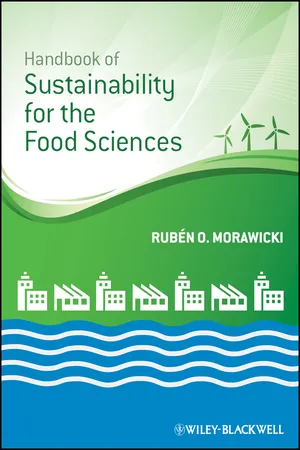
Structured in four sections, Handbook of Sustainability for the Food Sciences first covers the basic concepts of environmental sustainability and provides a detailed account of all the impacts of the food supply chain. Part two introduces the management principles of sustainability and the tools required to evaluate the environmental impacts of products and services as well as environmental claims and declarations. Part three looks at ways to alleviate food chain environmental impacts and includes chapters on air emissions, water and wastewater, solid waste, energy, packaging, and transportation. The final part summarizes the concepts presented in the book and looks at the measures that will be required in the near future to guarantee long term sustainability of the food supply chain. Handbook of Sustainability for the Food Sciences is aimed at food science professionals including food engineers, food scientists, product developers, managers, educators, and decision makers. It will also be of interest to students of food science.
- English
- ePUB (mobile friendly)
- Available on iOS & Android
eBook - ePub
Handbook of Sustainability for the Food Sciences
About this book
Many books on sustainability have been written in the last decade, most of them dealing with agricultural systems, communities, and general business practices. In contrast, Handbook of Sustainability for the Food Sciences presents the concept of sustainability as it applies to the food supply chain from farm to fork but with a special emphasis on processing.
Information
Part I
General Concepts
1 Introduction to Sustainability
INTRODUCTION
In the 1990s the term sustainability emerged as a concept to reduce humans’ environmental footprint and a way to assure the preservation of natural resources for future generations. The concept did not pick momentum steam until the last few years, when due to public scrutiny, many companies integrated the word sustainability into their corporate marketing strategies. Since then, many individuals have embraced the sustainability concept even without a complete understanding of the extent of its meaning. Others have been looking at sustainability as a new fad, which will soon fade. However, sustainability is here to stay.
By definition, sustainability is a simple concept, but it is difficult to implement. Sustain-ability is not just becoming more efficient in the use of energy and natural resources; it is a change in business practices. Likewise, total quality management (TQM) has changed the mind-set of many organizations by placing the customer first; sustainability is the challenge of minimizing humans’ environmental impact and reducing dependence on nonrenewable resources.
TQM was the industry response to customers’ demand for better products. Most companies adopted this program voluntarily to gain an edge over competitors. In the case of sustainability, pressure from declining resources will compel industries to implement real sustainability programs, thus making sustainability not just one more trend but instead, a concept that will need to be truly embedded in companies’ core values for their long-term survival.
SUSTAINABILITY: A TERM TO STAY
Not long ago, a sustainable company was one that simply turned profits year after year (Simmons, 2008), and the term sustainability as it is known these days was a foreign word in most people’s vocabulary. Today, sustainability and its associated jargon, including triple bottom line, social and environmental responsibility, green workplace, and such, have become part of everyday life of corporate managers, scientists, and engineers.
Conferences on sustainability and related subjects have sprouted around the world in nearly all technology fields. (See Sustainable Development Conferences Worldwide website http://www.conferencealerts.com/sustain.htm for a list of upcoming events.)
Even when, some business leaders see this as a trend that will end soon; the food industry is quickly catching up with the topic of sustainability as a response to stakeholders’ pressure, new regulations (e.g., cap and trade that is being implemented in some industrialized countries), and mainly the depletion of natural resources that the whole economic system is based on.
In the last part of the twentieth century, satisfying customers by incorporating quality in products was the paradigm. In the twenty-first century the new paradigm is the environment and social responsibility (Hitchcock and Willard, 2002). The quality movement changed the world by providing companies with management tools that allowed them to embed quality in their products, to reduce production costs, and to expand their business.
Quality management has placed customers first in terms of satisfying their needs and reducing defects in their products to levels that before were unimaginable. In the case of the food industry, despite some isolated cases, the food supply chain has become safer than ever in the industrialized world, which is the result of remarkable efforts. However, new stakes that require immediate attention have been raised for the twenty-first century. The new challenge still requires satisfying customers by providing them with safe products to eat while complying with laws and regulations, but this needs to be done in a framework of responsible behavior toward the community and the environment (Hitchcock and Willard, 2002).
Not all industries can become sustainable from the environmental perspective. Petroleum extraction and mining, for instance, are not sustainable by definition (Siegal and Longsworth, 2009); and unfortunately, most other industries, including food production and distribution, strictly depend on the use of natural resources, and therefore, the food industry as a whole has the imperative challenge of lessening its environmental impact. Issues, such as efficiency, substitution of nonrenewable resources with renewable ones, minimization of waste, use of renewable energy, efficient logistics, and minimization of water use and wastewater, are some of the challenges that food company will have to face in the near future.
DEFINING A SUSTAINABLE COMPANY
The definition of sustainability, as well as the whole concept, has become a controversial issue. Since the term was prevalently defined by the United Nations World Commission on Environment and Development (WCED)—also known as Brundtland Commission in honor of his chair, the Norwegian Gro Harlem Brundtland—definitions, promoters, and detractors of sustainability have sprung up (Table 1.1). The topic has turned into a political issue for many, an opportunity for others, and a cause of concern for many scientists and scholars around the world.
The turmoil that the concept of sustainability inflicts in many individuals can be understandable because sustainability and sustainable development challenge the status quo and the way that most industrialized countries conduct business. Typically, the main focus of the food business has been to concentrate on the economic aspects as well as safety and compliance with regulations. Recently, the new sustainability dimension has been added to the equation, which significantly increases the complexity of doing business.
Time and again it is claimed that the definition of sustainability is a subject of personal interpretation. Paradoxically, the term is often used quite precisely in the context of everyday life. In any event, sustainability is about long-term survival, or in other terms, prolonged existence, permanence, durability, and resilience. Sustainability is a term currently applied to business practices, but its reach extends to any activity or organization, including, countries, animals, plants, and humans.
Table 1.1 Definitions of sustainability from several sources.
| Definition | Reference |
| “[D]evelopment that meets the needs of the present without compromising the ability of future generations to meet their own needs.” | United Nations General Assembly, 1987 |
| “[S]ustainability occurs when we maintain or improve the material and social conditions for human health and the environment over time without exceeding the ecological capabilities that support them.” | Sikdar, 2003 |
| “Sustainability requires that businesses use resources in ways that meet the needs of the enterprise and its stakeholders today, while protecting, sustaining, and enhancing future resources and the environment.” | Gorman and Krehbiel, 1997 |
| “Business strategies and practices that promote the long-term well being of the environment, society and the bottom line.” | Food Marketing Institute Sustainability Task Force, n.d. |
| “A sustainable product or process is one that constrains resource consumption and waste generation to an acceptable level, makes a positive contribution to the satisfaction of human needs, and provides enduring economic value to the business enterprise.” | Bakshi and Fiksel, 2003 |
When talking about sustainability, it is important to define the time frame in which a practice is sustainable because it is unlikely that any activity perpetuates indefinitely in time. The current economic system, which includes food production and distribution, is based on the use of limited natural resources and we can expect the system will last as far as those resources are available unless we find substitutes.
A sustainable company is an organization that keep itself alive in time. To be viable and lasting, a company needs profits; resources, including capital, energy, and raw materials; and customers and a workforce. These three needs are also called by some the “three dimensions of sustainability,” and there is fair consensus among organizations about its validity. These days most corporations talk about the three components of sustainability as economic, social, and environmental.
Going back to our working definition of a sustainable company, since the main objective has been the generation of profits, decisions about investment have been based on one dimension: the return on investment (ROI). So, it is fairly understandable that the addition of two new dimensions can increase management complexity. Furthermore, the two new dimensions—social and environmental—cannot be reduced to one indicator, like the ROI, that is easily understandable.
The challenge for companies to stay in business in the future will not be only to make money but also to react to serious social and environmental issues. Examples of social aspects include stakeholders’ distrust in response to adverse socioeconomic impacts, such as widespread poverty, lack of education, and social disintegration due to displacement of traditional lifestyles; and environmental aspects, such a...
Table of contents
- Cover
- Title page
- Copyright page
- Dedication
- Preface
- Part I: General Concepts
- Part II: Management Aspects
- Part III: Working on the Impacts
- Part IV: Facing the Future
- Index
- Advertisement
Trusted by 375,005 students
Access to over 1.5 million titles for a fair monthly price.
Study more efficiently using our study tools.
Frequently asked questions
Yes, you can cancel anytime from the Subscription tab in your account settings on the Perlego website. Your subscription will stay active until the end of your current billing period. Learn how to cancel your subscription
No, books cannot be downloaded as external files, such as PDFs, for use outside of Perlego. However, you can download books within the Perlego app for offline reading on mobile or tablet. Learn how to download books offline
Perlego offers two plans: Essential and Complete
- Essential is ideal for learners and professionals who enjoy exploring a wide range of subjects. Access the Essential Library with 800,000+ trusted titles and best-sellers across business, personal growth, and the humanities. Includes unlimited reading time and Standard Read Aloud voice.
- Complete: Perfect for advanced learners and researchers needing full, unrestricted access. Unlock 1.5M+ books across hundreds of subjects, including academic and specialized titles. The Complete Plan also includes advanced features like Premium Read Aloud and Research Assistant.
We are an online textbook subscription service, where you can get access to an entire online library for less than the price of a single book per month. With over 1.5 million books across 990+ topics, we’ve got you covered! Learn about our mission
Look out for the read-aloud symbol on your next book to see if you can listen to it. The read-aloud tool reads text aloud for you, highlighting the text as it is being read. You can pause it, speed it up and slow it down. Learn more about Read Aloud
Yes! You can use the Perlego app on both iOS and Android devices to read anytime, anywhere — even offline. Perfect for commutes or when you’re on the go.
Please note we cannot support devices running on iOS 13 and Android 7 or earlier. Learn more about using the app
Please note we cannot support devices running on iOS 13 and Android 7 or earlier. Learn more about using the app
Yes, you can access Handbook of Sustainability for the Food Sciences by Rubén O. Morawicki in PDF and/or ePUB format, as well as other popular books in Technology & Engineering & Food Science. We have over 1.5 million books available in our catalogue for you to explore.