- Providing information to implement a new core healthcare requirement – patient involvement
- Including real case scenarios to illustrate the principles of effective PPI
- Following the unique Toolkit series format of flowcharts and layouts that guide the reader through each section
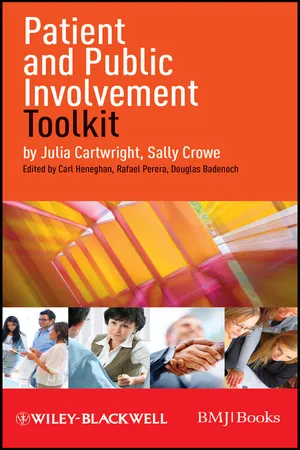
eBook - ePub
Patient and Public Involvement Toolkit
- English
- ePUB (mobile friendly)
- Available on iOS & Android
eBook - ePub
Patient and Public Involvement Toolkit
About this book
Information
CHAPTER 1
Introduction
The toolkit series
The ‘toolkit’ series encompasses a number of books and a website published by Blackwell. The concept behind the books is to make complex health care topics accessible and easy to understand to those who need them, particularly:
- health care students
- clinicians
- users of health care research
- researchers
- commissioners of health services and research.
This book is the fourth in the current series of toolkits, which also includes the Evidence-Based Medicine Toolkit, the Statistics Toolkit and the Searching Toolkit. The writing team for this book is Julia Cartwright and Sally Crowe, both experts in patient and public involvement (PPI). The editing team is Douglas Badenoch, Carl Heneghan and Rafael Perrera.
Aim of this toolkit

This book will take you through the journey of involving patients, carers and the public, with chapters that address specific and important stages of the journey. At the end of each chapter there will be a key points summary table. A list of icons used throughout the book is given on page 14.
We have created resource lists at the end of each section that will help you locate useful resources. While all of the resources were checked before publication, PPI is an evolving and fast-moving world, with new groups, resources and ideas becoming available all of the time. Since going into production, the UK government has issued its White Paper on health (Department of Health, 2010), Equity and Excellence. ‘No decision about me without me’ is the strap line for this policy document which aims to put patients at the heart of decision making in the NHS. This toolkit is therefore a timely resource for those individuals who need to make PPI happen. http://www.dh.gov.uk/en/Publicationsandstatistics/Publications/PublicationsPolicyAndGuidance/DH_117353.
Why have a PPI toolkit?
PPI is becoming much more integrated into service development at every level of health care, and increasingly is a common part of clinical health research. Despite these advances, PPI is often haphazard and inconsistent, with a plethora of individual but unconnected activities.
Therefore, we decided there is a need for a clear, simple toolkit that will help you to:
- Identify the purpose and useful outcomes of PPI.
- Understand how to run effective PPI programmes and how to engage constructively with patients.
- Clarify to those involved in a PPI programme what to expect from their involvement and how to make their voices heard.

Some of the most effective PPI happens when:
1 There is a clear understanding of what is needed to enable effective involvement.
2 There is recognition of the likely barriers to effective engagement.
3 The purpose and benefits of involvement are clear to everyone.
4 There is attention to detail.
The language of PPI
One of the problems in PPI is the complexity of the language that is used. This has been recognized at the highest level:
The conflation of these distinct terms and the confusion about the purpose of involvement has led to muddled initiatives and uncertainty about what should be done to achieve effective PPI.
UK Parliament, House of Commons Health Committee Report 2007
Getting started
What is PPI?
Healthcare professionals working together with patients and the public to improve the health communities they serve.
health professional A health professional is an organization, team or person who delivers health care in a professional manner to any individual in need of health care services.
Why do PPI?
- To improve access to health services.
- To have a better informed public.
- To improve the quality of health care.
- To make better use of health care resources.
- To improve how health services are measured and evaluated.
Who can benefit from PPI?
- Patients if they see their views being considered and used to improve the quality of care for other patients.
- Health researchers if they see that the quality of their research design and outputs are improved by working with patients from the outset.
- Health service managers if the standards of service they design are patient friendly and reduce the level of inappropriate admissions to hospital.
- Health professionals if they see a reduction in attendance at specialist clinics because patients can better self-care at home.
- Public if they see that decisions about health care and services are transparent and accountable.
For this toolkit we use the following terms throughout:
| Term | Definition |
| INVOLVE | To Inform. To consult. ‘Surely we are at the heart of care and treatment? My experiences can help services improve’ |
| ENGAGE | To partner. To work directly with. ‘I want staff to think about opportunities for PPI at the start of all projects’ |
| EMPOWER | To place authority for final decision making in the hands of the patient or the public. ‘We would like to see more patients and public at senior management meetings and having a real input to future strategy’ |
Sections will be colour coded throughout to help you see what level of PPI Is being described or suggested.
The following words are prohibited from this toolkit:
- Participatory – we will write about working with people.
- Stakeholder – we will write about patients or public.
- Client – we will talk about patients or public.
- Dialogue – we will write about talking to patients or public.
- Facilitate – we will write about working together and sharing.
- Partnership – we will write about doing things together.
- Lay – we will write about patients and the public.
For further words that should not be used when communicating with patients and the public go to:
www.idea.gov.uk/idk/core/page.do?pageId=17636724
KEY TERMS
patient People who are under the care of clinical services, or have recently used these services.
carers People who care for others in an ‘unpaid’ and non-professional capacity.
public People who are not under the care of clinical services but who may have a view on those services.
patient involvement Involving people who have used health services.
public involvement Involving people ...
Table of contents
- Cover
- Title page
- Copyright
- Foreword
- CHAPTER 1: Introduction
- CHAPTER 2: What is patient and public involvement?
- CHAPTER 3: How to conduct effective PPI
- CHAPTER 4: Building relationships
- CHAPTER 5: Evaluation of PPI
- CHAPTER 6: The future of PPI
- Index
Trusted by 375,005 students
Access to over 1.5 million titles for a fair monthly price.
Study more efficiently using our study tools.
Frequently asked questions
Yes, you can cancel anytime from the Subscription tab in your account settings on the Perlego website. Your subscription will stay active until the end of your current billing period. Learn how to cancel your subscription
No, books cannot be downloaded as external files, such as PDFs, for use outside of Perlego. However, you can download books within the Perlego app for offline reading on mobile or tablet. Learn how to download books offline
Perlego offers two plans: Essential and Complete
- Essential is ideal for learners and professionals who enjoy exploring a wide range of subjects. Access the Essential Library with 800,000+ trusted titles and best-sellers across business, personal growth, and the humanities. Includes unlimited reading time and Standard Read Aloud voice.
- Complete: Perfect for advanced learners and researchers needing full, unrestricted access. Unlock 1.5M+ books across hundreds of subjects, including academic and specialized titles. The Complete Plan also includes advanced features like Premium Read Aloud and Research Assistant.
We are an online textbook subscription service, where you can get access to an entire online library for less than the price of a single book per month. With over 1.5 million books across 990+ topics, we’ve got you covered! Learn about our mission
Look out for the read-aloud symbol on your next book to see if you can listen to it. The read-aloud tool reads text aloud for you, highlighting the text as it is being read. You can pause it, speed it up and slow it down. Learn more about Read Aloud
Yes! You can use the Perlego app on both iOS and Android devices to read anytime, anywhere — even offline. Perfect for commutes or when you’re on the go.
Please note we cannot support devices running on iOS 13 and Android 7 or earlier. Learn more about using the app
Please note we cannot support devices running on iOS 13 and Android 7 or earlier. Learn more about using the app
Yes, you can access Patient and Public Involvement Toolkit by Julia Cartwright,Sally Crowe, Carl Heneghan, Douglas Badenoch, Rafael Perera, Carl Heneghan,Douglas Badenoch,Rafael Perera in PDF and/or ePUB format, as well as other popular books in Medicine & Medical Theory, Practice & Reference. We have over 1.5 million books available in our catalogue for you to explore.