Power Definitions and the Physical Mechanism of Power Flow
eBook - ePub

Power Definitions and the Physical Mechanism of Power Flow

  1. English
  2. ePUB (mobile friendly)
  3. Available on iOS & Android
eBook - ePub

Power Definitions and the Physical Mechanism of Power Flow

About this book

Professor Emanuel uses clear presentation to compare and facilitate understanding of two seminal standards, The IEEE Std. 1459 and The DIN 40110-2: 2002-11. Through critical analysis of the most important and recent theories and review of basic concepts, a highly accessible guide to the essence of the standards is presented.

Key features:

  • Explains the physical mechanism of energy flow under different conditions: single- and three-phase, sinusoidal and nonsinusoidal, balanced and unbalanced systems
  • Starts at an elementary level and becomes more complex, with six core chapters and six appendices to clarify the mathematical aspects
  • Discusses and recommends power definitions that played a significant historical role in paving the road for the two standards
  • Provides a number of original unsolved problems at the end of each chapter
  • Introduces a new nonactive power; the Randomness power.

Power Definitions and the Physical Mechanism of Power Flow is useful for electrical engineers and consultants involved in energy and power quality. It is also helpful to engineers dealing with energy flow quantification, design and manufacturing of metering instrumentation; consultants working with regulations related to renewable energy courses and the smart grid; and electric utility planning and operation engineers dealing with energy bill structure. The text is also relevant to university researchers, professors, and advanced students in power systems, power quality and energy related courses.

Frequently asked questions

Yes, you can cancel anytime from the Subscription tab in your account settings on the Perlego website. Your subscription will stay active until the end of your current billing period. Learn how to cancel your subscription.
No, books cannot be downloaded as external files, such as PDFs, for use outside of Perlego. However, you can download books within the Perlego app for offline reading on mobile or tablet. Learn more here.
Perlego offers two plans: Essential and Complete
  • Essential is ideal for learners and professionals who enjoy exploring a wide range of subjects. Access the Essential Library with 800,000+ trusted titles and best-sellers across business, personal growth, and the humanities. Includes unlimited reading time and Standard Read Aloud voice.
  • Complete: Perfect for advanced learners and researchers needing full, unrestricted access. Unlock 1.4M+ books across hundreds of subjects, including academic and specialized titles. The Complete Plan also includes advanced features like Premium Read Aloud and Research Assistant.
Both plans are available with monthly, semester, or annual billing cycles.
We are an online textbook subscription service, where you can get access to an entire online library for less than the price of a single book per month. With over 1 million books across 1000+ topics, we’ve got you covered! Learn more here.
Look out for the read-aloud symbol on your next book to see if you can listen to it. The read-aloud tool reads text aloud for you, highlighting the text as it is being read. You can pause it, speed it up and slow it down. Learn more here.
Yes! You can use the Perlego app on both iOS or Android devices to read anytime, anywhere — even offline. Perfect for commutes or when you’re on the go.
Please note we cannot support devices running on iOS 13 and Android 7 or earlier. Learn more about using the app.
Yes, you can access Power Definitions and the Physical Mechanism of Power Flow by Alexander Eigeles Emanuel in PDF and/or ePUB format, as well as other popular books in Technology & Engineering & Quality Control in Engineering. We have over one million books available in our catalogue for you to explore.
1
Electric Energy Flow: Physical Mechanisms
Through valuation only is there value; and without valuation the nut of existence would be hollow. Hear it, ye creating ones!
—Fr. Nietzsche,Thus Spake Zarathustra
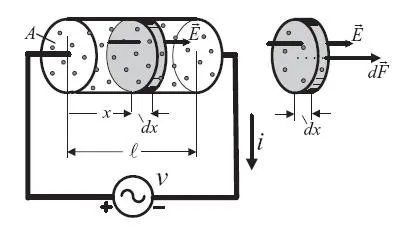
There are two schools of thought that help students visualize the flow of electric energy from source to load and grasp the basic relations among voltage, current, power, and energy. The first, and seemingly the simplest, explanation relies on the flow of electric charges represented in Fig. 1.1. We imagine a cylindrical conductor with a cross-sectional area A and length , containing uniformly distributed charged particles that carry a total electric charge q. The volume charge density is
(1.1)
Equation
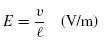
When a voltage ν is applied between the ends of the conductive cylinder, a uniform electric field
(1.2)
Equation
is created within the conductor. The vector of this field is oriented parallel with the conductor. The interaction between the charged particles and the field E is causing their motion along the conductor. The force developed on the charged particles found within a thin slice of thickness dx, that holds the charge dq = ρvAdx is dF = Edq. The total force applied on the entire charge held by the cylinder is
(1.3)
Equation
Once this system reaches steady-state the voltage source will pump continuously a constant flow of charge in a closed loop. One may picture this flow as the effect of a mechanical pressure
Figure 1.1 Flow of uniformly distributed charges in a homogeneous conductor.
Figure
F/A = ℓ ρν E = ρνν. This model leads us straight to the notion of work or energy. To side the total charge q a distance dx, consequent to the application of the force F, it is tantamount with doing the work
(1.4)
Equation
It may be assumed that the charged particles move with an average drift velocity u = dx/dt, proportional to the magnitude of the electric field, thus
(1.5)
Equation
where the constant K is known as the mobility of the particles, (m2/Vs). The elementary work dw is proportional to the drift velocity u. This fact becomes evident when (1.4) is written in the form
(1.6)
Equation
The drift velocity u = dx/dt is also hidden in the electric current expression
(1.7)
Equation
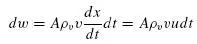
Substitution of (1.7) in (1.6) gives
(1.8)
Equation
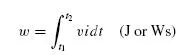
During a time interval t = t2 - t1 the voltage source will generate the total energy
(1.9)
Equation
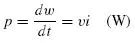
The rate of flow of the electric energy at a particular time is the electric power
(1.10)
Equation
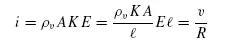
From (1.7) and (1.5) we also obtain a simple deduction of Ohm’s law. The current
(1.11)
Equation
(1.12)
Equation
is the resistance of the conductor of length t and cross-sectional area A, and κ = ρv K is the specific conductivity of the observed conductive medium, (Ωm)-1.
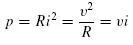
Finally, equations (1.10) and (1.11) lead to the well known expressions of electric power
(1.13)
Equation
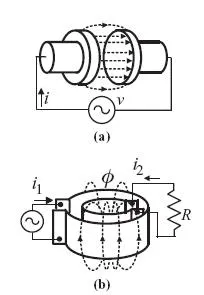
The above explanation of power and energy flow appears in some introductory textbooks of physics and is favored by electrical engineers that deal with low frequency equipment. A major drawback of this rudimentary model becomes apparent when we try to explain situations where the energy is stored in, or transferred through, dielectrics immersed in alternating electromagnetic fields, Fig. 1.2.
Figure 1.2 Examples where the Energy is Transferred via Dielectric Material: (a) Capacitor. (b) Magnetic Coupling.
Equation
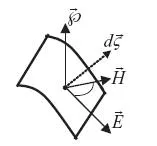
Figure 1.3 Poynting vector.
Equation
Engineers dealing with antennae, microwaves, and other high frequency applications long ago embraced a more advanced explanation based on a model loyal to the laws of storage, transmission, and dissipation of energy in any medium. Th...
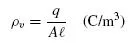
Table of contents

  1. Cover
  2. Title
  3. Foreword
  4. Dedication
  5. Preface
  6. 1: Electric Energy Flow: Physical Mechanisms
  7. 2: Single-Phase Systems With Sinusoidal Waveforms
  8. 3: Single-Phase Systems with Nonsinusoidal Waveforms
  9. 4: Apparent Power Resolution for Nonsinusoidal Single-Phase Systems
  10. 5: Three-Phase Systems with Sinusoidal Waveforms
  11. 6: Three-Phase Nonsinusoidal and Unbalanced Conditions
  12. 7: Power Definitions for Time-Varying Loads
  13. 8: Appendices
  14. Index