![]()
Chapter One
Word of Mouth Goes World of Mouth
Ask any Fortune 500 executive, small business owner, or sole proprietor what the most effective form of marketing is, and I guarantee the answer, without hesitation, is word of mouth. Word of mouth is not a new concept, but what happens when this is taken to another level? What happens when word of mouth goes to World of Mouth®?
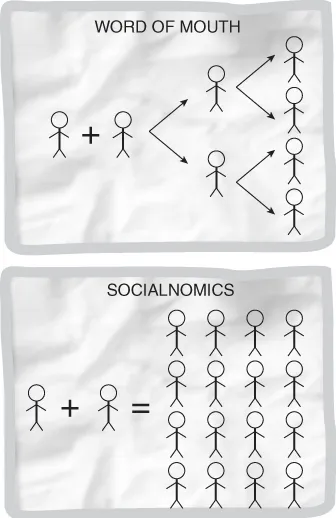
As depicted in Figure 1.1, an oversimplified historical model of word of mouth works something like this: Joe User has a great experience with his Dell computer; then he tells his friend Kelly about it and why he likes it. Kelly in turn tells her friends about it and so on down the line. This is a great model. However, no model is perfect. A few shortcomings of this model are: (1) the news/information can be slow to spread; (2) the original information can be altered as it changes hands; and (3) Kelly's friends may not know much about Joe. The beauty is that social media helps word of mouth overcome these imperfections. Yet, surprisingly, as of July, 2012, 70 percent of big company CEOs have no presence on social networks.1
While traditional word of mouth can be slow to spread, the opposite is true for Facebook status updates. These updates are pushed via news feeds to all friends in the network. Or, to an even greater extent, a platform like Twitter gives you access to hundreds of millions of uses who have the ability to read your messaging. This scales much better than an individual telling a few friends a week about the new product or service he or she enjoys.
Also, social media is global in nature; one of its biggest benefits is enabling users to stay connected with friends and family who are geographically separated. This global connectivity extends to positive and negative messages relating to products and services.
Also, since your opinion is in digital format, it is less likely to be misunderstood or diluted over time. Think about the children's game telephone. This is the game where you sit in a circle and start with a phrase like “lightweight knickers” and it is passed around the circle via whispers or word of mouth from child to child until it reaches the last child and she squeals, “Bright white Snickers!” While traditional word of mouth doesn't suffer the same degree of degradation as a children's game, the message, over time and distance, does lose meaning and context. However, when that message is passed digitally, as is the case with social media, it is less likely to lose its original intent. That digital string is passed intact. Along with the benefit of the message remaining intact, the viewer/reader can also see who was the originator of the initial thought. Beyond this, one can often see helpful information about the originator like age, education, hobbies, location, and so forth.
Is Social Media Just a Fad?
Why is there even a need for social media? In less than three years it became the most popular activity on the web,2 supplanting pornography for the first time in Internet history. Even search engines weren't powerful enough to do that.
Remember years ago when the last three to four seconds of many television commercials prompted viewers to use various America Online (AOL) keywords? You don't see or hear that anymore, do you? What do you see? People are sending this traffic to social networks. A good example of this is CBS, which sends a majority of its March Madness basketball traffic not to its own website, but to www.facebook.com/brackets.
Why has social media's popularity been so meteoric? Its rapid ascent is due in large part to its ability to help people avoid information indigestion. At first glance, this would seem counterintuitive because, inherently, social media actually produces more content and information (e.g., status updates, tweets, social bookmarks, video sharing, and social media's photo commenting). Because of this increase in information, you would think that it would cause more confusion, not less. But, when we dive deeper, we can see why this is not the case.
In his groundbreaking book The Long Tail, Chris Anderson succinctly describes the ability of the Internet within free markets to easily and effectively service small interest groups:
The great thing about broadcast is that it can bring one show to millions of people with unmatchable efficiency. But it can't do the opposite—bring a million shows to one person each. Yet that is exactly what the Internet does so well. The economics of the broadcast era required hit shows—big buckets—to catch huge audiences. Serving the same stream to millions of people at the same time is hugely expensive and wasteful for a distribution network optimized for point-to-point communications. Increasingly, the mass market is turning into a mass of niches.3
As we have seen, this is powerful stuff. This is terrific for individualism, but it greatly fragments the market. Life was much simpler when we knew that all our world news would come from Time and Life magazines. Fragmentation can be stress-inducing for people.
As human beings, we have the dichotomous psychological need to be individuals yet feel connected to and accepted by a much larger social set. Accordingly, people are willing to keep open running diaries as a way to stay connected and accepted. In his Hierarchy of Needs study, Abraham Maslow indicates that after the basic needs of survival and security, humanity's greatest need is to feel accepted. Being social animals by nature, we were highly receptive when social media came along.
However, as humans we experience an ongoing struggle between protecting our privacy and being accepted by others. As a result, there is often give and take when it comes to privacy and acceptance, and much depends on the individual and such factors as age, race, ethnicity, religion, and location. Often this struggle is resolved by balancing the acceptance we receive with the privacy we sacrifice:
If you can make something more relevant to me by having less privacy, well, that is a small price to pay.
—Bill Tancer, General Manager, Global Research, Hitwise
Everyone has a different privacy requirement, but whatever that level may be, most of us still have a yearning to understand what other people are doing.
It was much easier to know what the majority was doing when all you had to do was tune in to Casey Kasem's American Top 40 to find out the latest and greatest in music, or flip through Vogue magazine to quickly grasp fashion trends.
Who Cares What You Are Doing?
Why do I care if my friend is having the most amazing peanut-butter-and-jelly sandwich? Or that someone is at her child's dance recital? These types of questions are often posed by someone who doesn't understand social media, rather than by someone who hasn't embraced social media; there is a difference. These questions are usually posed by people who are frustrated, because they don't understand what social media is about.
Heavy social media users actually don't care about every little thing happening in their friends' lives all the time. Yes, there are the exceptional few who view every post, photo, tweet, or comment. Individual users make personal choices about how they establish their settings (privacy being one big item here) and, more importantly, viewing behavior.
This is similar to a BlackBerry, Android, or iPhone where users can customize their settings so that the unit vibrates every time a message comes in or they can disable that setting and download messages at their leisure, thereby avoiding what's called crackberry syndrome (addictive immediate response to every incoming message).
The key with social media is that it allows you to easily stay abreast of people you want to stay connected with via casual observation. Someone might argue, “Well, I already don't have enough time in my day; how can I possibly follow anybody else or keep those following me informed? I can't waste my time like that!” This is a fundamental misunderstanding. One of the key maxims of this book is that investing time on social media actually makes you more productive. Let's look at an example with a fictitious character dubbed Sally Supermarket.
We find Sally Supermarket at her favorite place and namesake. It's Fourth of July weekend, so all of the checkout lanes are congested. It's going to be a 10-minute wait until she reaches the cashier. During these 10 minutes, she can:
A. Ruminate about how upset she is that she has to wait in line for 10 minutes, for which she definitely doesn't have time.
B. Flip through a magazine she has no interest in.
C. Be rude and place a call on her cell phone, most likely annoying the others in line around her and potentially the person receiving the call as well, because it's noisy in the supermarket and she might have to hang up the call at any time.
D. Check on updates from her friends and family via social media.
Sally chooses option D, and here's what occurs:
- Sally's status: “Bummed that the supermarket is out of mayonnaise—I was planning to make my cold chicken curry salad for the annual picnic tomorrow.”
- Friend 1's status: “Excited to be boarding a plane to D.C. for the weekend!”
- Friend 2's status: “Who knew my kids would love mandarin oranges in a can?”
- Friend 3's status: “I'm pregnant!”
- Sally's daughter's status: “Excited! Got an A on my psychology exam—off to get a Frappuccino to celebrate!”
- Friend 4's comment: “Sally, plain yogurt is a great substitute for mayo—use a third more curry than normal to kill the bitterness. I recommend Dannon. It's healthy, too!”
- Friend 3's status: “Going in for first ultrasound. We've decided not to find out if the baby is a boy or a girl ahead of time.”
- Friend 5's post: “Great video on bike decorating for the Fourth of July is found here: www.tinyurl.com/4th/.”
After reading the status updates from her friends on her phone, Sally still has about four minutes before she'll be at the front of the checkout lane, so she runs to get some plain yogurt (per Friend 4's recommendation). While checking out, she sees a $10 gift card for Starbucks hanging above the magazines. She purchases this gift card with the intent of mailing it to her daughter as a congratulatory surprise for doing well on her exam and to let her know she's thinking about her.
Sally will see Friend 3 tomorrow at the picnic and be able to congratulate her on her pregnancy. Staying up to date on Friend 3 means that Sally won't spend time speculating whether Friend 3 is just putting on extra weight. Sally can also avoid asking if the couple knows whether the baby will be a boy or a girl, because based on Friend 3's last updated social media message she already knows that they are waiting. Sally knows from firsthand pregnancy experience how tiring answering the “Do you know if it's a boy or a girl?” question can become—if only she'd had social media back then!
On the way home, Sally's husband calls her.
Sally says, “Hey, honey, I'm on my way home from the supermarket—how are you?”
“Struggling—Jack and I are trying to decorate his bike, but it's not looking so hot, and the crepe paper keeps tearing in the spokes.”
“Not sure if this will help, but Friend 5 just bookmarked a video about bike decorating—maybe you could check it out for some ideas.”
This Sally Supermarket example is a little played up for the purpose of illustration, but it certainly isn't far-fetched. This 10-minute snapshot is just one simple example of why social media is a time saver rather than a time waster.
JetBlue Helps Reduce the Travel Blues via Twitter
Like many others, my wife and I experienced firsthand the ability of social media to help save time and stress. We were in Austin, Texas, for the SXSW Conference, where I was a keynote speaker, when my wife's departing JetBlue flight on Sunday was canceled due to bad weather in Boston. In fact, all flights to the Northeast on all airlines were delayed due to the extreme weather conditions. My wife tried calling JetBlue and a few other airlines that operated out of Austin, but most of the hold times were in excess of two hours. In our dismay, we turned to JetBlue's Twitter account and posted the following:
Wife's flight canceled to Boston, what are our choices?
JetBlue normally has exceptional customer service on Twitter. However, due to the high volume on this day, they couldn't get to all the thousands of tweets pouring in, including ours. We witnessed several others who tweeted almost the same question that we posted. While JetBlue couldn't get to the tweet, some fellow Twitters could. In the next few minutes we received several tweets from different users, but most were similar to this one:
Got thru to JB. First JB flight isn't until Thursday. If you need to get back BOS use Continental out of Houston. DFW sold out too.
This allowed us to hang up on...