- The most comprehensive and up-to-date history of American literature available today
- Covers fiction, poetry, drama, and non-fiction, as well as other forms of literature including folktale, spirituals, the detective story, the thriller, and science fiction
- Explores the plural character of American literature, including the contributions made by African American, Native American, Hispanic and Asian American writers
- Considers how our understanding of American literature has changed over the past?thirty years
- Situates American literature in the contexts of American history, politics and society
- Offers an invaluable introduction to American literature for students at all levels, academic and general readers
- English
- ePUB (mobile friendly)
- Available on iOS & Android
eBook - ePub
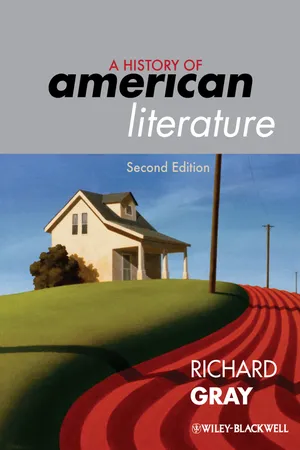
A History of American Literature
About this book
Updated throughout and with much new material, A History of American Literature, Second Edition, is the most up-to-date and comprehensive survey available of the myriad forms of American Literature from pre-Columbian times to the present.
Information
1
The First Americans
American Literature Before and During the Colonial and Revolutionary Periods
Imagining Eden
“America is a poem in our eyes: its ample geography dazzles the imagination, and it will not wait long for metres.” The words are those of Ralph Waldo Emerson, and they sum up that desire to turn the New World into words which has seized the imagination of so many Americans. But “America” was only one of the several names for a dream dreamed in the first instance by Europeans. “He invented America: a very great man,” one character observes of Christopher Columbus in a Henry James novel; and so, in a sense, he did. Columbus, however, was following a prototype devised long before him and surviving long after him, the idea of a new land outside and beyond history: “a Virgin Countrey,” to quote one early, English settler, “so preserved by Nature out of a desire to show mankinde fallen into the Old Age of Creation, what a brow of fertility and beauty she was adorned with when the world was vigorous and youthfull.” For a while, this imaginary America obliterated the history of those who had lived American lives long before the Europeans came. And, as Emerson’s invocation of “America … a poem” discloses, it also erased much sense of American literature as anything other than the writing into existence of a New Eden.
Not that the first European settlers were unaware of the strangeness of America: in October 1492, for example, Christopher Columbus (1451–1506) confided to his journals that there were “a thousand kinds of herbs and flowers” in this New World, “of all of which I remain in ignorance as to their properties.” His ignorance extended, famously, into areas he was hardly aware of: convinced that he had arrived at the continent of India, he christened the people he encountered Indians. “Their language I do not understand,” admitted Columbus. And their customs he found either odd or abhorrent. The “natives” went about “with firebrands in their hands,” Columbus along with other early European explorers observed, “these they call by the name of tabacos.” “They draw the smoke by sucking, this causes a drowsiness and sort of intoxication,” but, he concluded, “I do not see what relish or benefit they could find in them.” More seriously, they were “without any religion that could be discovered.” An “inoffensive, unwarlike people,” “without the knowledge of iniquity,” they were nevertheless strangers to the blessings of religion. This, however, was a problem ripe for the solving, since the “gentle race” in the New World could surely be introduced to the truths of the Old. “They very quickly learn such prayers as we repeat to them,” Columbus reported, “and also to make the sign of the cross.” So, he advised his royal masters, “Your Highnesses should adopt the resolution of converting them to Christianity.” Such a project, he explained without any trace of irony, “would suffice to gain to our holy faith multitudes of people, and to Spain great riches and immense dominion.”
Conversion was one strategy Columbus and other early Europeans had for dealing with America and the Americans they encountered. Comparison was another: the New World could be understood, perhaps, by discovering likeness with the Old. “Everything looked as green as in April in Andalusia,” reported Columbus of what he thought was India but was, in fact, Cuba. “The days here are hot, and the nights mild like May in Andalusia,” he added, and “the isle is full of pleasant mountains after the manner of Sicily.” Naming was another ploy: Columbus was not the first nor the last to believe that the strange could be familiarized by being given a familiar label. The strange people he met seemed less strange once he had convinced himself they were “Indians”; the strange places he visited became more understandable once they were given the names of saints. To map the New World meant either to deny its newness, by coming up with a name or a comparison associated with the Old, or to see that newness as precisely what had to be changed. “I have no doubt, most serene Princes,” Columbus reported,
that were proper devout and religious persons to come among the natives and learn their language, it would be an easy matter to convert them all to Christianity, and I hope in our Lord that your Highnesses will … bring into the church so many multitudes, inasmuch as you have exterminated those who refused to confess the Father, Son, and Holy Ghost.
Fundamental to this project of mapping the New World was the myth of Eden, according to which the European settlers were faced not so much with another culture as with nature, and not really encountering a possible future but, on the contrary, returning to an imagined past. “These people go naked,” Columbus observed, “except that the women wear a very slight covering at the loins”; and, while he was willing to confess that “their manners are very decent,” he could see this only as a sign of their aboriginal innocence. Stripped of culture, as well as clothes and Christianity, they were primitives, a recollection of natural man. In this, Columbus was not unusual; the only difference, if any, between him and many other early European explorers and settlers was that he eventually took the dream of Eden to its logical conclusion and a literal extreme. All his life, Columbus continued to believe he had discovered the Indies and only had to venture over the next hill or stream to find the legendary cities of gold and silver described by Marco Polo. When one discovery after another failed to confirm this belief, Columbus consoled himself with the conviction that what he had found was, literally, the Garden of Eden. “Each time I sailed from Spain to the Indies,” Columbus recalled toward the end of his life, “I reached a point when the heavens, the stars, the temperature of the air and the waters of the sea abruptly changed.” “It was as if the seas sloped upward at this point,” he remembered; and the odd behavior of his navigation equipment led him to conclude, finally, that the globe was not round. One hemisphere, he claimed, “resembles the half of a round pear with a raised stalk, like a woman’s nipple on a round ball.” “I do not hold that the earthly Paradise has the form of a rugged mountain,” Columbus insisted, “as it is shown in pictures, but that it lies at the summit of what I have described as the stalk of a pear.” “I do not find any Greek or Latin writings which definitely state the worldly situation of the earthly Paradise,” Columbus wrote, “and I believe that the earthly Paradise lies here” just beyond the strange new world he had found. He did not, he admitted, believe “that anyone can ascend to the top” and so enter the Garden of Eden. But he was firmly convinced that the streams and rivers he had discovered “flow out of the earthly Paradise” and that, accordingly, he had been closer than anyone to the place where “Our Lord placed the Tree of Life.”
The evidence Columbus adduced for associating the New World with Eden was an odd but, for its time, characteristic mix of scientific and pseudoscientific argument, biblical exegesis, and imaginative rhetoric. Not of least importance here was his rapt account of the vegetation and the native inhabitants of his earthly Paradise. “The land and trees were very green and as lovely as the orchards of Valencia in April,” he remembered, “and the inhabitants were lightly built and fairer than most of the other people we had seen in the Indies”; “their hair was long and straight and they were quicker, more intelligent, and less cowardly.” This is natural man as innocent rather than savage, reminding Europeans of their aboriginal, unfallen state rather than inviting conversion. The Indian as savage and the Indian as innocent were and are, of course, two sides of the same coin. Both map Native Americans, and the land they and their forebears had lived in for more than thirty thousand years, as somehow absent from history: existing in a timeless void, a place of nature and a site of myth. But, in mapping the New World and its inhabitants in this way, in trying to accommodate strange sights and experiences to familiar signs and legends, Columbus and other early European explorers were at least beginning a story of American literature: a story, that is, of encounters between cultures that leaves both sides altered. If there is one truth in the history of American writing, it is the truth of process and plurality. The American writer has to write in and of a world of permeable borders and change. Although he was hardly aware of it, Columbus was forging a narrative that was neither precisely Old World (because of the sights he had seen), nor exactly New World either (because of the signs he had used), but a mix or synthesis of both. Telling of meetings between strangers, oddly syncretic in its language and vision, it was in its own way an American tale he was telling.
Native American Oral Traditions
If Columbus thought some of his Indians were close to Paradise, then some of those Indians thought they came from heaven. Or so Columbus said. Some of the native inhabitants themselves tell a different story. Among some Native Americans of the Southeast, for example, there was the legend that white people came across the water to visit them. Treated hospitably, the whites then disappeared, leaving behind them only “a keg of something which we know was whiskey.” The people began smelling it, tasting it, then “some went so far as to drink a little,” whereupon “they began to reel and stagger and butt each other with their heads.” It was then that the white people came back for their real purpose: trade. Other Native Americans related the Europeans to their own myths of origin. Among the inhabitants of the Southeast, the Yuchis were not unusual in calling themselves “offspring of the sun.” If they were from the sun, then, the Yuchis felt, the whites clearly originated from the sea. “It was out upon the ocean,” Yuchi legend goes. “Some sea-foam formed against a big log floating there. Then a person emerged from the sea-foam and crawled out upon the log.” This was a white man. “Another person crawled up, on the other side of the log.” This was a white woman. After meetings on sea and land, many more white people came “with a great many ships.” They told the Yuchis “that their land was very strong and fertile” and asked them “to give a portion that they might live on it.” The Yuchis agreed, the tale concludes, “the white people came to shore, and they have lived there ever since.”
When we read Native American texts, with all due acknowledgment that what we are reading is a text and a translation, certain themes and preoccupations tend to recur. There are stories of world creation and the evolution of the sun, moon, and stars; there are tales of human and cultural emergence, involving the discovery of rituals or resources such as corn, buffalo, horses, salt, tobacco, or peyote vital to the tribe. There are the legends of culture heroes, sometimes related to history such as Hiawatha, sometimes purely mythic like the recurring figures of twin brothers; and, not unrelated to this, there are stories of tricksters, such as Coyote, Rabbit, and Spider Man. There are, invariably, tales of love and war, animals and spirits, mythic versions of a particular tribal history and mythic explanations of the geography, the place where the tribe now lives. Along with myths of origin, the evolution of the world out of water and primal mud, there are also myths of endings, although very often the ending is simply the prelude to another beginning. In one tale told among the Brule Sioux, for example, the “Creating Power” is thinking of other endings and beginnings even while he is creating our present world and telling the people “what tribes they belonged to.” “This is the third world I have made,” he declares. “The first world I made was bad; the creatures on it were bad. So I burned it up.” “The second world I made was bad too. So I burned it up.” “If you make this world bad and ugly,” he warns the men and women he has fashioned out of mud, “then I will destroy this world too. It’s up to you.” Then:
The Creating Power gave the people the pipe. “Live by it,” he said. He named this land the Turtle Continent because it was there that the turtle came up with the mud out of which the third world was made. “Someday there might be a fourth world,” the Creating Power thought. Then he rested.
Beginnings and endings in these tales are sometimes linked to the coming of the whites: in this case, the ending of peace and primal unity and the beginning of loss and division. “In the old, old days, before Columbus ‘discovered’ us, as they say,” one White River Sioux story goes, “we were even closer to the animals than we are now. Many people could understand the animal languages; they could talk to a bird, gossip with a butterfly. Animals could change themselves into people and people into animals.” These are common refrains in Native American tales: the vitality and unity of creation (“The earth was once a human being,” one Okanogan story goes. “Earth is alive yet.”), the vital thread of language that once connected humans and animals and the equally vital thread of being that still links them, the belief that this is a universe of metamorphosis, motion, and mutuality. What gives stories like that of the White River Sioux an extra edge is this conviction that the white man ruined things, at least for the time being. To the claim of Columbus that the New World was the earthly Paradise, the implicit response is, yes it was but you spoiled it. So, in one story told by the Papago, or Bear People, of the Southwest, the Creator or “Great Mystery Power” is imagined punishing his people by sending “the locust flying far across the eastern waters” to summon “a people in an unknown land” whose “face and bodies were full of hair, who rode astride strange beasts, who were encased in iron, wielding iron weapons” and “who had magic hollow sticks spitting fire, thunder, and destruction.” In another, Kiowa tale, the buffalo who “were the life of the Kiowa” finally leave because of “war between the buffalo and the white man.” Threatened with extinction at the hands of white soldiers, hunters, and developers, the buffalo retreat into a “green and fresh” world inside a local mountain “never to be seen again.” “The buffalo saw that their day was over,” the tale relates; and, since “everything the Kiowas had came from the buffalo,” the unspoken message is that so too is the day of the Kiowa people.
Stories of apocalypse like this one may rehearse themes and figures common to Native American tales of many ages – creation from the water, the holy mountain, the trickster-prophet – but they do clearly pivot on one significant moment of historical encounter. They are about the time when Columbus “invented America.” Many other stories are less bound to a specific time and place – although, of course, they are meant to explain the times and places in which the storytellers live – and among these, notably, are the stories of origin and emergence. These are often complex, symbolic narratives that characteristically project the tribal understanding of the origins of the earth and its people, confirm the fundamental relationships between the different elements of creation from the sun to the humblest plant, define the roles and rituals of the tribe, account for the distinctive climate and terrain of the homeland, and describe the origins of various social processes and activities. In short, they reveal the grounds of being for the storyteller and his audience: they explain the who, what, why, where, and how of their existence. “In the beginning the earth was covered with water,” begins a tale of origins told among the Jicarilla Apache. This is a common theme. “And all living things were below in the underworld.” This Jicarilla Apache tale, in fact, brings together the two most recurrent elements in accounts of origin: the emergence story, in which the people are led up from below the earth to find their place on the surface, very often near the place of emergence, and the story that begins with the primal element of water. Here, “all the people” come up from the underworld once the surface of the earth has become dry. “But the Jicarillas continued to circle around the hole where they had come up from the underworld,” the tale reveals. “Three times they went around it” before “the Ruler” of the universe took them to “the middle of the earth,” “a place very near Taos,” where “the Jicarillas made their home.”
What the Jicarilla story does not have is the earth diver theme. In many stories that begin with the primal element of water, a creature dives beneath the ocean to bring up enough mud to create the world and its inhabitants. The creature may be a deity, like “the Great Chief Above” in a Yakima tale. It may be an animal, such as the turtle in one story told among the Caddo. Or it may be a figure familiar from many other narratives, such as the trickster hero Coyote who, in one account of origins told by the Crow, “took up a handful of mud, and out of it made people” – dropping his clowning to become a creator. In a Yuma story, it is twins. Twins are common culture heroes in Native American legend. Sometimes, the twins are female – as they are in, say, the story of origins popular among the Acoma people of the Southwest, reflecting the matrilineal nature of their society. More often, as in Yuma myth, they are male; and, in the case of the Yuma myth as in many others, in order to account for the contraries and mysteries of existence, one is good and one is evil – and both are coextensive with their father. “This is how it all began,” the Yuma story announces. “There was only water – there was no land, only nothingness.” “Deep down” in the waters was “Kokomaht – the Creator.” “He was bodiless, nameless, breathless, motionless, and he was two beings – twins.” In this densely symbolic tale, the beginning of creation is marked by the emergence of Kokomaht, the Creator as “the first twin, the good twin”; Kokomaht, the Creator then names himself “Kokomaht-All-Father.” Having assumed bodily form, he proceeds to create the body of the earth and its inhabitants: “the four directions” of the north, south, east, and west, six series of four tribes, the creatures of the earth and sky, and the moon and stars. All that “Bakutahl, the Evil Blind One,” who emerges shortly after his brother, creates are the symptoms of his own incompetence, “creatures without hands or feet, toes or fingers”; “these were the fish and other water animals.”
There are touches of sly humor to some later versions of this legend. White people, we are told, Kokomaht “left for last” as the least of his creations. When the white man began to cry “because his hair was faded” and “his skin was pale and washed out,” Kokomaht tried to shut him up with the gift of a horse; “so the greedy one was satisfied – for a while.” More fundamental, and more characteristic of most tales of emergence, the Yuma legend describes the beginnings of birth and death. “Without help from a woman,” Kokomaht, the All-Father sires a son “Kumashtam’hu” and tells men and women “to join together and rear children.” “I taught the people to live,” Kokomaht, the All-Father declares. “Now I must teach them how to die, for without death there will be too many people on the earth.” The lesson is one of example. Kokomaht, the All-Father dies, and his son buries him, in the process teaching the people the proper rituals that follow a man’s death: which are, of course, the Yuma rituals of burning his house and belongings so they may “follow him to the spirit land.” Explaining birth and death, this tale of origins is typical also in explaining the special place and destiny of its tellers. Having taught the Yuma people the appropriate rites, Kumashtam’hu offers them the gift of corn and other “useful seeds from the four corners of the world.” He scatters the other tribes “over all the world,” but keeps the Yuma near him beside the Colorado River “because they were the special people he loved.” “I cannot stay with you forever,” he warns his people. “I am now only one, but I will become four:” four eagles that, after Kumashtam’hu no longer dwells among the Yuma “in the shape of a man,” still keep watch over them and enter their dreams to give them “power from Kokomaht.” “Everything that is good comes from Kokomaht,” the legend ends, “and everything evil comes from Bakutahl.” For Bakutahl, “the Evil Blind One,” survives beneath and “does bad things.” To him, for instance, are attributable all storms and earthquakes; when such things erupt, “then the people are afraid and say, ‘The Blind One is stirring down below.’ ”
Not all tales of origin resemble those of the Yuma people in attempting to explain the creation of the world, perhaps the evolution of sun, moon, and stars, and human and cultural emergence all in one narrative. There is, for example, the tale told by the Hopi people about a poor little boy who becomes a warrior and kills many. His power comes from his discovery that he is the son of the sun, but the tale is less about this than it is about the specifics of Hopi culture. The enemies the boy kills are all hunter-gatherers, reflecting the fear felt by the Pueblo farmers toward marauding nomadic tribes; and, having killed his enemies, the boy returns to the Hopi village where he proceeds to “teach the people the right way to live.” On the other hand, there is a legend popular among the Tsimshian, featuring Raven the Giant, a favorite hero among Northwest coast tribes, which is precisely about how daylight came into the world. A shifting, metamorphic creature, the hero of this legend assumes the...
Table of contents
- Cover
- Title page
- Copyright page
- Dedication
- Acknowledgments
- 1 The First Americans
- 2 Inventing Americas
- 3 Reconstructing the Past, Reimagining the Future
- 4 Making It New
- 5 Negotiating the American Century
- Further Reading
- Index
- Wiley End User License Agreement
Trusted by 375,005 students
Access to over 1.5 million titles for a fair monthly price.
Study more efficiently using our study tools.
Frequently asked questions
Yes, you can cancel anytime from the Subscription tab in your account settings on the Perlego website. Your subscription will stay active until the end of your current billing period. Learn how to cancel your subscription
No, books cannot be downloaded as external files, such as PDFs, for use outside of Perlego. However, you can download books within the Perlego app for offline reading on mobile or tablet. Learn how to download books offline
We are an online textbook subscription service, where you can get access to an entire online library for less than the price of a single book per month. With over 1.5 million books across 990+ topics, we’ve got you covered! Learn about our mission
Look out for the read-aloud symbol on your next book to see if you can listen to it. The read-aloud tool reads text aloud for you, highlighting the text as it is being read. You can pause it, speed it up and slow it down. Learn more about Read Aloud
Yes! You can use the Perlego app on both iOS and Android devices to read anytime, anywhere — even offline. Perfect for commutes or when you’re on the go.
Please note we cannot support devices running on iOS 13 and Android 7 or earlier. Learn more about using the app
Please note we cannot support devices running on iOS 13 and Android 7 or earlier. Learn more about using the app
Yes, you can access A History of American Literature by Richard Gray in PDF and/or ePUB format, as well as other popular books in Literature & North American Literary Criticism. We have over 1.5 million books available in our catalogue for you to explore.