eBook - ePub
Fundamentals of Sensor Network Programming
Applications and Technology
- English
- ePUB (mobile friendly)
- Available on iOS & Android
eBook - ePub
Fundamentals of Sensor Network Programming
Applications and Technology
About this book
This book provides the basics needed to develop sensor network software and supplements it with many case studies covering network applications. It also examines how to develop onboard applications on individual sensors, how to interconnect these sensors, and how to form networks of sensors, although the major aim of this book is to provide foundational principles of developing sensor networking software and critically examine sensor network applications.
Information
PART I
Overview
Chapter 1
Introduction
The creation of genuinely new software has far more in common with developing a new theory of physics than it does with producing cars or watches on an assembly line.
—T. Bollinger
Software that drives the operations of sensors and communication among sensors is basic to any meaningful application of sensor networks. The goal of this book is to provide an understanding of how this software functions; how it allows the sensors to gather information, process it, and interact with each other in networks; and how these networks interact with the physical world. One aim of this book is to provide fundamental information necessary to write efficient sensor network software. A second aim is to provide a balance between theory and applications, so that the subject matter is complete (self-contained).
Wireless sensor network (WSN) applications may consist of diverse sensors with varying capabilities. For example, sensors may range from an extremely constrained 8-bit “mote” to less resource-constrained 32-bit “microservers.” These sensors may be organized in different network configurations, which use different communication and data dissemination protocols, most software development platforms consist of libraries that implement message-passing interprocess communication (IPC) primitives, tools to support simulation, emulation, and visualization of networked systems, and services that support networking, sensing, and time synchronization. Given all of this diversity, there is an underlying theme of software development and deployment that cuts across platforms.
1.1 SOME FOUNDATIONAL INFORMATION
This section provides some basic information necessary for understanding the sensors and sensor networks.
1.1.1 Sensors
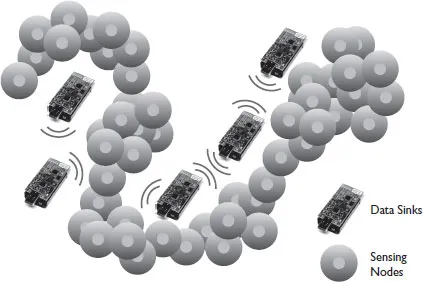
Typically a sensor is composed of components that sense the environment, process the data, and communicate with other sensors/computers. A sensor responds to a physical stimulus, such as heat, light, sound, or pressure, and produces a measurable electrical signal. Thus a sensor with its own sensing device, a memory, and a processor can typically be programmed with a high-level programming language, such as CorJava. The sensing devices can range from nanosensors to micro- and megasensors. In the remainder of this book when we refer to a sensor, we refer to a whole system such as a mote, which may have more than one physical sensor, its memory, processor, and other associated circuitry. Figure 1.1 shows a distributed sensor architecture and various components.
FIGURE 1.1 Networking structure of a distributed sensor network.
1.1.2 Sensor Networks
A distributed sensor network (DSN) is a collection of sensors distributed logically or geographically over an environment in order to collect data. Distributed computing and distributed problem solving are commonly used in DSN in order to abstract relevant information from the data gathered and derive appropriate inferences. This kind of data fusion can be used to compensate for the shortcomings of the individual sensor in real-world enviornments. For more details on sensor networks, see Refs. 1–3.
Most references to the term sensor network can denote multiple sensing configurations to be used in multiple contexts. Sensor networks typically consist of numerous sensing devices that may communicate over wired or wireless media, and may have as intrinsic properties limitations in computational capability, communication, or energy reserve. This does not imply that all sensor deployments consist of severely resource-constrained devices; for example, radar, closed-circuit cameras, and other wireline devices are commonly used in sensor network experimentations in academia and military research. These sensing devices possess reasonable computational capability and more importantly, may not have limited energy or constrained communication abilities. The main crux of this book is focused on the class of sensors having severely constrained computation, communication, and energy resources. These devices range from penny to matchbox in size and are deployed in an ad hoc and nonplanned (random) fashion. Examples of such devices include the mote platforms commonly used in academia.
1.2 NEXT-GENERATION SENSOR NETWORKED TINY DEVICES
1.2.1 Domain-Specific Challenges
Development of software in wireless sensor networks draws on experiences across several domains in computer science and some engineering disciplines such as
1. Networking. Networking knowledge is critical in sensor networks, providing information on how large-scale mobile ad hoc wireless networks can be created and managed efficiently.
2. Power Systems. Sensor networks, also rely on information from computer science and electrical and nanosystems engineering, in the creation of energy efficient software and hardware components, resulting in improved life of sensor networks.
3. Data Management. Experience in large-scale data management and data mining techniques is required in sensor networks since huge heterogenous datastreams are generated from these ubiquitous sensing devices.
4. Data Fusion. Since most devices have basic sensing capabilities, the need to create software systems capable of combining data from multiple sources to create more complex representation of the world is necessary; hence the need for data fusion. Fusion systems draw on advances in artificial intelligence, statistical analysis, and distributed systems.
1.2.2 Technology-Driven Methods
A few examples of technology driven methods in sensor networks follow.
1. Flooding, such as broadcast of packets in a synchronized network from source to destination until the path is formed to find the topology
2. Clustering, including K-means clustering to find K centers and form a cluster to minimize the distance between nodes in a dense region and efficiently form a topology
3. Short-path algorithms for data aggregation, such as data aggregation trees to form wireless spanners to efficiently collect data periodically
4. Distributed algorithms for energy and reusability loading and fault tolerance in large sensor networks
1.2.3 Wireless Sensor Network Environment
Sensor Network make it possible to monitor, instruct, or control various domains such as homes, buildings, warzones, cities, and forests. Sensor networks can observe the sensing environment at a close range and thus have many advantages, such as ability to monitor smallest details, proximity to places which are difficult to reach by humans, for example difficult terrain or hazardous environment. The major limitations of sensors are their limited power supply, limited communication bandwidth and range, and limited computation ability and memory capacity. Data transmission consumes a large percentage of energy; reducing the amount of data transmitted is the primary focus of data processing. The small bandwidth of the wireless links represents a challenge for data processing. Because of the limited communication radius of a sensor node, data may have to go through multiple hops to reach the final destination. This leads to extra power consumption in sensor nodes on the relay path. Limited processing and memory capacities restrict the complexity of data processing algorithms running at the sensor nodes. The intermediate results and other data are also burdensome to store in the node because of limited memory size. Sensor data are a stream: a real-time, continuous, ordered sequence with limited control over the order in which items arrive and the limitations of low battery life, low bandwidth, and low processing power and operating memory present programming challenges that are unique to the sensor network environment.
1.3 SENSOR NETWORK SOFTWARE
A network architecture and protocols are essential foundations for building software applications.
Developing computational/communication systems for deployment and application for wireless sensor networks has been a challenge since the mid-1990s. More Specifically, wireless ad hoc sensor networks have been largely designed with static and custom architectures for specific tasks, thus providing inflexible operation and interaction capabilities. WSN applications need to be programmed with constrained memory and process-centric resource requirements in mind, in order to write communication code with real-time sensing deadlines, which are critical to a dedicated scheduled measuring task. In short, the problem is the choice of abstraction for the sensor node runtime environment. Our computational framework or paradigm called INSPIRE, defines and supports nanofootprint and real-time deadlines, scheduled tasks for computing, and allows communication and sensing resources at the sensor nodes to be efficiently harnessed in high density event driven application-sensing fashion, through the use of an object oriented framework. A key feature of the runtime abstraction is that all the infrastructure used by the kernel is simulated to provide...
Table of contents
- Cover
- Half Title page
- Title page
- Copyright page
- Dedication
- Preface
- Foreword
- Acknowledgments
- About the Authors
- Notations and Abbreviations
- Part I: Overview
- Part II: Background
- Part III: Sensor Network Implementation
- Part IV: Real-World Scenarios
- Bibliography
- Index
Trusted by 375,005 students
Access to over 1.5 million titles for a fair monthly price.
Study more efficiently using our study tools.
Frequently asked questions
Yes, you can cancel anytime from the Subscription tab in your account settings on the Perlego website. Your subscription will stay active until the end of your current billing period. Learn how to cancel your subscription
No, books cannot be downloaded as external files, such as PDFs, for use outside of Perlego. However, you can download books within the Perlego app for offline reading on mobile or tablet. Learn how to download books offline
Perlego offers two plans: Essential and Complete
- Essential is ideal for learners and professionals who enjoy exploring a wide range of subjects. Access the Essential Library with 800,000+ trusted titles and best-sellers across business, personal growth, and the humanities. Includes unlimited reading time and Standard Read Aloud voice.
- Complete: Perfect for advanced learners and researchers needing full, unrestricted access. Unlock 1.5M+ books across hundreds of subjects, including academic and specialized titles. The Complete Plan also includes advanced features like Premium Read Aloud and Research Assistant.
We are an online textbook subscription service, where you can get access to an entire online library for less than the price of a single book per month. With over 1.5 million books across 990+ topics, we’ve got you covered! Learn about our mission
Look out for the read-aloud symbol on your next book to see if you can listen to it. The read-aloud tool reads text aloud for you, highlighting the text as it is being read. You can pause it, speed it up and slow it down. Learn more about Read Aloud
Yes! You can use the Perlego app on both iOS and Android devices to read anytime, anywhere — even offline. Perfect for commutes or when you’re on the go.
Please note we cannot support devices running on iOS 13 and Android 7 or earlier. Learn more about using the app
Please note we cannot support devices running on iOS 13 and Android 7 or earlier. Learn more about using the app
Yes, you can access Fundamentals of Sensor Network Programming by S. Sitharama Iyengar,Nandan Parameshwaran,Vir V. Phoha,N. Balakrishnan,Chuka D. Okoye,Narayanaswamy Balakrishnan in PDF and/or ePUB format, as well as other popular books in Technology & Engineering & Electrical Engineering & Telecommunications. We have over 1.5 million books available in our catalogue for you to explore.