Wearable Computing
From Modeling to Implementation of Wearable Systems based on Body Sensor Networks
- English
- ePUB (mobile friendly)
- Available on iOS & Android
Wearable Computing
From Modeling to Implementation of Wearable Systems based on Body Sensor Networks
About this book
This book provides the most up-to-date research and development on wearable computing, wireless body sensor networks, wearable systems integrated with mobile computing, wireless networking and cloud computing This book has a specific focus on advanced methods for programming Body Sensor Networks (BSNs) based on the reference SPINE project. It features an on-line website (http://spine.deis.unical.it) to support readers in developing their own BSN application/systems and covers new emerging topics on BSNs such as collaborative BSNs, BSN design methods, autonomic BSNs, integration of BSNs and pervasive environments, and integration of BSNs with cloud computing. The book provides a description of real BSN prototypes with the possibility to see on-line demos and download the software to test them on specific sensor platforms and includes case studies for more practical applications.
ā¢Provides a future roadmap by learning advanced technology and open research issues
ā¢Gathers the background knowledge to tackle key problems, for which solutions will enhance the evolution of next-generation wearable systems
ā¢References the SPINE web site (http://spine.deis.unical.it) that accompanies the text ā¢Includes SPINE case studies and span topics like human activity recognition, rehabilitation of elbow/knee, handshake detection, emotion recognition systems Wearable Systems and Body Sensor Networks: from modeling to implementation is a great reference for systems architects, practitioners, and product developers. Giancarlo Fortino is currently an Associate Professor of Computer Engineering (since 2006) at the Department of Electronics, Informatics and Systems (DEIS) of the University of Calabria (Unical), Rende (CS), Italy. He was recently nominated Guest Professor in Computer Engineering of Wuhan University of Technology on April, 18 2012 (the term of appointment is three years). His research interests include distributed computing and networks, wireless sensor networks, wireless body sensor networks, agent systems, agent oriented software engineering, streaming content distribution networks, distributed multimedia systems, GRID computing. Raffaele Gravina received the B.Sc. and M.S. degrees both in computer engineering from the University of Calabria, Rende, Italy, in 2004 and 2007, respectively. Here he also received the Ph.D. degree in computer engineering. He's now a Postdoctoral research fellow at University of Calabria. His research interests are focused on high-level programming methods for WSNs, specifically Wireless Body Sensor Networks. He wrote almost 30 scientific/technical articles in the area of the proposed Book. He is co-founder of SenSysCal S.r.l., a spin-off company of the University of Calabria, and CTO of the wearable computing area of the company. Stefano Galzarano received the B.S. and M.S. degrees both in computer engineering from the University of Calabria, Rende, Italy, in 2006 and 2009, respectively. He is currently pursuing a joint Ph.D. degree in computer engineering with University of Calabria and Technical University of Eindhoven (The Netherlands). His research interests are focused on high-level programming methods for wireless sensor networks and, specifically, novel methods and frameworks for autonomic wireless body sensor networks.
Frequently asked questions
- Essential is ideal for learners and professionals who enjoy exploring a wide range of subjects. Access the Essential Library with 800,000+ trusted titles and best-sellers across business, personal growth, and the humanities. Includes unlimited reading time and Standard Read Aloud voice.
- Complete: Perfect for advanced learners and researchers needing full, unrestricted access. Unlock 1.4M+ books across hundreds of subjects, including academic and specialized titles. The Complete Plan also includes advanced features like Premium Read Aloud and Research Assistant.
Please note we cannot support devices running on iOS 13 and Android 7 or earlier. Learn more about using the app.
Information
1
Body Sensor Networks
1.1 Introduction
1.2 Background
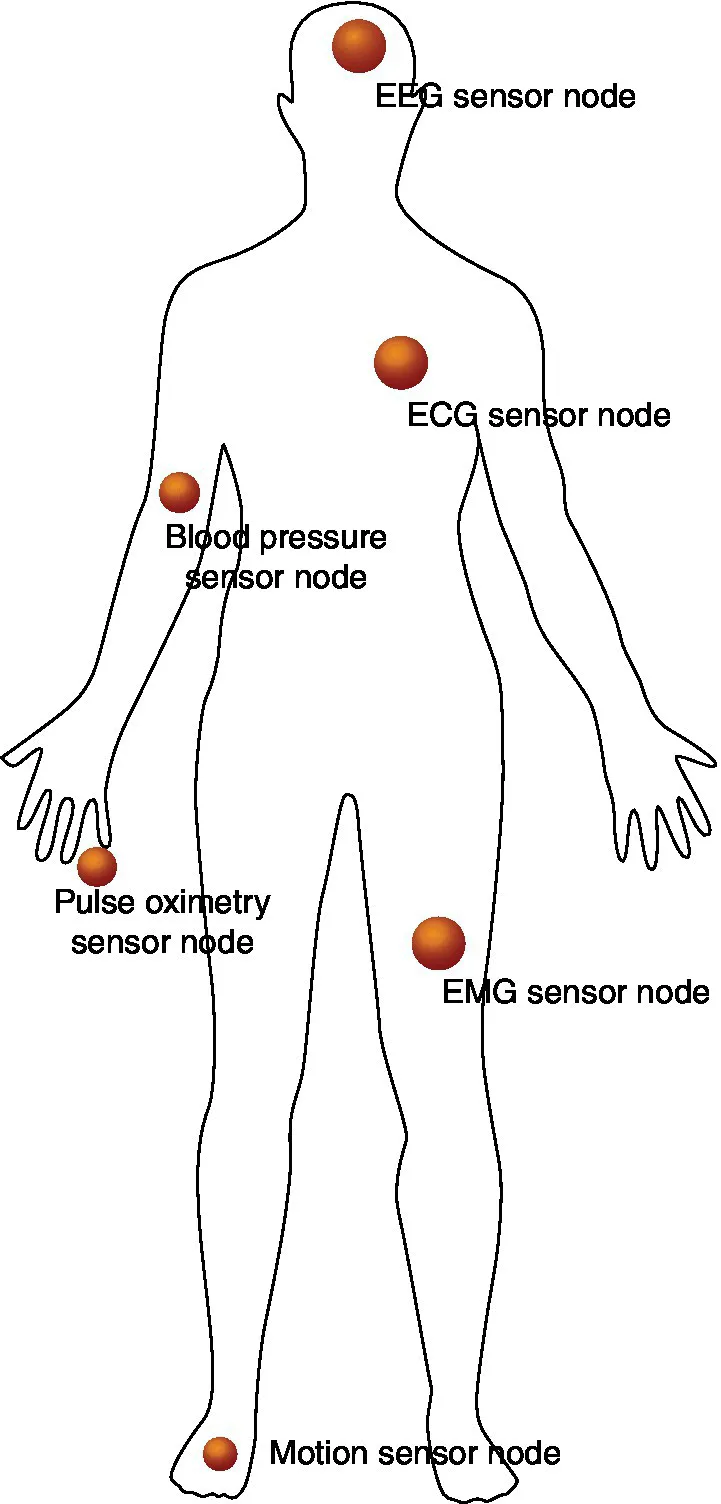
- Electrocardiography (ECG): the ECG is used to record the electrical activity (including the heart rate) of the heart over a period of time using electrodes placed on the skin.
- Blood pressure meter: also known as sphygmomanometer, it is a device used to measure (typically, both diastolic and systolic) blood pressure.
- Pulse oximetry: the oximeter is a medical device that allows us to measure noninvasively the amount of hemoglobin in the blood. Since hemoglobin binds with oxygen, it is therefore possible to obtain an estimate of the amount of oxygen present in the blood.
- Electromyography (EMG): the EMG sensor is used to monitor muscle activity, using a needle electrode inserted into the muscle for high accuracy, or, more practical and noninvasive, with simple skin electrodes. It records the activity of the muscle fibers under different conditions: at rest, during voluntary contraction up to the maximum effort, and during a sustained average contraction.
- Electroencephalography (EEG): the EEG sensor uses electrodes placed on the scalp to monitor the brain activity and capture different types of brain waves.
- Motion inertial sensors (e.g. accelerometers and gyroscopes) monitor human movements and even gestures.

- Interoperability: it is necessary to ensure the continuous data transfer through different standards (e.g. Bluetooth and ZigBee) to promote the exchange of information and ensure interaction between devices. In addition, it should provide an adequate level of scalability in relation to the number of sensor nodes and the workload of the BSN.
- System device: the sensors must be of low complexity, small size, lightweight, energy efficient, easy to use, and reconfigurable. In addition, patient biosignal storage, retrieval, visualization, and analysis must be facilitated.
- Security at the device and system level: particular attention must be paid to secure transmission and authenticated access to such sensible data.
- Privacy: the BSN could be considered as a āthreatā to the freedom of the individual, if the purpose of the applications goes ābeyondā the medical purposes. Social acceptance to these systems is the key to their wider dissemination.
- Reliability: the whole system must be reliable at hardware, network, and software levels. Reliability affects directly the quality of monitoring because, in the worst case, the failure to observe and/or successfully notify a ācritical risk eventā can be lethal for the patient. Because of the limitations and requirements on communication and power consumption, the reliability techniques used in traditional networks are not easily applicable in the BSN domain and, both at the design and implementation phase, this must be taken seriously.
- Validation and accuracy of sensory data: sensing devices are subject to hardware constraints that can affect the quality of the acquired data; both wired and wireless connections are not always reliable; envi...
Table of contents
- Cover
- Title Page
- Table of Contents
- Preface
- Acknowledgments
- 1 Body Sensor Networks
- 2 BSN Programming Frameworks
- 3 Signal Processing InāNode Environment
- 4 TaskāOriented Programming in BSNs
- 5 Autonomic Body Sensor Networks
- 6 AgentāOriented Body Sensor Networks
- 7 Collaborative Body Sensor Networks
- 8 Integration of Body Sensor Networks and Building Networks
- 9 Integration of Wearable and Cloud Computing
- 10 Development Methodology for BSN Systems
- 11 SPINEāBased Body Sensor Network Applications
- 12 SPINE at Work
- Index
- End User License Agreement