Winner of the Barclay Book Prize, German Studies Association
Winner of the Gomory Prize in Business History, American Historical Association and the Alfred P. Sloan Foundation
Winner of the Fraenkel Prize, Wiener Library for the Study of Holocaust and Genocide
Honorable Mention, European Studies Book Award, Council for European Studies
To control information is to control the world. This innovative history reveals how, across two devastating wars, Germany attempted to build a powerful communication empire—and how the Nazis manipulated the news to rise to dominance in Europe and further their global agenda.
Information warfare may seem like a new feature of our contemporary digital world. But it was just as crucial a century ago, when the great powers competed to control and expand their empires. In News from Germany, Heidi Tworek uncovers how Germans fought to regulate information at home and used the innovation of wireless technology to magnify their power abroad.
Tworek reveals how for nearly fifty years, across three different political regimes, Germany tried to control world communications—and nearly succeeded. From the turn of the twentieth century, German political and business elites worried that their British and French rivals dominated global news networks. Many Germans even blamed foreign media for Germany's defeat in World War I. The key to the British and French advantage was their news agencies—companies whose power over the content and distribution of news was arguably greater than that wielded by Google or Facebook today. Communications networks became a crucial battleground for interwar domestic democracy and international influence everywhere from Latin America to East Asia. Imperial leaders, and their Weimar and Nazi successors, nurtured wireless technology to make news from Germany a major source of information across the globe. The Nazi mastery of global propaganda by the 1930s was built on decades of Germany's obsession with the news.
News from Germany is not a story about Germany alone. It reveals how news became a form of international power and how communications changed the course of history.
eBook - ePub
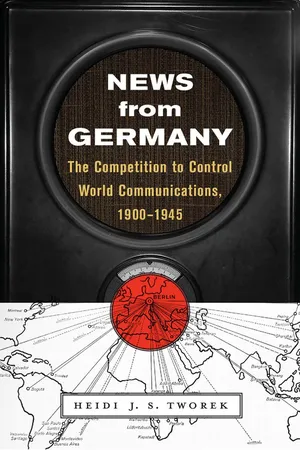
News from Germany
The Competition to Control World Communications, 1900–1945
- 333 pages
- English
- ePUB (mobile friendly)
- Available on iOS & Android
eBook - ePub
About this book
Information
Topic
StoriaSubtopic
Storia del XX secolo1
THE NEWS AGENCY CONSENSUS
It was “crucially important” to control an international news agency, concluded Gottfried Traub, editor in chief of the München-Augsburger Abendzeitung from 1921 to 1925. News agencies seemed to provide pure facts. At the same time, agencies “conveyed a value judgment” about facts by selecting, omitting, or shaping particular pieces of information. This “double character of a so-called ‘news item’ is the secret of every daily newspaper,” wrote Traub in his memoirs. News agencies created a network behind the news that molded reports before they even reached newspapers. Germany’s problem was that Britain and France “controlled the world” by creating news that bolstered their national priorities. Germany could only forge an independent press if it organized “its own international news service.”1 News agencies were embedded in international structures that constrained domestic room for maneuver. For men like Traub, the national and the international were inextricably intertwined.
Traub had to explain the importance of news agencies because they were unknown to most readers. But he would not have had to explain their importance to most German politicians, industrialists, bureaucrats, military generals, and journalists. These elites had come to see Germany as a global power around 1900. They became convinced that Germany could never become a global power without global media to back it up. The international structure of news seemed to undermine German imperial and great power ambitions. Though they disagreed about the nature of Germany’s ambitions, many industrialists, generals, bureaucrats, and politicians came to a consensus on how to change international news provision. It would be through the news agency.
Contemporaries understood that it was both expensive and difficult to gather international news. Very few news agencies existed, making them easier to control than thousands of newspapers. Information from news agencies could appear in political and nonpolitical, local and national newspapers. News agencies formed a source of information that most readers did not see. The invisibility of news agencies increasingly seemed a source of strength to elites, not weakness. It enabled them to shape public opinion secretly and, by extension, mold international politics, economics, and culture.
Beliefs about the effect of news on public opinion were paradoxical. Elites saw newspapers as a mirror of “public opinion” (or as a means to justify their actions based on public opinion). Simultaneously, they sought to shape that public opinion by controlling what newspapers published. If published opinion was the same as public opinion, then influencing published opinion would logically manufacture a different public opinion. News agencies seemed the most efficient method to shape many newspapers simultaneously without readers’ knowledge. Though they sought to influence news for different purposes, contemporaries increasingly focused on news agencies to achieve their broader goals.
The Rise of News Agencies
In 1920 the political editor of the Allgemeine Zeitung in Chemnitz, Ernst Heerdegen, complained about the triple dependency of Wolff Telegraph Bureau, Germany’s main news agency. First, Wolff depended politically on the government. Second, it depended financially on its owners, who were bankers. Finally, it depended internationally on its cartel relationship with the British and French news agencies, Reuters and Havas. Heerdegen disliked Wolff’s status as a junior partner in a system that had emerged in the mid-nineteenth century.2 Complaints like Heerdegen’s had started around 1900. It was not a coincidence that they focused on news agencies.
News agencies became the central firms collecting international news from the mid-nineteenth century. The “Big Three” news agencies were all created in this period: Agence Havas in the early 1830s, Wolff’s Telegraphisches Bureau (Wolff) in 1849, and Reuters Telegram Company in 1851. The founders of Reuters and Wolff, Julius Reuter and Bernhard Wolff, had fled to Paris from the German lands during the 1848 revolutions. They worked for Havas and built up a personal relationship with the owner, Charles Havas. The three continued to cooperate when Wolff founded his agency in Berlin and Reuter began his business in Aachen using pigeon post before moving to London in anticipation of the first submarine cable laid between Britain and France in 1851.
Informal cooperation between the three men and their agencies arose for technological as well as personal reasons. The spread of telegraphy meant news from around the world could be collected more swiftly than ever before. Although the development of steamships had accelerated travel in the first half of the nineteenth century, telegraphy was the first technology that allowed information to move far faster across oceans than goods or people.3 After the first permanent transatlantic cable in 1866, submarine telegraph expanded rapidly to reach India, Australia, Latin America, and Africa by the late 1870s.4 News sent by telegraph became essential for any serious newspaper.
The news agency business model addressed problems of cost and capacity in telegraphic news gathering, where there were very high fixed and sunk costs.5 Fixed costs are expenses that stay constant, no matter how much news is produced; sunk costs are expenses that a company has incurred and cannot recover. For international news gathering, these included a large network of correspondents stationed abroad and the expense of sending telegrams. Wolff spent over a million marks gathering news in 1913; Reuters spent four to five times that.6 Cables also had limited capacity: few providers could gain regular, swift access to send telegrams. These high barriers to entry made news agencies the main supplier of international news for most newspapers, which could not afford such expenses.
As fixed and sunk costs were so high, the Big Three news agencies cooperated to minimize the costs of news collection. The three agencies built on informal cooperation to create an astonishingly durable formal cartel from 1870 until the outbreak of World War II.7 The cartel divided the world into territories. Each agency reported on its assigned spheres and exchanged that news with the other agencies. Each company stationed agents in the headquarters of other agencies to select news items to telegraph back to their home country. Within their spheres, the Big Three negotiated contracts to exchange news with particular national and imperial news agencies.8 These arrangements fulfilled two aims simultaneously. They saved costs on news collection abroad and assured a dominant position in news supply at home.
Wolff often seemed like the junior cartel partner. Each agency covered its country’s colonial territories and any areas that seemed economically or culturally affiliated with the agency’s home country. Beyond Germany’s small colonial empire, Wolff only covered continental Europe: the Austro-Hungarian Empire, Scandinavia, and parts of Russia. Meanwhile, Agence Havas covered Spain and South America, while Reuters and Havas jointly administered places like parts of China. Both Wolff and Havas paid extra fees to Reuters, which spent more on telegrams from Britain’s far-flung empire. But only Wolff had to cede 25 percent of its annual profits to Reuters and Havas from 1890, as it used so much of their news.9
Compared to cartels in other industries, surprisingly few major changes occurred during the cartel’s formal existence. In 1893, it added a new signatory—the American Associated Press (AP). The AP began to participate as an equal partner in 1893; it left in 1933–1934 after disagreeing with Reuters about news exchange in Japan (though Reuters and AP cooperated informally into the 1960s). In 1900, Wolff gained the right to disseminate individual news items directly to newspapers in China, Japan, and South America, as long as the items were not sent to news agencies. This enabled Wolff to establish relationships with German-language newspapers in those countries, like Ostasiatischer Lloyd. The new arrangement barely dented the reach of Reuters and Havas.
After a hiatus during World War I, Reuters and Havas renegotiated the cartel. They restricted Wolff to Germany, but allowed new national agencies in Central and Eastern Europe to sign contracts with Wolff to exchange German news. In a highly contentious clause, Reuters and Havas gained the same rights as Wolff in the occupied Rhineland, though Reuters soon withdrew and left the field to Havas.10 Still, Wolff was not useless. In 1930, AP general manager, Kent Cooper, ranked Wolff above Havas as the second most useful foreign agency after Reuters “in the order of their efficiency and importance to us.”11
Wolff’s participation in the cartel was normal practice for German businesses. The German Imperial Court had ruled in 1897 that cartels offered a “particularly appropriate service to the entire national economy” and were justified as long as they did not create monopolies or exploit customers.12 In 1914 a German economist called the news agency cartel “the most rational” way to save costs.13 Cartels and similar arrangements regulated between 30 and 50 percent of global trade in the early 1930s; Germans were represented in 60 to 75 percent of cartel agreements in 1932.14 Regular contractual revisions help to explain the news cartel’s exceptional longevity, paralleling practices in German coal and steel cartels.15 Even the Nazis remained in the news cartel until 1939 (though under Wolff’s successor agency).
Contemporaries believed that the cartel agencies possessed “a sort of monopoly on world reporting.”16 As high costs created an effective barrier to entry, German scholars from the early 1900s into the 1930s were skeptical that anyone could ever challenge the cartel’s “monopoly” on world news.17 In 1932 three academics noted that the “Ring Combination,” as the cartel was sometimes known, “forms one of the most complex and politically significant structures which affected the everyday life of the reading publics of the world, in the whole realm of international affairs.”18
A news agency could only secure a place in the cartel by dominance at home. A few Germans had long seen a news agency as a vital part of national politics. Soon after establishing his eponymous agency in London, Julius Reuter tried to expand into mainland Europe. When he attempted to encroach on Prussian territory in the 1860s and compete with Wolff, the Prussian government provided financial, political, and technological backing to retain a news agency for Prussia. With support from Chancellor Otto von Bismarck, Gerson von Bleichröder’s bank purchased Wolff in 1865 as part of a four-bank consortium and turned it into a limited partnership called Continental-Telegraphen-Compagnie (CTC). The head of Bleichröder Bank sat on Wolff’s board until Wolff was finally sold to the government in 1931. In 1874, Wolff became a stock corporation. In 1903 / 1904, it even paid shareholders a handsome dividend of 11.4 percent.19
To combat Reuters’s encroachment, the state started to provide political and technological guarantees of Wolff’s dominance. Bismarck deemed it essential for Prussia to have access to a news agency based in Berlin and not to cede control over German news to London-based Reuters. The Postal Ministry prioritized Wolff telegrams over private messages. Called the Amts-Correspondenz Privileg (Official Correspondence Privilege, or AC privilege for short), this enabled Wolff to corner the market in swift news supply. This system ...
Table of contents
- Cover
- Title Page
- Copyright
- Contents
- Epigraph
- Introduction
- 1. The News Agency Consensus
- 2. A World Wireless Network
- 3. Revolution, Representation, and Reality
- 4. The Father of Radio and Economic News in Europe
- 5. Cultural Diplomacy in Istanbul
- 6. False News and Economic Nationalism
- 7. The Limits of Communications
- 8. The World War of Words
- Conclusion
- List of Abbreviations
- Notes
- Archives Consulted
- List of Figures
- Acknowledgments
- Index
Trusted by 375,005 students
Access to over 1.5 million titles for a fair monthly price.
Study more efficiently using our study tools.
Frequently asked questions
Yes, you can cancel anytime from the Subscription tab in your account settings on the Perlego website. Your subscription will stay active until the end of your current billing period. Learn how to cancel your subscription
No, books cannot be downloaded as external files, such as PDFs, for use outside of Perlego. However, you can download books within the Perlego app for offline reading on mobile or tablet. Learn how to download books offline
Perlego offers two plans: Essential and Complete
- Essential is ideal for learners and professionals who enjoy exploring a wide range of subjects. Access the Essential Library with 800,000+ trusted titles and best-sellers across business, personal growth, and the humanities. Includes unlimited reading time and Standard Read Aloud voice.
- Complete: Perfect for advanced learners and researchers needing full, unrestricted access. Unlock 1.5M+ books across hundreds of subjects, including academic and specialized titles. The Complete Plan also includes advanced features like Premium Read Aloud and Research Assistant.
We are an online textbook subscription service, where you can get access to an entire online library for less than the price of a single book per month. With over 1.5 million books across 990+ topics, we’ve got you covered! Learn about our mission
Look out for the read-aloud symbol on your next book to see if you can listen to it. The read-aloud tool reads text aloud for you, highlighting the text as it is being read. You can pause it, speed it up and slow it down. Learn more about Read Aloud
Yes! You can use the Perlego app on both iOS and Android devices to read anytime, anywhere — even offline. Perfect for commutes or when you’re on the go.
Please note we cannot support devices running on iOS 13 and Android 7 or earlier. Learn more about using the app
Please note we cannot support devices running on iOS 13 and Android 7 or earlier. Learn more about using the app
Yes, you can access News from Germany by Heidi J. S. Tworek in PDF and/or ePUB format, as well as other popular books in Storia & Storia del XX secolo. We have over 1.5 million books available in our catalogue for you to explore.