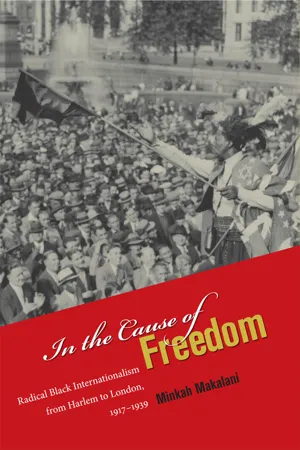
In this intellectual history, Minkah Makalani reveals how early-twentieth-century black radicals organized an international movement centered on ending racial oppression, colonialism, class exploitation, and global white supremacy. Focused primarily on two organizations, the Harlem-based African Blood Brotherhood, whose members became the first black Communists in the United States, and the International African Service Bureau, the major black anticolonial group in 1930s London, In the Cause of Freedom examines the ideas, initiatives, and networks of interwar black radicals, as well as how they communicated across continents.
Through a detailed analysis of black radical periodicals and extensive research in U.S., English, Dutch, and Soviet archives, Makalani explores how black radicals thought about race; understood the ties between African diasporic, Asian, and international workers' struggles; theorized the connections between colonialism and racial oppression; and confronted the limitations of international leftist organizations. Considering black radicals of Harlem and London together for the first time, In the Cause of Freedom reorients the story of blacks and Communism from questions of autonomy and the Kremlin’s reach to show the emergence of radical black internationalism separate from, and independent of, the white Left.
eBook - ePub
In the Cause of Freedom
Radical Black Internationalism from Harlem to London, 1917-1939
- 328 pages
- English
- ePUB (mobile friendly)
- Available on iOS & Android
eBook - ePub
In the Cause of Freedom
Radical Black Internationalism from Harlem to London, 1917-1939
About this book
Information
1
Straight Socialism or Negro-ology?
Diaspora, Harlem, and the Institutions of Black Radicalism
By the second decade of the twentieth century, one did not have to walk far in Harlem to find black Socialists among the scores of activist-intellectuals who transformed the neighborhood’s street corners into public lecterns from which to put forward their political programs. Alongside the nationalists, religious proselytizers, social reformers, and self-anointed race seers, black Socialists had a reputation as skilled orators with keen intellects who were just as willing to debate passersby as other activists. Harlem streets provided a relentlessly democratic public forum in which residents could engage a wide range of ideas and organizations. And the ideas one put forth were rivaled in importance only by one’s facility with the spoken word, a would-be leader’s political value measured in large part by his or her ability to bring into relief the circumstances of black people’s racial subordination. At the dawn of the Great Migration, such concerns were especially acute for black southerners who now enjoyed the freedoms offered by the urban North yet nevertheless recognized the all-too-familiar limitations, proscriptions, and social norms that subordinated blacks to whites. Tellingly, when black Socialists prepared for their public meetings, they routinely asked one another, “What shall we expound tonight, straight Socialism or Negro-ology?”1
The dilemma seemed false for black Socialists frustrated by the white Left’s tendency either to treat race as a facade masking the more fundamental class struggle or to claim that as workers, black people’s liberation would issue seamlessly from socialist revolution. Black Socialists realized that both claims freed white Socialists from thinking deeply about race or the difficulties of organizing black people alongside white workers. Black radicals had long rejected these views. Peter H. Clark, a Reconstruction-era educator and one of the first black Socialists in the United States, took the failure to address racial oppression as evidence that that “the welfare of the Negro” was not among late-nineteenth-century Socialists’ guiding concerns. At the founding convention of the Socialist Party of America (SPA) in 1901, three black coal miners, William Costley, John Adams, and Edward McKay, presented a resolution on the “Negro Problem” that demanded equal rights, including the franchise, and condemned lynching: The resolution was adopted only after all references to lynching and the right to vote had been removed. Two years later, the iconic Eugene V. Debs, who opposed segregated unions and had refused to address segregated southern audiences, implored the SPA to “repeal [its] resolutions on the negro question.” Since black people were workers, he wrote, their oppression would end with socialism. Thus, the SPA had no need for special resolutions on race or any other question and had “nothing special to offer the negro.”2
The African American and Caribbean radicals drawn into the SPA in the 1910s believed, like those before them, that Marxism best explained social inequality and racial and national oppression and helped them make sense of the U.S. South, the vagaries of the urban North, and social and political life in the Caribbean islands. Yet these radicals rejected any suggestion that class and race were theoretically incongruent terms or that class so thoroughly explained every other social ill that race was rendered a mere distraction. They understood that such class conceit diminished the importance of race by ignoring racism, which led to a refusal to organize black people as a racial group and to a general indifference toward black Socialists’ initiatives. If black radicals desired an integrated approach to race and class that did not yet exist, they would have to develop it themselves.
The politics of Caribbean radicals setting up street-corner platforms grew out of a complex history of race and intellectual and political engagements of which socialism was merely a part. Harlem’s intellectual ferment—its political organizations, periodicals, debates, and intellectual forums—provided the spaces in which Caribbean immigrants could work out their ideas about race, colonialism, class, and the place of African and Asian liberation in proletarian revolution. These radicals’ thinking about the global character of race, the imbricated structures of white supremacy and empire, and the relations of different African diasporic populations in pan-African struggle grew from personal experiences with race and colonialism in the Caribbean, which they believed gave them a unique perspective on American empire. Indeed, their thinking about these issues preceded their entrance into organized Marxist groups, and their conclusions outstripped the thinking of white leftists. The articulation of a black radical politics that reconciled the dichotomy between “straight Socialism or Negro-ology” occurred largely independent of the SPA’s institutions and initiatives, though it was hardly inconsequential to such an elaboration. Rather, they carried on such intellectual work in their own institutions and through their own political projects; at critical junctures, they did so in conversation with Asian radicals who had similar concerns that rested beyond the boundary of white radical thought. Possibly most important for Caribbean radicals, though few scholars have given the subject much attention, is the fact that their radicalism arose from their attempts to reconcile their experiences with the racial logics and systems of the Caribbean with a much different U.S. racial hierarchy, especially as it was experienced in Harlem’s unique diasporic community.
Race, Difference, and Diasporic Harlem
By the 1920s, the Harlem section of Manhattan grew into one of the most vibrant black communities in the world, leading contemporaries to dub it the Mecca of the New Negro. By 1900, Caribbeans began immigrating to New York, settling primarily in Manhattan and Brooklyn and ultimately comprising the largest group of foreign-born blacks in Manhattan. While in 1900 only 5,000 of the 60,000 black people in New York had been born outside the United States, that number grew rapidly over the next two decades. By 1910, nearly two-thirds of the 40,339 foreign-born blacks in the United States were Caribbeans, and most lived in Manhattan. In 1920, the percentage of Caribbean-born blacks in the city peaked at 33 percent before dropping to 16.7 percent ten years later.3 Caribbean immigrants had been drawn by the labor demands of U.S. industries during World War I, but the implementation of immigration restrictions in 1924 slowed the flow considerably. By that time, however, Harlem had transformed from simply an African American community into an African diasporic community that confronted a myriad of problems and conflicts but that also offered tremendous hope and possibility. Langston Hughes’s reflections on his early days in Harlem capture this complex tapestry:
Harlem—Southern Harlem—the Carolinas, Georgia, Florida—looking for the Promised Land—dressed in rhythmic words, painted in bright pictures, dancing to jazz—and ending up in the subway morning rush time—headed downtown. West Indian Harlem—warm rambunctious sassy remembering Marcus Garvey. Haitian Harlem, Cuban Harlem, little pockets of tropical dreams in alien tongues. Magnet Harlem, pulling an Arthur Schomburg from Puerto Rico, pulling an Arna Bontemps all the way from California, a Nora Holt from way out West, and E. Simms Campbell from St. Louis, likewise a Josephine Baker, a Charles S. Johnson from Virginia, an A. Philip Randolph from Florida, a Roy Wilkins from Minnesota, an Alta Douglas from Kansas. Melting pot Harlem—Harlem of honey and chocolate and caramel and rum and vinegar and lemon and lime and gall.4
Claude McKay wrote in equally moving prose, though a bit more soberly in describing his return to the New Negro Mecca after more than a year in London, where his literary interests began to merge with radical politics:
Ellis Island: doctors peered in my eyes, officials scrutinized my passport, and the gates were thrown open…. The elevated swung me up to Harlem. At first I felt a little fear and trembling, like a stray hound scenting out new territory. But soon I was stirred by familiar voices and the shapes of houses and saloons, and I was inflated with confidence. A wave of thrills flooded the arteries of my being, and I felt as if I had undergone initiation as a member of my tribe. And I was happy. Yet, it was a rare sensation again to be just one black among many. It was good to be lost in the shadows of Harlem again…. Spareribs and corn pone, fried chicken and corn fritters and sweet potatoes were like honey to my palate.
McKay found his way back to old haunts and explored new places, including Sanina’s, a 7th Avenue speakeasy he remembered “always humming like a beehive with brown butterflies and flames of all ages from the West Indies and from the South.”5
But while many young male intellectuals and artists were excited about Harlem and took comfort in the security provided by living in such a large enclave of black people, the experiences of African American migrants and Caribbean immigrants in Harlem could be trying. Racial and class dynamics Uptown were complex, often revealing internal conflicts that strained the ties binding its diverse peoples. Caribbeans created numerous organizations and social institutions that not only helped them adjust to the United States but also helped them sustain their national identities and demarcate themselves from African Americans. Class differences between the two groups exacerbated national differences. Early-twentieth-century Caribbean immigrants usually worked various jobs until they could secure work commensurate with their skills. Between 1911 and 1924, when African American migrants from the South worked primarily as unskilled laborers, approximately 14 percent of African Caribbeans held professional or white-collar jobs, while 55 percent worked as skilled laborers; only 31 percent worked as unskilled laborers.6
Caribbeans also had to adjust to race in America, as many who had light complexions and thus occupied an intermediary social position between blacks and whites in the Caribbean became undeniably black in the United States. And as Winston James argues, the experience of racial downgrading along with occasionally working menial jobs combined to radicalize many African Caribbean immigrant intellectuals.7 As historian Ula Taylor explains, for example, Amy Jacques, who became Marcus Garvey’s second wife, arrived in the United States and encountered racism, white supremacist organizations growing in popularity, and race riots, leading her to join the Universal Negro Improvement Association. Her decision constituted a clear indication “that she had by then relinquished some of her culturally colored attitude and embraced her ‘blackness’ in a new way.”8 According to racial identity theorists, such encounters disrupt people’s sense of the salience of race in the world, potentially leading to a reevaluation of their racial identity, or how they make sense of their racial group classification. Each person resolves such encounters in a unique way, although the process never follows a simple linear path and does not necessarily result in a black identity.9
For many Caribbean activist-intellectuals, however, their response to such encounters was part of a larger effort to mitigate the impact of national and class differences. They had to reconcile their most basic understanding of race in the Caribbean with the reality of the U.S. racial formation. And one could hardly have grown up in the Caribbean without confronting the complexities of race.
C. L. R. James’s well-known discussion of his choice of cricket clubs in Trinidad demonstrates both the importance and the particularity of race in the Caribbean. Around 1920, James, a dark-skinned but middle-class Trinidadian, had to choose whether to play for “Maple, the club of the brown-skinned middle class,” for which “class did not matter so much … as colour”; for the much better Shannon club, “the club of the black lower-middle class”; or for the Stingo club. Maple did not welcome dark-complexioned players regardless of their class, but James had gone to school with and knew well many of the club’s players, so it was an option in his case. He easily dismissed the idea of playing for Stingo, which was “too low.” Its members “were plebeians: the butcher, the tailor, the candlestick maker, the casual labourer, with a sprinkling of unemployed. Totally black and no social status whatsoever.” The choice between Maple and Shannon, however, was agonizing. Ultimately, despite the appeal of playing “the brilliant cricket Shannon played,” he joined Maple. The incident clearly demonstrates the salience of race in the Caribbean: Socially, James “was not bothered by my dark skin and had friends everywhere”; however, “the principle on which the Maple Club was founded … stuck in my throat.” Grant Farred considers James’s decision to join Maple a reflection of his social distance from those who formed Shannon. Moreover, James later recognized that his choice “delayed my political development for years. But no one could see that then, least of all me.” All the implications for a radical politics to which James would later dedicate his life inhered in that racial decision.10
Scholarly claims that race was less salient in the Caribbean than in the United States often overlook how race was (and is) understood in the islands. What in the United States are coded as color differences within a black/white binary may in the Caribbean be understood along a continuum of racial distinctions. Writing in the early 1930s, just before leaving Trinidad for England, James explained the complex nature of race in the Caribbean:
The Negroid population of the West Indies is composed of a large percentage of actually black people and about fifteen or twenty per cent of people who are a varying combination of white and black…. There are the nearly white hanging on tooth and nail to the fringes of white society, and these, as is easy to understand, hate contact with the darker skin far more than some of the broader-minded whites. Then there are the browns, intermediates, who cannot by any stretch of imagination pass as white, but who will not go one inch towards mixing with people darker than themselves…. Associations are formed of brown people who will not admit into their number those too much darker than themselves, and there have been heated arguments in committee as to whether such and such a person’s skin was fair enough to allow him or her to be admitted without lowering the tone of the institution…. Should the darker man, however, have money or position of some kind, he may aspire, and it is not too much to say that in a West Indian colony the surest sign of a man having arrived is the fact that he keeps company with people lighter in complexion than himself.11
African Americans made similar color distinctions, but they generally lacked the institutional and juridical armature necessary to elevate them to a racial distinction. Many Caribbean immigrants whose racially privileged position no longer obtained in the United States had to rethink themselves racially and adjust to a racial system that cast them as undeniably black. Racial downgrading entailed adjusting to a different register of blackness, being black in a new way, or being undeniably black for the first time.12
James’s contemplation of the political implications of his cricket decision involved his racial position as mediated by his class mobility. As a black Trinidadian, the racial politics of middle-class life struck James in a particular way. And though he downplayed the importance of race in his life, the fact that this episode plunged James “into a social and moral crisis which had a profound effect on [his] whole future life” suggests that race in the Caribbean had a far greater impact than much of the social science research might suggest.13
Few of Harlem’s black radicals in the mid-1910s left such rich and revealing accounts of their lives in the Caribbean. Also, most of those discussed in this book immigrated to the United States in their teen years, while James remained in Trinidad until he was past thirty. We therefore have relatively little information on how those radicals who were considered colored in the West Indies might have come to understand race in the Caribbean and on their adjustment to the United States and its radically different racial grammar. But one indication of their rejection of Caribbean racial mores is found in their response to the salience of national and color differences in Harlem. Black radicals gathered around the Socialist Party probed the complexities of race and confronted racial differences among Caribbeans that affected both social life and politics in Harlem.
Otto Huiswoud, Richard B. Moore, and Cyril Briggs were among the most important of these radicals. Huiswoud was born in 1893 in ...
Table of contents
- Cover Page
- In the Cause of Freedom
- Copyright Page
- Dedication
- Contents
- Illustrations
- Acknowledgments
- Abbreviations
- Introduction
- 1 Straight Socialism or Negro-ology?
- 2 Liberating Negroes Everywhere
- 3 With All Forces Menacing Empire
- 4 An Outcast Here as Outside
- 5 An Incessant Struggle against White Supremacy
- 6 The Rise of a Black International
- 7 An International African Opinion
- Epilogue
- Notes
- Bibliography
- Index
Trusted by 375,005 students
Access to over 1.5 million titles for a fair monthly price.
Study more efficiently using our study tools.
Frequently asked questions
Yes, you can cancel anytime from the Subscription tab in your account settings on the Perlego website. Your subscription will stay active until the end of your current billing period. Learn how to cancel your subscription
No, books cannot be downloaded as external files, such as PDFs, for use outside of Perlego. However, you can download books within the Perlego app for offline reading on mobile or tablet. Learn how to download books offline
Perlego offers two plans: Essential and Complete
- Essential is ideal for learners and professionals who enjoy exploring a wide range of subjects. Access the Essential Library with 800,000+ trusted titles and best-sellers across business, personal growth, and the humanities. Includes unlimited reading time and Standard Read Aloud voice.
- Complete: Perfect for advanced learners and researchers needing full, unrestricted access. Unlock 1.5M+ books across hundreds of subjects, including academic and specialized titles. The Complete Plan also includes advanced features like Premium Read Aloud and Research Assistant.
We are an online textbook subscription service, where you can get access to an entire online library for less than the price of a single book per month. With over 1.5 million books across 990+ topics, we’ve got you covered! Learn about our mission
Look out for the read-aloud symbol on your next book to see if you can listen to it. The read-aloud tool reads text aloud for you, highlighting the text as it is being read. You can pause it, speed it up and slow it down. Learn more about Read Aloud
Yes! You can use the Perlego app on both iOS and Android devices to read anytime, anywhere — even offline. Perfect for commutes or when you’re on the go.
Please note we cannot support devices running on iOS 13 and Android 7 or earlier. Learn more about using the app
Please note we cannot support devices running on iOS 13 and Android 7 or earlier. Learn more about using the app
Yes, you can access In the Cause of Freedom by Minkah Makalani in PDF and/or ePUB format, as well as other popular books in Social Sciences & British History. We have over 1.5 million books available in our catalogue for you to explore.