1
INTRODUCTION
Slippery position(s), unsettled setting(s)
On the morning of 21 February 2002, I was interviewing ‘Ala Jaradat in his office at Addameer, a Palestinian human rights organization that gives legal services to Palestinian political captives in the Israeli prisons.1 I was interviewing ‘Ala as a former political captive, as a person immersed in the narrative of captivity, as a political activist and because of his work in Addameer. It was a holiday, and except for ‘Ala and myself there was nobody else in the offices of Addameer. The interview was developing into a discussion, for I had known ‘Ala for quite a long time through mutual friends. Suddenly, we heard several loud explosions. It was obvious to ‘Ala that they were Israeli rockets fired from Apache helicopters. Both of us instinctively jumped to the large window to see where they had landed. First, we looked towards the headquarters of the Palestinian National Authority, a few hundred metres to the north, where Arafat was living. No smoke. Another series of explosions rocked Ramallah. Again, we saw no sign. The phone started to ring. Then the noisy mobile phones rang continuously. In such situations, everybody starts to garner information and passes it on. But the callers were looking for ‘Ala for other reasons than the air raid on Ramallah. A high-ranking political activist, who had been living underground for a long period, had been captured by the Israeli army, and it was estimated by human rights and political activists that the Israelis would harm him seriously if no international agency intervened. This evaluation was based on the fact that the Israeli army denied that it had arrested him. ‘Ala asked me to wait for him in the office, and to answer phone calls. He briefly explained the urgency of the situation, and left Addameer. Two hours later he came back. We discussed the situation, and decided to resume our interview. It was around 4 p.m. when the interview ended and we were both hungry, so we went out for lunch. Life in the streets of Ramallah was already back to ‘normal’ by then.
The fieldwork for this study was conducted under conditions of war. In ways that turned out to be ironic, the research, which was meant to explore one consequence of an ongoing violent conflict—the experience of political captivity—experienced war in each stage of its unfolding processes. These circumstances raise serious questions about the objective conditions of existence for the ethnographer and for ethnography, and, probably more important, questions about the nature of knowledge that communities produce in times of acute crises. By ‘probably more important’, I mean that there is no choice for the community investigated but to experience the war, in contrast to the many options open to the ethnographer to seek refuge from the crisis by staying outside physically and contemplating the crisis as an outsider. For example, it is almost a tradition among ethnographers, social researchers, and other Western professionals, who ‘do’ Palestine, to resort to the Jerusalem Hotel or the American Colony in the evenings to ‘share’ experiences and contemplate the Intifada, both the first and the second. These spots are almost liminal types of hybrid social spaces in which rites of passage into and out of the field are practiced through announcing the presence of an ethnographer to his or her community of peers, and they function as a refuge from the harsh realities. This illustrates what Genet described as his position vis-à-vis the Palestinian strugglers in Jordan in the early 1970s—as being with them and not of them.2
The position(s)
The ethnography that I conducted for this research was different. At one level, my position is of Us, Palestinians, and not with Them, western professionals—but not always, and not to the same degree in different contexts (Abu Lughod 1991: 147–57; Narayan 1993: 673; Kanaaneh 2002: 1–22). At each historical juncture in modern Palestinian history a different type of ‘identity’ emerged for the Palestinians. The war of 1948 resulted in many different categorizations. The two major identities were Palestinians who were expelled from Palestine and became refugees, and Palestinians who stayed in their homeland under Israeli rule and became Israeli citizens, at least officially As a result of the war of 1967, the West Bank and the Gaza Strip came under the rule of Israel, and this created a new set of identities for Palestinians living in the newly occupied territories vis-à-vis other Palestinian identities and, of course, in relation to the occupiers. I grew up as a Palestinian of 1948, entitled to Israeli citizenship (Zureik 1979: 1–7). So, here one has the first hyphenated identity with all its complexities. The daily realities and conditions of existence for the Palestinians of 1948, who possess Israeli citizenship, shape their self-perception and the dynamics of their identities in unique ways that do not resemble other Palestinian identities, say refugees or West Bankers (Bishara 1998: 51). But this is not the whole story of my sack of identities. Like any Palestinian family, mine has relatives in the different domains of Palestinian identities. The story of my mother’s family is a striking example of the fluidity of the construct of Palestinian identity. In the war of 1948 they were trapped in Taybih and couldn’t go back to their houses in Tulkarm. Taybih became part of the newly established Israeli state. So they, my mother’s family, became citizens. The border was closed for twenty years, until Israel occupied the West Bank. Then, after the war of 1967, they packed their belongings and went back to my grandfather’s house in Tulkarm.
In many ways, I acquired multiple identities in the local colonial scene of Palestine/Israel. These identities have some direct impacts on this study, and others that affect the research in more subtle ways. Many of the Palestinians I worked with while collecting data for my research at least recognized my family name. Some even knew specific family members; with some I could figure out my relations to them, and others I didn’t know.
Mostly, I tried to cope with these uncertainties by minimizing the importance of my family background. Usually, I would attempt to manoeuvre the conversation to the focus of the research. Academic affiliations were of great help in these attempts. Both my work at Bir Zeit University and my graduate studies in an American university would shift the emphasis from my familial identities to the professional ones. The professional and the national thus framed my ethnography to a large degree. Nonetheless, at times this could happen only after identifying the family name.
The research
With this inherited and acquired set of identities, I came to do ethnography. In contrast to other ethnographies, which have formal dates of officially entering the ‘field’, mine had no such ceremonial starting point. However, framing could help trace the changing shapes of the researcher-field interrelations. In early January 2000 I started a systematic pilot study of lingual and textual practices that could be described as expressions of Palestinian national ideologies and identities in the West Bank and the Gaza Strip. The corpus of such materials is enormous, at least in the Palestinian context that I was trying to classify. The first step was to look at the literature and any type of lingual and textual practices. This decision was based on personal as well as theoretical argumentation. I myself am a writer, and the whole process of creative writing is of prime concern to me, experientially and theoretically. Moreover, the Palestinian literary circles and networks in the West Bank and inside Israel are familiar to me, as I am part of several such networks. I argued to myself that these would be great assets in doing the research. However, in the long run it emerged that they would be assets in the pilot stage only. Theoretically, the debates in the academic literature about the relations between processes of literary production and nation-state ideologies, national identities, and issues of representation are the main horizons of interest for researchers who investigate the construction of identities, national and otherwise, in its modern historical contingency. The novel and the nation-state in these debates are the bride and the groom, respectively, of modern times. But in the Palestinian colonial context these issues are rarely addressed. The over-politicization of the researchers, or the politics of identity, overshadows the study of literary productions by Palestinians. Hence, there are few studies that focus on literature, and most examine ‘what really happened?’ This state of affairs makes the study of literary production more urgent if we wish to understand fully the intricate workings of the colonial condition in Palestine. This first narrowing step called for more selective criteria on two levels. First, the site/institution of production of such literature must be at least declared as a national one. Second, the site/institution had to be demarcated sufficiently clearly to satisfy the demands of ethnographic fieldwork, at least at the time of entrance to it. As I was searching for the literary national site par excellence, I came across several collections of short stories and poems written by political captives. The most salient feature of these literary products was that they kept mirroring themselves as prison literature. The themes, the plot, the metaphors, among other literary tropes and techniques, all shouted the fact that the writer was a Palestinian political captive. Moreover, each poem and story was signed with the date, and the name of the prison where it was written (see, for example, ‘Layan 1985; Abdallah 1989). In searching for more materials about literary production by Palestinian political captives, I explored many avenues: public libraries, bookshops, former political captives, the Palestinian Writers’ Union, and many personal friends who themselves are former captives. In two weeks I compiled a long list of collections and anthologies about the Palestinian political captives’ history, essays, personal testimonies, memoirs, short stories and poems. But above all, I became aware of the centrality of the experience of captivity in the daily lives of the Palestinians, and the ways in which it is represented in literature. The field was opening some of its gates to me, while building and closing others. At this stage, the realization that the Israeli colonial prison system is not only contested by its inmates, but also reconstructed as a Palestinian national site by the Palestinians who were forced to inhabit it, started to take shape in my mind, redefining my understanding of the Palestinian national fields. The first criterion of the research—to find a site/ institution that declares it produces national literature—was met satisfactorily. Palestinian prison literature is first and foremost declared as Palestinian. The second criterion, though, was more problematic. The colonial prison is so demarcated and structured that entrance to it entails security clearance from the Israeli authorities, a step that I was not sure about, to say the least. Hence, the research is based on two axes that demarcate the fieldwork: verbal reconstruction of the experience of political captivity by former political captives, and textual representation of captivity written by former political captives during their captivity. Thus, the demarcation of one side of the fieldwork in this ethnography is less physical, in that it relates to mental recollections of real experiences undergone during the phase of colonial conflict between 1967 and 1993, when it was seriously transformed. By July 2000, after six months spent collecting names and texts, I started to interview former political captives around the cities and villages of the West Bank. I was based in Ramallah, working at Bir Zeit University’s sociology department, and travelling around the country for the research.
Towards the end of September 2000, the ethnographic work was becoming more organized, with interviews, working on various collections of prison notebooks, archival work, and other practices of fieldwork. But, although nine months had passed since I started, the basic feeling was that I had many trees but no forest. I was collecting data and texts, establishing contacts with new former political captives, and trying to classify the piles of materials I had gathered.
Ariel Sharon’s visit to the Dome of the Rock on 28 September 2000 ignited a series of clashes between the Palestinians and the Israeli forces that developed into a full-scale confrontation between the two sides. These events changed and, to a large extent, shaped the daily practices of my ethnographic work, and coloured the whole ethnography in a certain light. The most appropriate description of it would be ethnography of war.
As the dynamics of events and confrontations in this Intifada took shape, they defined new realities unprecedented in their intensity and magnitude as an ongoing crisis for the Palestinian communities. Three years after the outbreak of these events, one could identify two stages in the nature of the relations between the Palestinian masses and their participation in resistance activities. During the first stage, which lasted several months, mass demonstrations and clashes with the Israeli forces were the main focus and practice of the second Intifada. This mass participation soon decreased and was replaced by guerrilla warfare, with armed operations and suicide bombers. The Israeli authorities, on their side, started to take severe measures that became increasingly brutal. One of these measures was the massive use of military force: for example, armoured vehicles and tanks firing at stone throwers, or F-16 fighter jets firing air-to-ground rockets to assassinate a single political leader. Another measure was the Israeli army roadblocks placed on most of the roads between the different Palestinian communities in the West Bank and the Gaza Strip in order to control the movement of the Palestinians. As a result, a five-minute journey between two adjacent villages would now take over an hour because of military checkpoints. The entrances to the Palestinian cities were closed, and movement in and out of them was monitored by the Israelis. These two practices were used as collective punishment. Living in the Palestinian occupied territories, one could not escape the basic feeling of being targeted individually and as part of the Palestinian collectivity.
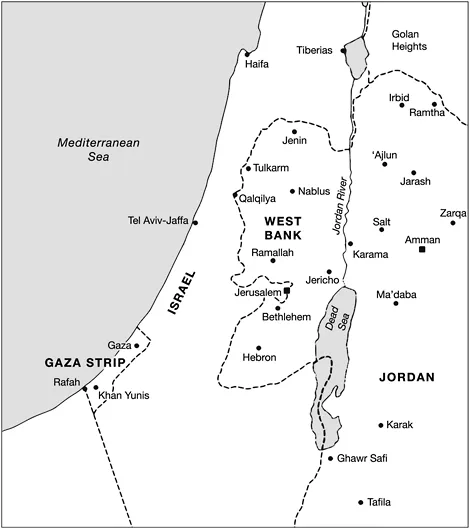
On 19 February 2002 I went to Nablus (see Map 1.1) to interview Abid al Star Qasim and Samy al Kylany. Both of them worked at al Najah University, the former as a professor and the latter as dean of students. My first plan was to stay overnight in Nablus so that I would have enough time for the interviews, and to visit the public library of Nablus, which has many original notebooks of prison literature. But the situation was very tense after several military operations, and there were rumours that the Israeli army was going to reinvade major Palestinian cities. This meant that Nablus could be under curfew for days if not weeks. So I decided to conduct two interviews in one day, and to dedicate a whole day to visiting the public library the following week.Map 1.1
At 6 a.m. I was in Qalandyah, at the military checkpoint. A few people were moving around, and many others were standing in line to pass through the checkpoint, which opens at 6 a.m. I did not have to stand in line, because the taxi shuttles bypass this checkpoint. I approached the taxi stand for Nablus. Dozens of yellow taxis were waiting for passengers. There were only five of us, and the taxi takes seven passengers, so we needed two more. I bought a cup of coffee from a man walking around the area of the checkpoint with a thermos flask, plastic cups, and a good voice for touting his wares. After thirty minutes of waiting, the taxi was finally full. It started moving, and I asked the passenger next to me: ‘How much do they [taxi drivers] charge to Nablus these days?’ He answered reluctantly: ‘I don’t know…last week it was fifteen shekels. You know it changes every day, depending on the road and how greedy the driver is…anyway we will pay only when we arrive…don’t worry.’
Map 1.1 The West Bank and its major cities.
Source: www.lib.utexas.edu/maps (24 July 2003).
Only the radio was talking. Everybody in the taxi was silent, a silence filled with tense expectation. After fifteen minutes we arrived at the first military checkpoint near the village of Taybih (Ramallah vicinity). The checkpoint was set in the middle of a junction, and on the four sides of it there were long lines of cars. The taxi driver sighed. ‘Here it comes, if God wishes it won’t take more than half an hour. Doesn’t everybody have an ID?’ Nobody answered. Time started to move slowly. Many Israeli civilian [settlers’] cars passed the checkpoint without stopping. A man in the back seat cursed. He didn’t curse the Israeli occupation but the Arabs, and the Mus-lims. He was in his late forties, short, fat, and humorous. He started a monologue about his recent life. The rest of the passengers were silent but listened to him. He was a famous carpenter from Nablus; he had a small furniture factory. He wanted to expand his business, so he had relocated to Ramallah in the mid-1990s. He stopped the monologue, looked out of the window.
‘Don’t worry, it’s moving. Last week it took me seven hours to get to Nablus. Don’t worry, we’ll get there…ha ha ha.’ He laughed harshly and ironically, almost a cold laugh. The line of cars was barely moving. The driver went out to smoke. After him, several of us took the chance too. We stood outside the taxi smoking. The carpenter from Nablus didn’t get out, nor did he continue his monologue. I kept looking at the time: 7.25 a.m. The line hadn’t moved for the last fifteen minutes. Without military checkpoints I would probably have reached Nablus by now, I thought. It is less than an hour’s drive to Nablus. Now 7.35 a.m. A group of soldiers approached our line. Suddenly, they broke up the line. We hurried back into the car. When our turn came to pass, the soldiers turned away from us, but the driver kept moving into the junction by the order of another soldier standing in the middle of it. When we realized that the shouting and the shooting were directed at our taxi, we froze. The driver stopped the car immediately. Seven or more soldiers were surrounding it with M-16s pointed at us. The soldier closest to the driv...