Transcending geographic and cultural lines, From Toussaint to Tupac is an ambitious collection of essays exploring black internationalism and its implications for a black consciousness. At its core, black internationalism is a struggle against oppression, whether manifested in slavery, colonialism, or racism. The ten essays in this volume offer a comprehensive overview of the global movements that define black internationalism, from its origins in the colonial period to the present.
From Toussaint to Tupac focuses on three moments in global black history: the American and Haitian revolutions, the Garvey movement and the Communist International following World War I, and the Black Power movement of the late twentieth century. Contributors demonstrate how black internationalism emerged and influenced events in particular localities, how participants in the various struggles communicated across natural and man-made boundaries, and how the black international aided resistance on the local level, creating a collective consciousness.
In sharp contrast to studies that confine Black Power to particular national locales, this volume demonstrates the global reach and resonance of the movement. The volume concludes with a discussion of hip hop, including its cultural and ideological antecedents in Black Power.
Contributors:
Hakim Adi, Middlesex University, London
Sylvia R. Frey, Tulane University
William G. Martin, Binghamton University
Brian Meeks, University of the West Indies, Mona, Jamaica
Marc D. Perry, University of Illinois, Urbana-Champaign
Lara Putnam, University of Pittsburgh
Vijay Prashad, Trinity College
Robyn Spencer, Lehman College
Robert T. Vinson, College of William and Mary
Michael O. West, Binghamton University
Fanon Che Wilkins, Doshisha University, Kyoto, Japan
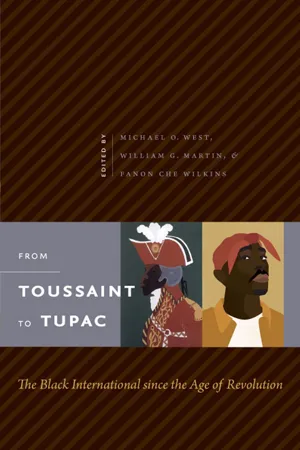
eBook - ePub
From Toussaint to Tupac
The Black International since the Age of Revolution
- 336 pages
- English
- ePUB (mobile friendly)
- Available on iOS & Android
eBook - ePub
From Toussaint to Tupac
The Black International since the Age of Revolution
About this book
Information
PART 1
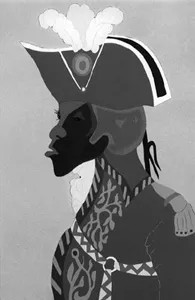
General Toussaint Louverture (1743–1803), as conceived by Jacob Lawrence. Leader of the Haitian Revolution, Toussaint Louverture was born into slavery but led African armies that defeated French, British, and Spanish forces and abolished slavery in Haiti and Santo Domingo. He was eventually captured and shipped to a cold and damp prison fortress in France, where he died in solitary confinement. (Jacob Lawrence, “General Toussaint L’Ouverture” [1986], ©2009 The Jacob and Gwendolyn Lawrence Foundation, Seattle/Artists Rights Society [ARS], New York)
The American Revolution and the Creation of a Global African World
The second half of the eighteenth century was a period of breathtaking historical change. It was an era in which peoples and ideas, commodities and cultures, crossed and recrossed regional and national boundaries from multiple corners of the world, transforming global demographics, building new Atlantic economies, and making connections in a variety of arenas—economic, political, linguistic, and religious. Africa was among the key points of circulation in this emerging world order, and African peoples made up a disproportionately large share of the human cargoes that traversed global waters. The African continent and its inhabitants were centrally involved in a vast process with overlapping and interacting parts, some of which were engaged in struggles against slavery and the expansion of capitalist modes of production. Within those transnational circuits lay the foundations of black internationalism, or pan-Africanism.
In this essay I argue that the era of the American Revolution played a seminal role in the development and spread of pan-Africanism. By contrast, North American historiography usually locates the origins of pan-Africanism in the nineteenth century, with the rise of emigration and colonization movements. An even more constricted temporal approach marks Pan-Africanism as a twentieth-century phenomenon, associating it with W. E. B. Du Bois and the five Pan-African Congresses (1919, 1921, 1923, 1927, and 1945), along with Marcus Garvey and the Universal Negro Improvement Association.1 In fact, African Americans of the American Revolutionary era played a significant part in the foundational wave of pan-Africanism: they helped to create and spread a diasporic consciousness unified by a collective memory of a lost homeland.
Definitional problems bedevil the subject of pan-Africanism. I use the term in the sense suggested by George Shepperson, who distinguished Pan-Africanism as a “clearly recognized movement associated with the five Pan-African Congresses” from pan-Africanism as “a group of movements, many very ephemeral,” in which cultural elements often predominate.2 My conceptual boundaries are the Black Atlantic created by the Atlantic slave trade, as distinct from the African Diaspora, a term that refers to the worldwide migration of African peoples, which began some 1,500 years before the emergence of the Atlantic diaspora.3
The phenomenon of pan-Africanism did not sprout by happenstance but was driven by ideological forces with truly complex origins. Its lineage can be traced to three main sources: evangelical Protestantism, whose affirmation of a millenarian future was a source of inspiration and promise; the era of the American Revolution, when the messianic destiny seemed to be at hand; and the black writers whose living memories of Africa served as a cultural anchor for exiled African peoples. An essential first step in the development of pan-Africanism was the emergence of a corporate African or racial identity in place of numerous ethnic identities. This occurred at different rates in different places, developed in multiple centers and institutional structures, and drew from diverse sources, the threads of which twisted into a knot during the tumultuous era of the American Revolution. For generations of enslaved men and women born in Africa, memory of the homeland remained strong and vital. Such memory was not just visibly present in architecture and dance but was also preserved aurally in language and music. African consciousness faded more quickly in slave societies that ceased to import slaves directly from Africa early, such as Virginia and Barbados. As direct imports slowed and the slave trade gradually ended, firsthand knowledge of Africa faded. Africa, however, lingered in the collective memory secretly passed down through the generations, whispered as the home of the ancestors and a place of freedom, once upon a time. Indeed, it seemed that the greater the distance in time, and the more removed from its physical reality, the more compelling Africa became as a symbol for people exiled from their homelands.
Evangelical Pan-Africanism, Black Seafaring, and the New Black Identity
A preliminary step in the rise of pan-Africanism began in the eighteenth century, with the forging of a spiritual community within autonomous black churches that sprung up throughout the Caribbean and North America under black leadership during the period of international revivalism.4 Evangelical revivalism was black and white, slave and free, more female than male, and unfolded within wide regional and transatlantic networks. At just about the time that John Wesley launched the Methodist movement in England, the Moravians, a pietistic offshoot of the Lutheran Church, inaugurated a revolutionary system of evangelization known as itinerancy. One of the pioneers of that system was a Dutch-speaking former slave named Rebecca Protten. Born in the Caribbean, Rebecca was in the vanguard of the first phase of a transatlantic black evangelical movement that had its genesis in white evangelical Protestantism but developed its own distinctive theology and ritual practices and provided some of the core beliefs of the black Atlantic revolutionary tradition. Decades before such better-known black evangelists as Olaudah Equiano, John Marrant, John Jea, George Liele, and David George began their worldwide itinerancy, Rebecca had traveled thousands of miles over two continents and several islands, broadcasting the evangelical message of divine deliverance from the bonds of sin.5
Rebecca is unique, but her story is not. David Margate was almost certainly the only black British missionary to work in the American colonies and quite possibly the first to articulate in unequivocal terms the biblical story of Exodus as both a spiritual pilgrimage and literal freedom from captivity, an idea that became a crucial motif in black diasporic discourse. “David the African” arrived in Charleston, South Carolina, in 1775. Claiming he was a second Moses “called to deliver his people from slavery,” David “not only severely reflected against the laws of the Province respecting slaves but even against the thing itself; he also compared their state to that of the Israelites during their Egyptian Bondade [sic].” David preached in South Carolina only seven months before he had to be spirited out of the colony to escape a lynch mob. But he had planted the seed of African consciousness and antislavery that continued to flower in all kinds of ways and in a variety of different contexts.6 The journey from international evangelical revivalism to evangelical Pan-Africanism had begun.
One of the forces driving the change was the black seafaring tradition. It is impossible to exaggerate the importance of black sailors in the creation of a diasporic consciousness. Black seafaring men were broadcasters of news, creators of a black literary tradition, and prime movers of rebellion. By the middle of the eighteenth century, the maritime industry employed a significant percentage of the Atlantic male slave populations as sailors, wharf workers, or fishermen.7 Sailing vessels functioned as global conveyor belts circulating around ocean basins, connecting Caribbean island communities to the great metropolitan ports of Europe, the docks of Atlantic North America, and the village markets and forts of Atlantic Africa. There were remarkable men among the black crews, pioneers in the antislavery movement and architects of a new diasporic consciousness formed around a remembrance of Africa.
Olaudah Equiano, John Jea, John Marrant, and others were not just sailors but, equally important, Christian ministers. In their professional identities as sailors, merchant mariners, fishermen, and preachers, they circulated through what Paul Gilroy calls “the black Atlantic world.”8 Men like Jea, who signed on as a ship’s cook, were as much part of the transnational circuit of evangelical preachers as John Wesley and George Whitefield, who launched the international movement known as the Great Awakening. Sailors wrote the first six autobiographies of blacks published in English before 1800. They included celebrated figures like Equiano, Marrant, Jea, Briton Hammon, Quobna Ottobah Cugoano, James Albert Ukawsaw Gronniosaw, and Paul Cuffe. Their writings speak of a new sense of energy and power derived for the most part from a variety of religious and secular ideas, and they collectively contributed in major ways to shifting consciousness away from ethnicity and toward a collective psyche.9
Equiano embodied that experience, and his memoir served as a fascinating chapter in the development of a black diasporic consciousness. His ethnic or national identity was fluid. Whereas Jea and Cugoano identified closely with their native land, Equiano was not really from any single place, but an international figure. His Interesting Narrative related his personal journey from his birth in 1745 in Benin, Africa, to his kidnapping at age eleven. Subsequently he became, like so many other pan-African pioneers, a sort of vagabond, moving from country to country as an enslaved sailor, his name changing with the same frequency as he changed owners and crossed cultural and geographic boundaries—from Michael to Jacob to Gustavus Vassa, the last the name he came to use most often.10
Equiano’s writings are an extraterritorial mirror on pan-Africanism, more a state of mind than a specific place. Like Briton Hammon, Equiano demonstrated no unified sense of racial identity; if anything, he came to view himself as both African and European, an Afro-Briton perhaps.11 In describing his native country and his fellow Ibos, Equiano used personal pronouns to characterize a certain “collective belonging,” which referred to his identity either or both as a European and as an African. Gradually, however, as his travels as a mariner took him through the Caribbean islands, he came to experience a sense of solidarity with the sufferings of enslaved people and to assign to them a collective identity as “Africans.” By the time he published his autobiography in 1789, Equiano had finally come to understand himself as African and to return to the use of his Ibo name, Olaudah Equiano.
As Equiano’s case demonstrates, the appropriation of Christianity by slaves 51 and free black men and women did not obliterate their African identity. Rather, Christianity helped them to forge a new pan-African identity out of disparate and often antagonistic ethnic identities. Cugoano probably spoke for many Africans of the diaspora who asserted themselves as Christians. Kidnapped from his birthplace in the Fanti region of modern-day Ghana in 1770 and enslaved in the Caribbean for two years, Cugoano was brought to England in 1772, at age fifteen. A year later he was baptized. Cugoano accepted the Christian name of John Stewart as part of his ritual incorporation into the church but insisted it did not alter his ethnic identity: “Christianity does not require that we should be deprived of our personal name, or the name of our ancestors, but it may very fitly add another name unto us, Christian, or one anointed.”12 The same cultural past that was so crucial to Cugoano’s sense of personal identity also centrally determined a collective sense of historical identity for diasporan Africans as a whole. The naming of black institutions offers a window onto that collective identity. It is impossible to say exactly when black churches in the United States began to assume racially specific designations, but with such names as the First African Baptist Church of Savannah, Georgia, in 1775, African Americans celebrated both an African heritage and a Christian identity.13
For enslaved people, becoming Christian was more than simply a metaphorical escape from the bonds of sin into the land of spiritual freedom. Little by little, the connection between religion and politics emerged, and religious identity began to meld with a national, African American one. The American Revolutionary era was a key moment in that transformation. The congruence of an evangelical idiom with secular republican ideology dramatically shifted the intellectual basis and the actual grounds for the construction of pan-Africanism. Petitions, sermons, and the writings of the emerging black leadership reflected that process. In them are found the historical antecedents for what Marcus Garvey and various nineteenth- and twentieth-century black intellectuals would preach: race pride, African redemption, and the return to Africa, in some cases in spiritua...
Table of contents
- Cover Page
- FROM TOUSSAINT TO TUPAC
- Copyright Page
- Dedication
- CONTENTS
- ILLUSTRATIONS
- PREFACE
- ACKNOWLEDGMENTS
- INTRODUCTION Contours of the Black International
- PART 1
- PART 2
- PART 3
- BIBLIOGRAPHY
- ABOUT THE AUTHORS
- INDEX
Trusted by 375,005 students
Access to over 1.5 million titles for a fair monthly price.
Study more efficiently using our study tools.
Frequently asked questions
Yes, you can cancel anytime from the Subscription tab in your account settings on the Perlego website. Your subscription will stay active until the end of your current billing period. Learn how to cancel your subscription
No, books cannot be downloaded as external files, such as PDFs, for use outside of Perlego. However, you can download books within the Perlego app for offline reading on mobile or tablet. Learn how to download books offline
Perlego offers two plans: Essential and Complete
- Essential is ideal for learners and professionals who enjoy exploring a wide range of subjects. Access the Essential Library with 800,000+ trusted titles and best-sellers across business, personal growth, and the humanities. Includes unlimited reading time and Standard Read Aloud voice.
- Complete: Perfect for advanced learners and researchers needing full, unrestricted access. Unlock 1.5M+ books across hundreds of subjects, including academic and specialized titles. The Complete Plan also includes advanced features like Premium Read Aloud and Research Assistant.
We are an online textbook subscription service, where you can get access to an entire online library for less than the price of a single book per month. With over 1.5 million books across 990+ topics, we’ve got you covered! Learn about our mission
Look out for the read-aloud symbol on your next book to see if you can listen to it. The read-aloud tool reads text aloud for you, highlighting the text as it is being read. You can pause it, speed it up and slow it down. Learn more about Read Aloud
Yes! You can use the Perlego app on both iOS and Android devices to read anytime, anywhere — even offline. Perfect for commutes or when you’re on the go.
Please note we cannot support devices running on iOS 13 and Android 7 or earlier. Learn more about using the app
Please note we cannot support devices running on iOS 13 and Android 7 or earlier. Learn more about using the app
Yes, you can access From Toussaint to Tupac by Michael O. West, William G. Martin, Fanon Che Wilkins, Michael O. West,William G. Martin,Fanon Che Wilkins in PDF and/or ePUB format, as well as other popular books in Social Sciences & African American Studies. We have over 1.5 million books available in our catalogue for you to explore.