Luis-Brown traces unfolding narratives of decolonization across a broad range of texts. He explores how Martí and Du Bois, known as the founders of Cuban and black nationalisms, came to develop anticolonial discourses that cut across racial and national divides. He illuminates how cross-fertilizations among the Harlem Renaissance, Mexican indigenismo, and Cuban negrismo in the 1920s contributed to broader efforts to keep pace with transformations unleashed by ongoing conflicts over imperialism, and he considers how those transformations were explored in novels by McKay of Jamaica, Jesús Masdeu of Cuba, and Miguel Ángel Menéndez of Mexico. Focusing on ethnography's uneven contributions to decolonization, he investigates how Manuel Gamio, a Mexican anthropologist, and Zora Neale Hurston each adapted metropolitan social science for use by writers from the racialized periphery.
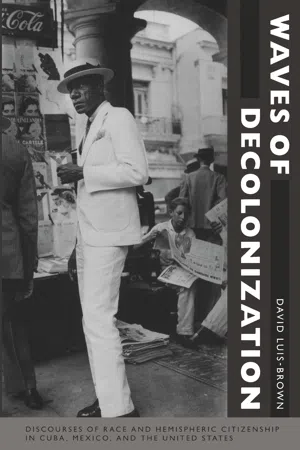
eBook - PDF
Waves of Decolonization
Discourses of Race and Hemispheric Citizenship in Cuba, Mexico, and the United States
- 353 pages
- English
- PDF
- Available on iOS & Android
eBook - PDF
Waves of Decolonization
Discourses of Race and Hemispheric Citizenship in Cuba, Mexico, and the United States
About this book
In Waves of Decolonization, David Luis-Brown reveals how between the 1880s and the 1930s, writer-activists in Cuba, Mexico, and the United States developed narratives and theories of decolonization, of full freedom and equality in the shadow of empire. They did so decades before the decolonization of Africa and Asia in the mid-twentieth century. Analyzing the work of nationalist leaders, novelists, and social scientists, including W. E. B. Du Bois, José Martí, Claude McKay, Luis-Brown brings together an array of thinkers who linked local struggles against racial oppression and imperialism to similar struggles in other nations. With discourses and practices of hemispheric citizenship, writers in the Americas broadened conventional conceptions of rights to redress their loss under the expanding United States empire. In focusing on the transnational production of the national in the wake of U.S. imperialism, Luis-Brown emphasizes the need for expanding the linguistic and national boundaries of U.S. American culture and history.
Information
Publisher
Duke University Press BooksYear
2008Print ISBN
9780822343660
9780822343653
eBook ISBN
9780822391463
Table of contents
- CONTENTS
- Acknowledgments
- Introduction
- One ‘‘White Slaves’’ and the ‘‘Arrogant Mestiza’’: Reconfiguring Whiteness in The Squatter and the Don and Ramona
- Two ‘‘The Coming Unities’’ in ‘‘Our America’’: Decolonization and Anticolonial Messianism in Martí, Du Bois, and the Santa de Cabora
- Three Transnationalisms against the State: Contesting Neocolonialism in the Harlem Renaissance, Cuban Negrismo, and Mexican Indigenismo
- Four ‘‘Rising Tides of Color’’: Ethnography and Theories of Race and Migration in Boas, Park, Gamio, and Hurston
- Coda Waves of Decolonization and Discourses of Hemispheric Citizenship
- Notes
- References
- Index
Trusted by 375,005 students
Access to over 1.5 million titles for a fair monthly price.
Study more efficiently using our study tools.
Frequently asked questions
Yes, you can cancel anytime from the Subscription tab in your account settings on the Perlego website. Your subscription will stay active until the end of your current billing period. Learn how to cancel your subscription
No, books cannot be downloaded as external files, such as PDFs, for use outside of Perlego. However, you can download books within the Perlego app for offline reading on mobile or tablet. Learn how to download books offline
Perlego offers two plans: Essential and Complete
- Essential is ideal for learners and professionals who enjoy exploring a wide range of subjects. Access the Essential Library with 800,000+ trusted titles and best-sellers across business, personal growth, and the humanities. Includes unlimited reading time and Standard Read Aloud voice.
- Complete: Perfect for advanced learners and researchers needing full, unrestricted access. Unlock 1.5M+ books across hundreds of subjects, including academic and specialized titles. The Complete Plan also includes advanced features like Premium Read Aloud and Research Assistant.
We are an online textbook subscription service, where you can get access to an entire online library for less than the price of a single book per month. With over 1.5 million books across 990+ topics, we’ve got you covered! Learn about our mission
Look out for the read-aloud symbol on your next book to see if you can listen to it. The read-aloud tool reads text aloud for you, highlighting the text as it is being read. You can pause it, speed it up and slow it down. Learn more about Read Aloud
Yes! You can use the Perlego app on both iOS and Android devices to read anytime, anywhere — even offline. Perfect for commutes or when you’re on the go.
Please note we cannot support devices running on iOS 13 and Android 7 or earlier. Learn more about using the app
Please note we cannot support devices running on iOS 13 and Android 7 or earlier. Learn more about using the app
Yes, you can access Waves of Decolonization by David Luis-Brown, Donald E. Pease in PDF and/or ePUB format, as well as other popular books in History & Latin American & Caribbean History. We have over 1.5 million books available in our catalogue for you to explore.