- 272 pages
- English
- ePUB (mobile friendly)
- Available on iOS & Android
eBook - ePub
About this book
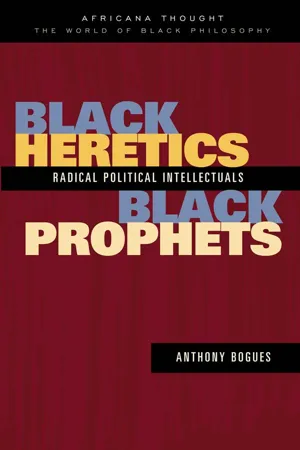
First published in 2003. This pioneering new book surveys the political thought of a selection of influential black thinkers in provocative exploration of the black radical tradition as it has evolved in the Caribbean, Africa, and the United States. Each chapter focuses on key figures or social movement including the slave Cugoano, the American anti-lynching activist Ida B. Wells-Barnett, C.L.R. James, W.E.B Du Bois, former leader of the anti-colonial movement in Tanzania Julius Nyerere, Walter Rodney, the political philosophy of Rastafari, and the activist-musician Bob Marley. This book is essential reading for anyone interested in the history of radical black thought and the development of an activist political tradition.
Information
THE HERETICS
CHAPTER 1
The Political Thought of
Quobna Cugoano
Radicalized Natural Liberty
I write what I like.
—Steve Biko
—Steve Biko
The slaves shall be free … [through a] … combination of ideas.
—Robert Wedderburn, former slave
—Robert Wedderburn, former slave
Introduction
The 1969 publication of African-American poet Ama Bontemps’s Great Slave Narratives consolidated the study of slave narratives as a genre of lit-erature.1 Bontemps made the case for the slave narrative as an “American genre” of popular autobiography. This classification has meant that subsequent studies on slave narratives have been primarily framed as memoirs, autobiography, and a genre of literature. To consider these frames as the only ones for the study of slave narratives is today problematic. First, it is well known that a common problem within the domain of knowledge production is the misconception that blacks produce experience and whites produce theory.2 Therefore, when we study the written productions of black slaves only within the autobiographical or literary frame, we can miss their political ideas and purposes. The second difficulty is that the narrow autobiographical frame which focuses on life experiences often ignores the broad context of textual production. When this occurs, the complex relationships between the written testimony of the slave and the political language and context in which the testimony is embedded are elided or reduced to a secondary position. The autobiographical/literary frame of slave narratives confines the politics of many narratives to a form of “literary black vindicationism” similar in some respects to the “vindicationism” of black history.3 The autobiographical frame also ignores the fact that the late eighteenth century and a good deal of the nineteenth century were periods in which black abolitionism was a significant radical plank on the world’s political stage.4 This essay challenges the dominant interpretive mode of the slave narratives as primarily literary and autobio-graphical. In doing so, it argues that Quobna Cugoano’s Thoughts and Sen-timents on the Evil of Slavery is a major late eighteenth-century text of political discourse on natural liberty and natural rights.
Henry Louis Gates, Jr.’s book The Signifying Monkey (1988) opened wider spaces for thinking about the location of slave narratives. However, it did so within the boundaries of the established literary canonization of the narratives. In this seminal work Gates argues that the slave narratives were an integral part of the African-American literary tradition. He further suggests that this tradition was a “double-voiced” one, and characterizes the slave narrative as “a talking book.” Positing a theory of origins, Gates asserts that the “literature of the slave” at the level of meaning was an oxymoron, and that for the slave, the capacity to read and write was his or her ability to “transgress [a] nebulous realm of liminality.”5 He further observes that, “The slave wrote not primarily to demonstrate humane letters, but to demonstrate his or her membership in the human community.”6
For Gates, blacks became subjects in the eyes of the world through the crafting of a written text. Probing this point, he demonstrates how the privileging of reason by the various European Enlightenments created writing as a badge and expression of Reason, and therefore of humanity. It is common knowledge that after Descartes proclaimed, “I think; therefore I am,” thinking was transformed into Reason, and that “I am” became an epistemological question rather than one of being.7 Over time, the written word became the signifier for Reason as rationality. As such, African slaves living in the “Age of the Enlightenment” did use writing as one means of human agency. Gates and others have suggested that slave narratives were also the early beginnings of a “Black Atlantic literary and cultural tradition … [which shared] a common creolized cultural heritage that crossed national and ethnic boundaries … defined political categories, social norms, and even literary genres.”8
In one sense this is accurate, and acknowledges the fact that modern Atlantic slavery was a large system and that the trade yoked different societies into a set of relationships. However, in spite of the above, we are still left with working through the specific forms of political writings and criticism that the narratives were embedded within. One way to grapple with the issue of the precise nature of slave narratives is to suggest that they were not only literature, political criticism, or narrative history, but integrated all these modes of writing into a form of critical exposition. This form of writing had an ethical dimension, and its primary modes were both communicative and calls to action, thereby making the narratives moments of slave critique. This shift in interpretation means that the narratives were something else; they were documents of freedom that can be interpreted within the context of the language and political ideas of their times. Today the act of reading these texts confronts one with a peculiar task of interpre-tation—the relationship between the meaning of these texts, the structural world of slavery, and the general ideas of natural liberty in what the critic Roland Barthes calls a “narrative communication.”
This essay will attempt to address some of these issues. Using Cugoano’s narrative, I want to suggest that perhaps another way to read some of the slave narratives of the late eighteenth century is to grapple with them as discursive practices of slave criticism and critique that probed alternative meanings of racial slavery, natural liberty, and natural rights, and countered the dominant eighteenth-century ideas of racial plantation slavery. As documents of slave political criticism and critique, the narratives have a great deal to tell us about eighteenth-century social and political ideas, and form a central part of an Africana radical intellectual political tradition.
Writing as Political Criticism
Dena Goodman tells us that there were many modes of critical writing during the eighteenth century: epistolary, historical narrative, letters, memoirs, treatises, and dialogical.9 The major objective of these forms of writing was to shape a society’s thinking. According to Goodman, these modes of writing constituted “conscious acts carried out by leading figures as part of the Enlightenment’s civic project.”10 Critical writing during this period involved a kind of dialectic. The production of a text was an engaged moment whereby the writer hoped that he or she would affect society’s thinking. As a mode of critical action, writing had three aspects—there was an audience who would be persuaded, who would be changed, and who would, eventually, act. From this standpoint we can better appreciate the emphasis that the English abolitionist movement placed upon written textual productions during the late eighteenth century as an integral part of its campaign to abolish the slave trade.
Another dimension of the discursive practices of the period was the language and vocabulary of political discourse. In general, four main themes provided the grammar for political discourse: state of nature, natural law, natural rights, and natural liberty. In England these themes were complicated by an older political tradition that had emerged in Stuart England—the Bible as the divine word of God and the application of the principles of the New Testament as a catalyst for conceptions of a harmonious political order. This tradition of appropriating biblical texts for radical purposes and reworking the language of revolution through the prism of religious beliefs was consolidated in the revolution of the 1640s when the major radical groups, the Levellers and the Diggers, conducted much of their revolutionary propaganda and journalism in the language of religious discourse.11 For many African ex-slaves and slaves, the Bible was also a central source for reading and gaining literacy skills. Slaves’ biblical exegesis readapted the narrative and prophetic forms of biblical discourse to explain and understand their condition. What is interesting in many slave narratives is how these forms functioned alongside secular Enlightenment discourse as part of the complex intellectual labor of the eighteenth-century black writer. Thus one could get in the slave narratives of the period the language of natural rights mixed with prophecy.12 At the heart of the themes (natural law, natural liberty, state of nature, natural rights, theories of human origins) was what Michel Foucault has described as the political rationality of governing men.13
The third feature of the eighteenth-century intellectual context that should draw our attention is the conception of the “Great Chain of Being.” This hierarchical conception formulated an originary theory of the universe in which human beings and the social order replicated “the divine hierarchy of heaven.” Basing itself on the natural history classification of Carolus Linnaeus, this system of classification led to a vigorous debate on polygenesis versus monogenesis as the theory of human origin. At the center of this debate was the location of Africans in a natural inferior posi- tion.14 This debate about the origins of the human became critical in late eighteenth- and early nineteenth-century mainstream arguments about the humanity of the black slave, and a major point of contention between abolitionists of all races and advocates of slavery.
The late eighteenth-century was a period when the questions that animated Western thinkers were framed around what Edmund Burke called the “great … unfolding map of mankind.”15 Part of this unfolding map was a preoccupation with the human and the development of a philosophical anthropology that postulated “natural” characteristics of the human. The evidence of this preoccupation can be discerned when we note the number of publications between George Berkeley’s Principles of Human Knowledge (1710) and Mary Wollstonecraft’s Vindication of the Rights of Women (1792), that had the human as a central focus. The following were some of the keys texts: Alexander Pope’s An Essay on Man (1734), David Hume’s Enquiry Concerning Human Understanding (1748), Gotthold Ephraim Lessing’s Education of the Human Race (1780), and Johann von Herder’s Ideas for the Philosophy of the History of Mankind (1784). The tragedy, of course, was that this human subject was narrowly defined, and excluded women, Africans, and other non-Europeans.16 From within this exclusive paradigm the political grammar of natural liberty and natural rights was framed. However, because it was grounded in exclusions and silences, natural rights and natural liberty would morph over time to have narrow meanings.
Burke’s “unfolding map” rested upon the notion of African inferiority, and was very dependent as well upon texts that reaffirmed Europe’s “superiority” because many Western thinkers in this period drew heavily from the travel writings and literature of “explorers.” Paul Kaufman’s study of English reading habits of the period confirms the tremendous attraction of intellectuals and the literate public to travel literature and books.17 Thus it is fair to say that there was during this period a general intellectual preoccupation in Europe with the nature of the New World and of colonialism. This preoccupation found its way into the writings and understandings of many early modern political thinkers, but via the musings and literate offerings of those who were conquering the New World. How these offerings infected political philosophy is detailed in Anthony Pagden’s wonderful volume, Lords of All the World (1995).
Against the background of colonial conquest, and ideas of racial servitude and of African inferiority, Western political thinkers began their strivings for new forms of society that would replace crumbling European absolutism. In such a context, very few thinkers included the slave trade and racial slavery in their discussion of these questions, and when they did so, they were discussed within two main frameworks.
The first owed its foundational assumptions to Greek and Roman conceptions of slavery.18 These conceptions stated that slavery was the result of war or of debt owed. John Locke’s comments on slavery and natural liberty exemplify this current when he writes in The Second Treatise of Government:
The Natural Liberty of Man is to be free from any Superior Power on Earth, and not to be under the Will or legislative Authority, but to have only the law of Nature for his Rule. … This Freedom from Absolute, Arbitrary Power, is so necessary to and closely joined with a Man’s Preservation. … For a Man, not having the Power of his own life cannot, by Compact, or his own Consent, enslave himself to anyone … the prefect condition of Slavery, which is nothing else, but the State of War continued between a lawful conqueror, and the captive. For, if once Compact enter between them, and make an agreement for limited Power on the one side, and Obedience on the other, the State of War and Slavery ceases, as long as the Compact endures.19
An analysis of the above passage reveals not only that natural liberty was posed in terms of the relationship between government and citizens, what Isaiah Berlin has called “the central question in politics—the question of obedience and coercion”20—but also that Locke defined slavery as the result of conquest. For Locke, conquest meant that the conquered were outside the social contract, and since the compact was critical to the creation of conditions in which slavery as he defined it would cease, then wherever and among whomever slavery existed, such persons existed outside of the compact and had no rights.21
The second definition of slavery during this period was located within the ideas of what has been called “civic republicanism.”22 This “civic republicanism” some political theorists have argued meant that the conception of freedom and slavery was tied to ideas of citizenship that primarily fo-cused on issues of how laws and the state shaped freedom as a form of political self-determination. Later on when this form of freedom is conceptualized as non-domination it is done so within the frame elaborated by Mill and Berlin, that of non-coerci...
Table of contents
- Cover
- Half Title
- Title Page
- Copyright Page
- Dedication
- Table of Contents
- Acknowledgments
- Opening Chant
- The Heretics
- The Prophets
- Closing Chant
- Notes
- Select Bibliography
- Index
Trusted by 375,005 students
Access to over 1.5 million titles for a fair monthly price.
Study more efficiently using our study tools.
Frequently asked questions
Yes, you can cancel anytime from the Subscription tab in your account settings on the Perlego website. Your subscription will stay active until the end of your current billing period. Learn how to cancel your subscription
No, books cannot be downloaded as external files, such as PDFs, for use outside of Perlego. However, you can download books within the Perlego app for offline reading on mobile or tablet. Learn how to download books offline
Perlego offers two plans: Essential and Complete
- Essential is ideal for learners and professionals who enjoy exploring a wide range of subjects. Access the Essential Library with 800,000+ trusted titles and best-sellers across business, personal growth, and the humanities. Includes unlimited reading time and Standard Read Aloud voice.
- Complete: Perfect for advanced learners and researchers needing full, unrestricted access. Unlock 1.5M+ books across hundreds of subjects, including academic and specialized titles. The Complete Plan also includes advanced features like Premium Read Aloud and Research Assistant.
We are an online textbook subscription service, where you can get access to an entire online library for less than the price of a single book per month. With over 1.5 million books across 990+ topics, we’ve got you covered! Learn about our mission
Look out for the read-aloud symbol on your next book to see if you can listen to it. The read-aloud tool reads text aloud for you, highlighting the text as it is being read. You can pause it, speed it up and slow it down. Learn more about Read Aloud
Yes! You can use the Perlego app on both iOS and Android devices to read anytime, anywhere — even offline. Perfect for commutes or when you’re on the go.
Please note we cannot support devices running on iOS 13 and Android 7 or earlier. Learn more about using the app
Please note we cannot support devices running on iOS 13 and Android 7 or earlier. Learn more about using the app
Yes, you can access Black Heretics, Black Prophets by Anthony Bogues in PDF and/or ePUB format, as well as other popular books in Philosophy & African American History. We have over 1.5 million books available in our catalogue for you to explore.