Noted mathematician offers basic treatment of theory of analytic functions of a complex variable, touching on analytic functions of several real or complex variables as well as the existence theorem for solutions of differential systems where data is analytic. Also included is a systematic, though elementary, exposition of theory of abstract complex manifolds of one complex dimension. Topics include power series in one variable, holomorphic functions, Cauchy’s integral, more. Exercises. 1973 edition.
Let K be a commutative field. We consider the formal polynomials in one symbol (or ‘indeterminate’) X with coefficients in K (for the moment we do not give a value to X). The laws of addition of two polynomials and of multiplication of a polynomial by a ‘scalar’ makes the set K[X] of polynomials into a vector space over K with the infinite base
Each polynomial is a finite linear combination of the Xn with coefficients in K and we write it
, where it is understood that only a finite number of the coefficients an are non-zero in the infinite sequence of these coefficients. The multiplication table
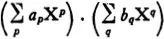
defines a multiplication in K[X]; the product
is
, where
This multiplication is commutative and associative. It is bilinear in the sense that
for all polynomials P, P1 P2, Q, and all scalars λ. It admits as unit element (denoted by 1) the polynomial
such that a0 = 1 and an = 0 for n > 0. We express all these properties by saying that K[X], provided with its vector space structure and its multiplication, is a commutative algebra with a unit element over the field K; it is, in particular, a commutative ring with a unit element.
2.THE ALGEBRA OF FORMAL SERIES
A formal power series in X is a formal expression
, where this time we no longer require that only a finite number of the coefficients an are non-zero. We define the sum of two formal series by
and the product of a formal series with a scalar by
The set K[[X]] of formal series then forms a vector space over K. The neutral element of the addition is denoted by 0; it is the formal series with all its coefficients zero.
The product of two formal series is defined by the formula (1.1), which still has a meaning because the sum on the right hand side is over a finite number of terms. The multiplication is still commutative, associative and bilinear with respect to the vector structure. Thus K[[X]] is an algebra over the field K with a unit element (denoted by 1), which is the series
such that a0 = 1 and an = 0 for n > 0.
The algebra K[X] is identified with a subalgebra of K[[X]], the subalgebra of for...
Table of contents
Cover Page
Title Page
Copyright Page
Contents
Preface
Chapter I. Power Series in One Variable
Chapter II. Holomorphic Functions; Cauchy’s Integral
Chapter III. Taylor and Laurent Expansions
Chapter IV. Analytic Functions of Several Variables; Harmonic Functions
Chapter V. Convergence of Sequences of Holomorphic or Meromorphic Functions; Series, Infinite Products; Normal Families
Chapter VI. Holomorphic Transformations
Chapter VII. Holomorphic Systems of Differential Equations
Some Numerical or Quantitative Answers
Terminological Index
Notational Index
Trusted by 375,005 students
Access to over 1.5 million titles for a fair monthly price.
Study more efficiently using our study tools.
Frequently asked questions
Yes, you can cancel anytime from the Subscription tab in your account settings on the Perlego website. Your subscription will stay active until the end of your current billing period. Learn how to cancel your subscription
No, books cannot be downloaded as external files, such as PDFs, for use outside of Perlego. However, you can download books within the Perlego app for offline reading on mobile or tablet. Learn how to download books offline
Perlego offers two plans: Essential and Complete
Essential is ideal for learners and professionals who enjoy exploring a wide range of subjects. Access the Essential Library with 800,000+ trusted titles and best-sellers across business, personal growth, and the humanities. Includes unlimited reading time and Standard Read Aloud voice.
Complete: Perfect for advanced learners and researchers needing full, unrestricted access. Unlock 1.5M+ books across hundreds of subjects, including academic and specialized titles. The Complete Plan also includes advanced features like Premium Read Aloud and Research Assistant.
Both plans are available with monthly, semester, or annual billing cycles.
We are an online textbook subscription service, where you can get access to an entire online library for less than the price of a single book per month. With over 1.5 million books across 990+ topics, we’ve got you covered! Learn about our mission
Look out for the read-aloud symbol on your next book to see if you can listen to it. The read-aloud tool reads text aloud for you, highlighting the text as it is being read. You can pause it, speed it up and slow it down. Learn more about Read Aloud
Yes! You can use the Perlego app on both iOS and Android devices to read anytime, anywhere — even offline. Perfect for commutes or when you’re on the go. Please note we cannot support devices running on iOS 13 and Android 7 or earlier. Learn more about using the app
Yes, you can access Elementary Theory of Analytic Functions of One or Several Complex Variables by Henri Cartan in PDF and/or ePUB format, as well as other popular books in Mathematics & Functional Analysis. We have over 1.5 million books available in our catalogue for you to explore.