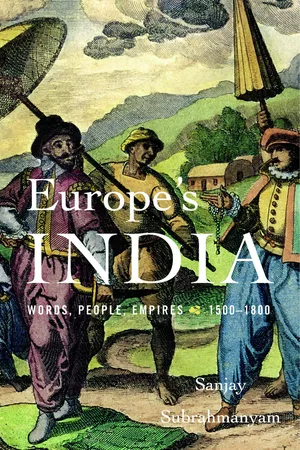
When Portuguese explorers first rounded the Cape of Good Hope and arrived in the subcontinent in the late fifteenth century, Europeans had little direct knowledge of India. The maritime passage opened new opportunities for exchange of goods as well as ideas. Traders were joined by ambassadors, missionaries, soldiers, and scholars from Portugal, England, Holland, France, Italy, and Germany, all hoping to learn about India for reasons as varied as their particular nationalities and professions. In the following centuries they produced a body of knowledge about India that significantly shaped European thought.
Europe's India tracks Europeans' changing ideas of India over the entire early modern period. Sanjay Subrahmanyam brings his expertise and erudition to bear in exploring the connection between European representations of India and the fascination with collecting Indian texts and objects that took root in the sixteenth century. European notions of India's history, geography, politics, and religion were strongly shaped by the manuscripts, paintings, and artifacts—both precious and prosaic—that found their way into Western hands.
Subrahmanyam rejects the opposition between "true" knowledge of India and the self-serving fantasies of European Orientalists. Instead, he shows how knowledge must always be understood in relation to the concrete circumstances of its production. Europe's India is as much about how the East came to be understood by the West as it is about how India shaped Europe's ideas concerning art, language, religion, and commerce.
- 394 pages
- English
- ePUB (mobile friendly)
- Available on iOS & Android
eBook - ePub
About this book
Information
1
ON THE INDO-PORTUGUESE MOMENT
Ganges, no qual os seus habitadores
Morrem banhados, tendo por certeza
Que, inda que sejam grandes pecadores,
Esta água santa os lava e dá pureza.
The Ganges, where every man of Hind
Washes himself and dies, knowing for sure,
That even if he has greatly sinned,
In that holy water he is rendered pure.
—Luís Vaz de Camões, Lusíadas (1572), 10.121
Introduction
SOME THREE DECADES into the Portuguese presence in Asia, in the year 1528, the Portuguese governor of the Estado da Índia, Lopo Vaz de Sampaio, was somewhat perplexed to receive a letter from Gujarat. The letter, written in a rather clear scribal hand, addressed him not in Portuguese or Persian, but in French. This is how its contents ran (in a more-or-less literal translation).
To the most high and powerful lord [blank space] Governor of India, under the high power of the very illustrious, invincible and most victorious King of Portugal.Thirty-six poor, miserable, Christians of the nation of France, held in captivity and servitude in the mountain of Chanpaner, in the hands of the great dog [grant chien] Bahador,1 supplicate the very high and powerful lord [blank space] Governor of India, under the high power of the most illustrious and invincible King of Portugal. We supplicate your high and noble lordship, that it may please you to take pity, compassion and have mercy and grace on [this] desolate company, who have been brought and conducted to these parts from over there in a ship [nef] called La Marie de Bon Secours, also termed Le Grant Engloys, belonging to the merchants of Rouen; under the charge and direction of a Portuguese who called himself Estiene Dies [Estêvão Dias], who was the captain, pilot, merchant, organizer and entrepreneur of the said voyage, under the permission of the King and of Monseigneur de Bryon, Grand Admiral of France. Which crew was misled and seduced by the said captain and merchants of the said ship, and by the master named Jehan Breulhy de Funag, who gave them to understand that the said ship was only going to the island of Sainct Thome or to the Magnicongue, and that if the said captain could not find a lading in the said places, to go to the land of Brazil in order to find a lading for the said ship, as is stated in the certificate and contract of the said captain. Even the contract of the companions and mariners with the master of the said ship which was passed before the registry of Honfleur states the same.2
The claim is thus made that rather than infringing on the monopoly of the Indian Ocean trade that the Portuguese claimed by view of Papal Bulls and the Treaty of Tordesillas (1494), the ship’s crew was under the impression that they were destined on a trading mission for West Africa, Brazil, or the São Tomé archipelago. Misled by the Portuguese Dias, and his other partners, they now find themselves instead in India, in the hands of Sultan Bahadur of Gujarat (r. 1526–1537), in his great fortress-capital of Champaner. How could this turn of events have come about? The letter continues with its explanation:
Which crew, in all good faith, undertook the said voyage, and they navigated so far that on the 20th day of November of 1527, we arrived at the port and haven of Quiloa [Kilwa, in East Africa], in which place we wintered, remaining there until the fifth day of the following April, while awaiting favourable weather; for our said captain gave us to understand that he would never take us to a place where the Portuguese had dominion or trade, while telling us that he wished to go to Dieu [Diu], a port of Canbaye [Cambay, or Gujarat]; and we had neither acquaintance nor knowledge of these places, for none of us had even heard of them. We raised anchor, and went to sea, and navigated so far that on the 25th of May we arrived before the city of Dieu.Then, having anchored in the said place at the roadstead, the said captain made it known to some foists [small galleys] that came to speak to us that we were merchants, and that they should give us an assurance to trade with them, which was granted to us; but after the assurance had been given, they held back our said captain on land and took the said ship and merchandise, and even our own bodies were taken, and held, and placed in perpetual captivity and servitude.
All this is posed as a sign of the lack of faith and honor on the part of the Diu authorities, but the context was in fact one where the Gujarat sultan (like his father, Sultan Muzaffar) had faced almost annual attacks by Portuguese fleets off his coast since around 1520. The arrival of an unknown European ship, ostensibly desiring trade and amity, was undoubtedly something of a novelty in the context. As for Estêvão Dias, he seems to have been a rather slippery character in his own right, as the remaining half of the letter now recounts to the Portuguese governor.
And therefore, noble Sire, we are miserable, and have no hope save in God and in your noble lordship, for if your noble will so desires, your great power can act, for if Your Highness does not see to it, we are on the route to perdition, for our said captain [Dias] is negotiating hard with the King to have his own liberty, and in fact the King has granted it to him and he goes about everywhere with the King, and it is clear that he does not wish ever to go to [Portuguese] India or negotiate to take us with him, and if your noble lordship does not remedy this, we shall be the children of perdition. But whatever happens to us, or is done to us, we will live and die in the Holy Catholic Faith of Jesus Christ: for we have been interrogated many times on which skills and things we know how to practice, for our said captain has entertained the King and the lords who have said that they will do us many favours and our captain has communicated this to us, to which we, and especially our bombardiers, have responded that in this land with this rabble [avec ceste quenaille], we have no desire to be any greater than we [already] are, for we would prefer to live in poverty with our Christian brothers rather than to be great lords with the enemies of the Faith.May it please Your Highness to turn your sweet countenance and survey with your pitying and merciful eye these poor Christians, who ask you for your pardon, and that your noble lordship might be enriched by the gift of pity for, excellent Sire, it is a virtue that is more divine than human to pardon, for it is the nature of God the Creator to pardon poor sinners when they ask him for pardon and mercy, and you should not permit that so many souls be lost and spent in the hands of these damned dogs. And therefore, noble Sire, may you be turned towards mercy and pity towards these poor Christians rather than to the rigour and severity of justice! By doing so, you will merit the grace of God, to whom we pray that He grants you a good and long life, with perpetual triumph and glory.
The interest expressed by the mercantile milieux of Dieppe, Honfleur, and Rouen in the Iberian overseas possession in the 1520s is quite well-known.3 The main figure involved was the corsair and entrepreneur Jean Ango, but a number of others—including some Italians and Portuguese—could be found around him, with ambitions in the Atlantic, but eventually also spilling into the Indian Ocean.4 Not long after the voyage of the unfortunate letter-writers cited above, the brothers Jean and Raoul Parmentier set off on an expedition to Sumatra, never to return; however, materials concerning their travels did survive and were even published.5 In the middle decades of the sixteenth century, a certain amount of information regarding the Indian Ocean came to accumulate in the hands of those in the ports of Normandy, contributing to the creation over several decades of the celebrated “Dieppe school” of cartography, which gave visual expression to the knowledge gathered, among others, from men like Estêvão Dias, who led the failed Diu voyage of 1527–1528. This school was partly based on practical knowledge, though one cannot underestimate the role played by armchair intellectuals such as Pierre Desceliers, the abbot at Arques-la-Bataille and something of a pioneer in the matter of making world maps.6
The letter from the anonymous Frenchmen in 1528 brings home a number of other curious aspects of the early Portuguese presence in the Indian Ocean. The first is the desire on the part of the Crown, whether Dom Manuel (r. 1495–1521) or his son and successor Dom João III (r. 1521–1557) to keep a relatively tight lid on concrete information concerning the Indian Ocean and Asia in the first decades of the sixteenth century. Almost all texts that the Portuguese produced and circulated in the years before 1530 were rather vague concerning the specifics, even when they were stridently propagandistic in nature. This certainly had an effect, and we can see that the Norman mariners of 1528 were woefully ill-informed. But other Europeans seem to have been less constrained in their access to information, whether cartographic or commercial, often using quite unscrupulous means. A celebrated example of this is the so-called Cantino planisphere, surreptitiously acquired in Lisbon by Alberto Cantino, the agent of the Duke of Ferrara in that city in 1502. Equally, in the first two decades of the sixteenth centuries, some of the Flemish, Germans, and Italians who sailed to India on board Portuguese ships began to put out accounts for audiences elsewhere in Europe. As early as 1504, there appeared in Antwerp an anonymous printed account in Flemish called Calcoen (a distortion of Calicut), whose author described his own participation in the second voyage of Vasco da Gama to India in 1502–1503.7 It begins thus: “This is the voyage which a man wrote himself, how far he sailed with seventy ships from the river of Lisbon, in Portugal, to go to Calicut in India, and this occurred in the year 1501 [sic].” Laconic in the extreme, it goes on to describe the fleet’s experiences in East Africa, the celebrated attack by Gama on a ship carrying returning hājīs from Mecca, and then offers a mere handful of other details. These include the Portuguese difficulties with the authorities at Calicut, and their happier dealings at Cochin, as well as with the so-called St. Thomas Christians in the region.
On the 2nd day of November we sailed from Calcoen 60 miles to a kingdom called Cusschaïn [Cochin]; and between these two towns is a Christian kingdom called Granor [Cranganor, Kerala], and there are many good Christians; and in this kingdom live many Jews, and they have a prince there. You understand that all the Jews of the country are also subjects of the same prince. And the Christians have nothing to do with anybody, and they are good Christians. They neither sell nor buy anything during the consecrated days, and they neither eat nor drink with anybody but Christians. They willingly came to our ships with fowls and sheep, and caused us to make good cheer. They had just sent priests to the pope at Rome to know the true faith.
Nor is the text particularly prolix in terms of the commercial or ethnographic details it provides in its remaining pages. One of the more extended passages runs as follows.
The people of this country have black teeth, because they eat the leaves of the trees and a white thing like chalk actually with the leaves, and it comes from it that the teeth become black, and that is called tombour [Arabic tanbul, betel] and they carry it always with them wherever they go or are traveling. The pepper grows as the vine does in our country. There are in the country cats as big as our foxes, and it is from them that the musk comes, and it is very dear, for a cat is worth 100 ducats, and the musk grows between his legs, under his tail. Ginger grows as a reed, and cinnamon as a willow; and every year they strip the cinnamon from its bark, however thin it is, and the youngest is the better. The true summer is in December and January.
A few years later, the South German commercial firm of Welser sent an agent, a Bavarian merchant named Balthasar Sprenger, to India along with the entering Captain-Major (and later viceroy) Dom Francisco de Almeida. On his return in 1506, Sprenger published an account that eventually gained a certain level of notoriety and inaugurated a series of such accounts in German concerning India in the sixteenth century.8 An aspect of some consequence here was the presence in Augsburg (where the Welsers based their affairs) of a number of prominent artists proficient in the art of the woodcut. One of these, Hans Burgkmair, seems to have drawn on a version of Sprenger’s account to produce iconic scenes of southern Indian life, notably one showing the “King of Cochin” (Der Kunig von Gutzin) being carried in a palanquin.9 Not long after, Burgkmair’s contemporary, Jörg Breu, produced illustrations for the 1515 German translation of the Itinerario of Ludovico di Varthema, a Bolognese adventurer who had also sojourned in early Portuguese India and produced a somewhat fanciful account of his experiences.10 Breu’s images famously underlined the horrific and monstrous aspects of the gods whom the Indians worshipped, and appear to have become the prototypes for the representation of a vast spectrum of religiosity in the non-European world, with “Calicut” coming to stand in for anything from Africa to Brazil.

The King of Cochin (Der Kunig von Gutzin), engravi...
Table of contents
- Cover
- Title Page
- Copyright
- Dedication
- Contents
- Preface
- Introduction: Before and Beyond “Orientalism”
- 1. On the Indo-Portuguese Moment
- 2. The Question of “Indian Religion”
- 3. Of Coproduction: The Case of James Fraser, 1730–1750
- 4. The Transition to Colonial Knowledge
- By Way of Conclusion: On India’s Europe
- Abbreviations
- Notes
- Index
Trusted by 375,005 students
Access to over 1.5 million titles for a fair monthly price.
Study more efficiently using our study tools.
Frequently asked questions
Yes, you can cancel anytime from the Subscription tab in your account settings on the Perlego website. Your subscription will stay active until the end of your current billing period. Learn how to cancel your subscription
No, books cannot be downloaded as external files, such as PDFs, for use outside of Perlego. However, you can download books within the Perlego app for offline reading on mobile or tablet. Learn how to download books offline
Perlego offers two plans: Essential and Complete
- Essential is ideal for learners and professionals who enjoy exploring a wide range of subjects. Access the Essential Library with 800,000+ trusted titles and best-sellers across business, personal growth, and the humanities. Includes unlimited reading time and Standard Read Aloud voice.
- Complete: Perfect for advanced learners and researchers needing full, unrestricted access. Unlock 1.5M+ books across hundreds of subjects, including academic and specialized titles. The Complete Plan also includes advanced features like Premium Read Aloud and Research Assistant.
We are an online textbook subscription service, where you can get access to an entire online library for less than the price of a single book per month. With over 1.5 million books across 990+ topics, we’ve got you covered! Learn about our mission
Look out for the read-aloud symbol on your next book to see if you can listen to it. The read-aloud tool reads text aloud for you, highlighting the text as it is being read. You can pause it, speed it up and slow it down. Learn more about Read Aloud
Yes! You can use the Perlego app on both iOS and Android devices to read anytime, anywhere — even offline. Perfect for commutes or when you’re on the go.
Please note we cannot support devices running on iOS 13 and Android 7 or earlier. Learn more about using the app
Please note we cannot support devices running on iOS 13 and Android 7 or earlier. Learn more about using the app
Yes, you can access Europe’s India by Sanjay Subrahmanyam in PDF and/or ePUB format, as well as other popular books in History & European History. We have over 1.5 million books available in our catalogue for you to explore.