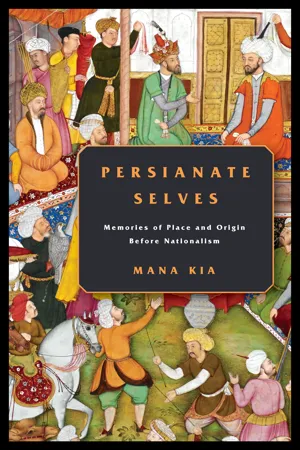
Persianate Selves
eBook - ePub

Persianate Selves

Memories of Place and Origin Before Nationalism

  1. 336 pages
  2. English
  3. ePUB (mobile friendly)
  4. Available on iOS & Android
eBook - ePub

Persianate Selves

Memories of Place and Origin Before Nationalism

About this book

For centuries, Persian was the language of power and learning across Central, South, and West Asia, and Persians received a particular basic education through which they understood and engaged with the world. Not everyone who lived in the land of Iran was Persian, and Persians lived in many other lands as well. Thus to be Persian was to be embedded in a set of connections with people we today consider members of different groups. Persianate selfhood encompassed a broader range of possibilities than contemporary nationalist claims to place and origin allow. We cannot grasp these older connections without historicizing our conceptions of difference and affiliation.

Mana Kia sketches the contours of a larger Persianate world, historicizing place, origin, and selfhood through its tradition of proper form: adab. In this shared culture, proximities and similarities constituted a logic that distinguished between people while simultaneously accommodating plurality. Adab was the basis of cohesion for self and community over the turbulent eighteenth century, as populations dispersed and centers of power shifted, disrupting the circulations that linked Persianate regions. Challenging the bases of protonationalist community, Persianate Selves seeks to make sense of an earlier transregional Persianate culture outside the anachronistic shadow of nationalisms.

Frequently asked questions

Yes, you can cancel anytime from the Subscription tab in your account settings on the Perlego website. Your subscription will stay active until the end of your current billing period. Learn how to cancel your subscription.
At the moment all of our mobile-responsive ePub books are available to download via the app. Most of our PDFs are also available to download and we're working on making the final remaining ones downloadable now. Learn more here.
Perlego offers two plans: Essential and Complete
  • Essential is ideal for learners and professionals who enjoy exploring a wide range of subjects. Access the Essential Library with 800,000+ trusted titles and best-sellers across business, personal growth, and the humanities. Includes unlimited reading time and Standard Read Aloud voice.
  • Complete: Perfect for advanced learners and researchers needing full, unrestricted access. Unlock 1.4M+ books across hundreds of subjects, including academic and specialized titles. The Complete Plan also includes advanced features like Premium Read Aloud and Research Assistant.
Both plans are available with monthly, semester, or annual billing cycles.
We are an online textbook subscription service, where you can get access to an entire online library for less than the price of a single book per month. With over 1 million books across 1000+ topics, we’ve got you covered! Learn more here.
Look out for the read-aloud symbol on your next book to see if you can listen to it. The read-aloud tool reads text aloud for you, highlighting the text as it is being read. You can pause it, speed it up and slow it down. Learn more here.
Yes! You can use the Perlego app on both iOS or Android devices to read anytime, anywhere — even offline. Perfect for commutes or when you’re on the go.
Please note we cannot support devices running on iOS 13 and Android 7 or earlier. Learn more about using the app.
Yes, you can access Persianate Selves by Mana Kia in PDF and/or ePUB format, as well as other popular books in History & Early Modern History. We have over one million books available in our catalogue for you to explore.

Table of contents

  1. Cover
  2. Title Page
  3. Copyright
  4. Dedication
  5. Contents
  6. Acknowledgments
  7. Notes on Dates and Transliteration
  8. Dramatis Personae
  9. Map
  10. Introduction. The Shadow of Nationalism
  11. Part I. Place
  12. Part II. Origin
  13. Coda. Memories and Multiplicity (Lost and Lingering)
  14. Notes
  15. Bibliography
  16. Index