Objects of Translation offers a nuanced approach to the entanglements of medieval elites in the regions that today comprise Afghanistan, Pakistan, and north India. The book--which ranges in time from the early eighth to the early thirteenth centuries--challenges existing narratives that cast the period as one of enduring hostility between monolithic "Hindu" and "Muslim" cultures. These narratives of conflict have generally depended upon premodern texts for their understanding of the past. By contrast, this book considers the role of material culture and highlights how objects such as coins, dress, monuments, paintings, and sculptures mediated diverse modes of encounter during a critical but neglected period in South Asian history.
The book explores modes of circulation--among them looting, gifting, and trade--through which artisans and artifacts traveled, remapping cultural boundaries usually imagined as stable and static. It analyzes the relationship between mobility and practices of cultural translation, and the role of both in the emergence of complex transcultural identities. Among the subjects discussed are the rendering of Arabic sacred texts in Sanskrit on Indian coins, the adoption of Turko-Persian dress by Buddhist rulers, the work of Indian stone masons in Afghanistan, and the incorporation of carvings from Hindu and Jain temples in early Indian mosques. Objects of Translation draws upon contemporary theories of cosmopolitanism and globalization to argue for radically new approaches to the cultural geography of premodern South Asia and the Islamic world.
eBook - ePub
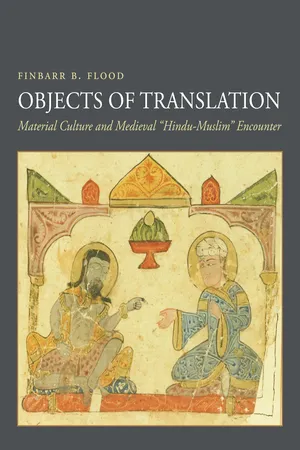
Objects of Translation
Material Culture and Medieval "Hindu-Muslim" Encounter
- 384 pages
- English
- ePUB (mobile friendly)
- Available on iOS & Android
eBook - ePub
About this book
Information
Publisher
Princeton University PressYear
2022Print ISBN
9780691180748
9780691125947
eBook ISBN
9781400833245
Topic
ArtSubtopic
History of ArchitectureTable of contents
- Cover
- Title
- Copyright
- About the Author
- Dedication
- Contents
- Acknowledgments
- A Note on Translations and Transliterations
- Introduction
- 1 The Mercantile Cosmopolis
- 2 Cultural Cross-dressing
- 3 Accommodating the Infidel
- 4 Looking at Loot
- 5 Remaking Monuments
- 6 Palimpsest Pasts and Fictive Genealogies
- Conclusion: In and Out of Place
- Appendix: Principal Dynasties and Rulers Mentioned
- Notes
- Bibliography
- Index
Trusted by 375,005 students
Access to over 1.5 million titles for a fair monthly price.
Study more efficiently using our study tools.
Frequently asked questions
Yes, you can cancel anytime from the Subscription tab in your account settings on the Perlego website. Your subscription will stay active until the end of your current billing period. Learn how to cancel your subscription
No, books cannot be downloaded as external files, such as PDFs, for use outside of Perlego. However, you can download books within the Perlego app for offline reading on mobile or tablet. Learn how to download books offline
We are an online textbook subscription service, where you can get access to an entire online library for less than the price of a single book per month. With over 1.5 million books across 990+ topics, we’ve got you covered! Learn about our mission
Look out for the read-aloud symbol on your next book to see if you can listen to it. The read-aloud tool reads text aloud for you, highlighting the text as it is being read. You can pause it, speed it up and slow it down. Learn more about Read Aloud
Yes! You can use the Perlego app on both iOS and Android devices to read anytime, anywhere — even offline. Perfect for commutes or when you’re on the go.
Please note we cannot support devices running on iOS 13 and Android 7 or earlier. Learn more about using the app
Please note we cannot support devices running on iOS 13 and Android 7 or earlier. Learn more about using the app
Yes, you can access Objects of Translation by Finbarr Barry Flood in PDF and/or ePUB format, as well as other popular books in Art & History of Architecture. We have over 1.5 million books available in our catalogue for you to explore.