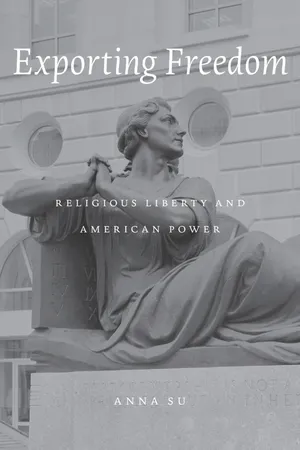
Religious freedom is widely recognized today as a basic human right, guaranteed by nearly all national constitutions. Exporting Freedom charts the rise of religious freedom as an ideal firmly enshrined in international law and shows how America's promotion of the cause of individuals worldwide to freely practice their faith advanced its ascent as a global power.
Anna Su traces America's exportation of religious freedom in various laws and policies enacted over the course of the twentieth century, in diverse locations and under a variety of historical circumstances. Influenced by growing religious tolerance at home and inspired by a belief in the United States' obligation to protect the persecuted beyond its borders, American officials drafted constitutions as part of military occupations—in the Philippines after the Spanish-American War, in Japan following World War II, and in Iraq after 2003. They also spearheaded efforts to reform the international legal order by pursuing Wilsonian principles in the League of Nations, drafting the United Nations Charter, and signing the Helsinki Accords during the Cold War. The fruits of these labors are evident in the religious freedom provisions in international legal instruments, regional human rights conventions, and national constitutions.
In examining the evolution of religious freedom from an expression of the civilizing impulse to the democratization of states and, finally, through the promotion of human rights, Su offers a new understanding of the significance of religion in international relations.
- 286 pages
- English
- ePUB (mobile friendly)
- Available on iOS & Android
eBook - ePub
About this book
Information
1
White Man’s Burden
[W]hen that group of islands, under the impulse of the year just past, shall have become the gems and glories of those tropical seas—a land of plenty and of increasing possibilities; a people redeemed from savage indolence and habits, devoted to the arts of peace, in touch with the commerce and trade of all nations, enjoying the blessings of freedom, of civil and religious liberty, of education, and of homes, and whose children and children’s children shall for ages hence bless the American republic because it emancipated and redeemed their fatherland, and set them in the pathway of the world’s best civilization.—U.S. president William F. McKinley, February 16, 1899
Elihu Root’s appointment as secretary of war came on the heels of what John Hay termed a “splendid little war” between the United States and Spain. The conflict began over American intervention in the Cuban struggle for independence, which then spilled over to the rest of the Spanish possessions in the Pacific.1 The lopsided nature of the war was best captured in Commodore George Dewey’s victory over the decrepit Spanish naval forces in the famous Battle of Manila Bay on May 1, 1898. The battle lasted for only seven hours total, including a three-hour break for breakfast,2 with no American casualties. Although skirmishes between the two powers continued, by the end of July 1898, beleaguered Spain had sent entreaties to Washington seeking an armistice.
The aftermath of the war plunged the United States, then a fledgling global power, into a national crisis unprecedented since the Civil War. While expansion and annexation of other separate territories were not new in American history,3 the prospect of possessing Spain’s erstwhile colonies with the certainty that none of them could be incorporated as states in the union tugged at the nation’s conscience. When Congress issued a joint resolution declaring war against Spain, it had sought to demonstrate benign American intentions by attaching to it the Teller amendment, which forbade the formal annexation of Cuba.4 As President William McKinley instructed the American peace negotiators in Paris to demand all of the Philippines from Spain,5 a divisive national debate exploded over the nature and character of the United States itself.
Colonialism clearly contradicted the self-image of a republican United States. But it also provided a means to international prestige and influence and meaningful participation in the international community. The British poet Rudyard Kipling’s infamous poem “White Man’s Burden,” addressed to the United States as the Senate was about to vote on the ratification of the Treaty of Paris, was one such invitation into the world of empires.6 As historian Frank Ninkovich noted, the United States, though a great industrial power by the end of the nineteenth century, exercised “little influence in shaping the political or ideological direction being taken by the industrial revolution.”7 Given this background, the common underlying national belief in American exceptionalism pointed to two opposing directions after the war. One view, espoused by the anti-imperialists, stated that the country should simply hold itself out as an example to the world.8 To occupy the position of colonizer would repudiate longstanding American traditions and ideals. They also believed that, for immutable reasons of race and religion, American civilization could not be a matter of export. The contradictory view, however, sought to export those very ideals to what were considered “lesser” civilizations and tapped into notions of duty and obligation in order to present the case for spreading the blessings of liberty around the world. For them, the United States could be a colonizer, not in the European mold of exploiter but as a tutor and shepherd for the eventual progress and membership of these colonies into the community of nations.
Despite common domestic and international fashions of thought prevailing at the time,9 it is important to distinguish American reasons and motivations for going to war against Spain from those in the decision to annex the Spanish possessions. Economic as well as humanitarian reasons supported the entry into war,10 but more vague were those supporting the annexation of far-flung colonies. Although the notion of an occupied Philippines reinforced long-held American visions of an Asian gateway to the Chinese pot of gold, the majority of the arguments entertained by McKinley were a mix of ideological, religious, and geopolitical considerations.11 The lack of clear economic or security rationales for the annexation of the Philippines provided a convenient entry for largely ideologically oriented projects. Dewey’s quick victory produced seductive vistas of an overseas empire. The Philippines would be a grand experiment in the application of American constitutional principles in the spirit of tutelage, a showcase of an exceptional American empire.12 The appointment of Root, a renowned corporate lawyer, as secretary of war when the country was about to embark on its path as a neophyte colonial power testified to a particular vision of imperialism—one that would be governed by and through law, particularly, though not quite fully as Filipinos and Puerto Ricans would later realize,13 the U.S. Constitution.
One of these constitutional principles was the right to freedom of religion, which, in the American mind, also carried the necessary corollary of separation between church and state. While both law and religion as analytic concepts have separately been made major subjects in a reinvigorated U.S. empire literature of recent years,14 none have as yet treated them together in reinterpreting early American visions for its newfound possessions. Moreover, there has been no account that considers McKinley’s Instructions to the Second Philippine Commission, dubbed the most important document in American colonial history by Root’s biographer and later distinguished international lawyer Philip C. Jessup, a central topic.15 The lack of attention is surprising considering contemporary interest on law as a facilitator and creator of empire and subjecthood.
Looking to these two concepts together affords a unique view into the U.S. imperial mindset, especially as the constitutional right to free worship and its implementation in the Philippine Islands, among other rights, served to reconcile the seemingly paradoxical notions of self-rule and colonialism, both to the American colonizers and the Filipino colonized. Within the constitutional framework it constructed to distinguish its colonial enterprise from those of its European counterparts,16 the U.S. government provided and promoted religious freedom in the early years of empire as it took away political independence from the Filipinos. In the Christian parts of the archipelago, disestablishment was brought about by the resolution of the friar lands controversy, which involved the sale of large tracts of land held by Spanish religious orders in the Philippines between the Holy See and the U.S. colonial government in the Philippines. This controversy was intimately tied with the growth and promotion of religious pluralism in the islands, thus ending centuries of Catholic monopoly. In the Muslim parts, on the other hand, the forcible reorganization of the political and religious structure of the area by the U.S. military government, while maintaining its adherence to free religious worship for its Muslim inhabitants, facilitated their pacification and subjugation.
Not often emphasized in previous accounts of American efforts to promote free exercise and disestablishment in the Philippines was how these efforts were as much a continuing contest and negotiation on what religious freedom meant between Catholics and Protestants in the United States as these were about the achievement of American aims in the colonies. The friar lands controversy and the civilization of the Filipino Muslims were important sites for those contests. As such, colonial policies in the Philippines were formulated even as the people responsible for these policies looked inward. Although religious liberty in the Instructions could be considered an exercise in obtaining Filipino consent, it was also an effort to reconcile the American conscience with its turn to empire. These episodes would set a similar trajectory for future American nation-building projects and partly laid the bases of enduring American visions of international order.
Writing McKinley’s Instructions
What started out as an altruistic war to liberate Cubans from the tyrannical Spanish yoke quickly turned into a war against Filipino nationalists who were understandably less thrilled about the prospect of exchanging one colonial master for another.17 Although the Philippines was not even part of the picture as a broad swath of American society clamored for U.S. intervention in Cuba,18 the question of empire that followed thereafter took on a similar humanitarian garb. Protestant groups led the way in advocating for the imperial turn, seeing a great evangelization opportunity not only in the Philippines but in the rest of Asia, especially China. The arguments, however, were not just overtly religious. It was a reflection of American society at that time that, while church and state were formally and constitutionally separated, there was not a lot separating Christianity from the wider public culture.19 A fusion of Christianity and progressivism, no doubt influenced by domestic intellectual developments, was the main lingua franca vis-à-vis foreign affairs. Most pro-annexation religious groups considered the Roman Catholic legacy of Spanish rule as a defective form of Christianity, no more than mere superstitions, and therefore the islands was a proper place in which to spread the Gospel anew.20 The Philippines provided an opportunity to see the spirit of humanitarianism prevalent in the late nineteenth century in action, one more site of the moral reform movements of American Protestants.21 It was also widely assumed that, for reasons of race, Filipinos were incapable of self-rule. The much-needed and indeed much-prescribed salve to this affliction was often a combination of Protestantism, indeed “a free Bible,” and American-type law and government insofar as these structures of thought and action presupposed voluntarism and free inquiry on the part of the individual believer and citizen.
The most prominent leaders of the time, among them, William McKinley, Elihu Root, naval strategist Alfred Thayer Mahan, Henry Cabot Lodge, and Theodore Roosevelt, all subscribed to varying degrees to this view.22 In his popular tract, Expansion under New World Conditions, the prominent Social Gospel adherent and Congregationalist leader Josiah Strong exhorted his fellow Americans to accept its civilizing mandate.23 “It is time to dismiss the craven fear of being great,” he wrote, “to recognize the place in the world which God has given us and to accept the responsibilities which it devolves upon us on behalf of the Christian civilization.”24 It was the same Strong who held up Romanism, a common pejorative term for the Roman Catholic religion at the time, as one of the ten perils threatening American society.25
Thanks to the reframing of the issue as a just cause and the fervent advocacy of it as such, the Treaty of Paris, wherein Spain ceded the Philippines to the United States in exchange for $20 million,26 was ratified by the Senate by a 57 to 27 vote, with only one vote more than the two-thirds majority required. The outbreak of the war between the Americans and the Filipinos at the time of ratification seemingly buttressed the argument of Filipino ingratitude and incompetence. In the words of a New York Times editorial at the time, why else would they attack their own liberators?27 Whereas the mission before was to save the Cubans from the Spanish, in the Philippines, it seemed, the mission was to save Filipinos from themselves.
As a long and bloody guerrilla war raged on in the Philippine countryside between the U.S. army and the Filipino insurgents, President William McKinley, in an oft-quoted account of how he arrived at the decision to keep the Islands, was telling a group of visiting Methodist ministers in the White House that he had no choice but to take them, and “to educate the Filipinos, and uplift and civilize and Christianize them,” after several nights of praying to almighty God.28 The task of determining how the uplifting and civilizing of the Filipinos would take the shape and form that it initially did fell in the lap of Elihu Root, the newly appointed secretary of war who would become the chief architect of American colonial policy.
On the eve of the Spanish-American War, Elihu Root was already one of the top corporate lawyers in New York. He was also a consummate hand in New York politics, having rubbed elbows with the likes of Chester Arthur and Theodore Roosevelt. Although he did not have any political experience beyond state-level reform efforts and as a U.S. attorney for the Southern District of New York, Root had a reputation for his keen judgment and problem-solving skills. As the New York Times put it, “Any perso...
Table of contents
- Cover
- Title Page
- Copyright
- Dedication
- Contents
- Introduction
- 1. White Man’s Burden
- 2. Removing the Fertile Sources of War
- 3. A God-Fearing Democracy
- 4. Spiritual Disarmament
- 5. Cold War, Hot Rights
- 6. Age of Exceptionalism
- Conclusion
- Notes
- Bibliography
- Acknowledgments
- Index
Trusted by 375,005 students
Access to over 1.5 million titles for a fair monthly price.
Study more efficiently using our study tools.
Frequently asked questions
Yes, you can cancel anytime from the Subscription tab in your account settings on the Perlego website. Your subscription will stay active until the end of your current billing period. Learn how to cancel your subscription
No, books cannot be downloaded as external files, such as PDFs, for use outside of Perlego. However, you can download books within the Perlego app for offline reading on mobile or tablet. Learn how to download books offline
Perlego offers two plans: Essential and Complete
- Essential is ideal for learners and professionals who enjoy exploring a wide range of subjects. Access the Essential Library with 800,000+ trusted titles and best-sellers across business, personal growth, and the humanities. Includes unlimited reading time and Standard Read Aloud voice.
- Complete: Perfect for advanced learners and researchers needing full, unrestricted access. Unlock 1.5M+ books across hundreds of subjects, including academic and specialized titles. The Complete Plan also includes advanced features like Premium Read Aloud and Research Assistant.
We are an online textbook subscription service, where you can get access to an entire online library for less than the price of a single book per month. With over 1.5 million books across 990+ topics, we’ve got you covered! Learn about our mission
Look out for the read-aloud symbol on your next book to see if you can listen to it. The read-aloud tool reads text aloud for you, highlighting the text as it is being read. You can pause it, speed it up and slow it down. Learn more about Read Aloud
Yes! You can use the Perlego app on both iOS and Android devices to read anytime, anywhere — even offline. Perfect for commutes or when you’re on the go.
Please note we cannot support devices running on iOS 13 and Android 7 or earlier. Learn more about using the app
Please note we cannot support devices running on iOS 13 and Android 7 or earlier. Learn more about using the app
Yes, you can access Exporting Freedom by Anna Su in PDF and/or ePUB format, as well as other popular books in History & North American History. We have over 1.5 million books available in our catalogue for you to explore.